<< preface

this blog is nina wenhart's collection of resources on the various histories of new media art. it consists mainly of non or very little edited material i found flaneuring on the net, sometimes with my own annotations and comments, sometimes it's also textparts i retyped from books that are out of print.

it is also meant to be an additional resource of information and recommended reading for my students of the prehystories of new media class that i teach at the school of the art institute of chicago in fall 2008.

the focus is on the time period from the beginning of the 20th century up to today.

>> search this blog

2008-10-02

>> Virtual Reality (VR) + CAVE

Virtual Reality in Art:
(from wikipedia: http://en.wikipedia.org/wiki/Virtual_reality)

"David Em was the first fine artist to create navigable virtual worlds in the 1970s. His early work was done on mainframes at III, JPL and Cal Tech. Jeffrey Shaw explored the potential of VR in fine arts with early works like Legible City (1989), Virtual Museum (1991), Golden Calf(1994).

Canadian artist Char Davies created immersive VR art pieces Osmose (1995) and Ephémère (1998). Maurice Benayoun's work introduced metaphorical, philosophical or political content, combining VR, network, generation and intelligent agents, in works like Is God Flat (1994), The Tunnel under the Atlantic (1995), World Skin (1997).


Other pioneering artists working in VR have include Luc Courchesne, Rita Addison, Knowbotic Research, Rebecca Allen, Perry Hoberman, Jacki Morie, and Brenda Laurel."


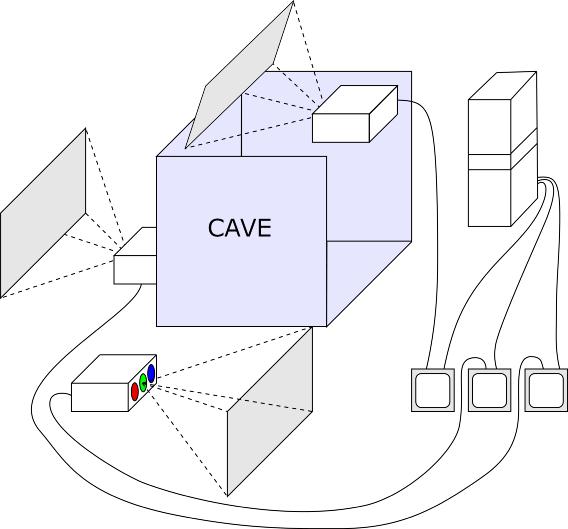
CAVE: a 3d immersive virtual environment, developed by Dan Sandin and Tom DeFanti at the Electronic Visualization Lab (EVL), Chicago:


http://en.wikipedia.org/wiki/Cave_Automatic_Virtual_Environment


some CAVEs:

@ EVL: http://www.evl.uic.edu/core.php?mod=4&type=1&indi=161
and http://www.evl.uic.edu/pape/CAVE/
@ Ars Electronica: http://www.aec.at/en/center/current_exhibition_detail.asp?iProjectID=11197
@ SAIC: http://bcchang.com/vrlab/index.php


some devices used in the CAVE:


head mounted display:
http://en.wikipedia.org/wiki/Head_mounted_display

data glove:
http://en.wikipedia.org/wiki/Data_glove


wand:
tracks the user and his/her interactions with and movements in the virtual environment.


what is...


... an immersive environment:

http://en.wikipedia.org/wiki/Immersive_environment

... augmented reality:
http://en.wikipedia.org/wiki/Augmented_reality


personalities important for the development of VR:

- Myron Krueger:

http://en.wikipedia.org/wiki/Myron_Krueger

- Dan Sandin:
http://en.wikipedia.org/wiki/Dan_Sandin

- Tom Defanti:
http://en.wikipedia.org/wiki/Thomas_A._DeFanti

- Scott Fisher:
http://en.wikipedia.org/wiki/Scott_Fisher_(technologist)

- Jaron Lanier:
http://en.wikipedia.org/wiki/Jaron_Lanier

- Marvin Minsky:
http://en.wikipedia.org/wiki/Marvin_minsky

- Timothy Leary:
By the mid 1980s, Leary had begun to incorporate computers, the Internet, and virtual reality into his aegis of thought. Leary established one of the earliest sites on the World Wide Web, and was often quoted describing the Internet as "the LSD of the 1990s."[citation needed] He became a promoter of virtual reality systems,[13] and sometimes demonstrated a prototype of the Mattel Power Glove as part of his lectures (as in From Psychedelics to Cybernetics). Around this time he cultivated friendships with a number of notable people in the field, including Brenda Laurel, a pioneering researcher in virtual environments and human-computer interaction.
http://en.wikipedia.org/wiki/Timothy_Leary#Leary.27s_last_two_decades


another VR-environment: the Immersa Desk

http://www.evl.uic.edu/core.php?mod=4&type=1&indi=163


some Art Projects done for the CAVE:

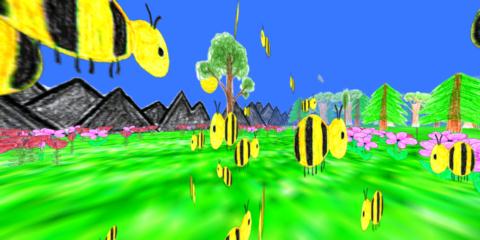
"Crayoland", one of the first and most successful CAVE-visualizations. Created by Dave OPape in 1995, 2d-crayon drawings serve as textures for the objects in this 3d-environment.


"CAVE", a project by Austrian artist Peter Kogler in collaboration with the Ars Electronica Futurelab, was realized in 1999. As a visitor, you could navigate through Kogler's abstract shapes.


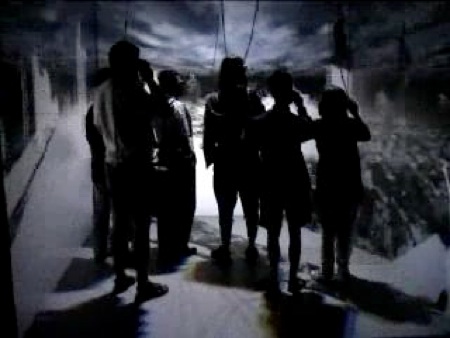
"World Skin" is an award-winning CAVE-project created by French artists Maurice Benayoun and Jean-Baptiste Barrière. What was special about it was the novel approach to the user's interaction with the envoronment. The wand served as a photocamera. When you took a photo of the scenes around you, the object was washed out, leaving a blank space.


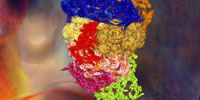
"Gesichtsraum" by Johannes Deutsch is anouther example for a collaboration of an artist with Ars Electronica's Futurelab: Deutsch and the programmers and 3d modellers worked together closely for a period of several months to develop an immersive environment out of Johannes Deutsch's paintings of his son.

>> tron (movie), 1982

wikipedia-entry for "tron":
http://en.wikipedia.org/wiki/Tron_(film)


to watch the movie online, see:
http://static.youku.com/v1.0.0330/v/swf/qplayer.swf?VideoIDS=XMzUxMDU5NTY&embedid=-&showAd=0


or here:

2008-10-01

>> Sandin Image Processor + Distribution Religion

from: http://www.evl.uic.edu/core.php?mod=4&type=1&indi=337

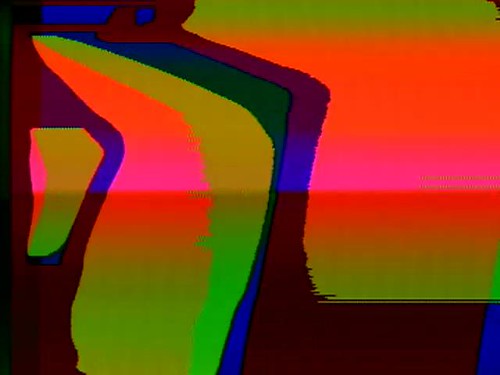
Between 1971 and 1973, Dan Sandin designed and built the Sandin Image Processor (IP) a patch programmable analog computer for real-time manipulation of video inputs through the control of the grey level information. The version that allowed for color manipulation was refered to as the Color IP

This modular design was based on the Moog synthesizer and is often explained as the "video equivalent of a Moog audio synthesizer" or as a video synthesizer. That is, it accepted basic video signals and mixed and modified them in a fashion similar to what a Moog synthesizer did with audio. An analog, modular, real time, video processing instrument, it provided video processing performance levels and produced subtle and delicate video effects that became popular with early video artists.

The IP's real-time effects naturally led to its use in live theater performance, including "Electronic Visualization Events" where the IP was seen processing the output of Tom DeFanti's Graphics Symbiosis System - GRASS. Real-time image processing was combined with sound to create visual concerts.

Physically, an Image Processor system would be built out of modules. Several types of modules were defined and typically would be an aluminum box containing a circuit board inside, video connectors and knobs on front of box and power connector on back of box.

The modules would be organized in rows. Individual systems could vary in size and increase in power with the addition of more modules. Typical modules would be signal sources, combiners and modifiers, effects modules, sync, color encoder, color decoder, and NTSC video interface.

Sandin was an advocate of education and espoused a non-commercial philosophy, emphasizing a public access to processing methods and the machines that assist in generating the images.

Accordingly, he placed the circuit board layouts for the IP with a commercial circuit board company and freely published schematics and other documentation. The Do It Yourself ethos combined with the low cost of the parts and a free dissemination of information created a large following of video artists, students, and others interested in experimental video electronics. The modules were often assembled by individuals who had no prior knowledge of electronics fabrication. Also, from time to time Sandin and staff would hold fix-it parties where modules that had failed to work would be repaired by the senior staff.

The Image Processor's educational success can be found in its numbers. In its time, more IP's were built than any other commercial "video-art" synthesizer. This distribution method was, and to a very large extent still is, unique in the proprietary and competitive industrial field of advanced electronics.

Sandin's IP, and the instructional video that accompanied the modules trained and inspired numerous individuals who would go on to make substantial contributions to both art and science.

Sandin received grants in support of his work from the Rockefeller Foundation (1981), the National Science Foundation, the National Endowment for the Arts (1980) and the Guggenheim Foundation (1978). Sandin's early IP video work "Spiral PTL" was one of the first pieces included in the Museum of Modern Art's video art collection.


for current images done with the IP, see on satrom's flickr-site: http://www.flickr.com/photos/jonsatrom/sets/72157602017681573/


The construction-instrucions for Sandin Image Processor were distributed freely, so anyone who wanted to have one could build it. This example of open source was called "Distribution Religion" or "copy it right". For further information see http://mediaarthistories.blogspot.com/2008/06/dan-sandin-demonstrates-sandin-image.html. To see and download the Distribution Religion, visit: http://criticalartware.net/rsrc/dwnl/dS_DISTREL.dwnl/www_VR/

>> collaborations of artists and engineers, some quotes

>> Leslie Mezei, “Collaboration and multimedia are not impossible, only extremely hard and rarely successful.”

>> Billy Klüver, “The raison d'etre of E.A.T. is the possibility of a work which is not the preconception of either the engineer or the artist, but is the result of the exploration of the human interaction between them."

>> Lilian Schwartz, „The associative properties once used by the non-computer artist no longer correspond to the direct will of the artist“ → simple acts become major programming tasks; mastery of the medium

>> Gene Youngblood: "the ultimate computer will be the sublime aesthetic device: a parapsychological instrument for the direct projection of thoughts and emotions.”

>> A.Michael Noll, “"Most certainly the computer is an electronic device capable of performing only those operations that it has been explicitly instructed to perform.”

>> Jasia Reichardt, “Noll is one of the few people involved in computer art from the technological end who has always claimed that the roles of the artist and the engineer are not only not interchangeable, but beyond making his techniques available and accessible, the engineer had no role in the area of creative activity generally called art.” (in: “The Computer in Art”)

>> Leslie Mezei, “The first wave of artists that came to the computer expected miracles from it without a serious effort of learning and exploring and creation on their part."

>> Herbert Franke: “A new generation of computer artists comes on the stage - Many of them have collaborated in the technical development, but also use their medium for free artistical performance. So they are entitled to call themselves artists as well as technicians.”

>> A.Michael Noll in “Expanded Cinema”, 1970:
“First of all, artists in general find it extremely difficult to verbalize the images and ideas they have in their minds.”

>> “Klüver's wish was to find 'new means of expressions for artists... and to find out where they stood in relation to the society that was sending men to the moon.'”

>> Gene Youngblood: “man so far has used the computer as a modified version of older, more traditional media.” [...] “But the chisel, brush, and canvas are passive media whereas the computer is an active participant in the creative process.”

>> Gene Youngblood: "Most certainly the computer [...] has been explicitly instructed to perform.”

>> Gene Youngblood: "For the first time, the artist is in a position to deal directly with fundamental scientific concepts of the twentieth century.”

>> Gene Youngblood, “When that occurs we will find that a new kind of art has resulted from the interface. Just as a new language is evolving from the binary elements of computers rather than the subject-predicate relation of the Indo-European system, so will a new aesthetic discipline that bears little resemblance to previous notions of art and the creative process. Already the image of the artist has changed radically.

In the new conceptual art, it is the artist's idea and not his technical ability in manipulating media that is important. Though much emphasis currently is placed on collaboration between artists and technologists, the real trend is more toward one man who is both artistically and technologically conversant.”

Billy Klüver, "It is hard to think of two professions with such great dissimilarities as the artists and the scientists. … I feel like a man standing with one leg each on an icefloat [sic]. The icefloats are drifting apart and I will end up with the fish. C.P. Snow cornered the market with his “two cultures.” Art and technology, art and science are not two cultures, they are two separate worlds speaking two entirely different languages" (Loewen 1975: 41).

summary of keywords:
--> language, new language, translation, conversant in both art and technology (Youngblood, Franke); human-computer interaction; human-human interaction (Klüver, Knowlton), conceptual art, art as research; direct will, deal directly (Schwartz, Youngblood); miracles, no serious learning efforts (Mezei, Noll, Knowlton); collaboration hardly ever successfull (Mezei, Knowlton) vs equal partners (Klüver)

2008-09-29

>> Peter Foldes, "Hunger", 1974

"Hunger" or "La Faim" is an 11 min 2d-computer animation by Peter Foldes, composed of hand drawn images and digital metamorphosis, nominated for the acadamy award in 1974 (didn't win).
Peter Foldes was born in Hungary in 1924, emigrated to France. Hunger was produced with the help of the National Filmboard of Canada.


part 1:


part 2:

>> Bill Buxton, "The Role of the Artist in the Lab", 1988

from: http://www.billbuxton.com/artistRole.html

"For centuries, there has been a kind of love/hate relationship between the arts and science and technology. From the artist's perspective, this has sometimes take the form of confrontation. At other times, it has resulted in new materials and techniques that enabled artistic breakthroughs. (Architecture, for example, is full of such examples.)

Our own era is no different. If anything, artist/technology synergies and confrontations are more visible today than in any previous period in history. Taking this view, as the result of my experience over the past twenty years, I believe the arts/sciences relationship begs scrutiny and discussion. That is my objective in what follows. The perspective that I take will be that of the artist.

My underlying view is that in the art/technology equation, the artist is too often viewed as some kind of welfare case begging for resources and at the mercy of the benvolent technologist who controls the means to production. Admittedly, this is an over simplification. Nevertheless, I feel strongly that the artist brings far more to the relationship than is generally acknowledged.

My central thesis is, therefore, that I believe that there is a vital role for the artist in the laboratory and that this role is equally beneficial to artist and scientist, alike. To summarize before the fact, the objective of what follows is to give my arguments for why I believe "all" research labs should have an artist in residence program. (I will leave it for another time to make the converse argument, why all art colleges should have a scientist in residence program.)

My first argument for the mutual benefit of art/science collaboration is based on precedent. First, there are some good examples of artists collaborating with scientists to produce art. An example is the whole arts-science mix orchestrated by Billy Klüver and EAT for the Pepsi Pavilion at Expo '70. In the other direction, there is a long history of artists contributing to scientific research. There is the mix of art and science in the work of Da Vinci. Then there is the case of music playing a role in the experiments that resulted in Galileo's discovery of the law of falling bodies.

A more recent example can be seen in research undertaken at the National Research Council of Canada in the early 1970s. This work in human-computer interaction took the form of two case studies: one in music, and one in animation. I conjecture that as a result of this collaborative study, the researchers at NRC knew more about human-computer interaction 15 years ago than 90% of today's "specialists". And from the other perspective, some important art was produced - most notably Pierre Foldes' film Hunger.

This mutual benefit is not isolated. At Bell Labs, for example, Max Mathew's work in computer music has contributed to numerous compositions, as well as our knowledge of psychoacoustics and speech synthesis. And at the same lab, work in animation by Ken Knowlton and Lillian Schwartz resulted in several films, and also contributed towards new techniques for displaying molecules. Finally, at the University of Pennsylvania and at Simon Fraser University, work in dance notation involving computer scientists, dance notators, kinesiologists and a sculptor has resulted in new tools for the study of human motion. This work has contributed new insights into the biomechanics of human locomotion. "Bubbleman", a computer model of human that was developed has even been used by NASA in studies of cockpit design and crash simulation.

To summarize our first argument, there are several clear examples of successful collaborations between artists and scientists (of which we have mentioned only a few). The point emphasize is that the benefits have gone both ways.

This brings me to my second argument. I believe that technology is currently faced with a set of research problems to which the artist can make a particular contribution. The problem is in realizing the full potential of the evolving microelectronic and communications technologies: potential from the the educational, recreational, commercial, social, and information providing perspective. Until very recently, computer scientists have designed systems for computer scientists. However, designing for a more general public presents a whole new set of problems - problems which require a multi-disciplinary approach. We can no longer afford to partition teams by profession. The industrial engineer, electrical engineer, behavioral scientist, computer programmer, psychophysicist, and graphic designer, animator, and composer all have their respective roles to play.

Visually rendering data so that it effectively informs is something that graphic artists do well. An excellent example of this is the work of Aaron Marcus who has made an important contribution to augmenting computer scientists' knowledge about effective display lay-out and typography.

In a similar way, animators understand the use of visual images over time, and therefore have a contribution to make in the effective graphical representation of computer simulations. Finally, musicians (especially those who write for film) have a wealth of knowledge in how to use sound to highlight key features of what is being viewed, or to communicate information in the absence of visual contact. For example, the work of Sarah Bly on using sound cues in the analysis of statistical data could not have been carried out without the contribution of work in computer music.

My third argument is the easiest to state, but the most difficult to measure. I believe that there is a very important socio-political benefit that accrues from collaboration. I believe that our society is increasingly being polarized into two groups: those intimidated by technology (cyberphobics) and those who place all their faith in it (cyberphillics). To break down this polarization, technologist must acknowledge the legitimacy of the cyberphobic's fears, just as the cyberphobic must understand the positive role that technology can play in society. Technical literacy will permit the humanist to function as an informed watch-dog as well as make some contribution to the enlightened use of technology. Involvement in the arts will help the scientist remain conscious of the human impact of technological developments. Polarization between camps is just downright dangerous.

In breaking down these barriers, artists have an important role to play. Their "business" is communication, and I see no better group with which to begin our assault on this artificial and counter-productive humanist/rationalist partitioning.

My final argument is a natural outgrowth of the issues just raised. I believe that the visual and audio arts are important areas in which to apply the emerging technologies. We have already discussed art with technology from the professional's perspective. Perhaps more important, however, is the potential impact of the technology for the amateur artist.

I subscribe to the Platonic view that everyone has some innate artistic ability, and that this creative potential is worth developing. In an era of (largely technologically induced) increased leisure time, I see it as only fitting that we capture that same technology's potential to aid in addressing problems that it helped create. Technology can provide a strong catalyst for artistic development. The New York composer Laurie Spiegel speaks of the microprocessor as "the folk instrument of the 80's", and there is compelling evidence that she is right. The point is, to fully develop the potential of this "digital folk art" will require the active collaboration of both professional artists and scientists.

If there is so much to benefit from arts-science collaboration, then why is it so hard to get projects going?

In my opinion, one reason is that the existing funding agencies are not well equipped to deal with most such projects. Having separate funding bodies for the arts, humanities, and engineering sciences makes interdisciplinary projects difficult to put forward. In addition, the environment for research in most universities is one which rewards increased specialization rather than encourages interdisciplinary cooperation. Clearly we are in need of some new mechanisms and policies.

Next, there needs to be a re-education on the side of both the artist and the scientist in order that each learn to respect the other, understand that they have common problems, and recognize that each stands to benefit as a result. The artist can no more afford to be scientificly illiterate than the scientist can afford to be illiterate in the humanities and arts.

Finally, I do not believe it overly dramatic to conclude by stating that without mutual respect and collaboration between the "two cultures", what future there is will be pretty bleak. Artists are not second class citizens who have access to technologies only at the whim of some scientific "guardian of the castle." Their importance and value is real, and has been sold short for too long. It is time for a change.

Acknowledgements

I must acknowledge the contribution made to this article by Catherine Richards, Ron Baecker, K.C. Smith, and Alain Fournier. Our (often animated) conversations have not only helped shape my opinions but have also provided yet another example of the benefits of cross-discipline pollination. In addition, Lillian Schwartz, Norm Badler, Max Mathews and Ken Knowlton have all made valuable comments and suggestions."

>> Leslie Mezei

published in Ruth Leavitt's book "Artist and Computer", 1976
article taken from: http://www.atariarchives.org/artist/sec7.php


Computer Art, as many new endeavors, has reached a plateau of stagnation after an exhilarating start full of promise. The computer specialists who first played with these possibilities soon exhausted their ideas and their interest. They merely did what was easy and obvious with their hardware and their even more limited software. Since they were first the results were unique and interesting, but generally 'artless,' and not very innovative. [--> compare to G. Youngblood, p.192: "However, there is a tendency to regard any computer-generated art as highly significant— even the most simplistic line drawing, which would be meaningless if rendered by
hand."]

The first wave of artists—really only a small ripple—that came to the computer expected miracles from it without a serious effort of learning and exploring and creation on their part. The results were in a way even more disappointing, except in the cases where the artist was already doing a type of art which could be directly assisted by computer techniques, such as modular art. Some instead succeeded in prettifying the output of their technical collaborator, without any real understanding of the processes involved. The rest were confined to existing programs and repeated the technicians and each other's work [--> compare to "creative" software applications such as photoshop & co. what freedom and what constraints do they give to artists?]. Those first class artists that deigned to inquire into the possibilities were quickly discouraged by the lack of convenient control over the computer, the difficulty of communicating visually with it, and the amount of effort required to do it really well.

Today we are left with a small number of people from both sides, each of whom is aware of the long term effort needed to exploit the potential. The promise is as great as ever, but, as usual, requires more application and ingenuity and application than at first realized. The artists, and especially the art students, are willing to learn programming and some mathematics, and to learn to think in an algorithmic, process oriented manner. More importantly, in my view, they are ready to transcend the technological art so far pursued, and learn something of the underlying scientific ideas. [Applying any new technology slavishly results in imitative work, often foreshadowed by visionary artists long before the new technology. (Compare Picasso's drawings with some of our transformations, such as my BIKINI SHIFTED).] It is the new concepts and ideas, the new ways of thinking provided by the information sciences that will provide this. I am referring to our enriched understanding of system, structure, randomness and process as well as of the very process of communication and language, and the more realistic accounts of the methods of discovery in the sciences and the arts.

I have developed an Interdisciplinary course on the Concepts of the Information Sciences, in which we explore many of the concepts which come from cybernetics and computer science, communication theory and linguistics, general systems research and morphology, mathematics and operations research, etc.

The technical computer specialists, on the other hand, have to become aware of the potential contribution of the artists, develop a respect for their pattern perceiving and pattern generating abilities, for their trained sensitivity to the exploration of novelty, their ability to select what is most significant; indeed—at their best—to make concrete the future before it happens, before we can define it, formalize it and verbalize it. We may well end up in the next few years with a few individuals who have mastered both sides reasonably well. Programmer-artists and artist-programmers. Collaboration and multimedia are not impossible, only extremely hard and rarely successful. But then, so is most activity of a high ambition, high risk, innovative nature.

Of course, both should have an awareness of what has been already done, and what directions have been pointed to. My own book (Computer Art), which does just this is still making the rounds of the publishers, and the book introducing some of the information theoretic ideas applied to this field is in the German language ("Asthetik als Informationsverarbeitung," Frieder Nake, Springer-Verlag). Though Franke's book covers too large an area too superficially, it is the only book in English I can recommend ("Computer Graphics, Computer Art," H.W. Franke, Phaidon). In any case no exciting new ideas and results have appeared in the last few years; the next wave of creativity in this field is probably still a few years away.

image

'Bikini Shifted'

image

'BEAVER SCALED'

image

'BABEL SHOOK'

What we ask of the artist is to use the science and technology to explore and expand our reality, and make statements of significance to today's tortured but expectant world. We have all filled pages and pages of programmatic notes, enough aims for a lifetime. Now it is time to raise the standards, to stop applauding the fact that we can do art with the aid of a computer at all, and apply as critical judgment to our results as to any other works of art. The hardware and software are becoming more flexible and less expensive. Our own Dynamic Graphics Group, for example, is developing, under the leadership of Ron Baecker, a system with both a high speed line display and a digital color video tube, with sophisticated software for interactive dynamic graphics for artistic and simulation purposes. We are now making an arrangement with the local art college for a few of us each to 'adopt' one art student to work with us, sit in on our courses and develop themselves in their own way gradually.

image

'SCALE of RANDOMNESS'

My own work, all done a few years ago, has tried to make a novel beginning in the exploration of controlled randomness, of various distortions and transformations. These were neither systematic enough to be scientific, nor did they try to achieve the ultimate exploitation of their medium to be really good art. They merely tried to point the way toward new possibilities. From the still graphics I shifted to animation, and some successful films were produced on our system by a number of artists working with the help of a programmer. But I was not sufficiently involved with this work, merely the producer allowing it to happen. As soon as our equipment and software are advanced enough to undertake ambitious concepts easily, I intend to combine my developing understanding of graphic simulation methods and of the new concepts of feedback, structure, system, randomness and so on to try to create a new combination of science and art.

My background was in mathematics, physics and meteorology by training, and for the last 21 years computers, learned on the job. An early interest in the possibility of computer art (first paper on the subject in 1964) led me to become an academic, and to computer graphics research, as well as many other fascinating ideas and people. There is a constant struggle within me between the symbolic mathematical, the visual artistic and the verbal literary modes of expression, with the verbal winning at the moment. I do have a fascination with the visual possibilities, especially as seen in the incredible complexity and variety in nature—combined within many organizing aspects. However, to express this is—at least for me—a difficult, time consuming and indirect process.

We need to find those things which uniquely suit these new media, which can only be expressed with their help, and thus make the effort worthwhile. I look for the fresh wind of ideas from the new wave of art students who will be literate in the information sciences, and conversant with interactive computers and the new processes which they can help visually explicate.

Toronto, Canada
July 1975

>> labels

>> cloudy with a chance of tags


Powered By:Blogger Widgets

followers

.........

My photo
... is a Media Art historian and researcher. She holds a PhD from the University of Art and Design Linz where she works as an associate professor. Her PhD-thesis is on "Speculative Archiving and Digital Art", focusing on facial recognition and algorithmic bias. Her Master Thesis "The Grammar of New Media" was on Descriptive Metadata for Media Arts. For many years, she has been working in the field of archiving/documenting Media Art, recently at the Ludwig Boltzmann Institute for Media.Art.Research and before as the head of the Ars Electronica Futurelab's videostudio, where she created their archives and primarily worked with the archival material. She was teaching the Prehystories of New Media Class at the School of the Art Institute of Chicago (SAIC) and in the Media Art Histories program at the Danube University Krems.