<< preface

this blog is nina wenhart's collection of resources on the various histories of new media art. it consists mainly of non or very little edited material i found flaneuring on the net, sometimes with my own annotations and comments, sometimes it's also textparts i retyped from books that are out of print.

it is also meant to be an additional resource of information and recommended reading for my students of the prehystories of new media class that i teach at the school of the art institute of chicago in fall 2008.

the focus is on the time period from the beginning of the 20th century up to today.

>> search this blog

Showing posts with label internet. Show all posts

2009-09-24

>> "Hyperland", Douglas Adams, 1990

50min documentary about hypertext, internet,...
written by Douglas Adams, produced by BBC2 in 1990

playlist in 5 parts on youtube:
http://www.youtube.com/view_play_list?p=E090E024E3E8E7A3


Douglas Adam's website for the project:
http://www.douglasadams.com/creations/hype.html
where it says:
"In this one-hour documentary produced by the BBC in 1990, Douglas falls asleep in front of a television and dreams about future time when he may be allowed to play a more active role in the information he chooses to digest. A software agent, Tom (played by Tom Baker), guides Douglas around a multimedia information landscape, examining (then) cuttting-edge research by the SF Multimedia Lab and NASA Ames research center, and encountering hypermedia visionaries such as Vannevar Bush and Ted Nelson. Looking back now, it's interesting to see how much he got right and how much he didn't: these days, no one's heard of the SF Multimedia Lab, and his super-high-tech portrayal of VR in 2005 could be outdone by a modern PC with a 3D card. However, these are just minor niggles when you consider how much more popular the technologies in question have become than anyone could have predicted - for while Douglas was creating Hyperland, a student at CERN in Switzerland was working on a little hypertext project he called the World Wide Web..."

>> brief history of the internet (excerpt)

from: http://www.isoc.org/internet/history/brief.shtml#Origins

"Origins of the Internet

The first recorded description of the social interactions that could be enabled through networking was a series of memos written by J.C.R. Licklider of MIT in August 1962 discussing his "Galactic Network" concept. He envisioned a globally interconnected set of computers through which everyone could quickly access data and programs from any site. In spirit, the concept was very much like the Internet of today. Licklider was the first head of the computer research program at DARPA, 4 starting in October 1962. While at DARPA he convinced his successors at DARPA, Ivan Sutherland, Bob Taylor, and MIT researcher Lawrence G. Roberts, of the importance of this networking concept.

Leonard Kleinrock at MIT published the first paper on packet switching theory in July 1961 and the first book on the subject in 1964. Kleinrock convinced Roberts of the theoretical feasibility of communications using packets rather than circuits, which was a major step along the path towards computer networking. The other key step was to make the computers talk together. To explore this, in 1965 working with Thomas Merrill, Roberts connected the TX-2 computer in Mass. to the Q-32 in California with a low speed dial-up telephone line creating the first (however small) wide-area computer network ever built. The result of this experiment was the realization that the time-shared computers could work well together, running programs and retrieving data as necessary on the remote machine, but that the circuit switched telephone system was totally inadequate for the job. Kleinrock's conviction of the need for packet switching was confirmed.

In late 1966 Roberts went to DARPA to develop the computer network concept and quickly put together his plan for the "ARPANET", publishing it in 1967. At the conference where he presented the paper, there was also a paper on a packet network concept from the UK by Donald Davies and Roger Scantlebury of NPL. Scantlebury told Roberts about the NPL work as well as that of Paul Baran and others at RAND. The RAND group had written a paper on packet switching networks for secure voice in the military in 1964. It happened that the work at MIT (1961-1967), at RAND (1962-1965), and at NPL (1964-1967) had all proceeded in parallel without any of the researchers knowing about the other work. The word "packet" was adopted from the work at NPL and the proposed line speed to be used in the ARPANET design was upgraded from 2.4 kbps to 50 kbps. 5

In August 1968, after Roberts and the DARPA funded community had refined the overall structure and specifications for the ARPANET, an RFQ was released by DARPA for the development of one of the key components, the packet switches called Interface Message Processors (IMP's). The RFQ was won in December 1968 by a group headed by Frank Heart at Bolt Beranek and Newman (BBN). As the BBN team worked on the IMP's with Bob Kahn playing a major role in the overall ARPANET architectural design, the network topology and economics were designed and optimized by Roberts working with Howard Frank and his team at Network Analysis Corporation, and the network measurement system was prepared by Kleinrock's team at UCLA. 6

Due to Kleinrock's early development of packet switching theory and his focus on analysis, design and measurement, his Network Measurement Center at UCLA was selected to be the first node on the ARPANET. All this came together in September 1969 when BBN installed the first IMP at UCLA and the first host computer was connected. Doug Engelbart's project on "Augmentation of Human Intellect" (which included NLS, an early hypertext system) at Stanford Research Institute (SRI) provided a second node. SRI supported the Network Information Center, led by Elizabeth (Jake) Feinler and including functions such as maintaining tables of host name to address mapping as well as a directory of the RFC's. One month later, when SRI was connected to the ARPANET, the first host-to-host message was sent from Kleinrock's laboratory to SRI. Two more nodes were added at UC Santa Barbara and University of Utah. These last two nodes incorporated application visualization projects, with Glen Culler and Burton Fried at UCSB investigating methods for display of mathematical functions using storage displays to deal with the problem of refresh over the net, and Robert Taylor and Ivan Sutherland at Utah investigating methods of 3-D representations over the net. Thus, by the end of 1969, four host computers were connected together into the initial ARPANET, and the budding Internet was off the ground. Even at this early stage, it should be noted that the networking research incorporated both work on the underlying network and work on how to utilize the network. This tradition continues to this day.

Computers were added quickly to the ARPANET during the following years, and work proceeded on completing a functionally complete Host-to-Host protocol and other network software. In December 1970 the Network Working Group (NWG) working under S. Crocker finished the initial ARPANET Host-to-Host protocol, called the Network Control Protocol (NCP). As the ARPANET sites completed implementing NCP during the period 1971-1972, the network users finally could begin to develop applications.

In October 1972 Kahn organized a large, very successful demonstration of the ARPANET at the International Computer Communication Conference (ICCC). This was the first public demonstration of this new network technology to the public. It was also in 1972 that the initial "hot" application, electronic mail, was introduced. In March Ray Tomlinson at BBN wrote the basic email message send and read software, motivated by the need of the ARPANET developers for an easy coordination mechanism. In July, Roberts expanded its utility by writing the first email utility program to list, selectively read, file, forward, and respond to messages. From there email took off as the largest network application for over a decade. This was a harbinger of the kind of activity we see on the World Wide Web today, namely, the enormous growth of all kinds of "people-to-people" traffic."

2009-09-21

>> "Man-Computer Symbiosis", J.C.R. Licklider, 1960

from: http://groups.csail.mit.edu/medg/people/psz/Licklider.html


Man-Computer Symbiosis


J. C. R. Licklider
IRE Transactions on Human Factors in Electronics,
volume HFE-1, pages 4-11, March 1960
Summary

Man-computer symbiosis is an expected development in cooperative interaction between men and electronic computers. It will involve very close coupling between the human and the electronic members of the partnership. The main aims are 1) to let computers facilitate formulative thinking as they now facilitate the solution of formulated problems, and 2) to enable men and computers to cooperate in making decisions and controlling complex situations without inflexible dependence on predetermined programs. In the anticipated symbiotic partnership, men will set the goals, formulate the hypotheses, determine the criteria, and perform the evaluations. Computing machines will do the routinizable work that must be done to prepare the way for insights and decisions in technical and scientific thinking. Preliminary analyses indicate that the symbiotic partnership will perform intellectual operations much more effectively than man alone can perform them. Prerequisites for the achievement of the effective, cooperative association include developments in computer time sharing, in memory components, in memory organization, in programming languages, and in input and output equipment.

1 Introduction
1.1 Symbiosis

The fig tree is pollinated only by the insect Blastophaga grossorun. The larva of the insect lives in the ovary of the fig tree, and there it gets its food. The tree and the insect are thus heavily interdependent: the tree cannot reproduce wit bout the insect; the insect cannot eat wit bout the tree; together, they constitute not only a viable but a productive and thriving partnership. This cooperative "living together in intimate association, or even close union, of two dissimilar organisms" is called symbiosis [27].

"Man-computer symbiosis is a subclass of man-machine systems. There are many man-machine systems. At present, however, there are no man-computer symbioses. The purposes of this paper are to present the concept and, hopefully, to foster the development of man-computer symbiosis by analyzing some problems of interaction between men and computing machines, calling attention to applicable principles of man-machine engineering, and pointing out a few questions to which research answers are needed. The hope is that, in not too many years, human brains and computing machines will be coupled together very tightly, and that the resulting partnership will think as no human brain has ever thought and process data in a way not approached by the information-handling machines we know today.
1.2 Between "Mechanically Extended Man" and "Artificial Intelligence"

As a concept, man-computer symbiosis is different in an important way from what North [21] has called "mechanically extended man." In the man-machine systems of the past, the human operator supplied the initiative, the direction, the integration, and the criterion. The mechanical parts of the systems were mere extensions, first of the human arm, then of the human eye. These systems certainly did not consist of "dissimilar organisms living together..." There was only one kind of organism-man-and the rest was there only to help him.

In one sense of course, any man-made system is intended to help man, to help a man or men outside the system. If we focus upon the human operator within the system, however, we see that, in some areas of technology, a fantastic change has taken place during the last few years. "Mechanical extension" has given way to replacement of men, to automation, and the men who remain are there more to help than to be helped. In some instances, particularly in large computer-centered information and control systems, the human operators are responsible mainly for functions that it proved infeasible to automate. Such systems ("humanly extended machines," North might call them) are not symbiotic systems. They are "semi-automatic" systems, systems that started out to be fully automatic but fell short of the goal.

Man-computer symbiosis is probably not the ultimate paradigm for complex technological systems. It seems entirely possible that, in due course, electronic or chemical "machines" will outdo the human brain in most of the functions we now consider exclusively within its province. Even now, Gelernter's IBM-704 program for proving theorems in plane geometry proceeds at about the same pace as Brooklyn high school students, and makes similar errors.[12] There are, in fact, several theorem-proving, problem-solving, chess-playing, and pattern-recognizing programs (too many for complete reference [1, 2, 5, 8, 11, 13, 17, 18, 19, 22, 23, 25]) capable of rivaling human intellectual performance in restricted areas; and Newell, Simon, and Shaw's [20] "general problem solver" may remove some of the restrictions. In short, it seems worthwhile to avoid argument with (other) enthusiasts for artificial intelligence by conceding dominance in the distant future of cerebration to machines alone. There will nevertheless be a fairly long interim during which the main intellectual advances will be made by men and computers working together in intimate association. A multidisciplinary study group, examining future research and development problems of the Air Force, estimated that it would be 1980 before developments in artificial intelligence make it possible for machines alone to do much thinking or problem solving of military significance. That would leave, say, five years to develop man-computer symbiosis and 15 years to use it. The 15 may be 10 or 500, but those years should be intellectually the most creative and exciting in the history of mankind.
2 Aims of Man-Computer Symbiosis

Present-day computers are designed primarily to solve preformulated problems or to process data according to predetermined procedures. The course of the computation may be conditional upon results obtained during the computation, but all the alternatives must be foreseen in advance. (If an unforeseen alternative arises, the whole process comes to a halt and awaits the necessary extension of the program.) The requirement for preformulation or predetermination is sometimes no great disadvantage. It is often said that programming for a computing machine forces one to think clearly, that it disciplines the thought process. If the user can think his problem through in advance, symbiotic association with a computing machine is not necessary.

However, many problems that can be thought through in advance are very difficult to think through in advance. They would be easier to solve, and they could be solved faster, through an intuitively guided trial-and-error procedure in which the computer cooperated, turning up flaws in the reasoning or revealing unexpected turns in the solution. Other problems simply cannot be formulated without computing-machine aid. Poincare anticipated the frustration of an important group of would-be computer users when he said, "The question is not, 'What is the answer?' The question is, 'What is the question?'" One of the main aims of man-computer symbiosis is to bring the computing machine effectively into the formulative parts of technical problems.

The other main aim is closely related. It is to bring computing machines effectively into processes of thinking that must go on in "real time," time that moves too fast to permit using computers in conventional ways. Imagine trying, for example, to direct a battle with the aid of a computer on such a schedule as this. You formulate your problem today. Tomorrow you spend with a programmer. Next week the computer devotes 5 minutes to assembling your program and 47 seconds to calculating the answer to your problem. You get a sheet of paper 20 feet long, full of numbers that, instead of providing a final solution, only suggest a tactic that should be explored by simulation. Obviously, the battle would be over before the second step in its planning was begun. To think in interaction with a computer in the same way that you think with a colleague whose competence supplements your own will require much tighter coupling between man and machine than is suggested by the example and than is possible today.
3 Need for Computer Participation in Formulative and Real-Time Thinking

The preceding paragraphs tacitly made the assumption that, if they could be introduced effectively into the thought process, the functions that can be performed by data-processing machines would improve or facilitate thinking and problem solving in an important way. That assumption may require justification.
3.1 A Preliminary and Informal Time-and-Motion Analysis of Technical Thinking

Despite the fact that there is a voluminous literature on thinking and problem solving, including intensive case-history studies of the process of invention, I could find nothing comparable to a time-and-motion-study analysis of the mental work of a person engaged in a scientific or technical enterprise. In the spring and summer of 1957, therefore, I tried to keep track of what one moderately technical person actually did during the hours he regarded as devoted to work. Although I was aware of the inadequacy of the sampling, I served as my own subject.

It soon became apparent that the main thing I did was to keep records, and the project would have become an infinite regress if the keeping of records had been carried through in the detail envisaged in the initial plan. It was not. Nevertheless, I obtained a picture of my activities that gave me pause. Perhaps my spectrum is not typical--I hope it is not, but I fear it is.

About 85 per cent of my "thinking" time was spent getting into a position to think, to make a decision, to learn something I needed to know. Much more time went into finding or obtaining information than into digesting it. Hours went into the plotting of graphs, and other hours into instructing an assistant how to plot. When the graphs were finished, the relations were obvious at once, but the plotting had to be done in order to make them so. At one point, it was necessary to compare six experimental determinations of a function relating speech-intelligibility to speech-to-noise ratio. No two experimenters had used the same definition or measure of speech-to-noise ratio. Several hours of calculating were required to get the data into comparable form. When they were in comparable form, it took only a few seconds to determine what I needed to know.

Throughout the period I examined, in short, my "thinking" time was devoted mainly to activities that were essentially clerical or mechanical: searching, calculating, plotting, transforming, determining the logical or dynamic consequences of a set of assumptions or hypotheses, preparing the way for a decision or an insight. Moreover, my choices of what to attempt and what not to attempt were determined to an embarrassingly great extent by considerations of clerical feasibility, not intellectual capability.

The main suggestion conveyed by the findings just described is that the operations that fill most of the time allegedly devoted to technical thinking are operations that can be performed more effectively by machines than by men. Severe problems are posed by the fact that these operations have to be performed upon diverse variables and in unforeseen and continually changing sequences. If those problems can be solved in such a way as to create a symbiotic relation between a man and a fast information-retrieval and data-processing machine, however, it seems evident that the cooperative interaction would greatly improve the thinking process.

It may be appropriate to acknowledge, at this point, that we are using the term "computer" to cover a wide class of calculating, data-processing, and information-storage-and-retrieval machines. The capabilities of machines in this class are increasing almost daily. It is therefore hazardous to make general statements about capabilities of the class. Perhaps it is equally hazardous to make general statements about the capabilities of men. Nevertheless, certain genotypic differences in capability between men and computers do stand out, and they have a bearing on the nature of possible man-computer symbiosis and the potential value of achieving it.

As has been said in various ways, men are noisy, narrow-band devices, but their nervous systems have very many parallel and simultaneously active channels. Relative to men, computing machines are very fast and very accurate, but they are constrained to perform only one or a few elementary operations at a time. Men are flexible, capable of "programming themselves contingently" on the basis of newly received information. Computing machines are single-minded, constrained by their " pre-programming." Men naturally speak redundant languages organized around unitary objects and coherent actions and employing 20 to 60 elementary symbols. Computers "naturally" speak nonredundant languages, usually with only two elementary symbols and no inherent appreciation either of unitary objects or of coherent actions.

To be rigorously correct, those characterizations would have to include many qualifiers. Nevertheless, the picture of dissimilarity (and therefore p0tential supplementation) that they present is essentially valid. Computing machines can do readily, well, and rapidly many things that are difficult or impossible for man, and men can do readily and well, though not rapidly, many things that are difficult or impossible for computers. That suggests that a symbiotic cooperation, if successful in integrating the positive characteristics of men and computers, would be of great value. The differences in speed and in language, of course, pose difficulties that must be overcome.
4 Separable Functions of Men and Computers in the Anticipated Symbiotic Association

It seems likely that the contributions of human operators and equipment will blend together so completely in many operations that it will be difficult to separate them neatly in analysis. That would be the case it; in gathering data on which to base a decision, for example, both the man and the computer came up with relevant precedents from experience and if the computer then suggested a course of action that agreed with the man's intuitive judgment. (In theorem-proving programs, computers find precedents in experience, and in the SAGE System, they suggest courses of action. The foregoing is not a far-fetched example. ) In other operations, however, the contributions of men and equipment will be to some extent separable.

Men will set the goals and supply the motivations, of course, at least in the early years. They will formulate hypotheses. They will ask questions. They will think of mechanisms, procedures, and models. They will remember that such-and-such a person did some possibly relevant work on a topic of interest back in 1947, or at any rate shortly after World War II, and they will have an idea in what journals it might have been published. In general, they will make approximate and fallible, but leading, contributions, and they will define criteria and serve as evaluators, judging the contributions of the equipment and guiding the general line of thought.

In addition, men will handle the very-low-probability situations when such situations do actually arise. (In current man-machine systems, that is one of the human operator's most important functions. The sum of the probabilities of very-low-probability alternatives is often much too large to neglect. ) Men will fill in the gaps, either in the problem solution or in the computer program, when the computer has no mode or routine that is applicable in a particular circumstance.

The information-processing equipment, for its part, will convert hypotheses into testable models and then test the models against data (which the human operator may designate roughly and identify as relevant when the computer presents them for his approval). The equipment will answer questions. It will simulate the mechanisms and models, carry out the procedures, and display the results to the operator. It will transform data, plot graphs ("cutting the cake" in whatever way the human operator specifies, or in several alternative ways if the human operator is not sure what he wants). The equipment will interpolate, extrapolate, and transform. It will convert static equations or logical statements into dynamic models so the human operator can examine their behavior. In general, it will carry out the routinizable, clerical operations that fill the intervals between decisions.

In addition, the computer will serve as a statistical-inference, decision-theory, or game-theory machine to make elementary evaluations of suggested courses of action whenever there is enough basis to support a formal statistical analysis. Finally, it will do as much diagnosis, pattern-matching, and relevance-recognizing as it profitably can, but it will accept a clearly secondary status in those areas.
5 Prerequisites for Realization of Man-Computer Symbiosis

The data-processing equipment tacitly postulated in the preceding section is not available. The computer programs have not been written. There are in fact several hurdles that stand between the nonsymbiotic present and the anticipated symbiotic future. Let us examine some of them to see more clearly what is needed and what the chances are of achieving it.
5.1 Speed Mismatch Between Men and Computers

Any present-day large-scale computer is too fast and too costly for real-time cooperative thinking with one man. Clearly, for the sake of efficiency and economy, the computer must divide its time among many users. Timesharing systems are currently under active development. There are even arrangements to keep users from "clobbering" anything but their own personal programs.

It seems reasonable to envision, for a time 10 or 15 years hence, a "thinking center" that will incorporate the functions of present-day libraries together with anticipated advances in information storage and retrieval and the symbiotic functions suggested earlier in this paper. The picture readily enlarges itself into a network of such centers, connected to one another by wide-band communication lines and to individual users by leased-wire services. In such a system, the speed of the computers would be balanced, and the cost of the gigantic memories and the sophisticated programs would be divided by the number of users.
5.2 Memory Hardware Requirements

When we start to think of storing any appreciable fraction of a technical literature in computer memory, we run into billions of bits and, unless things change markedly, billions of dollars.

The first thing to face is that we shall not store all the technical and scientific papers in computer memory. We may store the parts that can be summarized most succinctly-the quantitative parts and the reference citations-but not the whole. Books are among the most beautifully engineered, and human-engineered, components in existence, and they will continue to be functionally important within the context of man-computer symbiosis. (Hopefully, the computer will expedite the finding, delivering, and returning of books.)

The second point is that a very important section of memory will be permanent: part indelible memory and part published memory. The computer will be able to write once into indelible memory, and then read back indefinitely, but the computer will not be able to erase indelible memory. (It may also over-write, turning all the 0's into l's, as though marking over what was written earlier.) Published memory will be "read-only" memory. It will be introduced into the computer already structured. The computer will be able to refer to it repeatedly, but not to change it. These types of memory will become more and more important as computers grow larger. They can be made more compact than core, thin-film, or even tape memory, and they will be much less expensive. The main engineering problems will concern selection circuitry.

In so far as other aspects of memory requirement are concerned, we may count upon the continuing development of ordinary scientific and business computing machines There is some prospect that memory elements will become as fast as processing (logic) elements. That development would have a revolutionary effect upon the design of computers.
5.3 Memory Organization Requirements

Implicit in the idea of man-computer symbiosis are the requirements that information be retrievable both by name and by pattern and that it be accessible through procedure much faster than serial search. At least half of the problem of memory organization appears to reside in the storage procedure. Most of the remainder seems to be wrapped up in the problem of pattern recognition within the storage mechanism or medium. Detailed discussion of these problems is beyond the present scope. However, a brief outline of one promising idea, "trie memory," may serve to indicate the general nature of anticipated developments.

Trie memory is so called by its originator, Fredkin [10], because it is designed to facilitate retrieval of information and because the branching storage structure, when developed, resembles a tree. Most common memory systems store functions of arguments at locations designated by the arguments. (In one sense, they do not store the arguments at all. In another and more realistic sense, they store all the possible arguments in the framework structure of the memory.) The trie memory system, on the other hand, stores both the functions and the arguments. The argument is introduced into the memory first, one character at a time, starting at a standard initial register. Each argument register has one cell for each character of the ensemble (e.g., two for information encoded in binary form) and each character cell has within it storage space for the address of the next register. The argument is stored by writing a series of addresses, each one of which tells where to find the next. At the end of the argument is a special "end-of-argument" marker. Then follow directions to the function, which is stored in one or another of several ways, either further trie structure or "list structure" often being most effective.

The trie memory scheme is inefficient for small memories, but it becomes increasingly efficient in using available storage space as memory size increases. The attractive features of the scheme are these: 1) The retrieval process is extremely simple. Given the argument, enter the standard initial register with the first character, and pick up the address of the second. Then go to the second register, and pick up the address of the third, etc. 2) If two arguments have initial characters in common, they use the same storage space for those characters. 3) The lengths of the arguments need not be the same, and need not be specified in advance. 4) No room in storage is reserved for or used by any argument until it is actually stored. The trie structure is created as the items are introduced into the memory. 5) A function can be used as an argument for another function, and that function as an argument for the next. Thus, for example, by entering with the argument, "matrix multiplication," one might retrieve the entire program for performing a matrix multiplication on the computer. 6) By examining the storage at a given level, one can determine what thus-far similar items have been stored. For example, if there is no citation for Egan, J. P., it is but a step or two backward to pick up the trail of Egan, James ... .

The properties just described do not include all the desired ones, but they bring computer storage into resonance with human operators and their predilection to designate things by naming or pointing.
5.4 The Language Problem

The basic dissimilarity between human languages and computer languages may be the most serious obstacle to true symbiosis. It is reassuring, however, to note what great strides have already been made, through interpretive programs and particularly through assembly or compiling programs such as FORTRAN, to adapt computers to human language forms. The "Information Processing Language" of Shaw, Newell, Simon, and Ellis [24] represents another line of rapprochement. And, in ALGOL and related systems, men are proving their flexibility by adopting standard formulas of representation and expression that are readily translatable into machine language.

For the purposes of real-time cooperation between men and computers, it will be necessary, however, to make use of an additional and rather different principle of communication and control. The idea may be highlighted by comparing instructions ordinarily addressed to intelligent human beings with instructions ordinarily used with computers. The latter specify precisely the individual steps to take and the sequence in which to take them. The former present or imply something about incentive or motivation, and they supply a criterion by which the human executor of the instructions will know when he has accomplished his task. In short: instructions directed to computers specify courses; instructions-directed to human beings specify goals.

Men appear to think more naturally and easily in terms of goals than in terms of courses. True, they usually know something about directions in which to travel or lines along which to work, but few start out with precisely formulated itineraries. Who, for example, would depart from Boston for Los Angeles with a detailed specification of the route? Instead, to paraphrase Wiener, men bound for Los Angeles try continually to decrease the amount by which they are not yet in the smog.

Computer instruction through specification of goals is being approached along two paths. The first involves problem-solving, hill-climbing, self-organizing programs. The second involves real-time concatenation of preprogrammed segments and closed subroutines which the human operator can designate and call into action simply by name.

Along the first of these paths, there has been promising exploratory work. It is clear that, working within the loose constraints of predetermined strategies, computers will in due course be able to devise and simplify their own procedures for achieving stated goals. Thus far, the achievements have not been substantively important; they have constituted only "demonstration in principle." Nevertheless, the implications are far-reaching.

Although the second path is simpler and apparently capable of earlier realization, it has been relatively neglected. Fredkin's trie memory provides a promising paradigm. We may in due course see a serious effort to develop computer programs that can be connected together like the words and phrases of speech to do whatever computation or control is required at the moment. The consideration that holds back such an effort, apparently, is that the effort would produce nothing that would be of great value in the context of existing computers. It would be unrewarding to develop the language before there are any computing machines capable of responding meaningfully to it.
5.5 Input and Output Equipment

The department of data processing that seems least advanced, in so far as the requirements of man-computer symbiosis are concerned, is the one that deals with input and output equipment or, as it is seen from the human operator's point of view, displays and controls. Immediately after saying that, it is essential to make qualifying comments, because the engineering of equipment for high-speed introduction and extraction of information has been excellent, and because some very sophisticated display and control techniques have been developed in such research laboratories as the Lincoln Laboratory. By and large, in generally available computers, however, there is almost no provision for any more effective, immediate man-machine communication than can be achieved with an electric typewriter.

Displays seem to be in a somewhat better state than controls. Many computers plot graphs on oscilloscope screens, and a few take advantage of the remarkable capabilities, graphical and symbolic, of the charactron display tube. Nowhere, to my knowledge, however, is there anything approaching the flexibility and convenience of the pencil and doodle pad or the chalk and blackboard used by men in technical discussion.

1) Desk-Surface Display and Control: Certainly, for effective man-computer interaction, it will be necessary for the man and the computer to draw graphs and pictures and to write notes and equations to each other on the same display surface. The man should be able to present a function to the computer, in a rough but rapid fashion, by drawing a graph. The computer should read the man's writing, perhaps on the condition that it be in clear block capitals, and it should immediately post, at the location of each hand-drawn symbol, the corresponding character as interpreted and put into precise type-face. With such an input-output device, the operator would quickly learn to write or print in a manner legible to the machine. He could compose instructions and subroutines, set them into proper format, and check them over before introducing them finally into the computer's main memory. He could even define new symbols, as Gilmore and Savell [14] have done at the Lincoln Laboratory, and present them directly to the computer. He could sketch out the format of a table roughly and let the computer shape it up with precision. He could correct the computer's data, instruct the machine via flow diagrams, and in general interact with it very much as he would with another engineer, except that the "other engineer" would be a precise draftsman, a lightning calculator, a mnemonic wizard, and many other valuable partners all in one.

2) Computer-Posted Wall Display: In some technological systems, several men share responsibility for controlling vehicles whose behaviors interact. Some information must be presented simultaneously to all the men, preferably on a common grid, to coordinate their actions. Other information is of relevance only to one or two operators. There would be only a confusion of uninterpretable clutter if all the information were presented on one display to all of them. The information must be posted by a computer, since manual plotting is too slow to keep it up to date.

The problem just outlined is even now a critical one, and it seems certain to become more and more critical as time goes by. Several designers are convinced that displays with the desired characteristics can be constructed with the aid of flashing lights and time-sharing viewing screens based on the light-valve principle.

The large display should be supplemented, according to most of those who have thought about the problem, by individual display-control units. The latter would permit the operators to modify the wall display without leaving their locations. For some purposes, it would be desirable for the operators to be able to communicate with the computer through the supplementary displays and perhaps even through the wall display. At least one scheme for providing such communication seems feasible.

The large wall display and its associated system are relevant, of course, to symbiotic cooperation between a computer and a team of men. Laboratory experiments have indicated repeatedly that informal, parallel arrangements of operators, coordinating their activities through reference to a large situation display, have important advantages over the arrangement, more widely used, that locates the operators at individual consoles and attempts to correlate their actions through the agency of a computer. This is one of several operator-team problems in need of careful study.

3) Automatic Speech Production and Recognition: How desirable and how feasible is speech communication between human operators and computing machines? That compound question is asked whenever sophisticated data-processing systems are discussed. Engineers who work and live with computers take a conservative attitude toward the desirability. Engineers who have had experience in the field of automatic speech recognition take a conservative attitude toward the feasibility. Yet there is continuing interest in the idea of talking with computing machines. In large part, the interest stems from realization that one can hardly take a military commander or a corporation president away from his work to teach him to type. If computing machines are ever to be used directly by top-level decision makers, it may be worthwhile to provide communication via the most natural means, even at considerable cost.

Preliminary analysis of his problems and time scales suggests that a corporation president would be interested in a symbiotic association with a computer only as an avocation. Business situations usually move slowly enough that there is time for briefings and conferences. It seems reasonable, therefore, for computer specialists to be the ones who interact directly with computers in business offices.

The military commander, on the other hand, faces a greater probability of having to make critical decisions in short intervals of time. It is easy to overdramatize the notion of the ten-minute war, but it would be dangerous to count on having more than ten minutes in which to make a critical decision. As military system ground environments and control centers grow in capability and complexity, therefore, a real requirement for automatic speech production and recognition in computers seems likely to develop. Certainly, if the equipment were already developed, reliable, and available, it would be used.

In so far as feasibility is concerned, speech production poses less severe problems of a technical nature than does automatic recognition of speech sounds. A commercial electronic digital voltmeter now reads aloud its indications, digit by digit. For eight or ten years, at the Bell Telephone Laboratories, the Royal Institute of Technology (Stockholm), the Signals Research and Development Establishment (Christchurch), the Haskins Laboratory, and the Massachusetts Institute of Technology, Dunn [6], Fant [7], Lawrence [15], Cooper [3], Stevens [26], and their co-workers, have demonstrated successive generations of intelligible automatic talkers. Recent work at the Haskins Laboratory has led to the development of a digital code, suitable for use by computing machines, that makes an automatic voice utter intelligible connected discourse [16].

The feasibility of automatic speech recognition depends heavily upon the size of the vocabulary of words to be recognized and upon the diversity of talkers and accents with which it must work. Ninety-eight per cent correct recognition of naturally spoken decimal digits was demonstrated several years ago at the Bell Telephone Laboratories and at the Lincoln Laboratory [4], [9]. To go a step up the scale of vocabulary size, we may say that an automatic recognizer of clearly spoken alpha-numerical characters can almost surely be developed now on the basis of existing knowledge. Since untrained operators can read at least as rapidly as trained ones can type, such a device would be a convenient tool in almost any computer installation.

For real-time interaction on a truly symbiotic level, however, a vocabulary of about 2000 words, e.g., 1000 words of something like basic English and 1000 technical terms, would probably be required. That constitutes a challenging problem. In the consensus of acousticians and linguists, construction of a recognizer of 2000 words cannot be accomplished now. However, there are several organizations that would happily undertake to develop an automatic recognize for such a vocabulary on a five-year basis. They would stipulate that the speech be clear speech, dictation style, without unusual accent.

Although detailed discussion of techniques of automatic speech recognition is beyond the present scope, it is fitting to note that computing machines are playing a dominant role in the development of automatic speech recognizers. They have contributed the impetus that accounts for the present optimism, or rather for the optimism presently found in some quarters. Two or three years ago, it appeared that automatic recognition of sizeable vocabularies would not be achieved for ten or fifteen years; that it would have to await much further, gradual accumulation of knowledge of acoustic, phonetic, linguistic, and psychological processes in speech communication. Now, however, many see a prospect of accelerating the acquisition of that knowledge with the aid of computer processing of speech signals, and not a few workers have the feeling that sophisticated computer programs will be able to perform well as speech-pattern recognizes even without the aid of much substantive knowledge of speech signals and processes. Putting those two considerations together brings the estimate of the time required to achieve practically significant speech recognition down to perhaps five years, the five years just mentioned.


References

[1] A. Bernstein and M. deV. Roberts, "Computer versus chess-player," Scientific American, vol. 198, pp. 96-98; June, 1958.

[2] W. W. Bledsoe and I. Browning, "Pattern Recognition and Reading by Machine," presented at the Eastern Joint Computer Conf, Boston, Mass., December, 1959.

[3] F. S. Cooper, et al., "Some experiments on the perception of synthetic speech sounds," J. Acoust Soc. Amer., vol.24, pp.597-606; November, 1952.

[4] K. H. Davis, R. Biddulph, and S. Balashek, "Automatic recognition of spoken digits," in W. Jackson, Communication Theory, Butterworths Scientific Publications, London, Eng., pp. 433-441; 1953.

[5] G. P. Dinneen, "Programming pattern recognition," Proc. WJCC, pp. 94-100; March, 1955.

[6] H. K. Dunn, "The calculation of vowel resonances, and an electrical vocal tract," J. Acoust Soc. Amer., vol. 22, pp.740-753; November, 1950.

[7] G. Fant, "On the Acoustics of Speech," paper presented at the Third Internatl. Congress on Acoustics, Stuttgart, Ger.; September, 1959.

[8] B. G. Farley and W. A. Clark, "Simulation of self-organizing systems by digital computers." IRE Trans. on Information Theory, vol. IT-4, pp.76-84; September, 1954

[9] J. W. Forgie and C. D. Forgie, "Results obtained from a vowel recognition computer program," J. Acoust Soc. Amer., vol. 31, pp. 1480-1489; November, 1959

[10] E. Fredkin, "Trie memory," Communications of the ACM, Sept. 1960, pp. 490-499

[11] R. M. Friedberg, "A learning machine: Part I," IBM J. Res. & Dev., vol.2, pp.2-13; January, 1958.

[12] H. Gelernter, "Realization of a Geometry Theorem Proving Machine." Unesco, NS, ICIP, 1.6.6, Internatl. Conf. on Information Processing, Paris, France; June, 1959.

[13] P. C. Gilmore, "A Program for the Production of Proofs for Theorems Derivable Within the First Order Predicate Calculus from Axioms," Unesco, NS, ICIP, 1.6.14, Internatl. Conf. on Information Processing, Paris, France; June, 1959.

[14] J. T. Gilmore and R. E. Savell, "The Lincoln Writer," Lincoln Laboratory, M. I. T., Lexington, Mass., Rept. 51-8; October, 1959.

[15] W. Lawrence, et al., "Methods and Purposes of Speech Synthesis," Signals Res. and Dev. Estab., Ministry of Supply, Christchurch, Hants, England, Rept. 56/1457; March, 1956.

[16] A. M. Liberman, F. Ingemann, L. Lisker, P. Delattre, and F. S. Cooper, "Minimal rules for synthesizing speech," J. Acoust Soc. Amer., vol. 31, pp. 1490-1499; November, 1959.

[17] A. Newell, "The chess machine: an example of dealing with a complex task by adaptation," Proc. WJCC, pp. 101-108; March, 1955.

[18] A. Newell and J. C. Shaw, "Programming the logic theory machine." Proc. WJCC, pp. 230-240; March, 1957.

[19] A. Newell, J. C. Shaw, and H. A. Simon, "Chess-playing programs and the problem of complexity," IBM J. Res & Dev., vol.2, pp. 320-33.5; October, 1958.

[20] A. Newell, H. A. Simon, and J. C. Shaw, "Report on a general problem-solving program," Unesco, NS, ICIP, 1.6.8, Internatl. Conf. on Information Processing, Paris, France; June, 1959.

[21] J. D. North, "The rational behavior of mechanically extended man", Boulton Paul Aircraft Ltd., Wolverhampton, Eng.; September, 1954.

[22] 0. G. Selfridge, "Pandemonium, a paradigm for learning," Proc. Symp. Mechanisation of Thought Processes, Natl. Physical Lab., Teddington, Eng.; November, 1958.

[23] C. E. Shannon, "Programming a computer for playing chess," Phil. Mag., vol.41, pp.256-75; March, 1950.

[24] J. C. Shaw, A. Newell, H. A. Simon, and T. O. Ellis, "A command structure for complex information processing," Proc. WJCC, pp. 119-128; May, 1958.

[25] H. Sherman, "A Quasi-Topological Method for Recognition of Line Patterns," Unesco, NS, ICIP, H.L.5, Internatl. Conf. on Information Processing, Paris, France; June, 1959

[26] K. N. Stevens, S. Kasowski, and C. G. Fant, "Electric analog of the vocal tract," J. Acoust. Soc. Amer., vol. 25, pp. 734-742; July, 1953.

[27] Webster's New International Dictionary, 2nd e., G. and C. Merriam Co., Springfield, Mass., p. 2555; 1958.

2009-09-14

"the net", lutz dammbeck, 2004

http://www.youtube.com/view_play_list?p=FE019426C78CD603


http://www.t-h-e-n-e-t.com/start_html.htm

2008-09-25

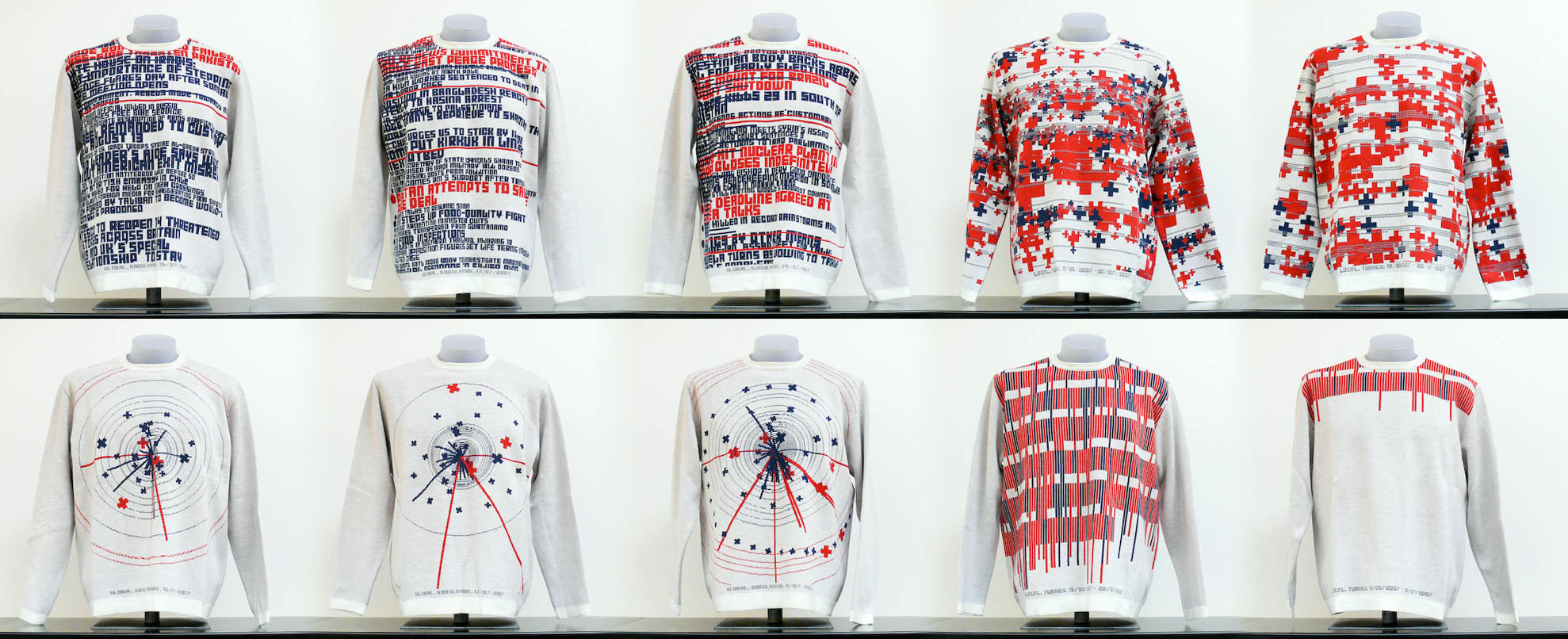
>> Newsknitter


project done in 2007 by Mahir Yavuz and Ebru Kurbak, students at the Interface Cultures department (Christa Sommerer, Laurent Mignonneau) at the Art University of Linz.


from: http://casualdata.com/newsknitter/:

News Knitter is a data visualization project which focuses on knitted garments as an alternative medium to visualize large scale data.

The production of knitted garments is a highly complex process which involves computer support at various steps starting with the designs of both the fabric and the shape of garments until they are ready-to-wear. In recent years, technical innovations in machine knitting have especially focused on the patterning facilities. The patterns are designed by individuals generally depending on the current trends of fashion and the intended target markets and multiplied through mass production. News Knitter translates this individual design process into a world-wide collaboration by utilizing live data streams as a base for pattern generation. Due to the dynamic nature of live data streams, the system generates patterns with unpredictable visuality.

News Knitter converts information gathered from the daily political news into clothing. Live news feed from the Internet that is broadcasted within 24 hours or a particular period is analyzed, filtered and converted into a unique visual pattern for a knitted sweater. The system consists of two different types of software: whereas one receives the content from live feeds the other converts it into visual patterns, and a fully computerized flat knitting machine produces the final output. Each product, sweater of News Knitter is an evidence/result of a specific day or period.

The exhibition consists of ten unique sweaters that are produced as sample outputs of the News Knitter project. The patterns of the sweaters are generated by using online global news of a particular day or local Turkish news of a particular time period.


compare it to "Struckmaschine", by Patrick Rüegg, Fabienne Blanc, 2007

2008-07-17

>> Blast Theory, "Can You See Me Now?", 2004


http://www.blasttheory.co.uk/bt/work_cysmn.html


Can You See Me Now? is a game that happens simultaneously online and on the streets. Players from anywhere in the world can play online in a virtual city against members of Blast Theory. Tracked by satellites, Blast Theory's runners appear online next to your player on a map of the city. On the streets, handheld computers showing the positions of online players guide the runners in tracking you down.

With up to 20 people playing online at a time, players can exchange tactics and send messages to Blast Theory. An audio stream from Blast Theory's walkie talkies allowed you to eavesdrop on your pursuers: getting lost, cold and out of breath on the streets of the city.

Locations

The work was premiered in Sheffield at the b.tv festival. Other venues include the Dutch Electronic Arts Festival in Rotterdam; the Edith Russ Site for Media Art in Oldenburg; the International Festival for Dance, Media and Performance in Köln; Gardner Arts Centre in Brighton; ArtFutura in Barcelona; the InterCommunication Center (ICC), Tokyo; Interactive Screen at the Banff Center, Canada; Museum of Contemporary Art in Chicago; We Are Here 2.0 in Dublin; Donau Festival in Austria and as part of In Certain Places in Preston.

Conceptual Background

Can You See Me Now? draws upon the near ubiquity of handheld electronic devices in many developed countries. Blast Theory are fascinated by the penetration of the mobile phone into the hands of poorer users, rural users, teenagers and other demographics usually excluded from new technologies.

Some research has suggested that there is a higher usage of mobile phones among the homeless than among the general population. The advent of 3G (third generation mobile telephony) brings constant internet access, location based services and massive bandwidth into this equation. Can You See Me Now? is a part of a sequence of works (Uncle Roy All Around You and I Like Frank have followed) that attempt to establish a cultural space on these devices. While the telecoms industry remains focused on revenue streams in order to repay the huge debts incurred by buying 3G licenses and rolling out the networks, Blast Theory in collaboration with the Mixed Reality Lab are looking to identify the wider repercussions of this communication infrastructure. When games, the internet and mobile phones converge what new possibilities arise?

These social forces have dramatic repercussions for the city. As the previously discrete zones of private and public space (the home, the office etc.) have become blurred, it has become commonplace to hear intimate conversations on the bus, in the park, in the workplace. And these conversations are altered by the audience that accompanies them: we are conscious of being overheard and our private conversations become three way: the speaker, the listener and the inadvertent audience.

Can You See Me Now? takes the fabric of the city and makes our location within it central to the game play. The piece uses the overlay of a real city and a virtual city to explore ideas of absence and presence. By sharing the same 'space', the players online and runners on the street enter into a relationship that is adversarial, playful and, ultimately, filled with pathos.

As soon as a player registers they must answer the question: "Is there someone you haven't seen for a long time that you still think of?". From that moment issues of presence and absence run through Can You See Me Now?. This person - absent in place and time - seems irrelevant to the subsequent game play; only at the point that the player is caught or 'seen' by a runner do they hear the name mentioned again as part of the live audio feed from the streets. The last words they hear are "Runner 1 has seen ______ _______".

Proximity and distance exist at five levels within Can You See Me Now? Firstly, any game of chase is predicated on staying distant from your pursuer. Secondly, the virtual city (which correlates closely to the real city) has an elastic relationship to the real city. At times the two cities seem identical; the virtual pavement and the real pavement match exactly and behave in the same way. At other times the two cities diverge and appear very remote from one another. For example, traffic is always absent from the virtual city. Thirdly, the internet itself brings geographically distant players into the same virtual space. It also enables those players to run alongside the runners as it streams their walkie talkie chat. Fourthly, the name of someone you haven't seen for a long time but you still think of brings someone from the player's past into the present: their name is spoken aloud by a runner on the distant streets of the city and exists for a seconds before fading into the ether. Finally, the photos taken by runners of the empty terrain where each player is seen are uploaded to the site and persist as a record of the events of each game. Each player is forever linked to this anonymous square of the cityscape.

With the advent of virtual spaces and, more recently, hybrid spaces in which virtual and real worlds are overlapping, the emotional tenor of these worlds has become an important question. In what ways can we talk about intimacy in the electronic realm? In Britain the internet is regularly characterised in the media as a space in which paedophiles 'groom' unsuspecting children and teenagers. Against this back drop can we establish a more subtle understanding of the nuances of online relationships. When two players who know one another place their avatars together and wait for the camera view to zoom down to head height so that the two players regard one another, what is going on? Is this mute tenderness manifest to anyone else and should it be?

And alongside these small moments, there is a louder and more forceful set of interactions between runners and players based on insults, teasing, goading and humour. These public declarations seem to happily coexist with the private moments that appear marginal to the casual observer. Yet, this demotic discourse also can surprise: the online players understanding that the runners are tired, cold, struggling with the environment on the street can become a powerful emotion.

A player from Seattle wrote: "I had a definite heart stopping moment when my concerns suddenly switched from desperately trying to escape, to desperately hoping that the runner chasing me had not been run over by a reversing truck (that's what it sounded like had happened)."

>> Noah Wardip-Fruin, "Hypermedia, eternal life, and the impermanence agent", 1999

introduction

Impermanence AgentThe story of hypermedia, in which the Web is a recent chapter, begins with a vision of transforming the brain's associative connections into media - media that can be infinitely duplicated and easily shared - creating pathways of thought in a form that will not fade with memory. In recent years, hypermedia has begun to permeate our lives. But it is not as we dreamed: constantly growing, with nothing lost, only showing what we wish to see. Instead we find 'Not Found' a nearly daily message.

The story of software agents begins with the idea of a 'soft robot' - capable of carrying out tasks toward a goal, while requesting and receiving advice in human terms. In recent years, a much narrower marketing fantasy of the agent has emerged (with a relationship to actual agent technologies as tenuous as Robbie the Robot's relationship to factory robots) and it grows despite failures such as Microsoft Bob. Now we often see agents as anthropomorphized, self-customizing virtual servants designed for a single task: to be a pleasing interface to a world of information that does not please us.

The Web disappoints us with its too-perfect reflection of our ambivalent relationships with impermanence and openness: dynamic and unstable, diverse and overwhelming. In response, some Web businesses are marketing fantasies of agents that will find for us only the information we desire, sheltering us from chance encounters with unpleasant content and broken links. The Impermanence Agent is a different response.

The Impermanence Agent, developed over the last year, interacts with users as a web browser window. The Agent is a storyteller, telling a personal story, a story of impermanence. The Agent is meant to be experienced peripherally, over time - not 'visited.' It tracks the user's web browsing, makes copies of the texts and images the user views, and then customizes its story by incorporating this material into it. The Agent customizes until none of its original story is left.

a box of letters

1. Ikkyu, the Zen master, was very clever even as a boy. His teacher had a precious teacup, a rare antique. Ikkyu happened to break this cup and was very perplexed. Hearing the footsteps of his teacher, he held the pieces of the cup behind him. When the master appeared Ikkyu asked: "Why do people have to die?"

"This is natural," explained the older man. "Everything has to die and has just so long to live." Ikkyu, producing the shattered cup, added: "It was time for your cup to die." - "Time to Die" from Zen Flesh, Zen Bones [Reps61]

...infinite reproducibility
....lossless archiving
.....continual versioning

Whatever we may say about digital culture, it is always time for something to die.

2. When I was nine months old, still in a walker, on a day that I do not remember, my mother was sitting in our living room. From where she sat she could see down our hallway, past the front door, to the place where the hallway turned in the direction of my bedroom.

From the bedroom came a crashing sound. But perhaps this was not so unusual, and it did not sound to her mother's ear as if I was hurt, so she waited. In time, I came clumsily down the hallway, dragging a small overnight suitcase. That hallway I do remember, with white plaster walls and a brass chime that the doorbell made ring (and a closet with stairs beneath it that led to a basement that may only exist in my imagination). I made my way to the front door, put my small hand on the knob, turned to look at my mother and waved (I couldn't speak): Bye-bye. Bye-bye.

My mother tells me that she cried.

3. There is a loss of memory. I was probably trying to visit Nana, my mother;s mother. By the time of my first self-aware, narrative memories Nana was already losing many of hers. I have only hints of what she was like from my own experience, a sense of her difference, and memories of moments in the kitchen when she named my puppet monkey Minkey and made chocolate milkshakes.

I remember going to visit her in the nursing home, where she was once she could no longer walk. On this visit she thought I was her son Wally, or so I imagine. She told me how she couldn't wait to get out of there, and back on her feet again. We took her to the house for Christmas. She looked at one of her great-grandsons, too young to be walking, and said, "He's coming and I'm going. But I can't get a seat." That summer she got a seat.

4. After she died we were left with a box of her letters. Not letters she had written, but letters that belonged to her. These seemed like poor materials for reconstituting a woman - but they, the paper trail, seemed to be all that was left.

At the same time, she seemed more alive after her death than in years. While she was alive, but after she was no longer herself, we had continued to leave her to carry the burden of being her. Once she was dead we took it upon ourselves. At the memorial service we treated each other with the care that she had given.

The paper trail is no dodge for impermanence. But here I sit, inscribing Nana's existence again, attempting another addition to the collective box of letters.

eternal life

5. Mark Bernstein wrote about web shrines for HypertextNow, pointing to memorial inscriptions on the Web "by sons and daughters, by grieving parents, by academic institutions, by an army medic who cannot forget the ravaged body of a child whose name she never learned" [Bernstein97]. He suggests that those of us who think about media should approach web shrines with profound humility - in recognition of suffering, and in recognition of the fact that none of us predicted, none of us directed, and none of us profited from this emergence in the docuverse. Now many links in Bernstein's article are broken. Yahoo! has sprouted the category Society_and_Culture / Death / Obituaries / Memorials.

Bernstein later added a link to an article from The New York Times Online, which tells the story of "a not-for-profit group named Afterlife, dedicated to preserving the Web sites of deceased surfers" [Dunn98]. Afterlife (http://www.afterlife.org) consists of "a few volunteers who have been slowly gathering information on the legal, financial and technical issues of maintaining thousands or maybe hundreds of thousands of Web sites for all 'eternity.'"

At a site called "Dearly Departed" I find the simple sentence, "We miss you Gama" and decide to include it in my essay about Nana.

6. The Internet Archive Project (http://www.archive.org) is more famous than Afterlife, and has more hubris in its aims [Kahle97], but I believe its impetus is the same.1 We find in the Internet that which expresses and creates, reflects and shapes, our complicated relationship with impermanence. The paper trail is changing, we are changing it, and with it we are changing our contact with immutability. There is a loss of memory, not only in broken links and missing sites and that which becomes outdated - but also in that which is updated, and those threads of newsgroup and email conversations with starting points lost and potentially infinite bifurcations. At the same time, a growing amount of our culture takes a form that allows identical, degradation-proof, multiply-viewable copies.

Consider the dream of hypermedia, put forth by Ted Nelson and others over the last three decades: That, in a not-so-distant future, we read and write (view and draw, hear and compose) most everything from and to a world-spanning computer network. That everyone have the ability to produce their own documents, and connect them with any other public documents. That the author may constantly create new versions of her or his own document, and individuals may create their own versions of any public document, and that public connections made between one version of one document and another version of another will usually automatically place themselves in all the extant versions. That historical backtrack and degradation-proof storage allows us to visit any version, any moment in the network's history [Nelson93a]. To have the ultimate archive, and yet have each element of this archive constantly in process. Dynamism without loss. Impermanence enfolded within permanence.

Afterlife, and the Internet Archive, and the dream of hypermedia aren't about embalming; they're about eternal life.

1. More focused, but perhaps equally Quixotic, is the work of librarians hoping to preserve traditional scholarly permanence. Consider this, from "Books to Bytes: The Electronic Archive" (New York Times Online, April 8): "If we increasingly as scholars rely on various digital resources and those aren't preserved, we won't have that kind of accountability and trail of how research develops," said Margaret Hedstrom, an associate professor at the School of Information at the University of Michigan at Ann Arbor. "It's both the loss of the information and the whole validation of scholarship. Those are the implications of not solving this problem." [Hafner99] Remember the analogy between text and water. Water flows freely, ice does not. The free-flowing live documents on the network are subject to constant new use and linkage, and those new links continually become interactively available. Any detached copy someone keeps is frozen and dead, lacking access to the new linkage (and, if there were any substantial body of in-links at the time the copy was made, probably most of those as well).
- Ted Nelson [Nelson93b] |back|

7. Even the origins of hypermedia contain traces of the quest for eternal life. In 1945, Vannevar Bush published "As We May Think" - an article now widely considered the genesis of hypermedia [Bush45]. In it Bush writes of the memex, a "future device for individual use... a sort of mechanized private file and library" in the shape of a desk. The memex, as described, uses methods such as microfilm storage, dry photography, and analog computing to give post-war scholars access to a huge, indexed repository of knowledge - any section of which can be called up with a few keystrokes.

The field of information retrieval has been inspired by Bush's vision of simple, elegant information access. Hypertext and hypermedia, however, have been inspired by Bush's description of the scholar creating links and pathways through this information - associative connections that attempt to partially reflect the "intricate web of trails carried by the cells of the brain." The trails envisioned freely interconnect all the contents of the memex, which include both public documents and personal notes, diagrams, and photographs. Bush describes a great thinker's disciples not simply inheriting that person's "additions to the world's record," but also the connections, the structure, the tools by which that work was created.

In this vision, we are not only immortalized by our additions to the paper trail (which are stored identically in innumerable memexes), but can preserve and pass on our very pathways of thought. These pathways will not break or fade. Those who follow us can keep these connections in use, expanding and updating them, tending to our virtual immortality in both word and connection. The volunteers of Afterlife may be seen, perhaps, as the progeny of this vision, half a century later.

the internet and the agent

8. Like grains of rice on a chessboard, Internet traffic doubles and redoubles within a single year.2 404 Not Founds notwithstanding. 503 Forbiddens notwithstanding. Broken images notwithstanding. It seems we can live without eternal life.

Or can we? In "Weaving a Better Web" Byte writes, "HTML isn't dead, but it is suffering from its own success - and every time you get a '404 URL not found' error message, you¹re suffering, too" [Mace98].

Did Byte write this to remind us, lest we forget suffering in our embrace of an impermanent

2. This redoubling was widely publicized after an April 15, 1998 report from the US Commerce Department ("The Emerging Digital Economy"(http://www.ecommerce.gov/emerging.htm) stated that Internet traffic was doubling every 100 days. URL verified: May 1999. . (The http://www.ecommerce.gov site also contains information on the May 25-26, 1999 conference, "Understanding the Digital Economy - Data, Tools and Research.")

"Grains of rice on a chessboard" refers to the various stories of a king who agrees to pay a subject 1 grain of rice for the first square of the chessboard, 2 for the second, 4 for the third, and so on through the progression. The stories end either with a bankrupt king or a headless subject. Web? In this formulation, is it the loss that is our suffering - or the message, the reminder, the error? Is HTML, the stuff of our newly-woven paper trail, a life of itself, suffering, perhaps to die - while we pull silk from our abdomens in overtime, doubling an already-massive body every few months? |back|

What can we do, except get rid of the message, the offending 404? We can't stop back-end filtration - we can't stop impermanence in the system.3 Byte itself is now a thing of memory. We may write "Web Pages Must Live Forever" [Nielsen98] but we must also know that they cannot.

9. The idea of an agent originated with John McCarthy in the mid-1950's, and the term was coined by Oliver G. Selfridge a few years later, when they were both at the Massachusetts Institute of Technology. They had in view a system that, when given a goal, could carry out the details of the appropriate computer operations and could ask for and receive advice, offered in human terms, when it was stuck. An agent would be a 'soft robot' living and doing its business within the computer's world.
- Alan Kay [Kay84]

The concept of a soft robot, or agent, is a very broad one. As is the concept of a mechanical robot. But each, in contact with our pervasive fantasies of human servitude, has spawned very narrow, anthropomorphic visions in entertainment and marketing.

From a muddling of these visions with ongoing agent research, the image has arisen of a perfect information servant - an agent with a singular task: to be a pleasing interface to a world of information that doesn't please us. Despite the disaster of Microsoft Bob, this image has continued to gain momentum. Now the Web, in its too-perfect reflection of our ambivalent relationships with impermanence and openness, is found displeasing by many. It is wonderfully dynamic, but unstable. Its openness is exciting, but we complain of information overload and find ourselves embroiled in censorship battles. We suffer, apparently, with each 404. There is continual talk of the Web being undigestible, uninteresting, uncomfortable, and difficult to understand. Yet we do not wish to abandon it, for all our talk of its faults.

Across the Web, many are attempting to sell fantasy images of an agent/servant as the key to mapping cyberspace into a comfortable coherence. Sometimes a fantasy agent image is used to market a much less sophisticated agent. Sometimes the fantasy of the agent is used to market something that isn't an agent at all. The signs of these fantasies can be read in the language of sites from NewsBot ("With NewsBot at your service, you¹ll always know...")

3. "front end (n.), front-end (adj.) - whatever stands between you and a system. A front end can be the terminal in your office, for example. A front-end program is one which mediates between a user and some other system or program, perhaps collecting data for it by quizzing you." (Ted Nelson, Dream Machines, p.9)

The back end is the system with which the front end interfaces. It is where all the data in the above data collection example is stored, along with the information about how it relates to other data.

In hypermedia systems, what one sees of the network, and how one sees it, is determined by the configuration of the front end (e.g., the client, the browser). The network one is looking at (what is available to see - e.g., the Internet) is what the back end contains.

Questions of filtration, particularly those of how we use back-end filtration to determine what is available to see (and to whom), are of great importance at this point in Internet history - a topic I address at greater length in "Reading and Writing, Linking and Filtering" in Intelligent Agent 2/2 [Wardrip-Fruin98]. |back|

to The Mining Company ("Guides Do The Hard Work, So You Don't Have To"), and are brought nearly to the level of parody at Ask Jeeves ("Jeeves here, at your service. I'm your host and I'm here to help you find what you're looking for, whatever that might be. I've spent years perusing the internet (so you don't have to), and I have found wonderful sites that will help simplify your life...").

10. During the last year, I have been working with a.c. chapman and Brion Moss to create the Impermanence Agent.

Like the fantasy agents, which are expected to give advice rather than receive it, the Impermanence Agent tells stories before listening to them.

The Impermanence Agent doesn't separate good information from bad, but combines family history with other fictions to tell stories of impermanence. They are Nana's stories, and mine, and each user's.

They are the user's not simply as audience, but also because the Impermanence Agent is always looking over the edge of the Netscape windows on each user's desktop, and using the information it gathers, the information users show it, in its storytelling to that user. It is a personal agent, a customizing agent, an illusion of an agent.

The Impermanence Agent appears, itself, as a Netscape window. It is a combination of server and client-side applications written in PERL and JavaScript, making liberal use of existing software such as WordNet (http://www.cogsci.princeton.edu/~wn/) and ImageMagick (http://www.wizards.dupont.com/cristy/ ), and benefiting much from the willingness of Duane Whitehurst to modify some existing code and create some new.

The Impermanence Agent is our addition to the box of letters. We have created the stories with which it begins, stories like Nana's, stories like this one. We have created the means by which it selects texts and images from the user's browsing and combines them with its own, customizing the story. We have set in motion the impermanence in which these pieces drawn from the user's Web browsing eventually entirely replace the stories we have created. And, because we can't help ourselves, we have also saved these stories. All of this will work until the next version of Netscape replaces the current one. Perhaps even longer. And it will last longer than it works, like the boxes of disks we each have, formatted for filesystems not read by any current operating system. Like the pictures of people, four generations back, that none of us ever met.

The Impermanence Agent is art meant to be experienced peripherally, to be left open on the desktop for a week. In its stories, children are born, letters are burned, we are duplicated and saved and lost. The texts and images of our daily browsing are incorporated into, then wear away, then become something new within the space that held the Agent's stories. Then the story has been told.

References

[Bernstein97] Bernstein, Mark. 1997. HypertextNow: Web Shrines. Eastgate Systems. URL verified: May 1999. http://www.eastgate.com/HypertextNow/archives/Shrines.html

[Bush45] Bush, Vannevar. 1945. As We May Think. Atlantic Monthly, Vol. 176, No. 1. URL verified: May 1999. http://www.theatlantic.com/unbound/flashbks/computer/bushf.htm

[Dunn98] Dunn, Ashley. 1998. Web's Evanescence Creates Challenge for Archivists. The New York Times on the Web: Cybertimes, Jan 21, 1998. URL verified: May 1999. http://www.nytimes.com/library/cyber/surf/012198mind.html [registration process required]

[Hafner99] Hafner, Katie. 1999. Books to Bytes: The Electronic Archive. The New York Times on the Web: Technology | Circuits, April 8, 1999. URL verified: May 1999. http://www.nytimes.com/library/tech/99/04/circuits/articles/08arch.html [registration process required]

[Kahle97] Kahle, Brewster. 1997. Preserving the Internet. Scientific American, Mar 1997. URLs verified: May 1999. http://www.archive.org/sciam_article.html, http://www.sciam.com/0397issue/0397kahle.html

[Kay84] Kay, Alan. 1984. Computer Software. Scientific American, Sep 1984.

[Mace98] Mace, Scott, Udo Flohr, Rick Dobson, and Tony Graham. 1998. Weaving a Better Web. Byte, Mar 1998. p. 68. URL verified May 1999. http://www.byte.com/art/9803/sec5/art1.htm

[Nelson93a] Nelson, Ted. 1993. Literary Machines 93.1. Mindful Press, Sausalito, CA.

[Nelson93b] ibid, page 2/48.

[Nielsen98] Nielsen, Jakob. 1998. Alertbox: Web Pages Must Live Forever. Nov. 29, 1998. URL verified: May 1999. http://www.useit.com/alertbox/981129.html

[Reps61] Reps, Paul (ed). 1961. Time To Die. Zen Flesh, Zen Bones. Anchor Doubleday, New York.

[Wardrip-Fruin98] Wardrip-Fruin, Noah. 1998. Reading and Writing, Linking and Filtering: the library, the web, Ted Nelson, and what's wrong with micropayment. Intelligent Agent 2/2. p. 32.

design by ADM's Design Machine www.theadm.com

>> Toshio Iwai, Ryuichi Sakamoto, "Music Plays Images x Images Play Music", 1997

This piece won the Golden Nica in the Interactive Art category in 1997's Prix Ars Electronica

from Ars Electronica: http://www.aec.at/en/archives/prix_archive/prix_projekt.asp?iProjectID=2494

"Music Plays Images x Images Play Music" is a multi-media concert that uses the system of Toshio Iwai's piano piece and visualizes a musical performance by Ryuichi Sakamoto in real time.

The idea for this collaborative performance has its origins in Toshio Iwai's installation "Piano ­ as image media" created at the ZKM, Karlsruhe, Germany in 1995. Conceived upon Iwai's return to Japan when he met Ryuichi Sakamoto, "Music Plays Images x Images Play Music" is a multi-media concert that uses the system of Iwai's piano piece and visualizes a musical performance by Sakamoto in real time. Over the course of a year, Iwai, who lives in Tokyo, often corresponded by e-mail with Sakamoto, who lives in New York. During their correspondence, the concept for the collaboration expanded rapidly, developing from the simple idea of "Sakamoto playing Iwai's 'Piano ­ as image media'" to a performance that links, in various ways, musical sounds with visual images. The actual performance was given on December 16, 1996 at the Art Tower Mito in Mito City, Japan. The result of the collaboration was more than a "novel combination of music and image." Many elements including the actual presence of Sakamoto/Iwai, the machinery that is called the piano, the acoustic sounds produced by the piano, and the virtual images generated from computers were linked and developed in various ways. From the feedback produced, a radically new space of musicality-visuality was created. In addition, the performance was transmitted over the Internet and relayed world-wide. This experiment, the first of its kind, was an attempt to utilize the interactive medium of the Internet. People on the other side of the Internet were able to play the piano located in Mito by remote control and in turn Sakamoto had a session with their playing.


The Set-Up of the Stage
Two concert grand pianos are placed on the stage. A semi-transparent screen 8 meters in height and 10 meters in width is suspended above them. The lids of both pianos are removed and their interiors and keyboards clearly illuminated. The screen is irradiated with a beautiful shade of blue. A black and white video camera is placed on each of the pianos in order to film the movements of the performer's fingers and the piano keys. The video cameras project enlarged images of each piano keyboard onto the screen on either side of the pianos. Several computers are set up on a long narrow table placed on the right side of the stage.

The Content of the Performance
1) Sakamoto does not initially appear on the stage. Amidst the silence, the piano begins to play on its own without a player. An image of Sakamoto playing the piano gradually comes into view on the screen to the side of the piano. Sakamoto's image slowly disappears as the music ends.

2) Sakamoto appears on the left side of the stage. He begins to play the small keyboard placed there. As he plays this keyboard, the piano starts to play. A faint light gradually emanates from the piano. At a certain point, Sakamoto stops playing. However, the last musical phrase repeats itself automatically, slowly fading out.

3) Sakamoto plays the piano directly. The light-images that visually represent each note of the musical piece begin to rise from within the piano. The images capture not only the timing of the notes, but every aspect of the music, including the length of the notes and their loudness. They are represented in a way that the eye can recognize.

4) During Sakamoto's performance, Iwai gradually modifies the image. The lights, which correspond to each note of the piece, are transformed over time in various ways. They do not merely rise from within the piano and fade into thin air. They radiate from the center of the screen out in all directions or revolve in a whirling pattern, eventually disappearing into a vortex. The metamorphoses of the projected images influence Sakamoto's playing as he watches the various transformations.

5) The image-objects, composed of 88 elements ­ the same number as the number of keys on a piano ­ appear on the center of the screen. Each of the elements coincides with the keys of the piano and the objects are continually transformed according to Sakamoto's piano performance.

6) Clicking a computer mouse, Iwai places dots of light onto the screen. Whenever the dots of light fall on the piano, the piano begins to play. The dots of light then rebound to their original position, striking the keyboard at fixed intervals. Depending on where the dots of light are placed, the pitch of the notes and the patterns of repetition change. The number of dots of light are increased. The dots of light bouncing from the piano are all shifted back and forth from left to right. The whole musical scale changes according to how the dots of light are moved. The dots of light are transformed into rays and then polygonal figures.

7) The video camera films Sakamoto's entire body. The computer captures the image in real time. Sakamoto's silhouette is pixelized and then projected onto the screen above the piano. When Sakamoto moves and the image of his body overlaps with the piano, the piano plays. When Sakamoto moves toward or away from the camera, or when a close-up image of his hands is projected, the sound is changed dynamically. The images of Sakamoto's hands and body are what plays the machine called the piano. Iwai implements further modifications by zooming in on and rotating Sakamoto's image on the screen thereby slowly modifying the sound. Sakamoto continues to move his body while looking on.

8) A chessboard-like grid appears on the screen and begins to rotate. Sakamoto and Iwai take turns placing glowing dots of light onto the grid, thereby creating a repetition of short melodic patterns. As the music is created through this collaboration, Iwai transposes the musical pattern, changing the octave and altering the sounds and the images. Sakamoto continues to create new patterns. Finally, with the completed musical phrases as a backdrop, Sakamoto improvises on the piano. Iwai continues to modify the performance piece.

9) The music played by Sakamoto is turned into an image. The image that springs from the first piano and lands on the second piano creates a parabola in its fall. The second piano plays according to this image. The figure of Sakamoto performing on the first piano is projected next to the second piano with a delay that coincides with the imaged music arriving at the second piano. It appears as if there are two Sakamotos playing the two different pianos.

10) The short musical phrase performed by Sakamoto and the resulting image loop between the two pianos, repeating again and again. Sakamoto continues to add more sounds to the loop. The repeating images and sounds, flowing forth like a waterfall between the two pianos, grow in layered richness and complexity.
(translated from Japanese by Dano O'Neill)

>> labels

>> cloudy with a chance of tags


Powered By:Blogger Widgets

followers

.........

My photo
... is a Media Art historian and researcher. She holds a PhD from the University of Art and Design Linz where she works as an associate professor. Her PhD-thesis is on "Speculative Archiving and Digital Art", focusing on facial recognition and algorithmic bias. Her Master Thesis "The Grammar of New Media" was on Descriptive Metadata for Media Arts. For many years, she has been working in the field of archiving/documenting Media Art, recently at the Ludwig Boltzmann Institute for Media.Art.Research and before as the head of the Ars Electronica Futurelab's videostudio, where she created their archives and primarily worked with the archival material. She was teaching the Prehystories of New Media Class at the School of the Art Institute of Chicago (SAIC) and in the Media Art Histories program at the Danube University Krems.