this blog is nina wenhart's collection of resources on the various histories of new media art. it consists mainly of non or very little edited material i found flaneuring on the net, sometimes with my own annotations and comments, sometimes it's also textparts i retyped from books that are out of print.
it is also meant to be an additional resource of information and recommended reading for my students of the prehystories of new media class that i teach at the school of the art institute of chicago in fall 2008.
the focus is on the time period from the beginning of the 20th century up to today.
>> search this blog
Showing posts with label virtual reality. Show all posts
Showing posts with label virtual reality. Show all posts
"David Em was the first fine artist to create navigable virtual worlds in the 1970s. His early work was done on mainframes at III, JPL and Cal Tech. Jeffrey Shaw explored the potential of VR in fine arts with early works like Legible City (1989), Virtual Museum (1991), Golden Calf(1994).
Canadian artist Char Davies created immersive VR art pieces Osmose (1995) and Ephémère (1998). Maurice Benayoun's work introduced metaphorical, philosophical or political content, combining VR, network, generation and intelligent agents, in works like Is God Flat (1994), The Tunnel under the Atlantic (1995), World Skin (1997).
- Timothy Leary: By the mid 1980s, Leary had begun to incorporate computers, the Internet, and virtual reality into his aegis of thought. Leary established one of the earliest sites on the World Wide Web, and was often quoted describing the Internet as "the LSD of the 1990s."[citation needed] He became a promoter of virtual reality systems,[13] and sometimes demonstrated a prototype of the MattelPower Glove as part of his lectures (as in From Psychedelics to Cybernetics). Around this time he cultivated friendships with a number of notable people in the field, including Brenda Laurel, a pioneering researcher in virtual environments and human-computer interaction. http://en.wikipedia.org/wiki/Timothy_Leary#Leary.27s_last_two_decades
"Crayoland", one of the first and most successful CAVE-visualizations. Created by Dave OPape in 1995, 2d-crayon drawings serve as textures for the objects in this 3d-environment.
"CAVE", a project by Austrian artist Peter Kogler in collaboration with the Ars Electronica Futurelab, was realized in 1999. As a visitor, you could navigate through Kogler's abstract shapes.
"World Skin" is an award-winning CAVE-project created by French artists Maurice Benayoun and Jean-Baptiste Barrière. What was special about it was the novel approach to the user's interaction with the envoronment. The wand served as a photocamera. When you took a photo of the scenes around you, the object was washed out, leaving a blank space.
"Gesichtsraum" by Johannes Deutsch is anouther example for a collaboration of an artist with Ars Electronica's Futurelab: Deutsch and the programmers and 3d modellers worked together closely for a period of several months to develop an immersive environment out of Johannes Deutsch's paintings of his son.
"TerraVision is a self-contained, virtual reality, 1-to-1 representation of our Earth. By means of a stylised globe users can zoom in on any location in the world and obtain minutely detailed pictures. (virtual earth)
The system offers not only satellite images and aerial photos but also geographically referenced data of all types – e.g. topographical or architectural schematic representations.
TerraVision was the first system to provide visualisation and unlimited freedom of navigation within an infinitely large spatial data environment. Providing visuals ranging from overviews of the Earth to extremely detailed movements in buildings, TerraVision provides smooth, real time pictures in a single, comprehensive, virtual reality system."
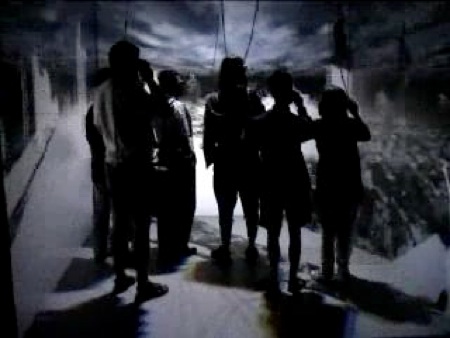
"Be Now Here is an installation about landscape and public places. Visitors gain a strong sense of place by wearing 3-D glasses and stepping into an immersive virtual environment. The imagery is of public plazas on the UNESCO World Heritage Centre's list of endangered places - Jerusalem, Dubrovnik, Timbuktu, and Angkor, Cambodia – places both exotic and disturbing. The style is ambient, as if the imagery is live.
For production, a unique recording system was built consisting of two 35mm motion-picture cameras (for 3D, one for each eye) mounted on a rotating tripod. The installation consists of an input pedestal for interactively choosing place and time, a stereoscopic projection screen, four-channel audio, and a 16-foot rotating floor on which the viewers stand.
Be Now Here is an extension of several media trajectories. One is of enhanced cinematic representation, such as the Imax-sized projections of the Lumiere brothers in 1900 and the 3-screen triptychs of Abel Gance’s Napoleon in 1927. Another is of non-narrative cultural activism, such as the films of Godfrey Reggio and Tony Gatlif. But Be Now Here also points forward: as a simulation of what net cinema can be, it is both a regard and a provocation."
"In The Legible City the visitor is able to ride a stationary bicycle through a simulated representation of a city that is constituted by computer-generated three-dimensional letters that form words and sentences along the sides of the streets. Using the ground plans of actual cities - Manhattan, Amsterdam and Karlsruhe - the existing architecture of these cities is completely replaced by textual formations written and compiled by Dirk Groeneveld. Travelling through these cities of words is consequently a journey of reading; choosing the path one takes is a choice of texts as well as their spontaneous juxtapositions and conjunctions of meaning.
The handlebar and pedals of the interface bicycle give the viewer interactive control over direction and speed of travel. The physical effort of cycling in the real world is gratuitously transposed into the virtual environment, affirming a conjunction of the active body in the virtual domain. A video projector is used to project the computer-generated image onto a large screen. Another small monitor screen in front of the bicycle shows a simple ground plan of each city, with an indicator showing the momentary position of the cyclist.
The Manhattan version (1989) of this work comprises eight separate fictional story lines in the form of monologues by ex-Mayor Koch, Frank Lloyd Wright, Donald Trump, a tour guide, a confidence trickster, an ambassador and a taxi-driver. Each story line has a specific letter colour so that the bicyclist can choose one or another to follow the path of a particular narration. In the Amsterdam (1990) and Karlsruhe (1991) versions all the letters are scaled so that they have the same proportion and location as the actual buildings which they replace, resulting in a transformed but exact representation of the actual architectural appearance of these cities. The texts for these two cities are largely derived from archive documents that describe mundane historical events there."
from Ars Electronica (Award of Distinction, interactive Art, 1990):
"In "The Legible City" by Jeffrey Shaw the visitor is able to ride a stationary bicycle through a simulated representation of a city that is constituted by computer-generated three-dimensional letters that form words and sentences along the sides of the streets.
The research and development of various mechanisms and codes of spatial representation has been a major preoccupation throughout the history of Western Art. The application of three dimensional computer imaging technologies in this context has a revolutionary meaning. Instead ofthe traditional activity of art as a representation of reality, the artwork can now become itself a simulation of reality within which the viewer's point of view is located. "The Legible City" is a first example of the possibility of the digital image to evoke a three dimensional virtual space which the spectator can enter and explore.
The spectator is able to use a bicycle to interactively travel in a video projected three dimensional virtual image space. In the first realized version of this work the image space in which the bicyclist can travel is based on the ground plan of part of Manhattan, New York - the area boundaried by 34th and 66thStreet, and Park and 11th Avenue. Using real-time computer graphic technology, the city visualised by solid three dimensional letters that form words and sentences along the sides of the streets. These words and sentences conform tothe actual plan and scale of this city - its particular organisation of streets, avenues, intersections, parks, etc. Thus the actual Manhattan architecture of buildings is completely replaced by a new architecture of text.
Travelling through this city of words is consequently a journey of reading. Choosing direction, choosing where to turn, is a choice of the story lines and the user's position. In this way this city of words is a kind of three dimensional book which can be read in any direction, and where the spectators construct their own conjunction of texts and meanings as they bicycle their chosen path there.
The image of the city is video projected onto a large video screen in front of the bicyclist. The bicycle is fixed on a platform in the installation, but the spectator controls his / her speed and direction of movement in the projected image space by pedalling faster or slower, and by turning the handle bars. The virtual world where the bicyclist is travelling simulates faithfully the experience of bicycling in the real world.
In this work the city is constituted physically by the three dimensional arrangement of words into streets, and the city is constituted psychologically by the meanings these words carry as they are read by the bicyclist travelling through these streets. The texts have been written as eight separate storylines that have a particular relationship to Manhattan - for instance monologues spoken by Mayor Koch, Frank Lloyd Wright, Donald Trump, Noah Webster, a cab driver, a tour guide, an ambassador, etc. Each storyline has a specific location in the city, and each is visually identifiable by the particular colour of its letters.Thus the bicyclist / reader can follow one story line by following its colour, andalso recognise higher shifts from one storyline to another because of the colour changes.
Directly in front of the bicyclist, a small video screen shows a plan of Manhattan, and the actual location of the bicyclist there by means of a flashing dot that represents the position and direction of movement. Electronic devices attached to the steering wheel and pedals of the bicycle measure the rotation of the steering wheel and speed of pedalling. Responding to this formation, the Manhattan database is interactively calculated and displayed by a Silicon Graphics Personal IRIS graphics computer. Video output from this computer goes to a video projector which shows the image on the large screen in front of the bicyclist. Another personal computer handles the small video display of the plan of Manhattan and the indication of the bicyclist's position there.
The authors of this work intend to realise more versions based on the ground plans of other major cities. What is felt to be interesting are the different formal geometries of these cities' plans, which will strongly effect the character of their lettered visualisation. Furthermore, each city's plan and historical identity asks for a different approach to the content and writing of the text.
"The Legible City", as it now has been created, is in a fundamental way determined by the capabilities of state-of-the-art computer graphic visualisation technologies. The ongoing and rapid evolution of these technologies generates new capabilities that are significant to future developments of this work. For instance utilizing NASA's stereoscopic head-mounted display, the bicyclist would experience the work as a totally surrounding three dimensional space of imagery."
from medienkunstnetz:
"Visitors to ‘The Legible City', created at the Institut für Neue Medien in Frankfurt/M., are seated on a stationary bicycle and ‘move' through streets projected onto the surface in front of them. In contrast to those of a normal city, the streets here are literally legible, lined not by buildings but by letters. On their passage through the city, cyclist-visitors can pursue various narrative threads, accumulating their own history of the city. On a small display on the handlebars is a map of the city on which the cyclists can plot their position. Between 1988 and 1991 Jeffrey Shaw created three versions of ‘The Legible City': Manhattan, Amsterdam and Karlsruhe. The Manhattan variant was one of the very first interactive installations, today regarded as a key work of the genre."
"Originally trained as a computer scientist, Myron Krueger, under the influence of John Cage's experiments in indeterminacy and audience participation, pioneered human-computer interaction in the context of physical environments. Beginning in 1969, he collaborated with artist and engineer colleagues to create artworks that responded to the movement and gesture of the viewer through an elaborate system of sensing floors, graphic tables, and video cameras.
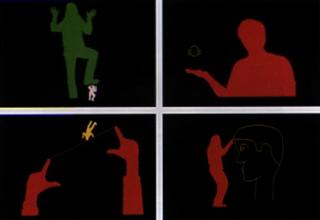
At the heart of Krueger's contribution to interactive computer art was the notion of the artist as a "composer" of intelligent, real-time computer-mediated spaces, or "responsive environments," as he called them. Krueger "composed" environments, such as Videoplace from 1970, in which the computer responded to the gestures of the audience by interpreting, and even anticipating, their actions. Audience members could "touch" each other's video-generated silhouettes, as well as manipulate the odd, playful assortment of graphical objects and animated organisms that appeared on the screen, imbued with the presence of artificial life."
from medienkunstnetz: "Two people in different rooms, each containing a projection screen and a video camera, were able to communicate through their projected images in a «shared space» on the screen. No computer was involved in the first Environment in 1975. In order to realize his ideas of an «artificial reality» he [Krueger] started to develop his own computer system in the years up to 1984, mastering the technical problems of image recognition, image analysis and response in real time. This system meant that he could now combine live video images of visitors with graphic images, using various programs to modify them. When «Videoplace» is shown today, visitors can interact with 25 different programs or interaction patterns. A switch from one program to another usually takes place when a new person steps in front of the camera. But the «Videoplace» team has still not achieved its ultimate aim of developing a program capable of learning independently."
Myron Krueger: "Since 1969, I have been trying to raise interactivity to the level of an art form as opposed to making art work that happened to be interactive.
From the beginning, I reasoned that interactivity would be limited by what the computer knew about the participant's behavior, and I developed specialized computers for perceiving the human body. I have also incorporated the image of the person's body into the computer graphic images.
In general, I have stuck to the premise that everything that happens should be a direct response to the participant's actions. However, within that discipline a number of different kinds of pieces can be developed. One family of interactions I think of as two- or three-dimensional "mini-media," which visitors can use to create their own dynamic artistic expressions. Others involve two or more participants in different locations who interact with each other in the same virtual space either as a spontaneous interaction or as a live performance.
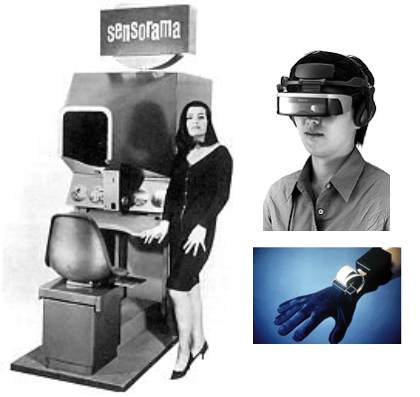
1962 - Morton Heilig, "Sensorama" and Experience Theatre --> head mounted display, senses, data glove
1970 - Ivan Sutherland, "Ultimate Display" --> head mounted display; essay "The Ultimate Display" written in 1965
1985 - Scott Fisher, "Telepresence" --> data glove, head mounted display, 3d headphones; telepresence: the projection of the self into a digital environment
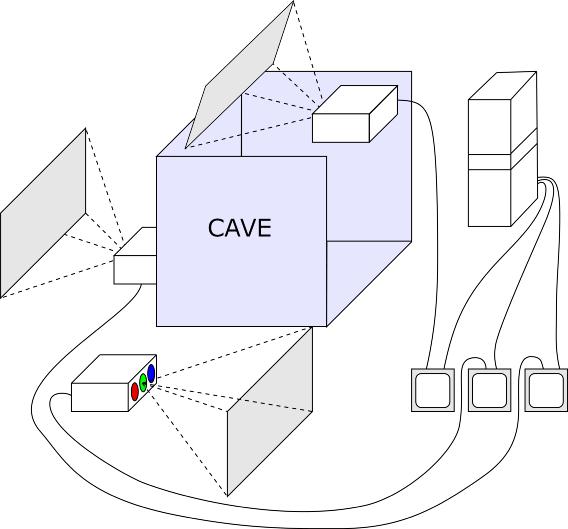
1992 - Dan Sandin, Tom deFanti, "CAVE" --> 3d immersive environment, head mounted display, data glove, wand
In the 1950's it occurred to cinematographer Morton Heilig that all the sensory splendor of life could be simulated with "reality machines." He proposed that an artist's expressive powers would be enhanced by a scientific understanding of the senses and perception. His premise was simple but striking for its time: if an artist controlled the multi-sensory stimulation of the audience, he could provide them with the illusion and sensation of first-person experience, of actually "being there."
Inspired by short-lived curiosities such as Cinerama and 3D movies, it occurred to Heilig that a logical extension of cinema would be to immerse the audience in a fabricated world that engaged all the senses. He believed that by expanding cinema to involve not only sight and sound, but also taste, touch, and smell, the traditional fourth wall of film and theater would dissolve, transporting the audience into a habitable, virtual world. He called this cinema of the future "experience theater", constructing a quirky, nickelodeon-style arcade machine in 1962 he aptly dubbed Sensorama, that catapulted viewers into multi-sensory excursions through the streets of Brooklyn, as well as other adventures in surrogate travel.
The Experience Theater is a version of the Sensorama Simulator but for a larger audience. It was patented in 1969 under patent # 3,469,837. It is a motion picture theater with a large semi-spherical screen, showing 3-D motion pictures, with peripheral imagery, directional sound, aromas, wind, temperature variations and body tilting of the seat. The audience is seated in the focus point in arena seating.
... is a Media Art historian and researcher. She holds a PhD from the University of Art and Design Linz where she works as an associate professor. Her PhD-thesis is on "Speculative Archiving and Digital Art", focusing on facial recognition and algorithmic bias. Her Master Thesis "The Grammar of New Media" was on Descriptive Metadata for Media Arts. For many years, she has been working in the field of archiving/documenting Media Art, recently at the Ludwig Boltzmann Institute for Media.Art.Research and before as the head of the Ars Electronica Futurelab's videostudio, where she created their archives and primarily worked with the archival material. She was teaching the Prehystories of New Media Class at the School of the Art Institute of Chicago (SAIC) and in the Media Art Histories program at the Danube University Krems.

 some CAVEs: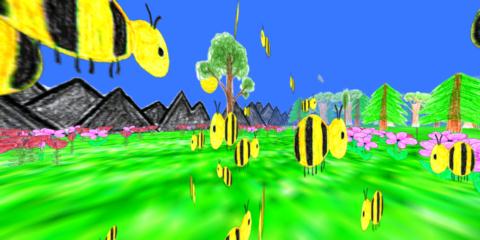








 Posts
Posts


