<< preface

this blog is nina wenhart's collection of resources on the various histories of new media art. it consists mainly of non or very little edited material i found flaneuring on the net, sometimes with my own annotations and comments, sometimes it's also textparts i retyped from books that are out of print.

it is also meant to be an additional resource of information and recommended reading for my students of the prehystories of new media class that i teach at the school of the art institute of chicago in fall 2008.

the focus is on the time period from the beginning of the 20th century up to today.

>> search this blog

Showing posts with label early exhibitions. Show all posts

2009-10-28

>> Cybernetic Serendipity, review in TIME, Friday Oct 4th, 1968

from: http://www.time.com/time/printout/0,8816,838821,00.html

"Can computers create? Maybe not, but many of their programmers have a lot of fun trying to make them behave as if they could. Some technicians feed a set of numbers into the computer which activates a mechanical arm which in turn plots designs on paper. Photographs, too, can be analyzed and stored in a computer's memory, then reorganized and distorted on electronic command. The results are often tantalizing facsimiles of op and pop. In addition, computers can be programmed to direct kinetic sculptures through any number of varied cycles.

Indeed, so widely has the computer's brain been applied to esthetic pursuits that London's Institute of Contemporary Art has mounted an entire exhibit devoted to "Cybernetic Serendipity." In seven weeks, it has packed in 40,000 London art lovers, schoolboys, mathematicians and Chelsea old-age pensioners, and from admissions alone has all but recouped its $45,000 cost.

Frog to a Phoenix. Visitors are caught up in a carnivalesque March of Progress from the moment they enter. At the door, they find that their bodies have been sighted by an electric eye, which in turn triggers the computer-generated voice that welcomes them in a deep monotone. They may be approached by R.O.S.A. (Radio Operated Simulated Actress) Bosom, a roving electronic robot who actually appeared with live performers in a 1966 London production of The Three Musketeers (R.O.S.A. played the Queen of France).

On the walls hang graceful, abstract designs that look like snail shells, plus computer variations on op designs by Jeffrey Steele and Bridget Riley. Ohio State University's Charles Csuri, a painter turned programmer, employs EDP (Electronic Data Processing) to sketch funhouse-mirror distortions of Leonardo da Vinci's drawing of a man in Vitruvian proportions. Japanese Engineer Fujio Niwa has produced a computer portrait of John F. Kennedy that converts a photograph into a series of dashes, all of which converge with sinister impact on the left ear.

From the ceiling hangs a huge mobile by Britain's Gordon Pask that responds electronically to lights flashed on it by visitors. Wen Ying Tsai's sonically activated bed of strobe-lit steel rods sways to each clap of the viewer's hands. Taped sounds of computer-composed music fill the air, and computer-made poetry is on view. Some of it reads rather like Alice in Wonderland as rewritten by Charles Olson.

One Hand Clapping. Even at its best, the show proves not that computers can make art, but that humans are more essential than ever. For each of the drawings, a detailed program, painstakingly prepared by a human, was needed; the computer did no more than fill in the requested dots and lines. No genuinely observant viewer could ever confuse a vibrant Riley or a vertigo-inducing Steele painting with the computer's dry, mechanical variants on the original works. And, elaborate though Tsai's kinetic sculpture may be, it too needs a human, in fact two: one to build it and one to clap it into life in the exhibition hall. EDP does not respond to ESP, and no esthetic results can be expected from the sound of one hand clapping."

2008-07-24

>> Cybernetic Serendipity catalogue

http://www.cibercultura.org.br/videos/cybernetic%20serendipity.pdf

2008-07-15

>> exhibition;: "This is Tomorrow", 1956

the complete catalogue can be found here: http://www.thisistomorrow2.com/images/cat_1956/cat_web/FrameSet.htm


from: www.independentgroup.org.uk/.../index.html

Hamilton’s most famous exhibition contribution was This is Tomorrow. He designed the space with John McHale and John Voelcker and its theme was problems of perception. It included a giant cut-out of Marilyn Monroe and Robbie the Robot – the latter borrowed from the opening of the film The Forbidden Planet – and a juke box. Each of the twelve groups involved with the exhibition designed a poster, and Hamilton designed Group 2’s, using a collage image that would be destined to become emblematic of 1950s, American consumer culture, Just What Is It That Makes Today’s Homes So Different, So Appealing?


from: http://www.thisistomorrow2.com/pages_gb/1956gb.html


This is Tomorrow has become an iconic exhibition notable not only for the arrival of the naming of Pop Art but also as a captured moment for the multi-disciplinary merging of the disciplines of art and architecture

"In 'This is Tomorrow' the visitor is exposed to space effects, play with signs, a wide range of materials and structures, which, taken together make of art and architecture a many chanelled activity, as far from ideal standards as the street outside". --- Lawrence ALLOWAY, introduction, Exhibition Catalogue

From: "orthodox abstract art, with its classical regularity and rational order, through room-size sculptures to walk through, to crazy-house structures plastered with pin-up images from the popular press." --- press release, This is Tomorrow 1956

>> exhibition: Jack Burnham, "Software", 1970

>> Robert Mallary, "Notes on Jack Burnham's Concepts of a Software Exhibition", 1970

from: Leonardo, Vol. 3, pp. 189-190. Pergamon Press 1970. Printed in Great Britain

Jack Burnham has been receiving, in my view, the recognition he deserves for his efforts to draw attention to the impact of cybernetics, general systems theory and computers on contemporary art. My own respect for Burnham is attested to by references to his book, Beyond Modern Sculpture, in my article 'Computer Sculpture: Six Levels of Cybernetics', Artforum (May 1969) and by my discussion of his work at a session of the International Cybernetics Congress held in London in September 1969. Recently, in a communication to the New York Review, Burnham defined his central premise as '... we are moving from an art centered upon objects to one focused upon systems, thus implying that sculptured objects are in eclipse'. In a statement explaining the scope of a 'Software' exhibition he has proposed for the Jewish Museum in New York (tentatively scheduled for late spring, 1970), he made his point even more explicitly by writing 'If the "Software" exhibit is to be successful in emphasizing the nature of electronically supported software, it should then remove the traditional hardware props of art from the eye of the viewer, mainly those vestiges of painting and sculpture'. In this same statement he defined electronically supported software as 'radio, telephone, telephone photo- copying, television, microcard library information systems, teletype and teaching machines'. These quotes make clear what Burnham means by software, though, to my knowledge, he has yet to define precisely what he means by 'systems art', except in the negative sense of repudiating the sculptural object. One can only surmise that his thinking accords more with what we have come to know as 'concept art' and related tendencies, rather than with cybernetics and general systems theory. What he has done in fact, is draw upon the prestige of these disciplines (and some of the vocabulary) to blur the distinction between art as a particular kind of immediate, sensory experience and the process of dealing with it on various levels of abstraction- apparently failing to realize that in both cybernetics and general systems theory it is normal to distinguish between the abstract model and the real-world system it is intended to represent. Burnham's more puzzling mistake, however, lies in his gross misunderstanding of the word software, or at least in his gross misuse of it, and his resort to such a misleading expression as 'electronically supported software'-as if hardware normally supports software, instead of the other way round [1]. This is a surprising choice because Burnham must have learned enough about computers by this time to know that software refers to programming input for the computer-the term having been derived from the use of punched cards and paper tape for this purpose. It is legitimate to speak of software as output if the program generates another program which in turn becomes a second input of the computer. While Burnham is not alone in his abuse of a perfectly good word such as software (e.g. in audio- visual education, slides and films are sometimes referred to as software and the projectors as hardware) there is more involved than mere quibbling over terminology. A large computer, supported by appropriate software, is a general, all-purpose device capable of performing a host of diverse functions. In effect, it is the software that makes the difference. Furthermore, software constitutes roughly half of the overhead costs of the computer industry. Its meaning, therefore, is too specific, too useful and too important to be used in connection with something as distinct and important in its own right as printed and graphic output. which is normally referred to as hard copy. To use software in describing a television image and the acoustical output from a radio or a telephone, is to drain the word of almost any meaning. It is also puzzling why Burnham, with his almost Manichean antiphysicalism and his bias against hardware, would thus limit the possibilities of cybernetic and systems art. Drawing upon computer terminology, it might even make sense to define sculpture as a shifting interface between the spiritual and the physical. In any event, the profound enigma and ambiguity involved in the conjunction of the physical and psychological aspects of sculpture are (for me, at least) one of its greatest attractions. I see no reason why this aspect of the art should not be refreshed and renewed on a higher technological and systems level. Astronauts are walking about on the Moon because software and hardware are brought together as integrated systems, so why should not cybernetic art benefit from the same approach ? Why should artists avoid either software or hardware? Why should not cybernetic art be experienced variously as objects, functions, processes-including conceptual processes-and combinations of these? I am not suggesting that the title of the exhibition be changed from 'Software' to 'Hard Copy' because, despite the label, there is a good chance of its turning out to be an interesting and important event, which will do much to stimulate interest in cybernetic and systems art. Even if the show fails in this or fails to provide us with good examples of 'systems' art, perhaps it will compel Burnham to give us a better idea of what he means by the phrase. In the statement already quoted, Burnham also wrote: 'Some of this educational background will be given in the catalogue but a more important approach will be to build this information into the exhibition as a mixed-media presentation'. This suggests that the exhibition itself may prove to be an example of what Burnham means by 'systems art'. It seems likely that it will turn out to be one of those new kinds of exhibitions in which the 'medium is the message'. An exhibition which, as an integrated entity, is itself the real system, with the individual displays functioning as so many cogwheels, i.e. as subsystems within the exhibition's global scheme.

REFERENCES 1. Terminology, Leonardo 3, 97 (1970). Mr. Burnham's comments on Mr. Mallary's notes will be found in the Letters section of this issue of Leonardo -THE EDITOR. 190

>> Edward Shanken, "The House That Jack Built: Jack Burnham's Concept of 'Software' as a Metaphor for Art ", 1998

from: http://www.artexetra.com/House.html

    Published by Leonardo Electronic Almanac 6:10 (November, 1998)
    Reprinted in Roy Ascott, ed., Reframing Consciousness: Art and Consciousness in the Post-Biological Era. Exeter: Intellect, 1999. This research is a portion of the author's doctoral dissertation in Art History, and was supported in part by a Luce/ACLS dissertation fellowship inAmerican art.

    Abstract: This paper identifies and analyzes the convergence of computers, experimental art practice, and structuralist theory in Jack Burnham's Software exhibition at the Jewish Museum. In contrast to the numerous art and technology exhibitions which took place between 1966-1972, and which focused on the aesthetic applications of technological apparatus, Software was predicated on theÝidea of "software" as a metaphor for art. Under this rubric, the curator explored his notion of the mythic structure of art, and its convergence with information technology, and the increasing conceptualism of art in the late 1960s. I suggest that these components represent the interlocked emergence of postmodernity at this critical art historical moment.

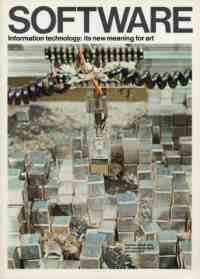
Like the famous cumulative story to which my title refers, this paper explores the complex, interrelated convergence of myriad elements in the exhibition Software, Information Technology: Its New Meaning for Art. Art historian Jack Burnham curated the show in 1970 at the Jewish Museum, then one of the premier venues for experimental art in New York. My research identifies how this "house that Jack built" was constructed of, and drew parallels between, computer information technology, conceptual art practice, and structuralist art theory, and was predicated on the idea of software as a metaphor for art. Software was designed to function, moreover, as a testing ground for public interaction with "information processing systems and their devices."[1] Many of the displays were indeed interactive and based on two-way communication between the viewer and the exhibit. In this and other respects, I interpret much of the work in Softwareas heralding postmodernist strategies for art-making. Finally, as will be discussed below, the architecture for the physical installation in the museum was based on the two-tiered model of Marcel Duchamp's Large Glass, which Burnham interpreted as a signpost announcing the demise of art as "a separate facet of life."[2]

Jack Burnham's first book, Beyond Modern Sculpture: The Effects of Science and Technology on the Sculpture of Our Time, 1968, established him as the pre-eminent champion of art and technology of his generation. Building on this foundation, his second book, The Structure of Art, 1971, developed one of the first systematic methods for applying structural analysis to the interpretation of individual artworks as well as to the canon of western art history itself. Many of his articles for Arts magazine from 1968-70, where he was Associate Editor (1972-76) and Artforum from 1971-3, where he was Contributing Editor (1971-2), were collected in his third book, The Great Western Salt Works, 1973. These essays still remain amongst the most insightful commentaries on conceptual art, already suggesting what he now sees in retrospect as the "great hiatus between standard modernism and postmodernism."[3]

In 1970, at the invitation of Jewish Museum director, Karl Katz, Burnham curated Software, the only major show he has curated to date. In contrast to the numerous art and technology exhibitions which took place between 1966-1972, and which focused on the aesthetic applications of technological apparatus, Software was predicated on the ideas of "software" and "information technology" as metaphors for art. He conceived of "software" as parallel to the aesthetic principles, concepts, or programs that underlie the formal embodiment of the actual art objects, which in turn parallel "hardware." In this regard, he interpreted "Post-Formalist Art" (his term referring to experimental art practices including performance, interactive art, and especially conceptual art) as predominantly concerned with the software aspect of aesthetic production.

It is significant that Burnham organized Software while writing The Structure of Art and conceived of the show, in part, as a concrete realization of his structuralist art theories. Drawing on Claude Levi-Strauss's idea that cultural institutions are mythic structures that emerge differentially from universal principles, Burnham theorized that western art constituted a mythic structure. And he theorized that the primary project of conceptual art was to question and lay bare the mythic structure of art, demystifying art and revealing it for what its internal logic.[4]

Such ideas were already present in Burnham's 1970 article "Alice's Head." True to the title, he began the essay - which focused on the work of conceptual artists Joseph Kosuth, Douglas Huebler, Robert Barry, Lawrence Wiener, and Les Levine - with the following quote from Lewis Carroll's Alice in Wonderland:

"...'Well! I've often seen a cat without a grin,' thought Alice, 'but a grin without a cat! It's the most curious thing I ever saw in all my life!'"[5]
By selecting for his preamble Alice's curiosity over a disembodied presence, Burnham suggested that, like a grin without a cat, a work of conceptual art is all but devoid of the material trappings of paint or marble traditionally associated with art objects. Similarly, he explained Software as "an attempt to produce aesthetic sensations without the intervening 'object;' in fact, to exacerbate the conflict or sense of aesthetic tension by placing works in mundane, non-art formats."[6]

Burnham directly interacted with computer software when he was a Fellow at the Center for Advanced Visual Studies under Gyorgy Kepes at MIT during the 1968-9 academic year. Having received his MFA from Yale in 1961, he was invited, as an artist, "to learn to use the time- sharing computer system at MIT's Lincoln Laboratories." In a paper entitled "The Aesthetics of Intelligent Systems" delivered at the Guggenheim Museum in 1969, Burnham discussed this experience of working with computers, comparing the brain and the computer as information processing systems, and drawing further parallels between information processing and conceptual art. He stated, moreover, that "the aesthetic implications of a technology become manifest only when it becomes pervasively, if not subconsciously, present in the life-style of a culture," and claimed that "present social circumstances point in that direction."[7]

As Burnham explained in the paper, given the artistic limits of the computer system at his disposal, he focused on the "challenge of ... discovering a program's memory, interactive ability, and logic functions," and on " gradually... conceptualiz[ing] an entirely abstract model of the program." In this regard, he was especially interested in how "a dialogue evolves between the participants - the computer program and the human subject - so that both move beyond their original state." Clearly he recognized how his interaction with software altered his own consciousness, which in turn simultaneously altered the program. Finally, he drew a parallel between this sort of two-way communication, and the "eventual two-way communication in art." In 1969, he wrote,

The computer's most profound aesthetic implication is that we are being forced to dismiss the classical view of art and reality which insists that man stand outside of reality in order to observe it, and, in art, requires the presence of the picture frame and the sculpture pedestal. The notion that art can be separated from its everyday environment is a cultural fixation [in other words, a mythic structure] as is the ideal of objectivity in science. It may be that the computer will negate the need for such an illusion by fusing both observer and observed, "inside" and "outside." It has already been observed that the everyday world is rapidly assuming identity with the condition of art.[8]
The metaphorical premise of Software permitted Burnham to explore convergences between his notion of the mythic structure of art, emerging information technology, and the increasing conceptualism characteristic of much experimental art in the late 1960's. These components were conjoined in works that emulated the sort of two-way communication he experienced with computer programs and which he advocated in art. The catalog emphasized the importance of creating a context in which "the public can personally respond to programmatic situations structured by artists," and explicitly stated that the show "makes no distinctions between art and non-art."

Burnham was careful to select works of art that demonstrated his theories. I contend that many of these works anticipated and participated in important trends in subsequent intellectual and cultural history. In this sense they contributed to the transformation of consciousness. Quoting McLuhan, Burnham identified this shift from the "isolation and domination of society by the visual sense" defined and limited by one-point perspective, to a way of thinking about the world based on the interactive feedback of information amongst systems and their components in global fields, in which there is "no logical separation between the mind of the perceiver and the environment."[10]

For example, in the hypertext system, "Labyrinth," a collaboration between Xanadu creator Ted Nelson and programmer Ned Woodman, users could obtain information from an "interactive catalog" of the exhibition by choosing their own narrative paths through an interlinked database of texts, then receive a print-out of their particular "user history." The self-constructed, non-linear unfolding of Labyrinth shares affinities with structuralist critiques of authorship, narrative structure, and "writerly" (as opposed to "readerly") texts, made by Barthes. Needless to say, with the advent of powerful Internet browsers like Netscape, and the proliferation of CD-ROM technology, the decentered and decentering quality of hypertext has become the subject (and method) of a growing critical post-structuralist literature, and arguably a central icon of postmodernity. It should be noted that this first public exhibition of a hypertext system occurred, and this was perhaps not just a coincidence, in the context of experimental art.

Hans Haacke's "Visitor's Profile" encouraged visitors to interact with a computer by inputting personal information, which was then tabulated to output statistical data on the exhibition's audience. Such demographic research - as art - opened up a critical discourse, following Foucault and others, on the exclusivity of cultural institutions and their patrons, revealing the myth of public service as a thin veneer justifying the hierarchical values that reify extant social relations. Similarly, "Interactive Paper Systems" by Sonia Sheridan, engaged museum- goers in a creative exchange with the artist and 3M's first commercially available color photocopying machine, dissolving conventional artist-viewer-object relations. In "The Seventh Investigation (Art as Idea as Idea)" Joseph Kosuth utilized multiple forms of mass media and distribution (a billboard, an newspaper advertisement, a banner, and a museum installation) to question the conceptual and contextual boundaries between art, philosophy, commerce, pictures, and texts.

In works such as these, the relationship Burnham intuited between experimental art practices and "art and technology" problematized conventional distinctions between them, and offered important insights into the complementarity of conventional, experimental, and electronic media in the emerging cultural paradigm later theorized as postmodernity. In this regard, Levi- Strauss's models from structural anthropology, along with Thomas Kuhn's critique of the history of science, led Burnham to question what he saw as the structural foundations of art history's narrative of progressive and discrete movements, a critique he elaborated in The Structure of Art.

As a final example, Nicholas Negroponte and the Architecture Machine Group (precursor to the MIT Media Lab, which Negroponte now directs) submitted "Seek," a computer-controlled robotic environment that, at least in theory, cybernetically reconfigured itself in response to the behavior of the gerbils that inhabited it. I interpret Seek as an early example of "intelligent architecture," a growing concern of the design community internationally.[11] By synthesizing cybernetics, aesthetics, phenomenology, and semiotics, Software emphasized the process of audience interaction with "control and communication techniques," encouraging the "public" to "personally respond" and ascribe meaning to experience. In so doing, Software questioned the intrinsic significance of objects and implied that meaning emerges from perception in what Burnham (quoting Barthes) later identified as "syntagmatic" and "systematic" contexts.[12]

A further abiding metaphor in Burnham's concept for Software was Marcel Duchamp's Large Glass, 1915-22, which served as an architectural model for the actual installation. Burnham described the relationship of Software to Duchamp's magnum opus in a 1970 interview with Willoughby Sharp. Iconographically, he explained, the Large Glass,

has a lot of machines in the lower section - scissors, grinders, gliders, etc... it represents the patriarchal element, the elements of reason, progress, male dominance. The top of [it] is the female component: intuition, love, internal consistency, art, beauty, and myth itself.[13]
Burnham claimed that "Duchamp was trying to establish that artists, in their lust to produce art, to ravish art, are going to slowly undress [it] until there's nothing left, and then art is over."

He then went on to reveal Software's organizational logic:

As a kind of personal joke... I tried to recreate the same relationships in Software. I've produced two floors of computers and experiments. Then upstairs on the third floor, conceptual art with Burgy, Huebler, Kosuth, and others, which to my mind represents the last intelligent gasp of the art impulse.
Burnham's point, following his interpretation of Duchamp, was not that art was dead, or dying, or about to dissolve into nothingness. Rather, he believed that art was "dissolving into comprehension." He claimed that conceptual art was playing an important role in that process, by "feeding off the logical structure of art itself..., taking a piece of information and reproducing it as both a signified and a signifier." In other words, such work explicitly identified the signifying codes which define the mythic structure of art. Instead of simply obeying or transgressing those codes, it appropriated them as motifs, as signifiers, thereby demystifying the protocols by which meaning and value have conventionally been produced in art.

In this regard, Burnham became very critical of the role of emerging technology in art.[14] Having lost faith in its ability to contribute in a meaningful way to the signifying system that he believed to mediate the mythic structure of western art, in Software he purposely joined the nearly absent forms of conceptual art with the mechanical forms of technological non-art to "exacerbate the conflict or sense of aesthetic tension" between them.[15] Given his interpretation of Duchamp, such a gesture also can be seen as an attempt to deconstruct the categorical oppositions of art and non-art by revealing their semiotic similarity as information processing systems.

I would be remiss if I did not mention that in many respects Software was a disaster. The DEC PDP-8 Time Share Computer that controlled many of the works did not function for the first month of the exhibition due to problems with, ironically enough, the software. The gerbils in SEEK attacked each other, a film was destroyed by its editors, and several aspects of the exhibition - including the catalog - were censored by the Board of Trustees of the museum. The show went greatly over budget which put the Jewish Museum in a precarious position financially. The Jewish Theological Seminary bailed it out, but dictated a radical shift in the museum's mission, which precipitated Karl Katz's dismissal as its director and its demise as a leading exhibition space for experimental art. The show was scheduled to travel to the Smithsonian Institution, but that venue was canceled.Ý Many other controversies plagued Burnhamís ill-fated exhibition.[16] Nonetheless, Software remains the most conceptually and - when it worked - technologically sophisticated art and technology of the period.

Software was founded on a structuralist analysis of art in which unfolding of the history of western art evolved exclusively by a process of demythification.Ý Technology in art, for Burnham, was meaningful only to the extent it contributed to stripping away signifiers to reveal the mythic structure of art.Ý Perhaps we a getting close to a moment in which the deconstruction of artís mythic structure is approaching completion.Ý And perhaps information technology has become, as Burnhamís own theory demanded, "pervasively, if not subconsciously present in the lifestyle of [our] culture," such that its aesthetic implications are sufficiently manifest to play a constructive role in proposing new artistic paradigms.Ý The problem now confronting artists and curators involved with technology is not so much getting the machines andsoftware to work, but living up to the conceptual richness of the house that Jack built.
Ý

Notes:

[1] Burnham, J. 1970. Notes on Art and Information Processing. In Software Information Technology: Its New Meaning for Art. New York: Jewish Museum, p. 10
[2] Burnham, J. 1972. Duchamp's Bride Stripped Bare: The Meaning of the Large Glass. In Jack Burnham, Great Western Salt Works: Essays on the Meaning of Post-Formalist Art, (New York: George Braziller, 1973):Ý 116.
[3] Burnham, J. 1998.Ý Personal correspondence with the author, April 23.
[4] Burnham, J. 1973.Ý The Structure of Art.Ý New York:Ý George Braziller.
[5] Burnham J. 1973.Ý Alice's Head in Great Western Salt Works, p.Ý47.
[6] Burnham, J. 1998. Personal correspondence with the author, April 23
[7] Burnham, J. 1969. The Aesthetics of Intelligent Systems. In Fry, E. F. ed. 1970. On the Future of Art. New York: The Viking Press, p. 119. The three subsequent quotes come from same page. The "present social circumstances" to which Burnham refers here can only be the increasing pervasiveness of computer information-processing systems, which he described in the Software catalog as "the fastest growing area in this culture."
[8] Ibid, p. 103
[9] Burnham, 1970. Notes on Art and Information Processing, p. 10
[10] Burnham, 1970. Alice's Head, p. 47.
[11] See, Gerbel K. and Weibel P. eds. 1994. Intelligente Ambiente (Ars Electronica 994 catalogue). Vienna: PVS Verleger.
[12] Burnham, 1971. The Structure of Art, pp. 19-27.
[13] Sharp, W. 1970. Willoughby Sharp Interviews Jack Burnham. In Arts 45:2 (November) p. 23. All subsequent quotations are from this page.
[14] While Burnhamís loss of faith in art and technology can already be seen in his 1969 article "The Aesthetics of Intelligent Systems," op cit., his most explicit and antagonistic pronouncement against it is in Jack Burnham, "Art and Technology:Ý The Panacea that Failed" in Myths of Information:Ý Technology and Postindustrial Culture, Kathleen Woodward, ed., (Madison:Ý Coda Press, 1980); reprinted in Video Culture, John Hanhardt, ed. (New York: Visual Studies Workshop Press, 1986):Ý 232-48.
[15] Burnham, J. 1998. Personal correspondence with the author, April 23
[16] Shanken, E., 1998.Ý "Gemini Rising, Moon in Apollo:Ý Art and Technology in the US, 1966-71," in ISEA97:Ý Proceedings of the Seventh International Symposium on Electronic Art.Chicago:Ý ISEA97, 1998.

© Edward A. Shanken

Edward A. Shanken,
Department of Art & Art History,Duke University,
Email: giftwrap@duke.edu

2008-07-14

>> äda'web

http://adaweb.com/

2008-07-09

>> Georg Nees


Jasia Reichardt in "The Computer in Art", 1971:
"Georg Nees, one of the first exponents in the field, has made graphics based on random parameters, developing one or two themes with great ingenuity and using repetition as his subject."


to the work shown here:
"

Schotter by George Nees

This work by Nees is a portrait-format graphic assembled from twelve sets of twenty-two squares, each set having the same length along the sides. Read from left to right, as one would read a European language, it shows disorder that increases from top to bottom as one views the graphic. The visible defines the order, which is not the same as the order of the pictures, but an optimal state in which the squares lie along a horizontal line, forming a row in which each one is set precisely beside the next one, so that straight lines are formed by the upper and lower edges. This state is not seen in the picture as illustrated here. Row by row, the state of disorder successively increases down to the lower border of the picture. The program creates disorder through the rotation of each square at the point of intersection of its diagonal, and also through the increasing distortion in the graphic space.

[...]

"Image 38, Schotter, is produced by invoking the SERIE procedure [...]. The non-parametric procedure QUAD serves to generate the elementary figure which is reproduced multiple times in the composition process controlled by SERIE. QUAD is located in lines 4 through 15 of the generator. This procedure draws squares with sides of constant length but at random locations and different angles. From lines 9 and 10, it can be seen that the position of a single square is influenced by random generator J1, and the angle placement by J2. The successively increasing variation between the relative coordinates P and Q, and the angle position PSI of a given square, is controlled by the counter index I, which is invoked by each call from QUAD (see line 14)."

Schotter code

(from: http://www.chart.ac.uk/chart2004/papers/weiss.html)


"On the occasion of Georg Nees’s 80th birthday, the ZKM continues its series on early computer art, inaugurated by an exhibition of the works of Frieder Nake, with this co-operative exhibition organized in 2005 by the Bremen Kunsthalle. Along with Herbert Franke and Frieder Nake, Nees is looked upon as one of the pioneers of computer art. In 1959, he began to program digital computers. In 1965, he procured for his department at Siemens a table-sized, punched tape-operated drawing automaton constructed by Konrad Zuse, the »Zuse-Graphomat«, which could move a descendible drawing pencil in two right-angled axes over a page of drawing paper. Nees recalls: »There it was, the great temptation for me, for once not to represent something technical with this machine but rather something ‘useless’ – geometrical patterns«. Together with Nake, Nees organized in Stuttgart the first exhibition of computer drawings and described these expressly as »computer art«. At a time when the computer was used exclusively for military and scientific purposes, Nees succeeded in transferring algorithmic thought to art. His independent drawings are accordingly based on the programming language ALGOL and the Siemens computer system 2002 in combination with the »Zuse-Graphomat«.
In 1968, he was one of the first to submit to Max Bense, the Stuttgart aesthetic theorist of information, with a work on the aesthetic categories of computer graphics, entitled »Generative Computer Graphics«." (http://on1.zkm.de/zkm/stories/storyReader$5255)

>> Bela Julesz

Jasia Reichardt in "The Computer in Art", 1971:

"Activities in the field of computer graphics at Bell Telephone Laboratories also include Bela Julesz's experiments with texture and visual perception, in which he used the techniques employed in the random generation of patterns. Ranom-dot patterns generated by computers have shown that the recognition of familiar shapes is not needed for the discrimination of textures, or even for the binocular perception of depth. Julesz used random fields of coloured dots. He discovered that texture discrimination is highly dependent on the way component colours are paired, which, for instance, red and yellow giving a higher degree of discrimination than blue and yellow or blue and green. The objective was to determine those pattern properties that make it impossible to distinguish immediately two adjacent displays. He found that it is the statistical properties of patterns that allow for spontaneous discrimination. This is independent of vrightness distribution but relies on the isolation of darker clusters hich could be said to form certain patterns. Using stereo pairs, Julesz found that one can perceive camouflaged objects with binocular vision which are invisible in a two-dimensional representation."

>> article: "TV as a creative Medium. Howard Wise and Video Art", Marita Sturken, 1984

Read this document on Scribd: AfterImageMay84(1004)


from: www.vasulka.org/archive/4-30c/AfterImageMay84(1004).rtf

2008-07-07

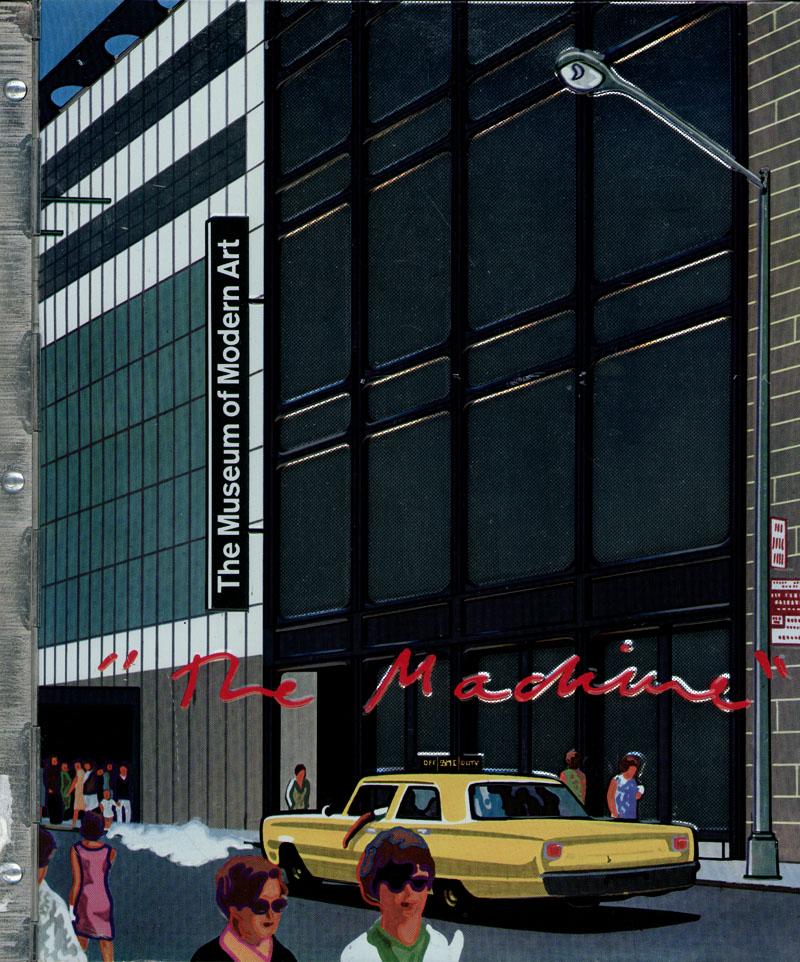
>> exhibition: The Machine as Seen at the end of the Mechanical Age, MoMa, 1968

curated by K.G. Pontus Hultén, November 1968 - February 9, 1969


put these in correct posts: Cybernetic Serendipity (ICA, curated by Jasia Reichardt, 1968); The Machine as Seen at the End of the Mechanical Age (MOMA, curated by K.G. Pontus Hulten, 1968); Software, Information Technology: Its Meaning for Art (Jewish Museum, New York, curated by Jack Burnham, 1970); Information (MOMA, curated by Kynaston McShine, 1970); and Art and Technology (LACMA, curated by Maurice Tuchman, 1970).

"Hulten remarks: "technology
today is undergoing a critical transition. . . . the mechanical
machine - which can most easily be defined as an imitation of our
muscles - is losing its dominating position among the tools of
mankind; while electronic and chemical devices - which imitate
the processes of the brain and the nervous system - are becoming increasingly important" (page 3).

[...] His (Hultén's) preferences include, in my opinion, the Dadaists, the Constructivists,
Charlie Chaplin and Jean Tinguely. This somewhat disparate collection of artists appears to be united - in Hulten's view - by their desire to dominate the mechanical world, to establish
better relations with machines so that a greater measure of humor, harmony and humanity might reign in our irrevocable marriage with technology.

[...] "The decisions that will shape our society in the future will have to be arrived at, developed, and carried out through technology. But they must be based on the same criteria of respect and appreciation for human capacities, freedom, and responsibility that prevail in art" (page I3).
"In planning for such a world, and in helping to bring it into being, artists are more important than politicians, and even than technicians" (page i).

[...] Nonetheless, he (Hultén) uses these symbols, and the application of "car" to Bugatti's La Royale (page I42), Fuller's Dymaxion Car (page I43) and Farhner's Boot Hill Express (page I8o) implies a simple distinction between "art" and "machine."

(from: William A. Camfield, The Machine as Seen at the End of the Mechanical Age by K. G. Pontus Hultén (review), The Art Bulletin, Vol. 53, No. 2, (Jun., 1971), pp. 275-277
Published by: College Art Association, Stable URL: http://www.jstor.org/stable/3048856)

>> exhibition: "Computer-Generated Pictures", 1965

First exhibition of computer generated art,
1965 at the Howard Wise Galleries in New York.
artists: Bela Julesz and A. Michael Noll (both from Bell Labs)

2008-07-01

>> poème electronique, Le Corbusier, Varese, Xenakis, World Fair 1958

>> It's important that you attend

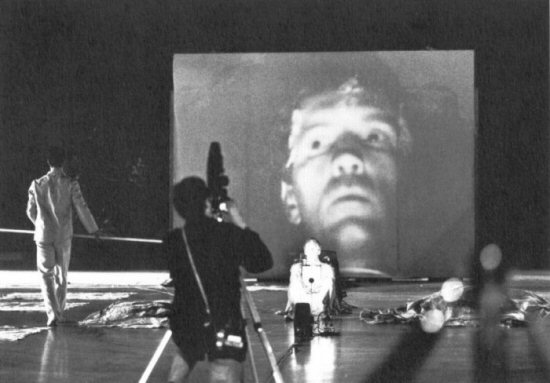
The advertising flyer for 9 Evenings presented the event as follows: "You will hear the body broadcast its sounds. You will see without light. You will witness a deaf-mute interview. You will see dancers floating on air. Those of the audience who are willing will become more than spectators. You too can actually float. It's art and engineering and a little theatrics. It's important that you attend." (1) This emphasizes viewer participation, a common enough practice within the context of happenings, and the unusual — or a priori impossible — character of the proposed experiences. The alliance of art and technology would make it possible to upset perceptual codes, as if technology fostered an extension of viewers' ordinary sensory apparatus and enhanced their perception. The performances presented novel situations in the form of experiments in which viewers were invited to take part: infrared cameras revealed the presence of a crowd of 500 people in total darkness (Open Score); the audience heard, amplified, sounds emitted by the muscles and the brain (Grass Field), or sounds considered inaudible (Variations VII); visual and audio sources were simultaneously multiplied (Two Holes of Water — 3); viewers were plunged into a labyrinth of transparent polyethylene (Physical Things), and so on. Speakers placed at selected points throughout the space of the stage and auditorium reinforced the viewer's feeling of immersion, and destabilized the frontal viewpoint instituted by the stage and its equipment. 9 Evenings constituted an example of "environmental theatre," as defined by Michael Kirby, a critic who took part in Rainer's performance: "It is only when the presentational field and/or performance elements move around, over, or under the spectator that we may call the performance 'environmental'." (2) This concept of environment was hardly foreign to 9 Evenings, since the TEEM system was based on it.

Another critic of the time, Richard Kostelanetz, was of the opinion that 9 Evenings belonged to what he called the "theatre of mixed means." This type of theatre does without a script, combines elements like music, dance, film, lighting, sculpture, and painting, and incorporates "new technologies."

On several occasions, Kostelanetz underscored the change in perception implied by this type of theatre: "Each piece demands of the spectator an actively engaged and highly personal perception." Further on, he says, "It employs various media of communication to create a field of activity that appeals to the total sensorium." (3) The importance attributed to perception, then, put the body back at the centre of the debate. Technology did not therefore dispense with the body, but suggested another approach to it, incorporating it into each of the 10 performances. There was, for example, Fahlström's robot body, machine body and marionnette, Alex Hay's enhanced body, Childs' and Rauschenberg's moving body in a dialogue with its environment, Paxton's immersed body, Whitman's deformed and fragmented body, Yvonne Rainer's and Deborah Hay's "remote-controlled" body, and Tudor's and Cage's body grappling with machines.

Whether visible or not, the various interfaces designed for the performers in 9 Evenings made the body into a sort of bridge between the stage and the technological environment. It is in this sense that we can use the expressions "interfaced actor" or "subjectile" to describe the body of the actor confronted with such interfaces. The Latin root of subjectile, subjectus, designates the surface that serves as a support. My line of thinking here derives from a text by Jacques Derrida, "Forcener le subjectile," (4) which deals with drawings by Antonin Artaud and the texts that accompany them. On several occasions, Artaud uses the term "subjectile" to designate the paper on which he draws, pointing out, among other things, that it betrays him. Taking Artaud's use of this term as his point of departure, Derrida wonders about the element of the subject that remains in the subjectile. The bridge that gets constructed between subjectus and subjectum, or subjectile and subject, seems to me to be a good way of designating the interfaced body, ambiguous, grappling with machines, like some operator who is alternately of a piece with and distinct from the object he or she operates.

In short, these concerns with the body and perception converge in a crucial way with those of the engineers and industrialists of the period, who were interested in the kind of changes in the user's perception produced by the new technologies developed in the 1950s and 1960s. Indeed, studies of perception were at the heart of the research then being conducted at the Bell Laboratories, whether it dealt with sound or with analog or digital imagery. 9 Evenings made it possible to indirectly explore certain aspects of these questions.

C.B. © 2006 FDL

>> E.A.T. - 9 evenings

this article consists of parts copied from the DLF-website and needs to be shortened!

Collection of Documents Published by E.A.T.
Lectures-Demonstration Series (1968-1969)
In conjunction with the Technical Service Program, E.A.T. organized 30 conferences given by scientists from specialized research labs and private companies including the Massachusetts Institute of Technology (Cambridge, Massachusetts, U.S.), Eastman-Kodak (Rochester, New York, U.S.) and Columbia University (New York, U.S.). Intended for artists wishing to exploit new technologies in their work, these conferences revolved around such topics as lasers, holography, and computer-generated images and sounds.


Collection of Documents Published by E.A.T.
This collection features over 500 documents that explore the activities of Experiments in Art and Technology (E.A.T.) from 1965 to 1981. Included are reports, project descriptions, technical drawings, correspondence, invitations, exhibition catalogues, periodicals, reprints of articles, and photocopies of press clippings.

Founded in 1966 by Billy Klüver, Fred Waldhauer, Robert Rauschenberg and Robert Whitman, E.A.T. was a non-profit group active primarily from the 1960s to the 1980s. Its aim: to mobilize the arts, industry and science around projects that involved participants from each field. E.A.T. promoted interdisciplinary collaborations through a program pairing artists and engineers. It also encouraged research into new means of expression at the crossroads of art and such emerging technologies as computer-generated images and sounds, video, synthetic materials and robotics. To complement these projects combining the talents of artists and engineers, E.A.T. organized educational activities to acquaint the public with telecommunication technologies like telewriting and satellite transmission. Other projects emulating international aid programs were devised to give developing countries access to community media. As of the mid-1970s, E.A.T. began opening chapters in the United States, Canada and Japan.

This collection, which Billy Klüver put together in 1981 to preserve E.A.T.'s heritage, is part of a limited edition of similar documentation collections accessible to researchers in documentation centres and specialized libraries in the United States, Canada and Australia. The E.A.T. archives are kept at the Getty Research Institute (Los Angeles, California). (1)

Vincent Bonin © 2002 FDL

(1) To browse through the inventory of E.A.T. archives, see "Inventory of the Experiments in Art and Technology Records, 1966-1993" , The Getty, Los Angeles, Getty Research Institute, 1996, (accessed April 23, 2002): http://www.getty.edu/research/tools/special_collections/eat.html


In 1965, with help from Robert Rauschenberg, Billy Klüver sought the expertise of engineers at Bell Laboratories (Murray Hills, New Jersey, U.S.) to participate in an interdisciplinary project blending avant-garde theatre, dance and new technologies. For the project, 10 artists (John Cage, Lucinda Childs, Öyvind Fahlström, Alex Hay, Deborah Hay, Steve Paxton, Yvonne Rainer, Robert Rauschenberg, David Tudor and Robert Whitman) each created an original performance. They were then paired with the engineers, who helped produce the technical components used on stage by the participants (dancers, actors, musicians). "9 Evenings: Theatre and Engineering" was to be presented as part of the Stockholm Festival of Art and Technology in 1966. But when the festival's American program was cancelled, Billy Klüver moved the event to the 69th Regiment Armory (New York), where it ran from October 13 to 23, 1966.


This program, which was founded in 1966, enabled artists to carry out highly technological projects in close collaboration with a scientist or engineer. E.A.T. first enlisted specialists from different scientific fields who could meet the artists' technical needs. Among these specialists: engineers from Bell Laboratories (Murray Hills, New Jersey, U.S.) and IBM Labs (Armonk, New York, U.S.). E.A.T. paired the artists and engineers, who became joint members of the group. Yet E.A.T. didn't intervene in the project's design and development stages. To complement this partnership service, the group published a newsletter, E.A.T. News, that spotlighted ongoing and completed projects. As well, E.A.T. offered rental equipment and organized forums on such emerging technologies as holography, lasers and computer-generated imagery. In the late '70s and '80s, E.A.T paired engineers and artists, however, the Technical Service Program came to an end in 1973.


Collection of Documents Published by E.A.T.
Technical Information (1966)
In conjunction with the Technical Service Program, E.A.T. formed a consulting service for artists. The service included a program for developing documentation resources in science and engineering (Technical Libraries) in New York City. Another feature of the service was a telephone assistance line run by engineers from E.A.T. offices.


In 1966, Billy Klüver — an engineer and organizer of the event — asked Austrian artist Alfons Schilling to film the nine evenings. Schilling used an Arriflex camera and a considerable amount of 16 mm film. In the end, almost five hours of footage (approximately 10 reels) were filmed. In the absence of a synchronized sound track, Thelma Schoonmacher and a number of engineers from Bell Telephone Laboratories (Murray Hills, N.J., U.S.) recorded the sound on magnetic tape. The five sound reels contained in this series are the original recordings of Variations VII by John Cage.

The factual footage was not Schilling's only objective, for above all, he hoped to collect enough material from the performances to produce a documentary on the entire event. At the request of Billy Klüver, who wanted to broadcast the work on television, Schilling was obliged to trim down his initial project. The film, entitled 9 Evenings: Theatre and Engineering (24 minutes), produced a few months after the event, contained a fraction of the filmed footage as well as excerpts from sound recordings. In addition, footage of the performances by Lucinda Childs, Robert Rauschenberg and David Tudor, shot in 35 mm film by unknown camera operators, can be found in this series. The series also includes a selection of props and technical components used on stage, interviews with the artists and engineers who participated (plus transcripts), recorded by Alfons Schilling in 1966, and notes and technical drawings/sketches by engineer Fred Waldhauer.

http://www.fondation-langlois.org/html/e/selection.php?Selection=9EVO
http://www.fondation-langlois.org/html/e/selection.php?Selection=9EVB

Clarisse Bardiot's essay on 9 Evenings: http://www.fondation-langlois.org/html/e/page.php?NumPage=572


9 Evenings: Theatre and Engineering fonds

1966-2005. — 24 film reels, 71 videocassettes, 5 sound reels, 8 props/technical components, 3 cm of textual documents.

In 1965, with the help of Robert Rauschenberg, Billy Klüver sought the expertise of some 30 engineers at Bell Laboratories (Murray Hills, N.J., U.S.), requesting that they participate in an interdisciplinary project blending avant-garde theatre, dance and new technologies. For the project, artists John Cage, Lucinda Childs, Öyvind Fahlström, Alex Hay, Deborah Hay, Steve Paxton, Yvonne Rainer, Robert Rauschenberg, David Tudor and Robert Whitman each created an original performance. The artists were paired with the engineers, and together they produced the technical components used on stage by the participants (dancers, actors, musicians). The event was originally intended to be presented as part of the Stockholm Festival of Art and Technology in 1966. But when the festival's American program was cancelled, Billy Klüver moved the event to the 69th Regiment Armory (New York, N.Y., U.S.), where it ran as 9 Evenings: Theatre and Engineering from October 13 to 23, 1966.

Custodial history:

Following 9 Evenings, Billy Klüver, Simone Forti (then Simone Whitman), Alfons Schilling and many other participants collected the documentary materials associated with the 10 performances: technical diagrams and sketches, choreographic scores, factual footage, sound recordings, props, technical components, etc. While certain artists chose to retain their own materials for their personal archives, Billy Klüver and Julie Martin kept most 9 Evenings materials until being deposited at the Getty Research Institute (Los Angeles, California, U.S.) in 1994 and the Daniel Langlois Foundation in 2001. Intellectual and physical processing of the fonds was conducted between 2002 and 2006.

Scope and content:

The fonds consists mainly of original factual footage (16 mm and 35 mm film) of the nine evenings as well as some audio recordings on magnetic tape. These materials can be found in the series: Documents associated with the performances presented as part of 9 Evenings: Theatre and Engineering (1966-1967). The fonds also include production materials and master video tapes of documentary films produced beginning in 1996 by Experiments in Art and Technology (Billy Klüver and Julie Martin) under the direction of Barbro Schultz Lundestam. These materials can be found in the series: Documentaries on 9 Evenings: Theatre and Engineering (1995-).

Notes:

Title proper. — English documents. — The fonds consists of originals and reproductions. — Certain restrictions with respect to consultation apply. — The reproduction and publication of archival materials are subject to directives adopted by the CR+D with respect to the protection of intellectual property and privacy. — The complete press review for 9 Evenings: Theatre and Engineering can be found in the Collection of Documents Published by Experiments in Art and Technology (E.A.T.), Daniel Langlois Foundation (Montreal, Canada). Also available in this finding aid: 9 Evenings: Theatre and Engineering Press Review. — Materials related to the event are also housed by the following institutions: Getty Research Institute, Research Library (Los Angeles, California, U.S.); New York Public Library (New York, N.Y., U.S.); and Archiv Sohm (Stuttgart, Germany). — More instalments are expected.

Vincent Bonin © 2006 FDL


“Information presented at the right time and in the right place can potentially be very powerful. It can affect the general social fabric... The working premise is to think in terms of systems: the production of systems, the interference with and the exposure of existing systems... Systems can be physical, biological or social.” (1)

And one might add... technological!

When engineers Billy Klüver and Fred Waldhauer and artists Robert Rauschenberg and Robert Whitman founded Experiments in Art and Technology (EAT) in 1966, they had just emerged from 9 Evenings: Theatre and Engineering, a series of performances held at the 69th Regiment Armory in New York City, where, it is said, ten thousand people attended.
(2) Although the performances received mixed reviews, the foursome didn't want the endeavour to end there. Their wish was to pursue the collaboration beyond the “event” to enable artists to make use of devices and advice that would have been beyond their reach without this type of joint venture.

What started all of this, beyond his friendship to countryman, curator and museum director Pontus Hulten, was Billy Klüver's collaboration with Jean Tinguely on his self-destructing machine Homage to New York, presented in the Museum of Modern Art's garden in New York on March 17, 1960. While working on Homage, Tinguely introduced Klüver to Robert Rauschenberg, who had agreed to participate in the edification of this suicidal installation with a work of his own entitled the Money Thrower, a box filled with gunpowder and twelve silver dollars, which exploded at one point in the process, sending the coins haywire into the garden.
(3) Klüver subsequently collaborated with Rauschenberg on many of his works (Oracle, 1965; Soundings, 1968; Solstice, 1968; etc.) as well as with other artists, such as Jasper Johns (Field Painting, 1962; Zone, 1965), dancer Yvonne Rainer (At My Body's House, 1964), Andy Warhol (Silver Clouds, 1965-1966), composer John Cage and choreographer Merce Cunningham (Variations V, 1965), and many others.

While 9 Evenings was judged by many as a forced marriage between artists and engineers, the event became a fertile ground for the invention of a number of technological tools never before used in theatrical or live performance environments or for that matter in the commercial arena. These devices included, for example, sound captors concealed in the tennis racquets' handles, in Rauschenberg's performance Open Score, that eventually led to the invention of the wireless microphone. The TEEM (Theatrical Electronic Environmental Module), a remote and proportional control system designed to control and relay movement, sound and light effects in all of the performances, was another machine created solely for 9 Evenings.
(4)

Above all, EAT became a tentacular service organization, whose mission was to facilitate the work of artists in any field or discipline. Klüver's wish was to find “new means of expressions for artists... and to find out where they stood in relation to the society that was sending men to the moon.”
(5) EAT triggered the creation of many “chapters” across the US, Canada, Japan, France, England and India. Each one of these chapters produced an array of events, activities, newsletters and match-ups between artists and industry. And it all happened before globalization had become a buzzword.

So what happened? Why did a pregnant silence prevail around this apparently revolutionary organization that had helped create work for so many artistic icons through thought provoking interactions between artists and scientists?

Although several essays and articles were published about the events produced by EAT at the moment they took place, only a small number of anthologies on art and technology mention EAT, and these amount to a few succinct sentences that largely contain the same information. The most exhaustive works written on EAT were, among others, Pavilion, a book written by Billy Klüver in collaboration with art critic Barbara Rose and other contributors on the trials and tribulations and the making of the Pepsi Pavilion at the 1970 Osaka Universal Exhibition, as well as a descriptive doctoral dissertation by Norma Loewen on EAT's activities in 1975.
(6) And while articles by Billy Klüver from the '60s and '70s have lately been reissued in a small number of publications, (7) and more recent texts by Klüver with Julie Martin have been edited in various books, catalogues or magazines, (8) not one comprehensive and contextual analysis of this phenomenon was ever undertaken, either in assessments dedicated to the art of the '60s and '70s or in a volume of its own. (9)

In the review of literature, I found factual inaccuracies that attribute, for example, links between EAT and the Art & Technology Program created by Maurice Tuchman at the Los Angeles County Museum of Art (LACMA) in 1967. Some consider EAT as a branch of LACMA's A&T program, while others assert that 9 Evenings was presented under EAT's umbrella, when to the contrary, the creation of EAT was a direct upshot of 9 Evenings. In fact, pour la petite histoire, the evening EAT was founded was dubbed “the 10th Evening” by Fred Waldhauer. But by far, the most notorious blunder stated: “In 1968 EAT created an exhibition at the Brooklyn Museum of Art and at the MoMA, called Some New Beginnings
(10) (...) And the same year the MoMA presented The Machine as Seen at the End of the Mechanical Age. The most interesting and spectacular machine was without doubt Homage to New York by Jean Tinguely.” (11) This is most disconcerting indeed, bearing in mind that it is known and documented that The MachineSome More Beginnings shown concurrently at the BMA. The latter was a showcase for all of the artist/engineer team projects entered in a contest launched by EAT and whose top ten contestants were exhibited in the Machine. Needless to say, it is unnecessary to comment on Tinguely's supposed participation in any of these exhibitions. was shown at the MoMA, with

(1) Jeanne Siegel, “An Interview with Hans Haacke,” Arts Magazine 45, no. 7 (May 1971); p. 21 as quoted in Six Years: The dematerialization of the art object from 1966 to 1972…/ edited and annotated by Lucy R. Lippard, (Berkeley/Los Angeles: University of California Press, 1997 (1973)) p. xiii.

(2) This event was originally planned for an Art and Technology Festival in Stockholm, Sweden. But as many financial problems arose, the event was cancelled, and Klüver and Rauschenberg decided nevertheless to take this risky enterprise to New York City. Simone Whitman, an artist herself and the wife of Robert Whitman, found the Armory as the site for 9 Evenings through her political connections.

(3) The coins were never found. Mary Lynn Kotz, Rauschenberg/Art and Life – New Edition (New York: Harry N. Abrams, 2004) p. 128.

(4) Unfortunately, the control over the lighting system in Open Score did not work as planned, and the lights had to be turned off manually, while the sound control worked perfectly.

(5) 9 Evenings : Theatre and Engineering (manuscript) / Harriet DeLong, Experiments in Art and Technology.-1966-1967 (1972-1973). Box 2. Experiments in Art and Technology. Records, 1966-1993, Research Library, The Getty Research Institute, Los Angeles, California (940003).

(6) Norma Loewen, Experiments in Art and Technology: A Descriptive History of the Organization (New York: New York University, 1975). Ph. D. dissertation delivered at the School of Education, Health, Nursing and Arts Professions, New York University, 1975.

(7) Among others, Billy Klüver, “Four Selections by Experiments in Art and Technology,” in The New Media Reader, Noah Wardrip-Fruin & Nick Montfort, Ed. (Cambridge/London: The MIT Press, 2003) pp. 211-227; Billy Klüver, Julie Martin, “Four Difficult Pieces,” Art in AmericaNouvelles de danse (2004) Title of issue : “Interagir avec les technologies numériques,” pp. 11-28 and Billy Klüver, “Le théâtre et l'ingénierie – une experience: Notes d'un ingénieur,” Nouvelles de danse (2004) pp. 29-35. Both texts were originally published in English in Artforum V, (February 1967). (July 1991) pp. 80-99, p. 138.; Simone (Whitman) Forti, “Le théâtre et l'ingénierie – une expérience: Notes d'une participante,”

(8) All are mentioned in the bibliography.

(9) On a more positive note, it should be pointed out that exhaustive research has been done recently on various aspects of EAT's activities by a few scholars.

(10) Underlined by the author

(11) Olivier Lussac, Happening & Fluxus – poly expressivité et pratique concrète des arts, Paris, L'Harmattan, 2004, p. 237-238. [Free translation by the author]


>> John Cage, "Variations VII", E.A.T, 9 Evenings, 1966


2008-06-26

>> Edward Ihnatovicz, SAM - Sound Activated Mobile

from: http://www.senster.com/ihnatowicz/SAM/sam.htm


"SAM was the first moving sculpture which moved directly and recognisably in response to what was going on around it. It was exhibited at the 'Cybernetic Serendipity' exhibition which was held initially at the Institute of Contemporary Art in London in 1968 and later toured Canada and the US ending at the Exploratorium in San Fransisco.

SAM consisted of an assembly of aluminium castings somewhat reminiscent of verebrae, surmounted by a flower-like fibreglass reflector with an array of four small microphones mounted immediately in front of it. The vertebrae contained miniature hydraulic pistons which enabled them to move in relation to each other so that the whole column could twist from side to side and lean forwards and backwards. A simple electronic circuit used the signals from the four microphones to determine the direction which any sound in the vicinity was coming from and two electo-hydraulic servo-valves moved the column in the direction of the sound until the microphones faced it.

The resultant behaviour, that of following the movement of people as they walked around its plinth, facinated many observers. Also, since the sculpture was sensitive to quiet but sustained noise, rather than shrieks, a great many people spent hours in front of SAM trying to produce the right level of sound to attract its attention."


--> compare it to cyclops ( Leading Edge Design Corp. , JP, 2001):

>> Edward Ihnatovicz, "Senster", 1970

from: http://www.senster.com/ihnatowicz/senster/index.htm

"The Senster, commissioned by the electronics giant, Philips, for their permanent showplace, the Evoluon, in Eindhoven, was a much bigger and more ambitious piece of work than SAM. In addition to responding to people's voices, the Senster also responded to their movements, which it detected by means of radar, and was (as far as I know) the first robotic sculpture to be controlled by a computer. It was unveiled in 1970 and remained on permanent show until 1974 when it was dismantled.

Its size - it was over 15 feet (4 m) long and could reach as high into the air - made the use of aluminium castings inappropriate, so it was welded out of steel tubing, with the castings employed only in the more intricate microphone positioning mechanism. Its behaviour, controlled by a computer, was much more subtle than SAM's but still fairly simple. The microphones would locate the direction of any predominant sound and home in on it, rather like SAM but much more efficiently, and the rest of the structure would follow them in stages if the sound persisted. Sudden movements or loud noises would make it shy away. The complicated acoustics of the hall and the completely unpredictable behaviour of the public made the Senster's movements seem a lot more sophisticated than they actually were. It soon became obvious that it was that behaviour and not anything in its appearance which was responsble for the impact which the Senster undoubtedly had on the audience."


--> compare it to Ken Rinaldo's "Autopoiesis", 2001
--> compare it to Theo Jansen's "Strandbeest"
--> compare it to "Gsellmann's Worldmachine"

>> Gordon Pask

"The Colloquy of Mobiles" was exhibited at the Cybernetic Serendipity exhibition in 1968. It consisted of five mobile, three female and two male, that were hanging from the ceiling and trying to mate with each other by reacting to stimuli of light and sound. The audience could interfere in that process by using flashlights and mirrors. "The Colloquy of Mobiles" can therefor be considered a technical as well as a social system.

"With this installation, Pask brought to a conclusion his idea for an «aesthetic potential environment»", Margit Rosen writes on mediaartnet. "After a phase of inactivity, the females (made of fiberglass) began to glow more intensely and the three males emitted a ray of light. When the ray of light struck the mirror inside the female mobile’s structure, by way of rotating the mirror, she tried deflecting the ray back at the free-hanging light sensors above and below the male’s aluminum body. The goal of communicating was to achieve this moment of satisfaction, and the mobiles learned to optimize their behavior to the point where this state could be reached with the least possible use of energy."


The technical description, also from mediaartnet:
"The installation covered a surface of 5 x 4 meters and consisted of five mobiles, each suspended at a height of 3,75 meters from the floor. This allowed the visitors to move between the hanging mobiles. The installation was conceived for dark lighting conditions. The mobiles rotated on their own axis. In addition, the males were attached to the end of a rotating rod—forcing them to coordinate their behavior. The females, encased in a three-part, shell-like fiberglass covering, were able to make 180-degree swinging motions, either up or down. The males consisted of an aluminum cube outfitted with a car’s headlight on a dimmer. The small, free-hanging plates with light sensors hung above and below the cube. Both the female and male mobiles were equipped with a loudspeaker and microphone for making and registering «hooting»noises. The mobiles contained no controlling devices. Cables inserted in the ceiling led to the control unit of a special purpose computer. The program’s hardware, implemented with electromagnetic relays, combined analog and digital computer technologies."


In "A comment on the cybernetic psychology of pleasure" Pask describes the the motivation of the system to interact:
"
With all this in view, it is worth considering the properties of aesthetically potent environments, that is, of environments designed to encourage or foster the type of interaction which is (by hypothesis) pleasurable. It is clear that an aesthetically potent environment should have the following attributes:
  1. It must have sufficient variety to provide the potentially controllable novelty required by a man (however, it not swamp him with variety - if it did, the environment would merely be unintelligible).
  2. It must contain forms that a man can interpret or learn to interpret at various levels of abstraction.
  3. It must provide cues or tacitly stated instructions to guide the learning and abstractive process.
  4. It may, in addition, respond to a man, engage him in conversation and adapt its characteristics to the prevailing mode of discourse."

This is the mastershot of the installation. More can be seen in the close-up version.


>> Cybernetic Serendipity, ICA London, August 2nd - October 20th, 1968

from the press release of the exhibition:
"«Cybernetics - derives from the Greek «kybernetes» meaning «steersman»; our word «governor» comes from the Latin version of the same word. The term cybernetics was first used by Norbert Wiener around 1948. In 1948 his book
«Cybernetics» was subtitled «communication and control in animal and machine.» The term today refers to systems of communication and control in complex electronic devices like computers, which have very definite similarities with the processes of communication and control in the human nervous system. A cybernetic device responds to stimulus from outside and in turn affects external environment, like a thermostat which responds to the coldness of a room by switching on the heating and thereby altering the temperature. This process is called feedback. Exhibits in the show are either produced with a cybernetic device (computer) or are cybernetic devices in themselves. They react to something in the environment, either human or machine, and in response produce either sound, light or movement. Serendipity – was coined by Horace Walpole in 1754. There was a legend about three princes of Serendip (old name for Ceylon) who used to travel throughout the world and whatever was their aim or whatever they looked for, they always found something very much better. Walpole used the term serendipity to describe the faculty of making happy chance discoveries. Through the use of cybernetic devides to make graphics, film and poems, as well as other randomising machines which interactc with the spectator, many happy discoveries were made. Hence the title of this show.» London 1968

from mediaartnet:
Statement by the curator, Jasia Reichardt: «One of the journals dealing with the Computer and the Arts in the mid-sixties, was Computers and the Humanities. In September 1967, Leslie Mezei of the University of Toronto, opened his article on «Computers and the Visual Arts» in the September issue, as follows: «Although there is much interest in applying the computer to various areas of the visual arts, few real accomplishments have been recorded so far. Two of the causes for this lack of progress are technical difficulty of processing two-dimensional images and the complexity and expense of the equipment and the software. Still the current explosive growth in computer graphics and automatic picture processing technology are likely to have dramatic ef
fects in this area in the next few years.» The development of picture processing technology took longer than Mezei had anticipated, partly because both the hardware and the software continued to be expensive. He also pointed out that most of the pictures in existence in 1967 were produced mainly as a hobby and he discussed the work of Michael Noll, Charles Csuri, Jack Citron, Frieder Nake, Georg Nees, and H.P. Paterson. All these names are familiar to us today as the pioneers of computer art history. Mezei himself too was a computer artist and produced series of images using maple leaf design and other national Canadian themes. Most of the computer art in 1967 was made with mechanical computer plotters, on CRT displays with a light pen or from scanned photographs. Mathematical equations that produced curves, lines or dots, and techniques to introduce randomness, all played their part in those early pictures. Art made with these techniques was instantaneously recognisable as having been produced either by mechanical means or with a program. It didn't actually look as if it had been done by hand. Then, and even now, most art made with the computer carries an indelible computer signature. The possibility of computer poetry and art was first mentioned in 1949. By the beginning of the 1950s it was a topic of conversation at universities and scientific establishments, and by the time computer graphics arrived on the scene, the artists were scientists, engineers, architects. Computer graphics were exhibited for the first time in 1965 in Germany and in America. 1965 was also the year when plans were laid for a show that later came to be called «Cybernetic Serendipity,» and presented at the ICA in London in 1968. It was the first exhibition to attempt to demonstrate all aspects of computer-aided creative activity: art, music, poetry, dance, sculpture, animation. The principal idea was to examine the role of cybernetics in contemporary arts. The exhibition included robots, poetry, music and painting machines, as well as all sorts of works where chance was an important ingredient. It was an intellectual exercise that became a spectacular exhibition in the summer of 1968." Jasia Reichardt, London 2005


from "Cybernetic Serendipity Revisited" by Brent MacGregor:
"Jasia Reichardt was Associate Director of the Institute of Contemporary Arts in London, when, as a result of organizing an exhibition on concrete poetry, she met Max Bense whose inspired words to her in 1965 were ‘look into computers’. Through various periodicals such as Data Systems and Computers and Automation (and their annual computer art competition), she made contact with Michael Noll of Bell Telephone Labs. These two contacts in Europe
and America and the computer Technique Group in Tokyo led her into new networks. After a substantial period of research, the ICA held a press conference in December of 1966, announcing the exhibition and commencing the process of fund raising. Supported by the Rt. Hon. Anthony Wedgewood Benn, Minister for Technology, letters went out to over 200 appropriate firms seeking support. This futile search for sponsors led to some of the tight fisted corporations being named and shamed later at the exhibition press launch. Only IBM helped with significant contributions in kind without which the exhibition would have not gone ahead. In all £20,000 was raised with the Arts Council providing £5000 and the US State Department coming up with a travel grant to support a research visit to New York. The scale of the project can be compared to the contemporary Matisse exhibition at London’s Hayward Gallery which cost £60,000. The exhibition was advertised at selected sites in the London underground (subway).

PARTICIPANTS
These ranged from corporate giants such as IBM, Boeing, General Motors, Westinghouse, Calcomp, major research institutes such as Bell Telephone Labs and US Airforce Research Labs. There were the ‘founding fathers’: Charles Csuri, Charles [hic! should be Gordon] Pask, Frieder Nake, Michael Noll, John Whitney, Edward Ihnatowicz, the Computer Technique Group, Tokyo (a list in no particular order and not exhaustive). These creators from various backgrounds who
were using computers in exciting new ways were joined by ‘traditional’ (non digital) contemporary artists who worked with machines and whose work would already have been seen in various gallery contexts. These artists included Bruce Lacey (photographed at the opening with Princess Margaret), Naim June Paik, Roger Dainton, Tsai Wen Ying, Jean Tinquely, and James Seawright. Lowell Nesbitt’s paintings of computers were also shown. There was the work of avantgarde musicians such as John Cage, Iannis Xenakis and Peter
Zinovieff and poetry including Edwin Morgan’s Computer’s first Christmas card. Films by Kenneth Knowlton, Michael Noll, Nicholas Negroponte and John Whitney among others were shown in a specially build viewing area. Finally the status of the event was such that Umberto Eco came from Italy to view its wonders.

THE EXHIBITION
As clearly stated in the exhibition Cybernetic Serendipity, was organised in three sections:
• computer generated work
• cybernetic devices-robots, painting machines
• machines demonstrating use of computers/history of cybernetics
It aim was clear: ‘. . . dealing with an exploratory field, all attempts at a historical perspective or firm evaluation were out of place. The exhibition and this record, therefore, are essentially a reportage of current trends and developments’ [7].
Quite sensibly the exhibition did not tear machine assisted creative work from its context and contemporary work which was not made in any way by machine was included. For example, Bridget Riley's geometric work was exhibited alongside similar computer generated work. Equally the contemporary avant-garde music on the exhibition record included work which was, for the most part, produced in nondigital ways but which helped to set the context for the computer generated work. Also it is important to note that a wide range of disciplines were represented in the exhibition, not just the visual arts. Poetry, music, dance, film and animation work with a technological dimension were all shown.
The much quoted and consulted publication is not, as is so often assumed, a catalogue of the exhibition, but rather a publication to coincide with the show. Many of the machines and some of the works displayed or referred to in the publication were not actually in the ICA show. which was nevertheless described as ‘a gallery full of tame wonders which look as if they’ve come straight out of a science
museum for the year 2000’ [8].

FINDINGS
Cybernetic Serendipity has a reputation as being the first computer art exhibition. It was not. There had been computer art exhibitions earlier in Germany and America. More crucially perhaps, Cybernetic Serendipity was, just as its title suggests, about cybernetics - ‘control and communication in the animal and machine’ [9] rather than exclusively concerning itself with computer generated work. The stated aim of the exhibition was to explore ‘the relationships between technology and creativity’ [10]. While clearly
centering on computers for publicity (and fund raising) purposes, there were only two digital machines in the exhibition and much of the work was produced using analogue technology. Of the two computers on show at the opening, one had nothing to do with creative work. This was an airline reservation system provided by IBM (the only industrial sponsor of some 200 approached to make any kind of contribution). The second, used by Peter Zinovieff to
compose music was removed for use by the composer for his continued use. The robotic devices in the exhibition which were a big hit with critics and the public alike were not digitally enabled.

INSIGHTS AND FORESIGHT
‘one can foresee the day when computers will replace railway trains and airliners as the cult symbols of the under twelve’s’ [11].
‘Cybernetic Serendipity deals with possibilities rather than achievements, and in this sense it is prematurely optimistic. There are no heroic claims to be made because computers have so far neither revolutionized music, nor art, nor poetry, in the same way that they have revolutionized science’ [12].
‘The computer is only a tool which, at the moment, still seems far removed from those polemic preoccupations which concern art. . . . The possibilities inherent in the computer as a creative tool will do little to change those idioms of art which rely primarily on the dialogue between the artist, his ideas and the canvas. They will, however, increase the scope of the art and contribute to its diversity’ [13].
These observations, made by curator Jasia Reichardt were, and remain, remarkably insightful, standing the test of time. The exhibitors were a mixture of artists and scientistengineers experimenting in a way not possible today. Whereas in 1968 scientists, engineers and artist all had to write software to produce work, today artists can use digital tools without needing coding skills. Teams of artists and engineers are less likely to exist today. Equally engineers and software developers are also less likely to experiment with artistic output.

--> what do you think about the last highlighted paragraph?, is the computer just a tool?


article in Time magazine from October 1968:
http://www.time.com/time/printout/0,8816,838821,00.html

>> labels

>> cloudy with a chance of tags


Powered By:Blogger Widgets

followers

.........

My photo
... is a Media Art historian and researcher. She holds a PhD from the University of Art and Design Linz where she works as an associate professor. Her PhD-thesis is on "Speculative Archiving and Digital Art", focusing on facial recognition and algorithmic bias. Her Master Thesis "The Grammar of New Media" was on Descriptive Metadata for Media Arts. For many years, she has been working in the field of archiving/documenting Media Art, recently at the Ludwig Boltzmann Institute for Media.Art.Research and before as the head of the Ars Electronica Futurelab's videostudio, where she created their archives and primarily worked with the archival material. She was teaching the Prehystories of New Media Class at the School of the Art Institute of Chicago (SAIC) and in the Media Art Histories program at the Danube University Krems.