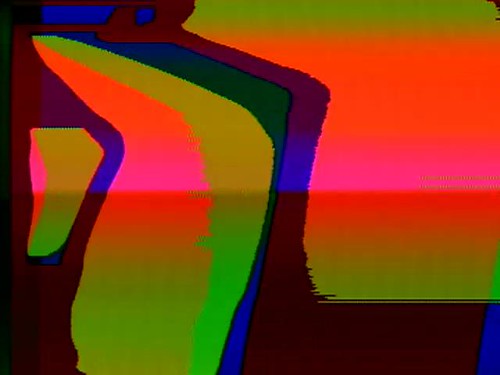
Phil Morton, "General Motors", 1976
made with the sandin image processor
digitized by joncates, SAIC, who also started and hosts the complete phil morton archive
enjoy a lot!
also see jon's entry on morton on wikipedia: http://en.wikipedia.org/wiki/Phil_Morton
as well as jon's online archive which also includes the distribution religion, a predecessor to open source licences:
http://copyitright.wordpress.com/
Showing posts with label video art. Show all posts
Showing posts with label video art. Show all posts
2009-10-08
>> "General Motors", Phil Morton, 1976
0
replies
tags -
archive,
copy-it-right,
open source,
sandin image processor,
video,
video art

Bookmark this post: | 


|
2009-09-11
>> "birds on wires", jarbas agnelli, 2009
Birds on the Wires from Jarbas Agnelli on Vimeo.
0
replies
tags -
generative art,
video,
video art
Bookmark this post: |
|
2008-10-01
>> Sandin Image Processor + Distribution Religion
from: http://www.evl.uic.edu/core.php?mod=4&type=1&indi=337

This modular design was based on the Moog synthesizer and is often explained as the "video equivalent of a Moog audio synthesizer" or as a video synthesizer. That is, it accepted basic video signals and mixed and modified them in a fashion similar to what a Moog synthesizer did with audio. An analog, modular, real time, video processing instrument, it provided video processing performance levels and produced subtle and delicate video effects that became popular with early video artists.
The IP's real-time effects naturally led to its use in live theater performance, including "Electronic Visualization Events" where the IP was seen processing the output of Tom DeFanti's Graphics Symbiosis System - GRASS. Real-time image processing was combined with sound to create visual concerts.
Physically, an Image Processor system would be built out of modules. Several types of modules were defined and typically would be an aluminum box containing a circuit board inside, video connectors and knobs on front of box and power connector on back of box.
The modules would be organized in rows. Individual systems could vary in size and increase in power with the addition of more modules. Typical modules would be signal sources, combiners and modifiers, effects modules, sync, color encoder, color decoder, and NTSC video interface.
Sandin was an advocate of education and espoused a non-commercial philosophy, emphasizing a public access to processing methods and the machines that assist in generating the images.
Accordingly, he placed the circuit board layouts for the IP with a commercial circuit board company and freely published schematics and other documentation. The Do It Yourself ethos combined with the low cost of the parts and a free dissemination of information created a large following of video artists, students, and others interested in experimental video electronics. The modules were often assembled by individuals who had no prior knowledge of electronics fabrication. Also, from time to time Sandin and staff would hold fix-it parties where modules that had failed to work would be repaired by the senior staff.
The Image Processor's educational success can be found in its numbers. In its time, more IP's were built than any other commercial "video-art" synthesizer. This distribution method was, and to a very large extent still is, unique in the proprietary and competitive industrial field of advanced electronics.
Sandin's IP, and the instructional video that accompanied the modules trained and inspired numerous individuals who would go on to make substantial contributions to both art and science.
Sandin received grants in support of his work from the Rockefeller Foundation (1981), the National Science Foundation, the National Endowment for the Arts (1980) and the Guggenheim Foundation (1978). Sandin's early IP video work "Spiral PTL" was one of the first pieces included in the Museum of Modern Art's video art collection.
The construction-instrucions for Sandin Image Processor were distributed freely, so anyone who wanted to have one could build it. This example of open source was called "Distribution Religion" or "copy it right". For further information see http://mediaarthistories.blogspot.com/2008/06/dan-sandin-demonstrates-sandin-image.html. To see and download the Distribution Religion, visit: http://criticalartware.net/rsrc/dwnl/dS_DISTREL.dwnl/www_VR/
0
replies
tags -
art + technology,
early new media,
open source,
technology,
video art,
video synthesizer
Bookmark this post: |
|
2008-07-09
2008-01-13

Subscribe to:
Posts (Atom)
>> additional class blogs


>> subscribe


 Posts
All Comments
.........

- Nina Wenhart ...
- ... is a Media Art historian and researcher. She holds a PhD from the University of Art and Design Linz where she works as an associate professor. Her PhD-thesis is on "Speculative Archiving and Digital Art", focusing on facial recognition and algorithmic bias. Her Master Thesis "The Grammar of New Media" was on Descriptive Metadata for Media Arts. For many years, she has been working in the field of archiving/documenting Media Art, recently at the Ludwig Boltzmann Institute for Media.Art.Research and before as the head of the Ars Electronica Futurelab's videostudio, where she created their archives and primarily worked with the archival material. She was teaching the Prehystories of New Media Class at the School of the Art Institute of Chicago (SAIC) and in the Media Art Histories program at the Danube University Krems.