full text available here:
http://www.ubu.com/aspen/aspen5and6/threeEssays.html#barthes
or:
http://www.pdf-search-engine.com/roland-barthes-%E2%80%9Cthe-death-of-the-author,%E2%80%9D-1968-in-his-story-sarrasine-html-www.mariabuszek.com/kcai/PoMoSeminar/Readings/BarthesAuthor.html
In his story Sarrasine Balzac, describing a castrate disguised as a woman, writes the following
sentence: “This was woman herself, with her sudden fears, her irrational whims, her instinctive
worries, her impetuous boldness, her fussings, and her delicious sensibility.” Who is speaking
thus? Is it the hero of the story bent on remaining ignorant of the castrato hidden beneath the
woman? Is it Balzac the individual, furnished by his personal experience with a philosophy of
Woman? Is it Balzac the author professing “literary” ideas on femininity? Is it universal
wisdom? Romantic psychology? We shall never know, for the good reason that writing is the
destruction of every voice, of every point of origin. Writing is that neutral, composite, oblique
space where our subject slips away; the negative where all identity is lost, starting with the very
identity of the body writing.
No doubt it has always been that way. As soon as a fact is narrated no longer with a view
to acting directly on reality but intransitively, that is to say, finally outside of any function other
than that of the very practice of the symbol itself, this disconnection occurs, the voice loses its
origin, the author enters into his own death, writing begins. The sense of this phenomenon,
however, has varied; in ethnographic societies the responsibility for a narrative is never assumed
by a person but by a mediator, shaman or relator whose “performance”—the mastery of the
narrative code—may possibly be admired but never his “genius.” The author is a modern figure,
a product of our society in so far as, emerging from the Middle Ages with English empiricism,
French rationalism and the personal faith of the Reformation, it discovered the prestige of the
individual, of, as it is more nobly put, the “human person.” It is thus logical that in literature it
should be this positivism, the epitome and culmination of capitalist ideology, which has attached
the greatest importance to the “person” of the author. The author still reigns, in histories of
literature, biographies of writers, interviews, magazines, as in the very consciousness of men of
letters anxious to unite their person and their work through diaries and memoirs. The image of
literature to be found in ordinary culture is tyrannically centered on the author, his person, his
life, his tastes, his passions, while criticism still consists for the most part in saying that
Baudelaire’s work is the failure of Baudelaire the man, Van Gogh’s his madness, Tchaikovsky’s
his vice. The explanation of a work is always sought in the man or woman who produced it, as if
it were always in the end, through the more or less transparent allegory of the fiction, the voice
of a single person, the author “confiding” in us.
Though the sway of the Author remains powerful (the new criticism has often done no
more than consolidate it), it goes without saying that certain writers have long since attempted to
loosen it. In France, Mallarmé was doubtless the first to see and to foresee in its full extent the
necessity to substitute language itself for the person who until then had been supposed to be its
owner. For him, for us too, it is language which speaks, not the author; to write is, through a
prerequisite impersonality (not at all to be confused with the castrating objectivity of the realist
novelist), to reach that point where only language acts, “performs,” and not “me.” Mallarmé’s
entire poetics consists in suppressing the author in the interests of writing (which is, as will be
seen, to restore the place of the reader). Valéry, encumbered by a psychology of the Ego,
considerably diluted Mallarmé’s theory but, his taste for classicism leading him to turn to the
lessons of rhetoric, he never stopped calling into question and deriding the Author; he stressed
the linguistic and, as it were, “hazardous” nature of his activity, and throughout his prose works
he militated in favor of the essentially verbal condition of literature, in the face of which all recourse to the writer’s interiority seemed to him pure superstition. Proust himself, despite the
apparently psychological character of what are called his analyses, was visibly concerned with
the task of inexorably blurring, by an extreme subtilization, the relation between the writer and
his characters; by making of the narrator not he who has seen and felt nor even he who is writing,
but he who is going to write (the young man in the novel—but, in fact, how old is he and who is
he?—wants to write but cannot; the novel ends when writing at last becomes possible), Proust
gave modern writing its epic. By a radical reversal, instead of putting his life into his novel, as is
so often maintained, he made of his very life a work for which his own book was the model; so
that it is clear to us that Charlus does not imitate Montesquieu but that Montesquieu—in his
anecdotal, historical reality—is no more than a secondary fragment, derived from Charlus.
Lastly, to go no further than this prehistory of modernity, Surrealism, though unable to accord
language a supreme place (language being system and the aim of the movement being,
romantically, a direct subversion of codes—itself moreover illusory: a code cannot be destroyed,
only”played off”), contributed to the desacrilization of the image of the Author by ceaselessly
recommending the abrupt disappointment of expectations of meaning (the famous surrealist
“jolt”), by entrusting the hand with the task of writing as quickly as possible what the head itself
is unaware of (automatic writing), by accepting the principle and the experience of several
people writing together. Leaving aside literature itself (such distinctions really becoming
invalid), linguistics has recently provided the destruction of the Author with a valuable analytical
tool by showing that the whole of the enunciation is an empty process, functioning perfectly
without there being any need for it to be filled with the person of the interlocutors. Linguistically,
the author is never more than the instance writing, just as I is nothing other than the instance
saying I: language knows a “subject,” not a “person, and this subject, empty outside of the very
enunciation which defines it, suffices to make language “hold together,” suffices, that is to say,
to exhaust it.
The removal of the Author (one could talk here with Brecht of a veritable “distancing,”
the Author diminishing like a figurine at the far end of the literary stage) is not merely an
historical fact or an act of writing; it utterly transforms the modern text (or—which is the same
thing—the text is henceforth made and read in such a way that at all its levels the author is
absent). The temporality is different. The Author, when believed in, is always conceived of as
the past of his own book: book and author stand automatically on a single line divided into a
before and an after. The Author is thought to nourish the book, which is to say that he exists
before it, thinks, suffers, lives for it, is in the same relation of antecedence to his work as a father
to his child. In complete contrast, the modem scriptor is born simultaneously with the text, is in
no way equipped with a being preceding or exceeding the writing, is not the subject with the
book as predicate; there is no other time than that of the enunciation and every text is eternally
written here and now. The fact is (or, it follows) that writing can no longer designate an
operation of recording, notation, representation, “depiction” (as the Classics would say); rather, it
designates exactly what linguists, referring to Oxford philosophy, call a performative, a rare
verbal form (exclusively given in the first person and in the present tense) in which the
enunciation has no other content (contains no other proposition) than the act by which it is
uttered—something like the I declare of kings or the I sing of very ancient poets. Having buried
the Author, the modern scriptor can thus no longer believe, as according to the pathetic view of
his predecessors, that this hand is too slow for his thought or passion and that consequently,
making a law of necessity, he must emphasize this delay and indefinitely “polish” his form. For
him, on the contrary, the hand, cut off from any voice, borne by a pure gesture of inscription (and not of expression), traces a field without origin—or which, at least, has no other origin than
language itself, language which ceaselessly calls into question all origins. We know now that a
text is not a line of words releasing a single “theological” meaning (the “message” of the Author-
God) but a multi-dimensional space in which a variety of writings, none of them original, blend
and clash. The text is a tissue of quotations drawn from the innumerable centers of culture.
Similar to Bouvard and Pécuchet, those eternal copyists, at once sublime and comic and whose
profound ridiculousness indicates precisely the truth, of writing, the writer can only imitate a
gesture that is always anterior, never original. His only power is to mix writings, to counter the
ones with the others, in such a way as never to rest on any one of them. Did he wish to express
himself, he ought at least to know that the inner “thing” he thinks to “translate” is itself only a
ready-formed dictionary, its words only explainable through other words, and so on indefinitely;
something experienced in exemplary fashion by the young Thomas de Quincey, he who was so
good at Greek that in order to translate absolutely modern ideas and images into that dead
language, he had, so Baudelaire tells us (in Paradis Artificiels), “created for himself an unfailing
dictionary, vastly more extensive and complex than those resulting from the ordinary patience of
purely literary themes.” Succeeding the Author, the scriptor no longer bears within him passions,
humours, feelings, impressions, but rather this immense dictionary from which he draws a
writing that can know no halt: life never does more than imitate the book, and the book itself is
only a tissue of signs, an imitation that is lost, infinitely deferred.
Once the Author is removed, the claim to decipher a text becomes quite futile. To give a
text an Author is to impose a limit on that text, to furnish it with a final signified, to close the
writing. Such a conception suits criticism very well, the latter then allotting itself the important
task of discovering the Author (or its hypostases: society, history, psyche, liberty) beneath the
work: when the Author has been found, the text is “explained”—victory to the critic. Hence there
is no surprise in the fact that, historically, the reign of the Author has also been that of the Critic,
nor again in the fact that criticism (be it new) is today undermined along with the Author. In the
multiplicity of writing, everything is to be disentangled, nothing deciphered; the structure can be
followed, “run” (like the thread of a stocking) at every point and at every level, but there is
nothing beneath: the space of writing is to be ranged over, not pierced; writing ceaselessly posits
meaning ceaselessly to evaporate it, carrying out a systematic exemption of meaning. In
precisely this way literature (it would be better from now on to say writing), by refusing to assign
a “secret,” an ultimate meaning, to the text (and to the world as text), liberates what may be
called an antitheological activity, an activity that is truly revolutionary since to refuse to fix
meaning is, in the end, to refuse God and his hypostases - reason, science, law.
Let us come back to the Balzac sentence. No one, no “person,” says it: its source, its
voice, is not the true place of the writing, which is reading. Another—very precise—example
will help to make this clear: recent research (J.-P. Vernant)1 has demonstrated the constitutively
ambiguous nature of Greek tragedy, its texts being woven from words with double meanings that
each character understands unilaterally (this perpetual misunderstanding is exactly the “tragic”);
there is, however, someone who understands each word in its duplicity and who, in addition,
hears the very deafness of the characters speaking in front of him—this someone being precisely
the reader (or here the listener). Thus is revealed the total existence of writing: a text is made of
multiple writings, drawn from many cultures and entering into mutual relations of dialogue,
parody, contestation, but there is one place where this multiplicity is focused and that place is the
reader, not, as was hitherto said, the author. The reader is the space on which all the quotations
that make up a writing are inscribed without any of them being lost; a text’s unity lies not in its origin but in its destination. Yet this destination cannot any longer be personal: the reader is
without history, biography, psychology; he is simply that someone who holds together in a single
field all the traces by which the written text is constituted. Which is why it is derisory to
condemn the new writing in the name of a humanism hypocritically turned champion of the
reader’s rights. Classic criticism has never paid any attention to the reader; for it, the writer is the
only person in literature. We are now beginning to let ourselves be fooled no longer by the
arrogant antiphrastical recriminations of good society in favor of the very thing it sets aside,
ignores, smothers or destroys; we know that to give writing its future, it is necessary to
overthrow the myth: the birth of the reader must be at the cost of the death of the Author.
Showing posts with label Critical Theory. Show all posts
Showing posts with label Critical Theory. Show all posts
2008-09-15
>> Roland Barthes, "Death of the Author", 1967
0
replies
tags -
Critical Theory,
text

Bookmark this post: | 


|
2008-07-13
>> Erkki Huhtamo, "WEB STALKER SEEK AARON Reflections on Digital Arts, Codes and Coders", 2003
from: http://www.aec.at/en/archives/festival_archive/festival_catalogs/festival_artikel.asp?iProjectID=12320
“..[A]ny notion of software leads us to reconsider our historical notions of art”
The mainstream of computing has evolved towards hiding the code. While producing and reading code was an everyday activity for early computer users - scientists, engineers, operators and even artists - the presence of the code has become more and more obscure, hidden behind the facade of the interface. Interfacing humans and computers in a “user-friedly” fashion has been one of the guidelines of the digital culture since the late 60s. For Nicholas Negroponte, writing in 1969, the real task was to teach the computer to understand humans, not vice versa: “A designer, when addressing a machine, must not be forced to resort to machine-oriented codes. And in spite of computational efficiency, a paradigm for fruitful conversations must be machines that can speak and respond to a natural language”. (1) The effort of creating “seamless” and “intimate” human-computer user interfaces became almost a definition of progressive computer culture, expanding from specialists to general users. From Xerox Star to the Apple Macintosh desktop and on to its bastard son, the Microsoft Windows, generations of users were taught to ignore the inner workings of the “box”. They dealt with software packages that opened their metaphor-filled offerings on the desktop by a mouseclick. The users saw icons of tools and trash cans, but no strings of zeros and ones - the program codes that actually power the whole system.
Jack Burnham, “Notes on art and information processing”, in the catalogue to the Software exhibition (1970)
1.
While the use of the computer has spread to all imaginable fields, direct access to the code and coding has remained a domain for specialists from computer scientists and professional programmers to hackers and builders of game engines. Mac users and even most Windows users rarely see even a glimpse of code. Even the brief revival of coding as a normal occupation for the general computer user as a result of the introduction of HTML, was soon obliterated by an avalanche of easy-to-use automated webpage authoring software. While this development can be justified by claiming that the computer is just an intermediary, a tool or a medium, and not a goal in itself, there is ample room for counter-arguments. The computer’s constantly expanding role as a universal machine powering innumerable applications and systems worldwide makes the invisibility of its workings alarming. Corporate and govermental coders (not to forget code breakers), as well as pranksters, cybercriminals and terrorists are monitoring and interfering with “innocent” computer use through the Internet. Lacking knowledge of programming, the users can only respond by subscribing to more corporate services or installing commercially marketed software packages. Yet both the core of the problem and the nature of the counter-measures remain vague. It has also been argued that merely using a pre-existing commercial software package restricts the user’s freedom of expression, forcing him/her unknowingly to adapt to a role envisioned by the corporate planners. (2) John Berger’s famous slogan, “every image embodies a way of seeing”, could perhaps be modified as “every software embodies a way of using”. (3) Gaining access to computer code, understanding its “message” and being able to use it for one’s own means are political, as well as social and economic issues. They are deeply intertwined with the dynamics of power and knowledge in contemporary society.
Against this background it is highly interesting to note the recent emphasis on coding within the field of the digital arts. This interest has manifested itself in various forms, particularly in the emergence of the discourse on “software art”. (4) In recent times we have witnessed the appreapance of artworks that modify the look and functioning of commercial software applications from web browsers to game worlds, introducing features that may be interpreted by users as formal interventions, disturbing pranks, ideological subversions or simply as technical bugs. The famous Web Stalker (I/O/D, 1997-) is a web browser that displays control codes and link structures instead of the usual graphical interface. Life_Sharing by 0100101110101101.ORG attacked the false openness of the web browser by giving anybody a permission to access its own hard disk with all its private files and programs through the Internet. (5) Other works use elements of computer code openly as building blocks of their aesthetics, without disguising them as graphics, images and sounds. Common to all these forms is the urge to question the prevailing conventions of computer use. Tearing down the veil of “user-friendliness”, seen as a deception, the artists are providing the users a look behind the scenes, to the engine room (to use an anacronistic metaphor). They themselves feel at ease in this engine room, using it as a laboratory, hangout, toolkit and venue for art. What are the reasons behind this interest? Is it enough to label it as an “inevitable” avantgarde of the digital culture? How will it relate to the wider, perhaps even non-digital, cultural context? This essay provides some preliminary answers to such questions by delving into the relationship between art, codes and coding from a media-archaeological point of view.2.
The earliest computer artists in the 1960s were all coders. There was no alternative. Each work, whether graphics, animation or music, was necessarily the result of an unique act of writing computer code. As if foreshadowing the recent claims for “software art”, some pioneers, like Michael L. Noll and the members of the Japanese Computer Technique Group (CTG), openly stated that the true work of art was the generating program itself rather than the computer-produced output. (6) Most of the early work on computer graphics and music took a formalist path, exploring issues like the possibilities of generative grammars and the relationship between rule-based behaviour and randomness. This state of things is aptly mirrored by the diagram-dotted pages of Jasia Reichardt’s early overview, The Computer in Art (1971). (7) Pioneers of computer graphics like Frieder Nake described their activity as formal “visual research”, deliberately segregated from any social or political concerns. They found inspiration from cybernetics, Claude Shannon’s information theory and the exact mathematical aesthetics of theorists like Max Bense. (8) Bense excluded the role of subjective perception from his aesthetic system and based it on mathematical equations that emphasized the universal rather than the particular, the rational rather than the irrational (identified with the subjective art impulse), the abstract rather than the representational. Although random operations were often used by the early artist-programmers, the computer was considered mainly a “tool”: it was expected to execute a program written beforehand.
This situation can be explained both by the state of the technology and the institutional context. In the 1960s computers were mostly available at governmental and corporate institutions. They were used primarily for statistical calculations, which emphasized the act of programming in the form of batch-processing. Although the early artists and composers began to “bend” the technology to other kinds of uses, they were forced to accomodate themselves into the roles that had been established in the non-artistic “mainframe” culture: working within a dedicated institution, the artists created programs and then waited until they had been executed by the computer. They were members of a small elite, living on the fringe of a larger technical and institutional elite, exploring a powerful means of expression in its infancy. However, the nature of computing was constantly changing as a result of innovations like new interfaces, the idea of time-sharing, and the creation of the first programming languages meant for creative purposes. BEFLIX, written by computer scientist Kenneth Knowlton at Bell Labs, was applied to groundbreaking computer graphics and animation by artists Stan Vanderbeek and Lillian Schwartz, working in collaboration with Knowlton. Equally interesting was the appearance of the program ART 1 created by university professors Katherine Nash and Richard H. Williams and meant as a tool for artists interested in using the computer without having the theoretical and technical skills to program. Criticized at the time for considering the artist “as a specialist with pre-defined professional needs”, it was, however, an early pointer towards the parting of ways between the creators of “soft” digital art and those involved in writing algorithms. (9)
The proliferation of art using pre-existing software tools such as Photoshop or Maya has not meant the disappearance of the activity of creating original algorithms. Many of the most rigorous digital art projects have been created by artists who either write sofware for themselves or work in close collaboration with a programmer. Prominent examples of the first are Myron Krueger, Harold Cohen and David Rokeby, while figures like Jeffrey Shaw (in collaboration with Gideon May and Bernt Lintermann) and Rafael Lozano-Hemmer (with Will Bauer) represent the second type. In some cases, like that of Christa Sommerer and Laurent Mignonneau, separating programming from other aspects of creation is almost impossible. (10) Pioneers like Krueger, Cohen and Rokeby have spent years, even decades, writing program code to refine their increasingly sophisticated systems. The artworks these artists have exhibited over the years may have had own identities, but they can also be characterized as “materializations” of these systems, documenting their state of development. The code provides the core of Krueger’s Videoplace as well as Rokeby’s Very Nervous System and Giver of Names.(11) Arguably the most rigorous and longterm effort to use original programming as a means of creating an evolving art project has been Harold Cohen’s AARON, continuously under development since the early 1970s. (12)
AARON is an AI-based computer program, an expert system that creates paintings and drawings. Over the past thirty years, different output devices have been used, from a drawing “turtle” moving on paper placed on the floor to complex painting machines and more recently to a software application automatically creating pictures on the desktop. AARON can be characterized as a semi-autonomous creature. Its works are based on the complex rules defined by Cohen, but it also has a consideble amount of autonomy from composition to coloring. It is significant that Cohen has not made AARON’s code public. The different stages of the program have not even been systematically preserved, which is why the code’s development can only be deciphered indirectly, as reflected in AARON’s numerous drawings and paintings. (13) Although a major creative effort, Cohen never considered the code as the artwork proper. Rather, it can be likened to the skills and techniques accumulated by a human artist during his lifespan. What will remain are the paintings, the material traces of a lifework. In this sense Cohen, painter by education, resorts to a conventional model of the creation and preservation art. However, AARON’s most recent manifestation, the software application available as freeware on the Internet, could point to a more radical direction. (14) Instead of remaining Cohen’s own cybernetic extension, AARON has been given a degree of independence from its creator. However, while becoming a software application on anybody’s desktop, AARON’s development has also stopped. Although it can keep on producing different paintings endlessly, it does not have a facility to learn other routines. Moved to the desktop AARON certainly immortalizes Cohen’s achievement, but it also turns into a cybernetic zombie. Releasing its source code would give it a chance to develop further by means of collective programming efforts through the Internet. (15)3.
The advocates of “software art” emphasize the primacy of the code as the main creative achievement and demand un-obstructed presence and role for it in the artwork. According to the statement of the first software art competition jury at the Transmediale 01, “software art is opposed to the notion of software as a tool”. (16) For the jury, software art has many faces: “it could be algorithms as an end to themselves, it could subvert perceived paradigms of computer software or create new ones, it could do something interesting or disrupting with your computer, it could be creative writing, it could be science.” In another text Mathias Cremer and Ulrike Gabriel (who were among the jury members) write: “Software art means a shift of the artist’s view from displays to the creation of systems and processes themselves; this is not covered by the concept of ‘media’”. (17) For these writers the principal “sin” media art has committed seems to be its excessive attention to interface design. For the software purist, the creation of detailed immersive environments and elaborate multisensory interfaces is in itself an act of mystification. Works that involve the participants both bodily and emotionally seduce them, instead of making them aware of the true nature of the system, hidden “behind the facade”.
It is highly interesting that interactive systems that in the not-so-distant past were seen as an empowering and critical alternative to “passivating” media experiences like watching television, have now become the target for criticism. This has to do with the rapid acceptance of interactivity and its adoption to the mainstream of digital culture. If interactivity was once seen as a gesture that questioned the prevailing logic of media, it has now been normalized, added to the internal cultural repertory. However, the recent criticism does not seem to be addressed to interactivity per se; rather, it addresses the way interactivity has been packaged and marketed, institutionalized and commodified. On fields like electronic gaming the near realtime interaction between the user and the game software/hardware complex has been claimed to lead to the “automation” of the action/reaction mechanism. Immersion into rapidly changing and emotionally engaging gameworlds leaves little time for reflecting on the algorithmic basis of the experience. (18)
For the gamer the system as if disappers, leaving only the phenomenological experience of the gameworld. The appearance of a phenomenon like game patch art is interesting in that it uses programming to directly address such mechanisms of identification. As a recent example, Anne-Marie Schleiner’s Velvet-Strike project (2002) invites people to create digital graffiti on the walls of Counter-Strike, the popular network shooter game about terrorism. (19) Situated somewhere between “textual poaching” gaming subcultures and critical software art, game patch art functions as an ambiguous counter-discourse to commercial game culture, true to the legacy of hackerism.
It should also be pointed out that media art from recent years has shown signs of self-reflectivity and a growing critical awareness of its own position vis a vis commercial and institutional applications. Works like Maurice Benayoun’s and Jean-Baptiste Barrière’s World Skin (1998) or Ken Feingold’s That Sinking Feeling (2002) are far from naive celebrations of the pleasures of the interface. While still offering memorable interactive experiences they at the same time disturb the bond with the user. (20) Both works create ambiguous situations where the seductive potential is constantly undermined by indiscrepant (World Skin) or deliberately “malfunctioning” (That Sinking Feeling) elements. Although neither work deals primarily with computer code, its role has by no means ignored. The functioning of the algorithmic base of these works may not have been highlighted, but its role is interconnected with the issues these works raise, from the role of media and the politics of simulation to social-psychology and the construction of identity. In their own ways they demonstrate that singling out the code for exclusive scrutiny at the expense of everything else may not be the right way to go in an integrated digital culture, where technical, ideological and cultural codes are no longer separable from each other.4.
It is interesting to note that the software art purists have already begun to trace their own geneology. This proves the well-known fact that history is mainly written to justify the present. A major formative event in the pre-history of software art has been located in the Software exhibition, curated by Jack Burnham for the Jewish Museum in New York in 1970. This technically catastrophic and until now largely ignored event has been identified as the nexus at which the efforts to explore the creative potential of information technology met conceptual art and Burnham’s own interest in structuralist analysis. (21) In his introduction to the exhibition catalogue Burnham made it clear that Software was not a normal art exhibition. Rather, it displayed exhibits that dealt with “conceptual and process relationships”. One of the purposes was “to undermine normal perceptual expectations and habits which viewers bring to an art exhibition”. (22) The visitors were supposed to interact with various technological devices, without being asked to consider them as artworks. The most noted exhibit was SEEK, created by Nicholas Negroponte and his colleagues at MIT’s Architectural Machine Group. It was another AI-inspired programming effort that hardly reached its goals, except on metaphorical level: living gerbils had been placed on a glass-caged arena with aluminium building blocks, and a computer-controlled robot arm operating from above. The system, engaged in arranging the blocks according to pre-programmed schemes was supposed to respond “intelligently” to the “noise” created by the gerbils, bumping on the blocks, etc. (23)
For the software art advocates the most inspiring exhibit seems Labyrinth, an early version of Ted Nelson’s hypertext displayed as a bare branching structure. Several other exhibits interfaced visitors with technological apparata making few efforts to weave fictions or elaborate “stage-sets” around them. In Software Burnham drew a connection between the use of computing technology and conceptual art, which made him include non-technological pieces from artists like John Baldessari, Lawrence Weiner and Douglas Huebler. In Burnham’s view all these forms shared the tendency to move away from art objects and to investigate linguistic structures and forms of information exchange underlying other forms of expression. This was also in unison with Burnham’s simultaneous effort to reveal the mythical structures underlying the traditions of Western art. (24) Conceptual art, interpreted broadly to include also John Cage’s method of composition, the series of instructions for imaginary events composed by the Fluxus artists and some forms of lettrist poetry, certainly provide one possible background against which to assess the role of code in software art.
However, one might also refer to the field of structural and materialist film and the ideology of “anti-illusionism” in the film culture of the late 1960s and early 70s. Attacking the illusionism of conventional narrative cinema, filmmakers began to deconstruct the cinematic apparatus in its constituent elements. They emphasized the materiality of film, including sprocket holes, frames, emulsions, scratches and dirt. Some filmmakers, including Hollis Frampton, Michael Snow and the Croatian Ladislav Galeta, used (quasi-)generative principles to structure their films. In its most extreme form, filmmakers abandoned film altogether, staging events that merely highlighted the basic elements of the cinematic apparatus, the light beam from the projector, the screen, the darkness of the auditorium. Writing in the seminal Structural Film Anthology (1976), Peter Gidal defined Structural / Materialist films as “at once object and procedure”. (25) In another text he stated: “A film is materialist if it does not cover its apparatus of illusionism. Thus it is not a matter of anti-illusionism pure and simple, uncovered truth, but rather, a constant procedural work against the attempts at producing an illusionist continuum’s hegemony.” (26) In other words, materialist film was not a purification ritual as much as it was a constant struggle against the hegemonic forces resorting to illusionism.5.
The struggles of the structural and materialist film movement could perhaps be compared with the efforts the software artists are currently making to scratch the slick corporate facades of cyberculture, metaphorically manifested in the deceptive openness and the pretended democracy of the graphical user interface. (27) Yet comparisons across time are risky. Drawing a parallel between a 1960s computer generated picture consisting of dense arrays of ASCII characters and a piece of “ASCII art” from the late 1990s is only valid in a limited sense. The student hackers that created Spacewar, considered the first computer game, have little in common with today’s commercial game developers and even with game patch artists. Similarly, the programming efforts of the computer graphics pioneers of the 1960s cannot be directly compared with the software art of the early 21st century, because of the widely different cultural contexts. The discourse on software art has emerged in a situation, where digital culture has already had time to create a history and a memory. During its first half a century, digital computing has gone through a number of different stages that have progressively re-defined the meanings of computing in warfare, administration, society, economy and culture. Issues like artificial intelligence, virtual reality, agents and avatars, A-Life, GUI, physical computing and digital networking are all elements in an evolving fabric that changes shape depending on time and place and the position and identity of the observer. Last but not least, software art is in a position to profit from the experiences of the net art pioneers.
Digital art has for some time shown signs of a growing self-conciousness in relation to the history of digital technology. Yet the recent interest in AI among artists does not mean an artistic revival of the classic artificial intelligence research. It is not a simple homage either. Projects like David Rokeby’s A Giver of Names, Kenneth Rinaldo’s Autopoiesis and Ken Feingold’s talking and responding puppet heads are examples of meta-art that engages in a dialogue with the cultural representations of AI (including, in Feingold’s case, Joseph Weizenbaum’s quasi-intelligent conversation program ELIZA), while pursuing at the same time other intellectual and ideological goals. Perhaps it is not wrong to say that there has been a cultural demand for a phenomenon like software art, just like there was for the appearance of structural / materialist film, which was “called for” by a conglomeration of conflicting cultural forces, from the increasing uniformity and untouchability of commercial film production to the impact of counter-cultural movements, the emergence of decontructionist philosophy and the “dematerialization of the art object”. Structural / materialist film movement emerged as a critical position that questioned the prevailing audiovisual hegemony, demanding an approach that highlighted the “primitives” of the filmic medium in dynamic interplay with its application to narrative and metamorphic purposes. In its anti-illusionistic fervor it evoked the idea of a modernist reaction, but not in a simple revivalist fashion.
The claims and prognoses made by the software art advocates also have a certain neo-modernist flavor. Emphasizing the centrality of the code and the algoritmic approach means positing a “hard core”, often felt to have been lost in the postmodern world. Indeed, there are “small but uninfluential” (to brutally appropriate an expression from Vuc Cosic) groups, such as the one dedicated to exploring the aesthetics of the generative code (Geoff Cox, Alec McLean, Adrian Ward, etc.), that fulfill many of the criteria for classical avantgarde movements. (28) Florian Cramer has identified the group’s activities, which include poetry readings in Perl program code, as “software formalism”. (29) On the other hand there are approaches that emphasize the cultural and ideological underpinnings of computer programming. For groups like the British Mongrel and I/O/D (creator of Web Stalker), digital code cannot be separated from the operations of ideology manifested on the Internet and elsewhere. Their actions and projects are much more difficult to fit into a modernist strait-jacket. The situation becomes even more difficult in the case of the independent artist-activists operating on the no-(wo)man’s land between popular cultural forms like gaming, various forms of net activism (including cyber-feminism) and theoretical approaches. Appropriation, pastiche, bricolage and other postmodernist tricks are still among their favourite tools.
If the digital arts are going to make a difference in the media culture of the 21st century, it is clear that they have to shed their veil of innocence. They have to face the problematic, conflicting realities of cyberculture. While doing so, they need to scrutinize and make public their own internal workings, as well as their relationship to the systems of power, control and commerce that envelop them, infiltrate them, co-opt them and influence their public image, whether welcome or not. Just as science and technology can never be free from the constraints imposed upon them by economy, culture and politics, the digital arts cannot be “pure” and “free”, even when purporting to focus on the quest for formal, mathematical, algorithmic beauty. Researching the aesthetics of digital grammars and exploring the workings of the code are important goals; yet getting the findings out from the isolated engine room and into the consciousness of the cyber citizen - also in the role of the cyberart lover - is quite another matter.
0
replies
tags -
code art,
Critical Theory,
text
Bookmark this post: |
|
2008-07-07
>> Vanevar Bush, "Memex", 1945
memex: a sort of microfilm-based knowledge desk.
pre-digital precursor to the internet.
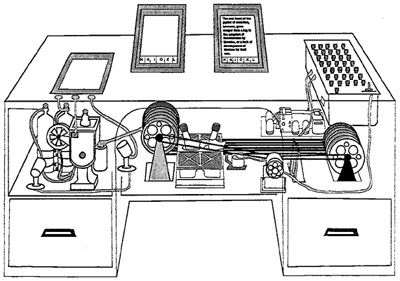
The Atlantic Monthly, 1945: Vanevar Bush, "As We May Think"
http://www.theatlantic.com/doc/194507/bush
0
replies
tags -
Critical Theory,
history,
information theory,
internet,
text
Bookmark this post: |
|
2008-07-03
>> Theodor W. Adorno, "The Culture Industry: Enlightenment as Mass-Deception", 1944

THE sociological theory that the loss of the support of objectively established religion, the dissolution of the last remnants of pre-capitalism, together with technological and social differentiation or specialisation, have led to cultural chaos is disproved every day; for culture now impresses the same stamp on everything.
Films, radio and magazines make up a system which is uniform as a whole and in every part. Even the aesthetic activities of political opposites are one in their enthusiastic obedience to the rhythm of the iron system. The decorative industrial management buildings and exhibition centers in authoritarian countries are much the same as anywhere else. The huge gleaming towers that shoot up everywhere are outward signs of the ingenious planning of international concerns, toward which the unleashed entrepreneurial system (whose monuments are a mass of gloomy houses and business premises in grimy, spiritless cities) was already hastening. Even now the older houses just outside the concrete city centres look like slums, and the new bungalows on the outskirts are at one with the flimsy structures of world fairs in their praise of technical progress and their built-in demand to be discarded after a short while like empty food cans.
Yet the city housing projects designed to perpetuate the individual as a supposedly independent unit in a small hygienic dwelling make him all the more subservient to his adversary – the absolute power of capitalism. Because the inhabitants, as producers and as consumers, are drawn into the center in search of work and pleasure, all the living units crystallise into well-organised complexes. The striking unity of microcosm and macrocosm presents men with a model of their culture: the false identity of the general and the particular. Under monopoly all mass culture is identical, and the lines of its artificial framework begin to show through. The people at the top are no longer so interested in concealing monopoly: as its violence becomes more open, so its power grows. Movies and radio need no longer pretend to be art. The truth that they are just business is made into an ideology in order to justify the rubbish they deliberately produce. They call themselves industries; and when their directors’ incomes are published, any doubt about the social utility of the finished products is removed.
Interested parties explain the culture industry in technological terms. It is alleged that because millions participate in it, certain reproduction processes are necessary that inevitably require identical needs in innumerable places to be satisfied with identical goods. The technical contrast between the few production centers and the large number of widely dispersed consumption points is said to demand organisation and planning by management. Furthermore, it is claimed that standards were based in the first place on consumers’ needs, and for that reason were accepted with so little resistance. The result is the circle of manipulation and retroactive need in which the unity of the system grows ever stronger. No mention is made of the fact that the basis on which technology acquires power over society is the power of those whose economic hold over society is greatest. A technological rationale is the rationale of domination itself. It is the coercive nature of society alienated from itself. Automobiles, bombs, and movies keep the whole thing together until their leveling element shows its strength in the very wrong which it furthered. It has made the technology of the culture industry no more than the achievement of standardisation and mass production, sacrificing whatever involved a distinction between the logic of the work and that of the social system.
This is the result not of a law of movement in technology as such but of its function in today’s economy. The need which might resist central control has already been suppressed by the control of the individual consciousness. The step from the telephone to the radio has clearly distinguished the roles. The former still allowed the subscriber to play the role of subject, and was liberal. The latter is democratic: it turns all participants into listeners and authoritatively subjects them to broadcast programs which are all exactly the same. No machinery of rejoinder has been devised, and private broadcasters are denied any freedom. They are confined to the apocryphal field of the “amateur,” and also have to accept organisation from above.
But any trace of spontaneity from the public in official broadcasting is controlled and absorbed by talent scouts, studio competitions and official programs of every kind selected by professionals. Talented performers belong to the industry long before it displays them; otherwise they would not be so eager to fit in. The attitude of the public, which ostensibly and actually favours the system of the culture industry, is a part of the system and not an excuse for it. If one branch of art follows the same formula as one with a very different medium and content; if the dramatic intrigue of broadcast soap operas becomes no more than useful material for showing how to master technical problems at both ends of the scale of musical experience – real jazz or a cheap imitation; or if a movement from a Beethoven symphony is crudely “adapted” for a film sound-track in the same way as a Tolstoy novel is garbled in a film script: then the claim that this is done to satisfy the spontaneous wishes of the public is no more than hot air.
We are closer to the facts if we explain these phenomena as inherent in the technical and personnel apparatus which, down to its last cog, itself forms part of the economic mechanism of selection. In addition there is the agreement – or at least the determination – of all executive authorities not to produce or sanction anything that in any way differs from their own rules, their own ideas about consumers, or above all themselves.
In our age the objective social tendency is incarnate in the hidden subjective purposes of company directors, the foremost among whom are in the most powerful sectors of industry – steel, petroleum, electricity, and chemicals. Culture monopolies are weak and dependent in comparison. They cannot afford to neglect their appeasement of the real holders of power if their sphere of activity in mass society (a sphere producing a specific type of commodity which anyhow is still too closely bound up with easy-going liberalism and Jewish intellectuals) is not to undergo a series of purges. The dependence of the most powerful broadcasting company on the electrical industry, or of the motion picture industry on the banks, is characteristic of the whole sphere, whose individual branches are themselves economically interwoven. All are in such close contact that the extreme concentration of mental forces allows demarcation lines between different firms and technical branches to be ignored.
The ruthless unity in the culture industry is evidence of what will happen in politics. Marked differentiations such as those of A and B films, or of stories in magazines in different price ranges, depend not so much on subject matter as on classifying, organising, and labelling consumers. Something is provided for all so that none may escape; the distinctions are emphasised and extended. The public is catered for with a hierarchical range of mass-produced products of varying quality, thus advancing the rule of complete quantification. Everybody must behave (as if spontaneously) in accordance with his previously determined and indexed level, and choose the category of mass product turned out for his type. Consumers appear as statistics on research organisation charts, and are divided by income groups into red, green, and blue areas; the technique is that used for any type of propaganda.
How formalised the procedure is can be seen when the mechanically differentiated products prove to be all alike in the end. That the difference between the Chrysler range and General Motors products is basically illusory strikes every child with a keen interest in varieties. What connoisseurs discuss as good or bad points serve only to perpetuate the semblance of competition and range of choice. The same applies to the Warner Brothers and Metro Goldwyn Mayer productions. But even the differences between the more expensive and cheaper models put out by the same firm steadily diminish: for automobiles, there are such differences as the number of cylinders, cubic capacity, details of patented gadgets; and for films there are the number of stars, the extravagant use of technology, labor, and equipment, and the introduction of the latest psychological formulas. The universal criterion of merit is the amount of “conspicuous production,” of blatant cash investment. The varying budgets in the culture industry do not bear the slightest relation to factual values, to the meaning of the products themselves.
Even the technical media are relentlessly forced into uniformity. Television aims at a synthesis of radio and film, and is held up only because the interested parties have not yet reached agreement, but its consequences will be quite enormous and promise to intensify the impoverishment of aesthetic matter so drastically, that by tomorrow the thinly veiled identity of all industrial culture products can come triumphantly out into the open, derisively fulfilling the Wagnerian dream of the Gesamtkunstwerk – the fusion of all the arts in one work.
The alliance of word, image, and music is all the more perfect than in Tristan because the sensuous elements which all approvingly reflect the surface of social reality are in principle embodied in the same technical process, the unity of which becomes its distinctive content. This process integrates all the elements of the production, from the novel (shaped with an eye to the film) to the last sound effect. It is the triumph of invested capital, whose title as absolute master is etched deep into the hearts of the dispossessed in the employment line; it is the meaningful content of every film, whatever plot the production team may have selected.
The man with leisure has to accept what the culture manufacturers offer him. Kant’s formalism still expected a contribution from the individual, who was thought to relate the varied experiences of the senses to fundamental concepts; but industry robs the individual of his function. Its prime service to the customer is to do his schematising for him.
Kant said that there was a secret mechanism in the soul which prepared direct intuitions in such a way that they could be fitted into the system of pure reason. But today that secret has been deciphered. While the mechanism is to all appearances planned by those who serve up the data of experience, that is, by the culture industry, it is in fact forced upon the latter by the power of society, which remains irrational, however we may try to rationalise it; and this inescapable force is processed by commercial agencies so that they give an artificial impression of being in command.
There is nothing left for the consumer to classify. Producers have done it for him. Art for the masses has destroyed the dream but still conforms to the tenets of that dreaming idealism which critical idealism baulked at. Everything derives from consciousness: for Malebranche and Berkeley, from the consciousness of God; in mass art, from the consciousness of the production team. Not only are the hit songs, stars, and soap operas cyclically recurrent and rigidly invariable types, but the specific content of the entertainment itself is derived from them and only appears to change. The details are interchangeable. The short interval sequence which was effective in a hit song, the hero’s momentary fall from grace (which he accepts as good sport), the rough treatment which the beloved gets from the male star, the latter’s rugged defiance of the spoilt heiress, are, like all the other details, ready-made clichés to be slotted in anywhere; they never do anything more than fulfil the purpose allotted them in the overall plan. Their whole raison d’être is to confirm it by being its constituent parts. As soon as the film begins, it is quite clear how it will end, and who will be rewarded, punished, or forgotten. In light music, once the trained ear has heard the first notes of the hit song, it can guess what is coming and feel flattered when it does come. The average length of the short story has to be rigidly adhered to. Even gags, effects, and jokes are calculated like the setting in which they are placed. They are the responsibility of special experts and their narrow range makes it easy for them to be apportioned in the office.
The development of the culture industry has led to the predominance of the effect, the obvious touch, and the technical detail over the work itself – which once expressed an idea, but was liquidated together with the idea. When the detail won its freedom, it became rebellious and, in the period from Romanticism to Expressionism, asserted itself as free expression, as a vehicle of protest against the organisation. In music the single harmonic effect obliterated the awareness of form as a whole; in painting the individual colour was stressed at the expense of pictorial composition; and in the novel psychology became more important than structure. The totality of the culture industry has put an end to this.
Though concerned exclusively with effects, it crushes their insubordination and makes them subserve the formula, which replaces the work. The same fate is inflicted on whole and parts alike. The whole inevitably bears no relation to the details – just like the career of a successful man into which everything is made to fit as an illustration or a proof, whereas it is nothing more than the sum of all those idiotic events. The so-called dominant idea is like a file which ensures order but not coherence. The whole and the parts are alike; there is no antithesis and no connection. Their prearranged harmony is a mockery of what had to be striven after in the great bourgeois works of art. In Germany the graveyard stillness of the dictatorship already hung over the gayest films of the democratic era.
The whole world is made to pass through the filter of the culture industry. The old experience of the movie-goer, who sees the world outside as an extension of the film he has just left (because the latter is intent upon reproducing the world of everyday perceptions), is now the producer’s guideline. The more intensely and flawlessly his techniques duplicate empirical objects, the easier it is today for the illusion to prevail that the outside world is the straightforward continuation of that presented on the screen. This purpose has been furthered by mechanical reproduction since the lightning takeover by the sound film.
Real life is becoming indistinguishable from the movies. The sound film, far surpassing the theatre of illusion, leaves no room for imagination or reflection on the part of the audience, who is unable to respond within the structure of the film, yet deviate from its precise detail without losing the thread of the story; hence the film forces its victims to equate it directly with reality. The stunting of the mass-media consumer’s powers of imagination and spontaneity does not have to be traced back to any psychological mechanisms; he must ascribe the loss of those attributes to the objective nature of the products themselves, especially to the most characteristic of them, the sound film. They are so designed that quickness, powers of observation, and experience are undeniably needed to apprehend them at all; yet sustained thought is out of the question if the spectator is not to miss the relentless rush of facts.
Even though the effort required for his response is semi-automatic, no scope is left for the imagination. Those who are so absorbed by the world of the movie – by its images, gestures, and words – that they are unable to supply what really makes it a world, do not have to dwell on particular points of its mechanics during a screening. All the other films and products of the entertainment industry which they have seen have taught them what to expect; they react automatically.
The might of industrial society is lodged in men’s minds. The entertainments manufacturers know that their products will be consumed with alertness even when the customer is distraught, for each of them is a model of the huge economic machinery which has always sustained the masses, whether at work or at leisure – which is akin to work. From every sound film and every broadcast program the social effect can be inferred which is exclusive to none but is shared by all alike. The culture industry as a whole has moulded men as a type unfailingly reproduced in every product. All the agents of this process, from the producer to the women’s clubs, take good care that the simple reproduction of this mental state is not nuanced or extended in any way.
The art historians and guardians of culture who complain of the extinction in the West of a basic style-determining power are wrong. The stereotyped appropriation of everything, even the inchoate, for the purposes of mechanical reproduction surpasses the rigour and general currency of any “real style,” in the sense in which cultural cognoscenti celebrate the organic pre-capitalist past. No Palestrina could be more of a purist in eliminating every unprepared and unresolved discord than the jazz arranger in suppressing any development which does not conform to the jargon. When jazzing up Mozart he changes him not only when he is too serious or too difficult but when he harmonises the melody in a different way, perhaps more simply, than is customary now. No medieval builder can have scrutinised the subjects for church windows and sculptures more suspiciously than the studio hierarchy scrutinises a work by Balzac or Hugo before finally approving it. No medieval theologian could have determined the degree of the torment to be suffered by the damned in accordance with the order of divine love more meticulously than the producers of shoddy epics calculate the torture to be undergone by the hero or the exact point to which the leading lady’s hemline shall be raised. The explicit and implicit, exoteric and esoteric catalogue of the forbidden and tolerated is so extensive that it not only defines the area of freedom but is all-powerful inside it. Everything down to the last detail is shaped accordingly.
Like its counterpart, avant-garde art, the entertainment industry determines its own language, down to its very syntax and vocabulary, by the use of anathema. The constant pressure to produce new effects (which must conform to the old pattern) serves merely as another rule to increase the power of the conventions when any single effect threatens to slip through the net. Every detail is so firmly stamped with sameness that nothing can appear which is not marked at birth, or does not meet with approval at first sight. And the star performers, whether they produce or reproduce, use this jargon as freely and fluently and with as much gusto as if it were the very language which it silenced long ago. Such is the ideal of what is natural in this field of activity, and its influence becomes all the more powerful, the more technique is perfected and diminishes the tension between the finished product and everyday life. The paradox of this routine, which is essentially travesty, can be detected and is often predominant in everything that the culture industry turns out. A jazz musician who is playing a piece of serious music, one of Beethoven’s simplest minuets, syncopates it involuntarily and will smile superciliously when asked to follow the normal divisions of the beat. This is the “nature” which, complicated by the ever-present and extravagant demands of the specific medium, constitutes the new style and is a “system of non-culture, to which one might even concede a certain ‘unity of style’ if it really made any sense to speak of stylised barbarity.” [Nietzsche]
The universal imposition of this stylised mode can even go beyond what is quasi-officially sanctioned or forbidden; today a hit song is more readily forgiven for not observing the 32 beats or the compass of the ninth than for containing even the most clandestine melodic or harmonic detail which does not conform to the idiom. Whenever Orson Welles offends against the tricks of the trade, he is forgiven because his departures from the norm are regarded as calculated mutations which serve all the more strongly to confirm the validity of the system. The constraint of the technically-conditioned idiom which stars and directors have to produce as “nature” so that the people can appropriate it, extends to such fine nuances that they almost attain the subtlety of the devices of an avant-garde work as against those of truth. The rare capacity minutely to fulfil the obligations of the natural idiom in all branches of the culture industry becomes the criterion of efficiency. What and how they say it must be measurable by everyday language, as in logical positivism.
The producers are experts. The idiom demands an astounding productive power, which it absorbs and squanders. In a diabolical way it has overreached the culturally conservative distinction between genuine and artificial style. A style might be called artificial which is imposed from without on the refractory impulses of a form. But in the culture industry every element of the subject matter has its origin in the same apparatus as that jargon whose stamp it bears. The quarrels in which the artistic experts become involved with sponsor and censor about a lie going beyond the bounds of credibility are evidence not so much of an inner aesthetic tension as of a divergence of interests. The reputation of the specialist, in which a last remnant of objective independence sometimes finds refuge, conflicts with the business politics of the Church, or the concern which is manufacturing the cultural commodity. But the thing itself has been essentially objectified and made viable before the established authorities began to argue about it. Even before Zanuck acquired her, Saint Bernadette was regarded by her latter-day hagiographer as brilliant propaganda for all interested parties. That is what became of the emotions of the character. Hence the style of the culture industry, which no longer has to test itself against any refractory material, is also the negation of style. The reconciliation of the general and particular, of the rule and the specific demands of the subject matter, the achievement of which alone gives essential, meaningful content to style, is futile because there has ceased to be the slightest tension between opposite poles: these concordant extremes are dismally identical; the general can replace the particular, and vice versa.
Nevertheless, this caricature of style does not amount to something beyond the genuine style of the past. In the culture industry the notion of genuine style is seen to be the aesthetic equivalent of domination. Style considered as mere aesthetic regularity is a romantic dream of the past. The unity of style not only of the Christian Middle Ages but of the Renaissance expresses in each case the different structure of social power, and not the obscure experience of the oppressed in which the general was enclosed. The great artists were never those who embodied a wholly flawless and perfect style, but those who used style as a way of hardening themselves against the chaotic expression of suffering, as a negative truth. The style of their works gave what was expressed that force without which life flows away unheard. Those very art forms which are known as classical, such as Mozart’s music, contain objective trends which represent something different to the style which they incarnate.
As late as Schönberg and Picasso, the great artists have retained a mistrust of style, and at crucial points have subordinated it to the logic of the matter. What Dadaists and Expressionists called the untruth of style as such triumphs today in the sung jargon of a crooner, in the carefully contrived elegance of a film star, and even in the admirable expertise of a photograph of a peasant’s squalid hut. Style represents a promise in every work of art. That which is expressed is subsumed through style into the dominant forms of generality, into the language of music, painting, or words, in the hope that it will be reconciled thus with the idea of true generality. This promise held out by the work of art that it will create truth by lending new shape to the conventional social forms is as necessary as it is hypocritical. It unconditionally posits the real forms of life as it is by suggesting that fulfilment lies in their aesthetic derivatives. To this extent the claim of art is always ideology too.
However, only in this confrontation with tradition of which style is the record can art express suffering. That factor in a work of art which enables it to transcend reality certainly cannot be detached from style; but it does not consist of the harmony actually realised, of any doubtful unity of form and content, within and without, of individual and society; it is to be found in those features in which discrepancy appears: in the necessary failure of the passionate striving for identity. Instead of exposing itself to this failure in which the style of the great work of art has always achieved self-negation, the inferior work has always relied on its similarity with others – on a surrogate identity.
In the culture industry this imitation finally becomes absolute. Having ceased to be anything but style, it reveals the latter’s secret: obedience to the social hierarchy. Today aesthetic barbarity completes what has threatened the creations of the spirit since they were gathered together as culture and neutralised. To speak of culture was always contrary to culture. Culture as a common denominator already contains in embryo that schematisation and process of cataloguing and classification which bring culture within the sphere of administration. And it is precisely the industrialised, the consequent, subsumption which entirely accords with this notion of culture. By subordinating in the same way and to the same end all areas of intellectual creation, by occupying men’s senses from the time they leave the factory in the evening to the time they clock in again the next morning with matter that bears the impress of the labor process they themselves have to sustain throughout the day, this subsumption mockingly satisfies the concept of a unified culture which the philosophers of personality contrasted with mass culture.
And so the culture industry, the most rigid of all styles, proves to be the goal of liberalism, which is reproached for its lack of style. Not only do its categories and contents derive from liberalism – domesticated naturalism as well as operetta and revue – but the modern culture monopolies form the economic area in which, together with the corresponding entrepreneurial types, for the time being some part of its sphere of operation survives, despite the process of disintegration elsewhere.
It is still possible to make one’s way in entertainment, if one is not too obstinate about one’s own concerns, and proves appropriately pliable. Anyone who resists can only survive by fitting in. Once his particular brand of deviation from the norm has been noted by the industry, he belongs to it as does the land-reformer to capitalism. Realistic dissidence is the trademark of anyone who has a new idea in business. In the public voice of modern society accusations are seldom audible; if they are, the perceptive can already detect signs that the dissident will soon be reconciled. The more immeasurable the gap between chorus and leaders, the more certainly there is room at the top for everybody who demonstrates his superiority by well-planned originality. Hence, in the culture industry, too, the liberal tendency to give full scope to its able men survives.
To do this for the efficient today is still the function of the market, which is otherwise proficiently controlled; as for the market’s freedom, in the high period of art as elsewhere, it was freedom for the stupid to starve. Significantly, the system of the culture industry comes from the more liberal industrial nations, and all its characteristic media, such as movies, radio, jazz, and magazines, flourish there. Its progress, to be sure, had its origin in the general laws of capital. Gaumont and Pathe, Ullstein and Hugenberg followed the international trend with some success; Europe’s economic dependence on the United States after war and inflation was a contributory factor. The belief that the barbarity of the culture industry is a result of “cultural lag,” of the fact that the American consciousness did not keep up with the growth of technology, is quite wrong. It was pre-Fascist Europe which did not keep up with the trend toward the culture monopoly.
But it was this very lag which left intellect and creativity some degree of independence and enabled its last representatives to exist – however dismally. In Germany the failure of democratic control to permeate life had led to a paradoxical situation. Many things were exempt from the market mechanism which had invaded the Western countries. The German educational system, universities, theatres with artistic standards, great orchestras, and museums enjoyed protection. The political powers, state and municipalities, which had inherited such institutions from absolutism, had left them with a measure of the freedom from the forces of power which dominates the market, just as princes and feudal lords had done up to the nineteenth century. This strengthened art in this late phase against the verdict of supply and demand, and increased its resistance far beyond the actual degree of protection. In the market itself the tribute of a quality for which no use had been found was turned into purchasing power; in this way, respectable literary and music publishers could help authors who yielded little more in the way of profit than the respect of the connoisseur.
But what completely fettered the artist was the pressure (and the accompanying drastic threats), always to fit into business life as an aesthetic expert. Formerly, like Kant and Hume, they signed their letters “Your most humble and obedient servant,” and undermined the foundations of throne and altar. Today they address heads of government by their first names, yet in every artistic activity they are subject to their illiterate masters.
The analysis Tocqueville offered a century ago has in the meantime proved wholly accurate. Under the private culture monopoly it is a fact that “tyranny leaves the body free and directs its attack at the soul. The ruler no longer says: You must think as I do or die. He says: You are free not to think as I do; your life, your property, everything shall remain yours, but from this day on you are a stranger among us.” Not to conform means to be rendered powerless, economically and therefore spiritually – to be “self-employed.” When the outsider is excluded from the concern, he can only too easily be accused of incompetence.
Whereas today in material production the mechanism of supply and demand is disintegrating, in the superstructure it still operates as a check in the rulers’ favour. The consumers are the workers and employees, the farmers and lower middle class. Capitalist production so confines them, body and soul, that they fall helpless victims to what is offered them. As naturally as the ruled always took the morality imposed upon them more seriously than did the rulers themselves, the deceived masses are today captivated by the myth of success even more than the successful are. Immovably, they insist on the very ideology which enslaves them. The misplaced love of the common people for the wrong which is done them is a greater force than the cunning of the authorities. It is stronger even than the rigorism of the Hays Office, just as in certain great times in history it has inflamed greater forces that were turned against it, namely, the terror of the tribunals. It calls for Mickey Rooney in preference to the tragic Garbo, for Donald Duck instead of Betty Boop. The industry submits to the vote which it has itself inspired. What is a loss for the firm which cannot fully exploit a contract with a declining star is a legitimate expense for the system as a whole. By craftily sanctioning the demand for rubbish it inaugurates total harmony. The connoisseur and the expert are despised for their pretentious claim to know better than the others, even though culture is democratic and distributes its privileges to all. In view of the ideological truce, the conformism of the buyers and the effrontery of the producers who supply them prevail. The result is a constant reproduction of the same thing.
A constant sameness governs the relationship to the past as well. What is new about the phase of mass culture compared with the late liberal stage is the exclusion of the new. The machine rotates on the same spot. While determining consumption it excludes the untried as a risk. The movie-makers distrust any manuscript which is not reassuringly backed by a bestseller. Yet for this very reason there is never-ending talk of ideas, novelty, and surprise, of what is taken for granted but has never existed. Tempo and dynamics serve this trend. Nothing remains as of old; everything has to run incessantly, to keep moving. For only the universal triumph of the rhythm of mechanical production and reproduction promises that nothing changes, and nothing unsuitable will appear. Any additions to the well-proven culture inventory are too much of a speculation. The ossified forms – such as the sketch, short story, problem film, or hit song – are the standardised average of late liberal taste, dictated with threats from above. The people at the top in the culture agencies, who work in harmony as only one manager can with another, whether he comes from the rag trade or from college, have long since reorganised and rationalised the objective spirit. One might think that an omnipresent authority had sifted the material and drawn up an official catalogue of cultural commodities to provide a smooth supply of available mass-produced lines. The ideas are written in the cultural firmament where they had already been numbered by Plato – and were indeed numbers, incapable of increase and immutable.
Amusement and all the elements of the culture industry existed long before the latter came into existence. Now they are taken over from above and brought up to date. The culture industry can pride itself on having energetically executed the previously clumsy transposition of art into the sphere of consumption, on making this a principle, on divesting amusement of its obtrusive naïvetes and improving the type of commodities. The more absolute it became, the more ruthless it was in forcing every outsider either into bankruptcy or into a syndicate, and became more refined and elevated – until it ended up as a synthesis of Beethoven and the Casino de Paris. It enjoys a double victory: the truth it extinguishes without it can reproduce at will as a lie within. “Light” art as such, distraction, is not a decadent form. Anyone who complains that it is a betrayal of the ideal of pure expression is under an illusion about society. The purity of bourgeois art, which hypostasised itself as a world of freedom in contrast to what was happening in the material world, was from the beginning bought with the exclusion of the lower classes – with whose cause, the real universality, art keeps faith precisely by its freedom from the ends of the false universality. Serious art has been withheld from those for whom the hardship and oppression of life make a mockery of seriousness, and who must be glad if they can use time not spent at the production line just to keep going. Light art has been the shadow of autonomous art. It is the social bad conscience of serious art. The truth which the latter necessarily lacked because of its social premises gives the other the semblance of legitimacy. The division itself is the truth: it does at least express the negativity of the culture which the different spheres constitute. Least of all can the antithesis be reconciled by absorbing light into serious art, or vice versa. But that is what the culture industry attempts.
The eccentricity of the circus, peepshow, and brothel is as embarrassing to it as that of Schönberg and Karl Kraus. And so the jazz musician Benny Goodman appears with the Budapest string quartet, more pedantic rhythmically than any philharmonic clarinettist, while the style of the Budapest players is as uniform and sugary as that of Guy Lombardo. But what is significant is not vulgarity, stupidity, and lack of polish.
The culture industry did away with yesterday’s rubbish by its own perfection, and by forbidding and domesticating the amateurish, although it constantly allows gross blunders without which the standard of the exalted style cannot be perceived. But what is new is that the irreconcilable elements of culture, art and distraction, are subordinated to one end and subsumed under one false formula: the totality of the culture industry. It consists of repetition. That its characteristic innovations are never anything more than improvements of mass reproduction is not external to the system. It is with good reason that the interest of innumerable consumers is directed to the technique, and not to the contents – which are stubbornly repeated, outworn, and by now half-discredited. The social power which the spectators worship shows itself more effectively in the omnipresence of the stereotype imposed by technical skill than in the stale ideologies for which the ephemeral contents stand in.
Nevertheless the culture industry remains the entertainment business. Its influence over the consumers is established by entertainment; that will ultimately be broken not by an outright decree, but by the hostility inherent in the principle of entertainment to what is greater than itself. Since all the trends of the culture industry are profoundly embedded in the public by the whole social process, they are encouraged by the survival of the market in this area. Demand has not yet been replaced by simple obedience. As is well known, the major reorganisation of the film industry shortly before World War I, the material prerequisite of its expansion, was precisely its deliberate acceptance of the public’s needs as recorded at the box-office – a procedure which was hardly thought necessary in the pioneering days of the screen. The same opinion is held today by the captains of the film industry, who take as their criterion the more or less phenomenal song hits but wisely never have recourse to the judgment of truth, the opposite criterion. Business is their ideology. It is quite correct that the power of the culture industry resides in its identification with a manufactured need, and not in simple contrast to it, even if this contrast were one of complete power and complete powerlessness.
Amusement under late capitalism is the prolongation of work. It is sought after as an escape from the mechanised work process, and to recruit strength in order to be able to cope with it again. But at the same time mechanisation has such power over a man’s leisure and happiness, and so profoundly determines the manufacture of amusement goods, that his experiences are inevitably after-images of the work process itself. The ostensible content is merely a faded foreground; what sinks in is the automatic succession of standardised operations. What happens at work, in the factory, or in the office can only be escaped from by approximation to it in one’s leisure time.
All amusement suffers from this incurable malady. Pleasure hardens into boredom because, if it is to remain pleasure, it must not demand any effort and therefore moves rigorously in the worn grooves of association. No independent thinking must be expected from the audience: the product prescribes every reaction: not by its natural structure (which collapses under reflection), but by signals. Any logical connection calling for mental effort is painstakingly avoided. As far as possible, developments must follow from the immediately preceding situation and never from the idea of the whole. For the attentive movie-goer any individual scene will give him the whole thing. Even the set pattern itself still seems dangerous, offering some meaning – wretched as it might be – where only meaninglessness is acceptable. Often the plot is maliciously deprived of the development demanded by characters and matter according to the old pattern. Instead, the next step is what the script writer takes to be the most striking effect in the particular situation. Banal though elaborate surprise interrupts the story-line.
The tendency mischievously to fall back on pure nonsense, which was a legitimate part of popular art, farce and clowning, right up to Chaplin and the Marx Brothers, is most obvious in the unpretentious kinds. This tendency has completely asserted itself in the text of the novelty song, in the thriller movie, and in cartoons, although in films starring Greer Garson and Bette Davis the unity of the socio-psychological case study provides something approximating a claim to a consistent plot. The idea itself, together with the objects of comedy and terror, is massacred and fragmented. Novelty songs have always existed on a contempt for meaning which, as predecessors and successors of psychoanalysis, they reduce to the monotony of sexual symbolism. Today, detective and adventure films no longer give the audience the opportunity to experience the resolution. In the non-ironic varieties of the genre, it has also to rest content with the simple horror of situations which have almost ceased to be linked in any way.
Cartoons were once exponents of fantasy as opposed to rationalism. They ensured that justice was done to the creatures and objects they electrified, by giving the maimed specimens a second life. All they do today is to confirm the victory of technological reason over truth. A few years ago they had a consistent plot which only broke up in the final moments in a crazy chase, and thus resembled the old slapstick comedy. Now, however, time relations have shifted. In the very first sequence a motive is stated so that in the course of the action destruction can get to work on it: with the audience in pursuit, the protagonist becomes the worthless object of general violence. The quantity of organised amusement changes into the quality of organised cruelty. The self-elected censors of the film industry (with whom it enjoys a close relationship) watch over the unfolding of the crime, which is as drawn-out as a hunt. Fun replaces the pleasure which the sight of an embrace would allegedly afford, and postpones satisfaction till the day of the pogrom. Insofar as cartoons do any more than accustom the senses to the new tempo, they hammer into every brain the old lesson that continuous friction, the breaking down of all individual resistance, is the condition of life in this society. Donald Duck in the cartoons and the unfortunate in real life get their thrashing so that the audience can learn to take their own punishment.
The enjoyment of the violence suffered by the movie character turns into violence against the spectator, and distraction into exertion. Nothing that the experts have devised as a stimulant must escape the weary eye; no stupidity is allowed in the face of all the trickery; one has to follow everything and even display the smart responses shown and recommended in the film. This raises the question whether the culture industry fulfils the function of diverting minds which it boasts about so loudly. If most of the radio stations and movie theatres were closed down, the consumers would probably not lose so very much. To walk from the street into the movie theatre is no longer to enter a world of dream; as soon as the very existence of these institutions no longer made it obligatory to use them, there would be no great urge to do so. Such closures would not be reactionary machine wrecking. The disappointment would be felt not so much by the enthusiasts as by the slow-witted, who are the ones who suffer for everything anyhow. In spite of the films which are intended to complete her integration, the housewife finds in the darkness of the movie theatre a place of refuge where she can sit for a few hours with nobody watching, just as she used to look out of the window when there were still homes and rest in the evening. The unemployed in the great cities find coolness in summer and warmth in winter in these temperature-controlled locations. Otherwise, despite its size, this bloated pleasure apparatus adds no dignity to man’s lives. The idea of “fully exploiting” available technical resources and the facilities for aesthetic mass consumption is part of the economic system which refuses to exploit resources to abolish hunger.
The culture industry perpetually cheats its consumers of what it perpetually promises. The promissory note which, with its plots and staging, it draws on pleasure is endlessly prolonged; the promise, which is actually all the spectacle consists of, is illusory: all it actually confirms is that the real point will never be reached, that the diner must be satisfied with the menu. In front of the appetite stimulated by all those brilliant names and images there is finally set no more than a commendation of the depressing everyday world it sought to escape. Of course works of art were not sexual exhibitions either. However, by representing deprivation as negative, they retracted, as it were, the prostitution of the impulse and rescued by mediation what was denied.
The secret of aesthetic sublimation is its representation of fulfilment as a broken promise. The culture industry does not sublimate; it represses. By repeatedly exposing the objects of desire, breasts in a clinging sweater or the naked torso of the athletic hero, it only stimulates the unsublimated forepleasure which habitual deprivation has long since reduced to a masochistic semblance. There is no erotic situation which, while insinuating and exciting, does not fail to indicate unmistakably that things can never go that far. The Hays Office merely confirms the ritual of Tantalus that the culture industry has established anyway. Works of art are ascetic and unashamed; the culture industry is pornographic and prudish. Love is downgraded to romance. And, after the descent, much is permitted; even license as a marketable speciality has its quota bearing the trade description “daring.” The mass production of the sexual automatically achieves its repression. Because of his ubiquity, the film star with whom one is meant to fall in love is from the outset a copy of himself. Every tenor voice comes to sound like a Caruso record, and the “natural” faces of Texas girls are like the successful models by whom Hollywood has typecast them. The mechanical reproduction of beauty, which reactionary cultural fanaticism wholeheartedly serves in its methodical idolisation of individuality, leaves no room for that unconscious idolatry which was once essential to beauty.
The triumph over beauty is celebrated by humour – the Schadenfreude that every successful deprivation calls forth. There is laughter because there is nothing to laugh at. Laughter, whether conciliatory or terrible, always occurs when some fear passes. It indicates liberation either from physical danger or from the grip of logic. Conciliatory laughter is heard as the echo of an escape from power; the wrong kind overcomes fear by capitulating to the forces which are to be feared. It is the echo of power as something inescapable. Fun is a medicinal bath. The pleasure industry never fails to prescribe it. It makes laughter the instrument of the fraud practised on happiness. Moments of happiness are without laughter; only operettas and films portray sex to the accompaniment of resounding laughter. But Baudelaire is as devoid of humour as Hölderlin. In the false society laughter is a disease which has attacked happiness and is drawing it into its worthless totality. To laugh at something is always to deride it, and the life which, according to Bergson, in laughter breaks through the barrier, is actually an invading barbaric life, self-assertion prepared to parade its liberation from any scruple when the social occasion arises. Such a laughing audience is a parody of humanity. Its members are monads, all dedicated to the pleasure of being ready for anything at the expense of everyone else. Their harmony is a caricature of solidarity. What is fiendish about this false laughter is that it is a compelling parody of the best, which is conciliatory. Delight is austere: res severa verum gaudium. The monastic theory that not asceticism but the sexual act denotes the renunciation of attainable bliss receives negative confirmation in the gravity of the lover who with foreboding commits his life to the fleeting moment. In the culture industry, jovial denial takes the place of the pain found in ecstasy and in asceticism. The supreme law is that they shall not satisfy their desires at any price; they must laugh and be content with laughter. In every product of the culture industry, the permanent denial imposed by civilisation is once again unmistakably demonstrated and inflicted on its victims. To offer and to deprive them of something is one and the same. This is what happens in erotic films. Precisely because it must never take place, everything centres upon copulation. In films it is more strictly forbidden for an illegitimate relationship to be admitted without the parties being punished than for a millionaire’s future son-in-law to be active in the labour movement. In contrast to the liberal era, industrialised as well as popular culture may wax indignant at capitalism, but it cannot renounce the threat of castration. This is fundamental. It outlasts the organised acceptance of the uniformed seen in the films which are produced to that end, and in reality. What is decisive today is no longer puritanism, although it still asserts itself in the form of women’s organisations, but the necessity inherent in the system not to leave the customer alone, not for a moment to allow him any suspicion that resistance is possible.
The principle dictates that he should be shown all his needs as capable of-fulfilment, but that those needs should be so predetermined that he feels himself to be the eternal consumer, the object of the culture industry. Not only does it make him believe that the deception it practices is satisfaction, but it goes further and implies that, whatever the state of affairs, he must put up with what is offered. The escape from everyday drudgery which the whole culture industry promises may be compared to the daughter’s abduction in the cartoon: the father is holding the ladder in the dark. The paradise offered by the culture industry is the same old drudgery. Both escape and elopement are pre-designed to lead back to the starting point. Pleasure promotes the resignation which it ought to help to forget.
...
Even today the culture industry dresses works of art like political slogans and forces them upon a resistant public at reduced prices; they are as accessible for public enjoyment as a park. But the disappearance of their genuine commodity character does not mean that they have been abolished in the life of a free society, but that the last defence against their reduction to culture goods has fallen. The abolition of educational privilege by the device of clearance sales does not open for the masses the spheres from which they were formerly excluded, but, given existing social conditions, contributes directly to the decay of education and the progress of barbaric meaninglessness. Those who spent their money in the nineteenth or the early twentieth century to see a play or to go to a concert respected the performance as much as the money they spent. The bourgeois who wanted to get something out of it tried occasionally to establish some rapport with the work. Evidence for this is to be found in the literary “introductions” to works, or in the commentaries on Faust. These were the first steps toward the biographical coating and other practices to which a work of art is subjected today.
Even in the early, prosperous days of business, exchange-value did carry use value as a mere appendix but had developed it as a prerequisite for its own existence; this was socially helpful for works of art. Art exercised some restraint on the bourgeois as long as it cost money. That is now a thing of the past. Now that it has lost every restraint and there is no need to pay any money, the proximity of art to those who are exposed to it completes the alienation and assimilates one to the other under the banner of triumphant objectivity. Criticism and respect disappear in the culture industry; the former becomes a mechanical expertise, the latter is succeeded by a shallow cult of leading personalities. Consumers now find nothing expensive. Nevertheless, they suspect that the less anything costs, the less it is being given them. The double mistrust of traditional culture as ideology is combined with mistrust of industrialised culture as a swindle. When thrown in free, the now debased works of art, together with the rubbish to which the medium assimilates them, are secretly rejected by the fortunate recipients, who are supposed to be satisfied by the mere fact that there is so much to be seen and heard. Everything can be obtained. The screenos and vaudevilles in the movie theatre, the competitions for guessing music, the free books, rewards and gifts offered on certain radio programs, are not mere accidents but a continuation of the practice obtaining with culture products. The symphony becomes a reward for listening to the radio, and – if technology had its way - the film would be delivered to people’s homes as happens with the radio. It is moving toward the commercial system. Television points the way to a development which might easily enough force the Warner Brothers into what would certainly be the unwelcome position of serious musicians and cultural conservatives. But the gift system has already taken hold among consumers. As culture is represented as a bonus with undoubted private and social advantages, they have to seize the chance. They rush in lest they miss something. Exactly what, is not clear, but in any case the only ones with a chance are the participants. Fascism, however, hopes to use the training the culture industry has given these recipients of gifts, in order to organise them into its own forced battalions.
Culture is a paradoxical commodity. So completely is it subject to the law of exchange that it is no longer exchanged; it is so blindly consumed in use that it can no longer be used. Therefore it amalgamates with advertising. The more meaningless the latter seems to be under a monopoly, the more omnipotent it becomes. The motives are markedly economic.
One could certainly live without the culture industry, therefore it necessarily creates too much satiation and apathy. In itself, it has few resources itself to correct this. Advertising is its elixir of life. But as its product never fails to reduce to a mere promise the enjoyment which it promises as a commodity, it eventually coincides with publicity, which it needs because it cannot be enjoyed. In a competitive society, advertising performed the social service of informing the buyer about the market; it made choice easier and helped the unknown but more efficient supplier to dispose of his goods. Far from costing time, it saved it.
Today, when the free market is coming to an end, those who control the system are entrenching themselves in it. It strengthens the firm bond between the consumers and the big combines. Only those who can pay the exorbitant rates charged by the advertising agencies, chief of which are the radio networks themselves; that is, only those who are already in a position to do so, or are co-opted by the decision of the banks and industrial capital, can enter the pseudo-market as sellers. The costs of advertising, which finally flow back into the pockets of the combines, make it unnecessary to defeat unwelcome outsiders by laborious competition. They guarantee that power will remain in the same hands – not unlike those economic decisions by which the establishment and running of undertakings is controlled in a totalitarian state. Advertising today is a negative principle, a blocking device: everything that does not bear its stamp is economically suspect. Universal publicity is in no way necessary for people to get to know the kinds of goods – whose supply is restricted anyway. It helps sales only indirectly. For a particular firm, to phase out a current advertising practice constitutes a loss of prestige, and a breach of the discipline imposed by the influential clique on its members. In wartime, goods which are unobtainable are still advertised, merely to keep industrial power in view. Subsidising ideological media is more important than the repetition of the name. Because the system obliges every product to use advertising, it has permeated the idiom – the “style” – of the culture industry. Its victory is so complete that it is no longer evident in the key positions: the huge buildings of the top men, floodlit stone advertisements, are free of advertising; at most they exhibit on the rooftops, in monumental brilliance and without any self-glorification, the firm’s initials. But, in contrast, the nineteenth-century houses, whose architecture still shamefully indicates that they can be used as a consumption commodity and are intended to be lived in, are covered with posters and inscriptions from the ground right up to and beyond the roof: until they become no more than backgrounds for bills and sign-boards. Advertising becomes art and nothing else, just as Goebbels – with foresight – combines them: l’art pour l’art, advertising for its own sake, a pure representation of social power. In the most influential American magazines, Life and Fortune, a quick glance can now scarcely distinguish advertising from editorial picture and text. The latter features an enthusiastic and gratuitous account of the great man (with illustrations of his life and grooming habits) which will bring him new fans, while the advertisement pages use so many factual photographs and details that they represent the ideal of information which the editorial part has only begun to try to achieve.
The assembly-line character of the culture industry, the synthetic, planned method of turning out its products (factory-like not only in the studio but, more or less, in the compilation of cheap biographies, pseudo-documentary novels, and hit songs) is very suited to advertising: the important individual points, by becoming detachable, interchangeable, and even technically alienated from any connected meaning, lend themselves to ends external to the work. The effect, the trick, the isolated repeatable device, have always been used to exhibit goods for advertising purposes, and today every monster close-up of a star is an advertisement for her name, and every hit song a plug for its tune. Advertising and the culture industry merge technically as well as economically. In both cases the same thing can be seen in innumerable places, and the mechanical repetition of the same culture product has come to be the same as that of the propaganda slogan. In both cases the insistent demand for effectiveness makes technology into psycho-technology, into a procedure for manipulating men. In both cases the standards are the striking yet familiar, the easy yet catchy, the skilful yet simple; the object is to overpower the customer, who is conceived as absent-minded or resistant.
By the language he speaks, he makes his own contribution to culture as publicity. The more completely language is lost in the announcement, the more words are debased as substantial vehicles of meaning and become signs devoid of quality; the more purely and transparently words communicate what is intended, the more impenetrable they become.
The demythologisation of language, taken as an element of the whole process of enlightenment, is a relapse into magic. Word and essential content were distinct yet inseparable from one another. Concepts like melancholy and history, even life, were recognised in the word, which separated them out and preserved them. Its form simultaneously constituted and reflected them. The absolute separation, which makes the moving accidental and its relation to the object arbitrary, puts an end to the superstitious fusion of word and thing.
Anything in a determined literal sequence which goes beyond the correlation to the event is rejected as unclear and as verbal metaphysics. But the result is that the word, which can now be only a sign without any meaning, becomes so fixed to the thing that it is just a petrified formula. This affects language and object alike. Instead of making the object experiential, the purified word treats it as an abstract instance, and everything else (now excluded by the demand for ruthless clarity from expression – itself now banished) fades away in reality. A left-half at football, a black-shirt, a member of the Hitler Youth, and so on, are no more than names. If before its rationalisation the word had given rise to lies as well as to longing, now, after its rationalisation, it is a straitjacket for longing more even than for lies.
The blindness and dumbness of the data to which positivism reduces the world pass over into language itself, which restricts itself to recording those data. Terms themselves become impenetrable; they obtain a striking force, a power of adhesion and repulsion which makes them like their extreme opposite, incantations. They come to be a kind of trick, because the name of the prima donna is cooked up in the studio on a statistical basis, or because a welfare state is anathematised by using taboo terms such as “bureaucrats” or “intellectuals,” or because base practice uses the name of the country as a charm.
In general, the name – to which magic most easily attaches – is undergoing a chemical change: a metamorphosis into capricious, manipulable designations, whose effect is admittedly now calculable, but which for that very reason is just as despotic as that of the archaic name. First names, those archaic remnants, have been brought up to date either by stylisation as advertising trade-marks (film stars’ surnames have become first names), or by collective standardisation.
In comparison, the bourgeois family name which, instead of being a trade-mark, once individualised its bearer by relating him to his own past history, seems antiquated. It arouses a strange embarrassment in Americans. In order to hide the awkward distance between individuals, they call one another “Bob” and “Harry,” as interchangeable team members. This practice reduces relations between human beings to the good fellowship of the sporting community and is a defence against the true kind of relationship.
Signification, which is the only function of a word admitted by semantics, reaches perfection in the sign. Whether folk-songs were rightly or wrongly called upper-class culture in decay, their elements have only acquired their popular form through a long process of repeated transmission. The spread of popular songs, on the other hand, takes place at lightning speed. The American expression “fad,” used for fashions which appear like epidemics – that is, inflamed by highly-concentrated economic forces – designated this phenomenon long before totalitarian advertising bosses enforced the general lines of culture. When the German Fascists decide one day to launch a word – say, “intolerable” – over the loudspeakers the next day the whole nation is saying “intolerable.” By the same pattern, the nations against whom the weight of the German blitzkrieg was thrown took the word into their own jargon. The general repetition of names for measures to be taken by the authorities makes them, so to speak, familiar, just as the brand name on everybody’s lips increased sales in the era of the free market. The blind and rapidly spreading repetition of words with special designations links advertising with the totalitarian watchword. The layer of experience which created the words for their speakers has been removed; in this swift appropriation language acquires the coldness which until now it had only on billboards and in the advertisement columns of newspapers. Innumerable people use words and expressions which they have either ceased to understand or employ only because they trigger off conditioned reflexes; in this sense, words are trade-marks which are finally all the more firmly linked to the things they denote, the less their linguistic sense is grasped. The minister for mass education talks incomprehendingly of “dynamic forces,” and the hit songs unceasingly celebrate “reverie” and “rhapsody,” yet base their popularity precisely on the magic of the unintelligible as creating the thrill of a more exalted life. Other stereotypes, such as memory, are still partly comprehended, but escape from the experience which might allow them content. They appear like enclaves in the spoken language. On the radio of Flesch and Hitler they may be recognised from the affected pronunciation of the announcer when he says to the nation, “Good night, everybody!” or “This is the Hitler Youth,” and even intones “the Fuehrer” in a way imitated by millions. In such cliches the last bond between sedimentary experience and language is severed which still had a reconciling effect in dialect in the nineteenth century. But in the prose of the journalist whose adaptable attitude led to his appointment as an all-German editor, the German words become petrified, alien terms. Every word shows how far it has been debased by the Fascist pseudo-folk community.
By now, of course, this kind of language is already universal, totalitarian. All the violence done to words is so vile that one can hardly bear to hear them any longer. The announcer does not need to speak pompously; he would indeed be impossible if his inflection were different from that of his particular audience. But, as against that, the language and gestures of the audience and spectators are coloured more strongly than ever before by the culture industry, even in fine nuances which cannot yet be explained experimentally.
Today the culture industry has taken over the civilising inheritance of the entrepreneurial and frontier democracy – whose appreciation of intellectual deviations was never very finely attuned. All are free to dance and enjoy themselves, just as they have been free, since the historical neutralisation of religion, to join any of the innumerable sects. But freedom to choose an ideology – since ideology always reflects economic coercion – everywhere proves to be freedom to choose what is always the same. The way in which a girl accepts and keeps the obligatory date, the inflection on the telephone or in the most intimate situation, the choice of words in conversation, and the whole inner life as classified by the now somewhat devalued depth psychology, bear witness to man’s attempt to make himself a proficient apparatus, similar (even in emotions) to the model served up by the culture industry.
The most intimate reactions of human beings have been so thoroughly reified that the idea of anything specific to themselves now persists only as an utterly abstract notion: personality scarcely signifies anything more than shining white teeth and freedom from body odour and emotions. The triumph of advertising in the culture industry is that consumers feel compelled to buy and use its products even though they see through them.
--> uniformity, standardization (whole and parts)
--> vs convergence
--> consumer vs producer Adrono/Horkheimer vs Certeau --> object vs subject
--> porpaganda --> time-context
--> technical apparatus only represents the structures of personal/financial power
0
replies
tags -
Critical Theory,
text,
theory
Bookmark this post: |
|
Subscribe to:
Posts (Atom)
>> additional class blogs


>> subscribe


 Posts
All Comments
Posts
All Comments
.........

- Nina Wenhart ...
- ... is a Media Art historian and researcher. She holds a PhD from the University of Art and Design Linz where she works as an associate professor. Her PhD-thesis is on "Speculative Archiving and Digital Art", focusing on facial recognition and algorithmic bias. Her Master Thesis "The Grammar of New Media" was on Descriptive Metadata for Media Arts. For many years, she has been working in the field of archiving/documenting Media Art, recently at the Ludwig Boltzmann Institute for Media.Art.Research and before as the head of the Ars Electronica Futurelab's videostudio, where she created their archives and primarily worked with the archival material. She was teaching the Prehystories of New Media Class at the School of the Art Institute of Chicago (SAIC) and in the Media Art Histories program at the Danube University Krems.