Showing posts with label computer animation. Show all posts
Showing posts with label computer animation. Show all posts
2009-09-30
>> Larry Cuba, computer animated scene from star wars
0
replies
tags -
computer animation,
film

Bookmark this post: | 


|
2008-10-02
>> tron (movie), 1982
 wikipedia-entry for "tron":
http://en.wikipedia.org/wiki/Tron_(film)
to watch the movie online, see:
http://static.youku.com/v1.0.0330/v/swf/qplayer.swf?VideoIDS=XMzUxMDU5NTY&embedid=-&showAd=0
or here:
0
replies
tags -
computer animation,
movie
Bookmark this post: |
|
2008-09-29
>> Peter Foldes, "Hunger", 1974

Peter Foldes was born in Hungary in 1924, emigrated to France. Hunger was produced with the help of the National Filmboard of Canada.
part 1:
part 2:
0
replies
tags -
artists,
computer animation
Bookmark this post: |
|
2008-07-17
>> Karl Sims, "Artificial Evolution for Computer Graphics", 1991
http://www.karlsims.com/papers/siggraph91.html
1 ABSTRACT
This paper describes how evolutionary techniques of variation and selection can be used to create complex simulated structures, textures, and motions for use in computer graphics and animation. Interactive selection, based on visual perception of procedurally generated results, allows the user to direct simulated evolutions in preferred directions. Several examples using these methods have been implemented and are described. 3D plant structures are grown using fixed sets of genetic parameters. Images, solid textures, and animations are created using mutating symbolic lisp expressions. Genotypes consisting of symbolic expressions are presented as an attempt to surpass the limitations of fixed-length genotypes with predefined expression rules. It is proposed that artificial evolution has potential as a powerful tool for achieving flexible complexity with a minimum of user input and knowledge of details.
(that was to get a general idea, if you are interested in the history of artificial life then go on reading here:)
2 INTRODUCTION
Procedural models are increasingly employed in computer graphics to create scenes and animations having high degrees of complexity. A price paid for this complexity is that the user often loses the ability to maintain sufficient control over the results. Procedural models can also have limitations because the details of the procedure must be conceived, understood, and designed by a human. The techniques presented here contribute towards solutions to these problems by enabling ``evolution'' of procedural models using interactive ``perceptual selection.'' Although they do not give complete control over every detail of the results, they do permit the creation of a large variety of complex entities which are still user directed, and the user is not required to understand the underlying creation process involved.
Many years ago Charles Darwin proposed the theory that all species came about via the process of evolution [2]. Evolution is now considered not only powerful enough to bring about biological entities as complex as humans and consciousness, but also useful in simulation to create algorithms and structures of higher levels of complexity than could easily be built by design. Genetic algorithms have shown to be a useful method of searching large spaces using simulated systems of variation and selection [23][7][6][5]. In The Blind Watchmaker, Dawkins has demonstrated the power of Darwinism with a simulated evolution of 2D branching structures made from sets of genetic parameters. The user selects the ``biomorphs'' that survive and reproduce to create each new generation [4][3]. Latham and Todd have applied these concepts to help generate computer sculptures made with constructive solid geometry techniques [28][9].
Variations on these techniques are used here with the emphasis on the potential of creating forms, textures, and motions that are useful in the production of computer graphics and animation, and also on the potential of using representations that are not bounded by a fixed space of possible results.
2.1 Evolution
Both biological and simulated evolutions involve the basic concepts of genotype and phenotype, and the processes of expression, selection, and reproduction with variation.
The genotype is the genetic information that codes for the creation of an individual. In biological systems, genotypes are normally composed of DNA. In simulated evolutions there are many possible representations of genotypes, such as strings of binary digits, sets of procedural parameters, or symbolic expressions. The phenotype is the individual itself, or the form that results from the developmental rules and the genotype. Expression is the process by which the phenotype is generated from the genotype. For example, expression can be a biological developmental process that reads and executes the information from DNA strands, or a set of procedural rules that utilize a set of genetic parameters to create a simulated structure. Usually, there is a significant amplification of information between the genotype and phenotype.
Selection is the process by which the fitness of phenotypes is determined. The likelihood of survival and the number of new offspring an individual generates is proportional to its fitness measure. Fitness is simply the ability of an organism to survive and reproduce. In simulation, it can be calculated by an explicitly defined fitness evaluation function, or it can be provided by a human observer as it is in this work.
Reproduction is the process by which new genotypes are generated from an existing genotype or genotypes. For evolution to progress there must be variation or mutations in new genotypes with some frequency. Mutations are usually probabilistic as opposed to deterministic. Note that selection is, in general, non-random and is performed on phenotypes; variation is usually random and is performed on the corresponding genotypes [See figure 1].

Figure 1: Phenotype selection, genotype reproduction.
The repeated cycle of reproduction with variation and selection of the most fit individuals drives the evolution of a population towards higher and higher levels of fitness.
Sexual combination can allow genetic material of more than one parent to be mixed together in some way to create new genotypes. This permits features to evolve independently and later be combined into a single individual. Although it is not necessary for evolution to occur, it is a valuable practice that can enhance progress in both biological and simulated evolutions.
2.2 Genetic Algorithms
Genetic algorithms were first developed by Holland [11] as robust searching techniques in which populations of test points are evolved by random variation and selection. They have become widely used in a number of applications to find optima in very large search spaces [23][7][6].
Genetic algorithms differ from the examples presented in this paper in that they usually utilize an explicit analytic function to measure the fitness of phenotypes. Since it is difficult to automatically measure the aesthetic visual success of simulated objects or images, here the fitness is provided by a human user based on visual perception. Some combinations of automatic selection and interactive selection are also utilized.
Population sizes used for genetic algorithms are usually fairly large (100 to 1000 or more) to allow searching of many test points and avoiding only local optima. At each generation, many individuals survive and reproduce to create the next generation. For the examples presented in this paper, the success of a solution is dependent on human opinion, therefore there is no single global optimum. Many local optima are potentially interesting solutions. For this reason, and also because of user interface practicality, a smaller population size has been used (20 - 40), and only one or two individuals are chosen to reproduce for each new generation.
Genotypes used in genetic algorithms traditionally consist of fixed-length character strings used by fixed expression rules. This is appropriate for searching predefined dimensional spaces for optimum solutions, but these restrictions are sometimes limiting. Koza [13][12] has used hierarchical lisp expressions as genotypes such that the dimensionality of the search space itself can be extended to successfully solve problems such as artificial ant navigation and game strategies. Discovery systems, such as AM, Eurisko, and Cyrano, also utilize a form of mutating lisp programs [14][8]. The examples of evolving images, volume textures, and animations presented here also use genotypic representations composed of lisp expressions, although the set of functions used includes various vector transformations, noise generators, and image processing operations, as well as standard numerical functions.
In the next section, techniques for using artificial evolution to explore samples in parameter spaces are discussed. In section 4, examples of evolving images, volume textures, and animations which utilize mutating symbolic expressions as genotypes are presented. Finally, results, suggestions for future work, and conclusions are given in the last three sections.
3 EXPLORING PARAMETER SPACES
Procedural models such as fractals, graftals, and procedural texturing allow a user to create a high degree of complexity with relatively simple input information [25][21][19][18]. One method of procedural structure creation involves a set of N input parameters each of which has an effect on a developmental process which assembles the structure. The set of possible structures corresponds to the N-dimensional space of possible parameter values. Consider an array of knobs, each controlling one parameter, that can be experimentally turned to adjust the results. As more options are added to the procedure for more variation of results, the number of input parameters grows and it can become increasingly difficult for a user to predict the effects of adjusting particular parameters and combinations of parameters, and to adjust the knobs effectively by hand.
An alternative approach is to sample randomly in the neighborhood of a currently existing parameter set by making random alterations to a parameter or several parameters, then inspect and select the best sample or samples of those presented. This allows exploration through the parameter space in incremental arbitrary directions without requiring knowledge of the specific effects of each parameter. This is artificial evolution in which the genotype is the parameter set, and the phenotype is the resulting structure. Selection is performed by the user picking preferred phenotypes from groups of samples, and as long as the samples can be generated and displayed quickly enough, it can be a useful technique.
(to continue reading, visit the url posted above)
0
replies
tags -
artificial life,
computer animation,
particle systems
Bookmark this post: |
|
>> Karl Sims, "Particle Dreams", 1988 + "Panspermia", 1990
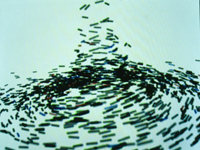
1988, 1:30
This piece contains a collection of dream sequences created using 3D particle systems techniques. Behavior rules are applied to thousands of individual particles to model complex phenomena such as an explosion, a snowstorm, a tumultuous head, and a waterfall. Data-parallel computation was us
ed to perform physical simulations on thousands of particles simultaneously, one processor for each particle.
Software and Animation: Karl Sims
Sound: Robert Moore, BLC Sound
Hardware: Connection Machine CM-2

1990, 2:08
Panspermia is the name for the theory that life exists and is distributed throughout the universe in the form of germs or spores. This piece places the viewer in the middle of a virtual world of an aggressively reproducing inter-galactic life form, and depicts a single life cycle of this unusual self propagating system.
Original software was used to create and animate forests of 3D plant structures. "Artificial evolution" techniques were used to interactively select from random mutations of plant shapes until a variety of interesting structures emerged. The subject matter of the piece suggests the underlying biological methods that were used to efficiently create an unusual level of complexity. Dynamic simulations and particle systems were also employed to achieve motions that are calculated automatically.
Attempts were made to bring together several concepts: chaos, complexity, evolution, self propagating entities, and the nature of life itself. This botanical form of life, reproducing itself from planet to planet through space, is in many ways analogous to other self replicating systems including organisms, entire species, or even ideas. A window into this system, replicating on a grander scale, is meant to increase awareness of self propagating systems in general, as well as inspire thoughts about our entire planet of life as a whole entity.
Software and Animation: Karl Sims
Sound: David Atherton, David Grimes, Steve Blake, Target Productions
Thanks to: Lew Tucker, Jim Salem, Carl Feynman, Dave Sheppard, David Marvit, JP Massar, Gary Oberbrunner, & Danny Hillis
Hardware: Connection Machine CM-2
0
replies
tags -
artificial life,
computer animation,
particle systems
Bookmark this post: |
|
2008-07-07
>> Casey Reas

"I like to manifest the software in different media because each media gives me some sort of different way of presenting a thought or a concept. When presenting the software as running software, as interactive software, it allows me to explore the domain of response. Doing it as a print allows me to explore a new level of materiality and tactile quality, which is not possible in screen based media. All the work that is being shown here explores being able not to have control over the machine. So, in essence, it's the same software but each media gives me a different way of exploring a piece of code."
(http://www.artificial.dk/articles/reas.htm)
a bit further down:
"Perhaps one of your more ambitious projects is Processing, which is also featured here at Ars Electronica. It's a programming language and software environment that you are developing with Ben Fry. When and why did you start this project?
We began 2 years ago, I guess, actually, I have been programming for 5 years then. Ha-ha... time flies! Ben and I are both teachers doing all our work in software and we are really frustrated with the current software environments that exist for doing this kind of work. Nobody has really designed a software environment for working in the way that we like to work, so that's why we started building it. We always worked in software environments like C, C++, Java, and OpenGL. These environments are too complex. They're trying to do everything so they're just massively difficult to use. And what we need is just something that is specifically tailored for the work that we want to do. So in our language for example, we have a simpler and better control over color than any other programming language that I have ever seen before. So it's specifically designed for the things we find important.
An artistic tool?
Yes, it's specifically made for what we call electronic arts. Oh, and it's very good for connecting electronics to computers as well. So you're able to connect a camera or connect two computers together.
It has three different learning levels. In the most basic layer you're able to type in just a few lines of code and see a result, and the next layer there's a slightly larger structure that allows you to do things that are responsive and things that can be animated. And then, in the third layer, you are actually programming in Java itself. We taught a lot of workshops were we had people who had never learned to program before and after just two weeks they were doing really nice works. Another really important thing about the language is that we have designed it slowly over 2 years, and we have always been teaching with it and using it personally the whole time, so it grows very organically.
I heard Golan Levin quote John Maeda, saying something like "When you use other people's software you live in somebody else's dream". Do you recognize the quote? - Are 'processing users' living in your dream?
I don't know this quote directly, but it makes sense. There are many levels of software from the general to the specific. As software becomes more specific, it limits the possibilities. Processing is very general and doesn't put many constraints on the possibilities of software. In many respects Processing is living in the dream of Java and OpenGL. It's more a collage of ideas than a specific revolution…"
0
replies
tags -
artists,
computer animation,
computer graphics,
media art,
processing
Bookmark this post: |
|
>> LIA

www.strangethingshappen.org
see also @c, a collaboration of LIA, Miguel Carvalhais and Pedro Tudela:
http://www.at-c.org/

0
replies
tags -
artists,
computer animation,
computer graphics,
live visuals,
processing,
real time
Bookmark this post: |
|
2008-07-03
>> Ed Zajac, "A Two Gyro Gravity Gradient Altitude Control System", 1962

0
replies
tags -
computer animation,
computer graphics,
Labs,
scientific visualization
Bookmark this post: |
|
>> Small Talk, Shazam (animation SW), Dynabook
http://www.newmediareader.com/book_samples/nmr-26-kay.pdf
"Much of the design of SHAZAM, their animation tool, is an automation of the media with which animators are familiar: movies consisting of sequences of frames which are a composition of transparent cels containing foreground and background drawings. Besides retaining these basic concepts of conventional animation, SHAZAM incorporates some creative supplementary capabilities. Animators know that the main action of animation is due not to an individual frame, but to the change from one frame to the next. It is therefore much easier to plan an animation if it can be seen moving as it is being created. SHAZAM allows any cel of any frame in an animation to be edited while the animation is in progress. A library of alreadycreated cels is maintained. The animation can be singlestepped; individual cels can be repositioned, reframed, and redrawn; new frames can be inserted; and a frame sequence
can be created at any time by attaching the cel to the pointing device, then showing the system what kind of movement is desired. The cels can be stacked for background parallax; holes and windows are made with transparent paint. Animation objects can be painted by programs as well as by hand. The control of the animation can also be easily done from a Smalltalk simulation. For example, an animation of objects bouncing in a room is most easily accomplished by a few lines of Smalltalk that express the class of bouncing objects in physical terms."
--> McLaren
--> Baecker, GENESYS
+++++++++++++++
SMALL TALK
... is an object-oriented programming language, developed at Xerox PARC by Alan Kay, Adele Goldberg, et.at. in the 1970ies. Influences come from LOGO (as mentioned below), Lisp, Simula and Sketchpad.
Seymour Papert, a great influence on Kay, was creating computer systems for children to use creatively on the other side of the United States, at MIT. There, he developed LOGO (see ◊28). Kay’s previous work on FLEX had sought to create a computer that users could program themselves. This work led to the definition of object-oriented programming (inspired, in part, by Sutherland’s “Sketchpad” (◊09)). From Papert’s work, Kay saw how far this idea could be carried, and refined his notion of why it was important. The next stage of Kay’s work in this area culminated in Smalltalk.
http://www.newmediareader.com/book_samples/nmr-26-kay.pdf, page 2:
Kay on Papert's Papert’s influence in 1990:
“I was possessed by the analogy between print literacy and LOGO. While designing the FLEX machine I had believed that end users needed to be able to program before the computer could become truly theirs—but here was a real demonstration, and with children! The ability to ‘read’ a medium means you can access materials and tools generated by others. The ability to ‘write’ in a medium means you can generate materials and tools for others. You must have both to be literate. In print writing, the tools you generate are rhetorical; they demonstrate and convince. In computer writing, the tools you generate are processes; they simulate and decide.” (“User Interface: A Personal View,” 193)
(http://www.smalltalk.org/smalltalk/TheEarlyHistoryOfSmalltalk_Abstract.html)
"Early Smalltalk was the first complete realization of these new points of view as parented by its many predecessors in hardware, language and user interface design. It became the exemplar of the new computing, in part, because we were actually trying for a qualitative shift in belief structures--a new Kuhnian paradigm in the same spirit as the invention of the printing press-and thus took highly extreme positions which almost forced these new styles to be invented." (Alan Kay)
++++++++++++++++
DYNABOOK
"I remembered a wonderful phrase of Marshall McLuhan. He said, I don't know who discovered water, but it wasn't a fish. The idea is if you are immersed in a context you can't even see it. So we decided to follow Seymour Papert's lead and instead of trying to design for adults we would try and see what this Dynabook of the future would be like for children and then maybe hope some of it would spill over into the adult world. So children were an absolutely critical factor here. " (Alan Kay, http://www.artmuseum.net/w2vr/archives/Kay/01_Dynabook.html#)
The concept of the Dynabook is what later on became the laptop. The target audience would be children. The Dynabook ran on Small Talk. Kay was one of the main developers and was involved in the creation of the 1-Laptop-per-Child group.
Alan Kay about Humans and Media:
“Devices” which variously store, retrieve, or manipulate information in the form of messages embedded in a medium have been in existence for thousands of years. People use them to communicate ideas and feelings both to others and back to themselves. Although thinking goes on in one’s head, external media serve to materialize thoughts and, through feedback, to augment the actual paths the thinking follows. Methods discovered in one medium provide metaphors which contribute new ways to think about notions in other media."
Alan Kay on Dynabook:
(http://www.smalltalk.org/smalltalk/TheEarlyHistoryOfSmalltalk_Abstract.html)
"Most ideas come from previous ideas. The sixties, particularly in the ARPA community, gave rise to a host of notions about "human-computer symbiosis" through interactive time-shared computers, graphics screens and pointing devices. Advanced computer languages were invented to simulate complex systems such as oil refineries and semi-intelligent behavior. The soon-to-follow paradigm shift of modern personal computing, overlapping window interfaces, and object-oriented design came from seeing the work of the sixties as something more than a "better old thing." This is, more than a better way: to do mainframe computing; for end-users to invoke functionality; to make data structures more abstract. Instead the promise of exponential growth in computing /$/ volume demanded that the sixties be regarded as "almost a new thing" and to find out what the actual "new things" might be. For example, one would computer with a handheld "Dynabook" in a way that would not be possible on a shared mainframe; millions of potential users meant that the user interface would have to become a learning environment along the lines of Montessori and Bruner; and needs for large scope, reduction in complexity, and end-user literacy would require that data and control structures be done away with in favor of a more biological scheme of protected universal cells interacting only through messages that could mimic any desired behavior."
0
replies
tags -
computer animation,
computer history,
Xerox PARC
Bookmark this post: |
|
>> Larry Cuba, interviewed by Gene Youngblood, 1986


CALCULATED MOVEMENTS
An Interview with Larry Cuba
by Gene Youngblood
Larry Cuba is one of the most important artists currently working in the tradition known variously as abstract, absolute or concrete animation. This is the approach to cinema (film and video) as a purely visual experience, an art form related more to painting and music than to drama or photography. Viking Eggeling, Hans Richter, Oskar Fischinger, Len Lye, Norman McLaren and the Whitney brothers are among the diverse group of painters, sculptors, architects, filmmakers and video and computer artists who have made distinguished contributions to this field over the last 73 years.Insofar as it is understood as the visual equivalent of musical composition, abstract animation necessarily has an underlying mathematical structure; and since the computer is the supreme instrument of mathematical description, it's not surprising that computer artists have inherited the responsibility of advancing this tradition into new territory. Ironically, very few artists in the world today employ the digital computer exclusively to explore the possibilities of abstract animation as music's visual counterpart. John Whitney, Sr. is the most famous, and rightly so: he was the first to carry the tradition into the digital domain, and his book Digital Harmony is among the most rigorous (if also controversial) theoretical treatments of the subject. But for me Cuba's work is by far the more aesthetically satisfying. Indeed, if there is a Bach of abstract animation it is Larry Cuba.
Words like elegant, graceful, exhilarating or spectacular do not begin to articulate the evocative power of these sublime works characterized by cascading designs, startling shifts of perspective and the ineffable beauty of precise, mathematical structure. They are as close to music---particularly the mathematically transcendent music of Bach---as the moving-image arts will ever get.
Cuba has produced only four films in thirteen years. The best known are 3/78 (Objects and Transformations) (1978) and Two Space (1979). The imagery in both consists of white dots against a black field. In 3/78 sixteen "objects," each consisting of a hundred points of light, perform a series of precisely choreographed rhythmic transformations against a haunting, minimal soundtrack of the shakuhachi, the Japanese bamboo flute. Cuba described it as “an exercise in the visual perception of motion and musical structure." In Two Space, patterns resembling the tiles of Islamic temples are generated by performing a set of symmetry operations (translations, rotations, reflections, etc.) upon a basic figure or "tile." Twelve such patterns constructed from nine different animating figures are choreographed to produce illusions of figure-ground reversal and afterimages of color. This is set against 200 year old Javanese gamelan music. Both films have won numerous awards and have been exhibited at festivals around the world . Calculated Movements, Cuba's first work in six years, premiered in July at the San Francisco Museum of Modern Art and was also included in the film and video show of SIGGRAPH '85, the international computer graphics conference. It is a magnificent work, destined to join 3/78 and Two Space as a classic of abstract animation. It represents a formal departure from its predecessors. Whereas they were produced on expensive vector graphic equipment at institutional facilities, using a mainframe and minicomputer respectively, Calculated Movements was produced at Cuba's studio in Santa Cruz on the Datamax UV-1 personal computer with Tom DeFanti's Zgrass graphics language. This is a raster-graphic system that allowed Cuba to work for the first time with solid areas and "volumes" rather than just dots of light. The result, both in design and dynamism, is strongly reminiscent of the films of Oskar Fischinger.
Computer animation is neither film nor video---those are simply media through which a computer's output can be stored, distributed and displayed. Previously Cuba released his work only on film, but Calculated Movements is available on both film and video. We talked about the theory and practice of abstract animation, about the computer as an instrument of that practice, and about the production of Calculated Movements.
GENE: There's a widespread belief that mathematics and intuition are somehow antithetical; yet the outstanding characteristic of your work is a graceful musicality that feels profoundly intuitive, even spiritual.
LARRY: I appreciate your saying that because that's clearly my goal . Music does do that, and it has an underlying mathematical structure, although I think no one's really clear on how or why it affects us the way it does, what the rules are. A lot of people are working on that and have theories about it. It seems my job is to see how we can do it graphically.
What I'm trying to do is, I think, very difficult. The creative process here appears to be so much different than from most art forms---using mathematics to create pictures, trying to make them affect us the way music does. ' How do I create these things? . . . " I think it comes from paying attention to things that affect me. When I see visuals that elicit that response I think about why, where it came from, what is the quality? In a sense, this is what abstraction is about: what's the essence without the details? I'm always searching for that. In computer graphics today there's, this great push toward simulating reality, especially natural phenomena. Realistic simulations of plants, for example. Plants are beautiful, so naturally the simulations are beautiful. Plants, mountains, trees, the pattern water makes when it goes over a rock-these are evocative in the same way music is. But I want to know why. I don't want to simply reproduce the pattern; I want to know what it is about the pattern that evokes that feeling. And what's the relation between that pattern and its mathematical description?
What they're finding now as they attempt to simulate things like trees is that there's a balance between total randomness and an order that's very predictable. Leaves of a tree are different in some ways and the same in others. So there's a delicate balance between the order which makes them the same and the randomness which makes them different. It's what makes the tree so aesthetically satisfying. And that's where the underlying mathematics comes in. In my work, I start with a very ordered system and continually add the variations which make it more and more interesting.
GENE: When you show your films in person, you frequently talk about the history of hand-drawn abstract animation and show examples of work by Fischinger and McLaren and others.
LARRY: That's to establish an appropriate context for the work. Because typically the interest in these films comes from an interest in the technology, the fact that it's computer graphics or computer animation. It seems the major assumed goal is to push the state of the art technologically. I'm not interested in that. My work is not part of that big race for the flashiest, zoomiest, most chrome, most glass, most super-rendered image. My interest is experimental animation as the design of form in motion, independent of any particular technology used to create it. The underlying problems of design in motion are universal to everyone working in this tradition whether they use the computer or not. So in that sense what I do is not "computer art.”
On the other hand the technology is clearly important. If you think about the process used in abstract animation it does become important that you’re using a computer in the way it affects your vocabulary. Because if you start with these mathematical structures you can discover imagery that you have not previsualized but have ‘found’ within the dimensions of the search space. Certainly every artist is engaged in some form of dialogue with their tools and their medium, whether it's brushes on paint and paper or a video synthesizer or a computer. But my tool is the mathematics and the programming that depend on a computer as the medium to execute it. So in that sense the computer adds a new dimension to this field of exploration which started with Gina and Corra, the Italian Futurists who are attributed with the earliest abstract films in 1912. They were talking 20th century dynamism. Today we're talking mathematics.
GENE: Do you have a formal background in math?
LARRY: I don’t use any math more advanced than what you learn in high school. Just algebra. But I do have an interest in mathematics as a domain of thought. It’s a lot like art---a world in itself, apart from everyday reality yet also underlying everyday reality. And the more advanced the mathematics the more abstract it is. It becomes more a world of its own. You can say the same about art as it be comes more abstract.
GENE: How do you work? Do you think up an image and then work backward from image to an equation?
LARRY: A little of both. It's ironic, but I find that when I visualize a specific image and program it up, it never looks as interesting as I thought it would. But that's the beginning. I can see what's wrong with it and that's where I start making changes. It's a real exploration through a space of imagery that I'm led to through this dialog, so that every experiment leads to the next experiment.
GENE: That's the whole point of experimental work. It's research.
LARRY: Or art. Someone once asked what I mean by the term "experimental film." What makes them experimental? I said because they’re not previsualized. They're the result of experiments and dialog with the medium. And he said, 'Well, all art is like that, that's what art is." I said all art is like that but all film is not. We're much more used to films being preconceived, both in content and execution. Even many people with whom I share the same intent will listen to a piece of music, come up with images, storyboard them and animate them . So that by the time they get to the production stage the result is almost a foregone conclusion.
That's much less of a dialog than my approach and in that sense it's not as experimental. Also there's the danger that the music is carrying the piece: take away the sound and there's not much left. In my work, the visuals come first. I'm trying to discover what works visually, so I never start with music. That would be starting with a composition that already exists, and composition is the problem. I don't have an image of the final film or even any of the scenes before I start programming. I only have basic structural ideas that come from algebra, or from the nature of the [computer] drawing process, or from the hierarchical structure of the items in the scene and how they will dance---the choreographic movements from a mathematical point of view.
GENE: Calculated Movements differs from your earlier films more than they differ from one another.
LARRY: The most obvious difference comes directly from the hardware. The other films were done on vector systems, so I was using dots. Going to the Zgrass machine meant not only going down from a mainframe to a mini to a micro but also going from vector to raster graphics. So this is my new palette, so to speak. New in two ways: I could draw solid areas so that my form became delineated areas instead of just dots, and I had four colors: white, black, light grey and dark gray. Every film I've made was done on a different system. This is the only piece I've made on this machine. So the evolution of my work is directly parallel to the evolution of systems I've used.
Two Space was not composed in real time. It was done in the traditional manner of writing the program, running it on a computer in animation mode where it takes several seconds per frame, then it goes to film, then the film is processed, and only then can you see it move. As a result, the rhythmic structure of Two Space is rather limited. There isn't much variation. The pacing is very much like the gamelan music I used on the soundtrack, regular and continuous. The advantage was that working in animated time imposed no limit on the complexity of the image. As long as I was willing to wait it would continue to draw dots. So the images could be dense and they could be of any arbitrary formulation---the computation required to calculate where the dot goes could be arbitrarily complex. For 3/78, I used a real time system. When I ran my programs I could see the animation immediately. That feedback allowed me to deal with a more varied rhythmic structure. There's much more variation in 3/78, so it feels more musical in the western sense of polyrhythmic structure. But there was a trade-off because there's a limit to what can be calculated and drawn in real time, and that imposed a limitation on its visual complexity. With Calculated Movements, I was back working in animated time. Consequently, I don't think it's as rhythmic as 3/78 in the sense of a variety of movements. 3/78 is one continuous transformation from beginning to end whose movements start and stop and change speed according to a fairly complex score without much repetition, whereas each event in Calculated Movements has its own fixed internal rhythm. It comes and goes and there isn't much variation other than that. So in that sense it's more like Two Space.
GENE: It feels very fluid and elegant to me. Can you describe the compositional strategy?
LARRY: There are five movements that alternate between two types. The odd-numbered movements are each structured as a single event about a minute long in which ribbon-like figures follow a single trajectory against a middle gray background, and each scene represents a structural variation on this theme.
In the first movement a single rib bon appears, follows a trajectory and disappears; it's followed by another ribbon, then another, and so on, all following the same path. So there are no transformations in space but a large transformation in time---that is, the figures are shifted out of phase only in time but not two dimensionally. Another option is to spread them out in a two-dimensional pattern so they can be traversing this path simultaneously. So in the third movement they're shifted both in time and space. Also, because the figures are longer they overlap and form a dense array. They appear, go through the trajectory and disappear. In the fifth movement, they’re also shifted in time and space but they're shorter in length, so they look more like a flock of birds.
The strategy for the even-numbered movements, in contrast, was a collection of forty short events ranging from one and a half seconds to five seconds, orchestrated to appear and disappear at different intervals. Each event follows the same basic structure of a trajectory, repetition of the figure and some transformation spatially and temporally of each repetition. I designed these events using a random number generator that selected values for each parameter from within a predetermined range. Many events were generated this way, then I selected and orchestrated them intuitively. So the overall strategy for Calculated Movements is a two dimensional pattern whose parameters are: What is the path? How many figures are there? How far apart are they? What are the dimensions of each ribbon? And the phasing---how far apart in time are they? This is essentially an evolution of the Two Space approach. All of Two Space came from variations of the basic figure whose parameters were fixed for the whole film. The next step was to start varying those parameters to get more degrees of freedom. And that's Calculated Movements.
GENE: What about sound?
LARRY: Larry Simon and Craig Harris did the odd-numbered movements based on my suggestions. They used a computer-controlled Yamaha DX-7. These are the scenes that follow the same path and have the feel of being one long event, so they have one type of very melodic music almost Philip Glass style.
The other scenes were more difficult because their structure is more intricate- more isolated events. Rand Weatherwax did the sound for these using an Emulator Two, a digital sampling device like the Fairlight or the Synclavier that has a built-in sequencer. I found it would be easy to match the sequencing of sound events with graphics events by programming into the sequencer the same temporal structure as the images. So, because we synced up sonic events with graphic events you might say that the composition-in the sense of when notes appear and disappear-comes directly from the underlying structure that I had composed for the graphics. But when it came to what sounds to plug in for each event, Rand would pull out one of his library of effects and would modify it until I was satisfied. So in that sense it was a collaboration not unlike my collaboration with John Whitney as programmer for Arabesque. John didn't actually write the programs but he had very specific ideas. So who composed Arabesque? Well, it's John’s film creatively; I only worked as programmer, but I think if someone else had programmed it, it would have come out differently.
GENE: How long did you work on the visual composition?
LARRY: About two and a half years. The first few months are always spent developing tools in the particular language you're using. The language itself is a tool but then you create your own tools with it---called macros or sub routines---to do generalized classes of things. That’s a reason why the generalized approach takes more time. For 3/78, I spent about three months developing the tools that would allow me to manipulate geometric figures and score them with different phasing and patterns and so on. Then came the matter of using that tool to score a specific sequence. So first I developed the tools and then I made the film.
But with Calculated Movements the tools evolved simultaneously with the visual composition. I started making serious progress only when I got a Lyon-Lamb video animation system about two years ago. Then I could do extended scenes on tape so I could see what I was doing. I'd program the scenes then run the computer for ten or twenty hours to produce the animation. I did have some preview during the still phase/ while I was developing the program. I could look at some images to make sure the program was running right. Then I’d run it and look at the tape, and that was the first time I actually saw the images move. At that point l’d frequently realize I needed a whole other set of tools so I'd rewrite the entire system and experiment some more. Over two years I generated about ninety minutes of working material, about a hundred individual shots. That represents an evolution of programs. So there was an evolution of the tool simultaneously with the evolution of the pictures-to the extent that I'd get way down the line and look back at the early pictures and realize I couldn't generate those pictures anymore because the software had evolved. I'd opened up new dimensions and closed off others. So it represents my own personal evolution. As Jane Veeder likes to say, the artist is the work in progress. This is two years of working on me. The films are like progress reports. They represent where I am at this point in the evolution.
Gene Youngblood on "Calculated Movements":
"Calculated Movements...was produced on a raster-graphic system that allowed Cuba to work for the first time with solid areas and "volumes" rather than just dots of light. The result, both in design and dynamism, is strongly reminiscent of the films of Oskar Fischinger.
Words like elegant, graceful, exhilarating or spectacular do not begin to articulate the evocative power of these sublime works characterized by cascading designs, startling shifts of perspective and the ineffable beauty of precise, mathematical structure. They are as close to music --- particularly the mathematically transcendent music of Bach --- as the moving-image arts will ever get."
--- Gene Youngblood, Video and the Arts
fromthe EVL-website:
"Calculated Movements by Larry Cuba is an example of early video art using software developed at the Electronic Visualization Laboratory (EVL). The video has a minimalist/ambient original sound piece.
In the 1970s the computer graphics for the first Star Wars film (1977) was created by Larry Cuba at the Electronic Visualization Laboratory (EVL) (at the time known as the Circle Graphics Habitat) at the University of Illinois at Chicago.
Calculated Movements is a sample of Cuba's later work."
from: www.well.com/user/cuba/Mediagramm.html
"Larry Cuba must be considered the most distinguished practitioner of "computer graphics", for, though he has created only three films in the last 20 years, each one of them remains a masterpiece of Visual Music that resonates with fresh interest each time it is viewed-- the same replay-value that fine auditory music possesses.
The origin of Cuba's excellence arises from several factors, one of them undoubtedly native genius, but that can not be measured or discussed so easily. Larry was born in 1950 in Altanta, Georgia-- home of Gone With the Wind, Coca Cola, Delta Airlines and the 1996 Olympic Games. He received his Master's Degree from California Institute of the Arts, a unique college near Los Angeles, which includes parallel schools of Dance, Music, Film, Theater, Fine Arts, and Writing. The Cal Arts faculty included abstract animator Jules Engel, Expanded Cinema critic Gene Youngblood, and special- effects wizard Pat O'Neill. The animation studios at Cal Arts also sit next door to the Gamelan rooms which host a staff of Indonesian instructors, with both a Balinese and a Javanese gamelan orchestra-- so that while the animators work, they can often hear the mellow bell harmonies such as those Larry would later use for his film Two Space. Engel and Youngblood definitely instilled in all the students a love for the great masters of Visual Music from the pioneers Walter Ruttmann, Oskar Fischinger and Viking Eggeling to the living (then) California masters James Whitney, Jordan Belson and Harry Smith. For Larry this certainly meant a refinement of his aesthetic perception and standards, which would make him prepare his own later films consciously, with extra care and no compromise.
Pat O'Neill, in addition to the inspiration from his fascinating, exquisitely-complex animation/live-action films, influenced a generation of Cal Arts students, including Adam Beckett, Robbie Blalock, Chris Casady and Larry Cuba, who all worked on special effects for the landmark 1977 science-fiction feature Star Wars.
Next to the factor of artistic taste, the most important aspect of Larry Cuba's success in Computer Graphics probably rests in the fact that he himself programs his own films. Beginning with the "pioneers"-- like Stan Vanderbeek and Lillian Schwartz who both used Ken Knowlton's Beflix program to create numerous "computer graphic films" which all look painfully alike, awkward in their accretion of oozing grids-- most artists have relied on software packages prepared by a technician or endemic to a particular hardware system. Their artistic compositions had to cope with the parameters, demands and limitations of a program over which they had no control. John Whitney, one of the senior pioneers of Computer Graphics (for whom Larry Cuba prepared the program of the 1975 Arabesque), complained until his dying day about the limitations of his hardware and software, which never allowed him to create simultaneous real-time parallel visual and auditory compositions-- and, for example, usually left him employing an automatic color-mapping instead of a more sophisticated nuancing of hues that might have suggested an equivalent of auditory tone colors.
In his own films, Larry has avoided aspects such as texture and color which can not be adequately modulated to produce genuinely satisfying artistic effects. In 3/78 and Two Space (1979) he uses only points of light against a pure black background, which if properly printed on dense black-and-white film stock and correctly projected onto a film screen (no video substitutes, please), produce after- images in the viewers' eyes that sometimes trace trajectories, sometimes add luminous sparkles of gold and iridescent colors to the dots-- a kind of predictable optical phenomenon also employed by James Whitney and Jordan Belson for "magical" effects in their films.
3/78 , created in Chicago with Tom DeFanti's Graphic Symbiosis System [GRASS], consists of sixteen "objects", each composed of 100 points of light, some of them geometric shapes like circles and squares, others more organic shapes resembling gushes of water. Each object performs rhythmic choreography, precisely programmed by Cuba to satisfy mathematic potentials. The fascinating aesthetic results exude musicality-- a lyrical splash of mirror-image fountains bouncing and rebounding, percussive snaps of imploding squares leaving gashes of afterimage. The spare sound score for Kazu Matsui's shakuhachi flute perfectly complements the contemplative visual images.
By comparison, Two Space presents lush, full-screen image- patterns which parallel the layered continuities of classical gamelan music. Using a programming language called RAP at the Los Angeles firm Information International Inc. (III), Larry was able to systematically explore the classic 17 symmetry groups, which Islamic artists had long since discovered as the basis for their abstract temple decorations. Since Cuba's images again consist of white points of light on a black background, the movement of these dots create patterns by their movement, and imply other patterns in the black matrix by not occupying certain "negative space". Within the film's nine-minute duration, one senses an increasing complexity, an infinite potential-- and a dazzling climax of exquisite, "imaginary" complexity, as the viewer recognizes the eye's complicity in manufacturing afterimages and negative space illusions.
For Calculated Movements (1985), Larry again tried something quite different, using Tom DeFanti's Zgrass language on a raster- graphic system, which allowed him to program solid areas and volumes instead of merely the vector dots of the previous two films. It also allowed Cuba to choose four "colors": black, white, light grey and dark grey. These new parameters let Larry work with something he had long admired in Oskar Fischinger's black-and-white Studies: the complex choreography of simple forms. In five episodes, he alternates single events involving ribbon-like figures following intricate trajectories, with more complex episodes consisting of up to 40 individual events that appear and disappear at irregular intervals. Separate electronic sound scores underline the different nature of the odd and even episodes.
Larry Cuba's residency at ZKM will allow him to explore yet another territory. Silicon Graphics, until recently, could only be used with pre-programmed modeling packages, which made it easy for artists and animators to use, but unsatisfactory for someone like Larry Cuba, who prepares his films through algorithmic concepts at the programming level, generating his musical quantities with mathematical quantities. The new Python software available for Silicon Graphics at ZKM will allow Larry to program a new film there, and possibly discover a new, unexplored world of Visual Music sensations."
0
replies
tags -
computer animation,
text,
video
Bookmark this post: |
|
2008-07-02
>> Ronald Baecker, GENESYS, 1967-69
GENESYS: Interactive Computer-Mediated Animation
The Genesys system, developed by Dr. Ron Baecker in MIT's Lincoln Laboratory from 1967-69, was one of the world's first interactive systems for real-time animation. The system involves the process of "interactive computer-mediated animation", in which dynamic displays are constructed by utilizing direct console commands, algorithms, free-hand sketches, and real-time actions. The resulting "movie" can then be immediately viewed and altered. Genesys utilizes a special kind of interactive computer-mediated animation that exploits the potentialities of direct graphical interaction. The animator may sketch and refine (1) static images to be used as components of individual frames of the movie, and (2) static and dynamic images that represent dynamic behaviour; that is, movement and rhythm. Because these latter pictures drive algorithms to generate dynamic displays, the process is called "picture-driven animation".
0
replies
tags -
computer animation,
early new media
Bookmark this post: |
|
2008-06-26
>> Charles Csuri, "Random War", "Humming Bird", mid 1960ies
Charles Csuri on http://www.siggraph.org/artdesign/profile/csuri/artworks/plot/plot.html:
"I was fascinated by the idea of being able to do transformations on a drawing. The work of Sir D'Arcy Thompson the noted biologist and mathematician was of great interest to me. His book Growth and Form was first published in 1917 and another edition in 1961. He illustrated the use of a 2D grid system to make transformations on a drawing.

His work had an influence upon the analogue computer art I created in 1963. Beginning in 1964 I began creating my first digital images. These images were generated with fortran programs which ran on an IBM 7094 computer. This computer was much slower than today's personal computers and one had to submit a job for processing.
For computer graphics the 7094 had as output cards about 4 x 7 inches with holes in them which contained information to drive a drum plotter. Boxes of cards could represent a single image. The cards were entered into a card reader on an IBM 1130 computer with a plotter device. These punch cards had the information to move the pen and pick the pen up or down as well as programmed instructions for end of line, etc."
You might also want to read th ehistory of the Computer Graphics Research Group (CGRG) at the Ohio State University, the university, where Charles Csuri taught:
http://design.osu.edu/carlson/history/ACCAD-overview/overview1.html

--> early animation
--> morphing
Jasia Reichardt, "The Computer in Art", 1971
"Unlike so many artists involved in the development of a relationship between art and technology who have to rely entirely on help from engineers and technicians in order to realize their ideas, Csuri is a competent programmer and is capable of designing systems to suit his own purposes. His centennial project was the first of this kind in a university, involving fourteen departments contributing their skills and equipment. The exhibition involved decision-making on the part of the audience in the form of evaluation and participation. Csuri has gone beyond that area of computer graphics which is limited to transformations from one image to another, or indeed transformations of a single image, according to a set of predetermined principles. As we sshall see later, it is no longer possible to talk about computer-generated graphics as an art medium without mentioning environmental art, cybernetic systems and spectator participation - events which have grown out of and around the idea of converting images into their equivalents either in sound or movement. Typical of the sort of possibility that computer technology offers beyond the two-dimensional works on paper, Csuri's venture, like other exhibitions dealing with the computer and the arts, was open-ended - there was nothing absolutely finite either about the results produced or the possibilities encountered. Apart from the on-line drawing controls, there were television sets on which one could alter colour, movement or shape, screen projection of pictures controlled by signals from the spectator's body, as well as an electronic sound laboratory where visitors could make their own sound sequences. The other important and significant aspect of this sort of venture is that it is a do-it-yourself platform where those involved are not strictly divided into two categories of those admiring and those admired. This has a far more sociological implication than one might immediately realize judging by the results, most of which have no significant aesthetic value.
Charles Csuri's own work has also undergone some changes since he first made computer graphics in 1967. He became increasingly involved in the development of a real-time interactive environment for computer film animation. Csuri writes:
'Basically this is what I can do now, I sit in front of a cathode ray tube display and draw images upon the screen with a light pen. The drawing routine has been designed with an artist in mind rather than an engineer. These cathode ray tube drawings can be background images and abstract structures as well as representational images. A computer program stores the data which represents drawings on a disc, and I can, through program control, read them into animation programs also stored on the disc. With the light pen I draw the path I wish a drawing to follow, in fact I can draw several paths for several drawings on the same screen. Then I type the parameters which control speed, rotation and transformation changes (permutations) of each drawing on the screen. The computer reacts so quickly that once I depress the last key of my message, the images move like a motion picture display on a television set. All the calculations representing the hundreds of individual frames for moving pictures are done so rapidly that it happens like a film. If I don't like the result I can change it within a few seconds and see the new result again to judge time, speed, shape and position. For a zoom effect I draw the path which can be any path and press a function key to witness the effect. I can try out several dozen combinations withon one hour. Throug a switch on the control panel of the computer I can have the images generated for a stop action filming. We have built some electronic circuitry to automatically control the camera. The computer keeps track of my frame count which is very useful if I want to back up the film on the motion picture camera and overlay one moving image upon another one. It also calculates the number of frames required, say 2 per second, 10 per second, 31 per second, and so forth for smooth real-time motion. Recently we also developed a three-dimensional computer animation program for rotation, projection and translation. I can take a three-dimensional drawing (x,y,z, coordinates) and move it along a path in three dimensions and change its shape and size as it is in motion. From my point of view a program to control three-dimensional moving images (a real-time environment) is a significant one. This program represents quite an achievement fo rthe project. In another program I can animate any part of a drawing independent of the other parts. For example, if I use a line drawing representing a face, I can move an eye, eyebrow, nose, ear, mouth, and so forth in real-time. There are several other things we can do in computer animation but it would take considerable detail to explain them.
My computer-animated film Hummingbird cost about $12.000 in compuet time to make and that was in 1967. By comparison that is, assuming 10 minutes of animation, I am now making more complex films in a spontaneous manner in living color for $120, and that includes costs of computer time, film and film processing.'
More recently, Csuri has turned to computer sculpture, of which by the end of 1969 there were only a few examples. Csuri describes a technique for creating a computer sculpture:
'This approach to computer sculpture involves two basic procedures. One procedure is mathematical and involves a computer technique to generate x,y,z, coordinates which represent a three-dimensional form. The second requires a comprehensive set of computer programs which analyze the form for a continuous path, 3 axis milling machine.
Procedure 1:
A unit cube was used in the mathematical technique to develop a three-dimensional surface, which with values between 0 and 1 has certain computational advantages and is a convenient module that permits the development of complicated forms. A modular concept permits the juxtaposition of many unit cubes to achieve a desired aesthetic result. The artist has the option to define the boundary curves on each of the four faces of the unit cube. Once the boundary curves are eestablished they are approximated by equations. These equations generate 100 points along each boundary curve, and the computer program takes an average from all four sides of a cube. An alternative approach is to define the boundary curves on graph paper and then 'read in' their coordinates into the computer program. In figure 36, the two opposite faces with boundary curves, the simple case of how a surface can be defined is demonstrated. As one views figure 35 it is difficult to visualize the interior of the unit cube based on the four boundary curves indicated in the illustration. In thoe instances where lines from opposite curves intersect in the x-y plane but do not meet in the z plane, a mathematical technique was used averaging out the two zs to establish a three-dimensional coordinates of the surface, at the same time preserving the artist's original boundary curves.
In the next step a computer program takes the coordinates, which represent the surface, and makes the necessary calculations for computer drawings. It is a three-dimensinal perspective routine that eliminates hidden lines from a specified viewing angle. The artist can indicate his viewing angle and the computer program with a graphic plotter will give him a representation of the form. Figures 37 to 40 are an example in which a viewing angle of 45° was specified and the form was rotated in four steps through 360°. The hidden line routine also permits the representation of stereo pairs based on the data-set, so that the artist can have some feeling for the three-dimensional experience (fig. 41). There are other inetersting options available to the artist which permit further experimentation. At an operational level, peaks and valleys can be used to manipulate the surface which was developed through the technique of the unit cube. Figure 42 shows an x-y plane,while figure 43 is a representation of several peaks which have been added to the x-y plane. The artist needs only to specify an x,y,z, coordinate (a location on the plane plus a height or depth) for each peak and a computer program handles the problem. There are options in the program to specify the angle of the slope of a peak with variation on each side of the peak. It is also possible to establish a relationship betweeneach of the peaks to give smotth continuity. Valleys or depressions can be made in the same way as peaks, as shown in figure 44. Figure 45 illustrates a combiantion of peaks and valleys.
[...] - to be continued --- i just dont liek to continue typing for the moment
--> key fram animation
-_> compare to the logics of after effects, flash or other animation software now
Charles Csuri:
"In 1963, I used an analog computer to make transformations on my line drawings. It could represent directly mea-surable quantities, and the results could be replicated. I discovered digital computer graphics in 1964, and my world was changed, forever.
Thirty-four years later, I find the problem of art is still the same, which is to create a meaningful structure to reveal aesthetic content. However, I have been affected by computer processes and procedures. I came from a traditional background as an artist, with a relatively simplistic viewpoint about structure and nature. My conception of nature and an object has been expanded by science and computer graphics. I better understand how computer procedures can affect one¹s definition of an object. An object is not simply a geometry. My object has built-in procedures that affect its behavior. Also, when I touch it, my object can make sounds or change its form. It can send messages to other objects.
I see and feel a single object from many points of view. When I make copies of an object, they become captured instances of time representing inner agents and different psychological states. Symbolically, it represents past, pre-sent, and future states and becomes a character within a virtual space. The surrounding atmosphere is symbolic of distance and a time past. Shadows are like an echo of what was once another reality. I try to define a mythological space to express a range of feelings, inner problems, and mysteries."
(http://www.siggraph.org/artdesign/gallery/S98/pione/pione1/csuri.html)
0
replies
tags -
artists,
computer animation,
computer graphics,
computer sculpture,
early new media,
rotten + forgotten
Bookmark this post: |
|
2008-06-25
>> Sten Vanderbeek and Ken Knowlton, Beflix
In this two-part demo, Sten Vanderbeek (at that time artist in residence at MIT) demonstrates the use of Beflix, a programming language especially designed for him by Ken Knowlton (from Bell Labs). With creating Beflix, Knowlton's goal was to invent an intuitive tool for artists.
"BEFLIX is the name of the first specialised computer animation language.
BEFLIX was invented by Kenneth C. Knowlton at Bell Telephone Laboratories, USA.
BEFLIX was invented in 1963.
BEFLIX is a corruption of "Bell Flicks".
BEFLIX produced images at a resolution of 252 x 184 in 8 shades of grey.
BEFLIX-generated films, created using an IBM 7094 computer and Stromberg-Carlson 4020 microfilm recorder, cost approximately $500 per minute of output.
Beflix-operations are:
Draw straight lines from dots
Draw curves
Copy region
Move region
Solid fill area
Zoom area
Jasia Reichardt in "The Computer in Art", 1971:
"The mosaic picture system devised by Kenneth C. Knowlton was used to produce both educational and research films. The other main programming language used was FORTRAN. Knowlton used the computer in two specific and distinct ways: always as a high-powered drafting machine and sometimes as a calculating machine which could determine the consequences of mathematical and logical statements.
With the mosaic system or BEFLIX (corruption of Bell Flicks) the pictures are made up of 252x184 arrays of spots of different shades of grea, or as numbers 0 to 7, indicating light intensity at that point. Pictures are built up and modified within the computer by appropriate manipulation of htese numbers. BEFLIX is not a complex language mathematically since it does things that could literally be done by hand, although it performs this task more easily (not to mention faster) since some of the patterns are 'logically simple' although graphically complex. The instructions in the BEFLIX language permit drawing straight lines consisting of dots, or drawing arcs and other curves, or copying one area with a solid shade of grey, or shifting the contents of one area up, down, right, or left, a specified number of raster positions. There are also operations for automatically filling an outline with a specific shade of grey, for enlarging part of a picture or a whole one, and for gradually dissolving one picture into another. The BEFLIX films were produced at approximately $500 per minute.
Apart from a film which demonstrated how the BEFLIX system works, Knowlton together with Stan Vanderbeek made a number of films for pleasure, with pulsating colours and intricate cascades of dots changing colour and position at a phenomenal speed. One of them Man and his World, was made for the World Fair in Montreal in 1967."
Dissolve image transition"
(from: Jasia Reichardt, The Computer in Art)
0
replies
tags -
artistic software,
artists,
collaboration,
computer animation,
computer programming language,
early new media,
world fair
Bookmark this post: |
|
>> Stan Vanderbeek and Ken Knowlton, "Poemfield"
„All of the Poemfield films explore variations of poems, computer graphics, and in some cases combine live action images and animation collage; all are geometric and fast moving and in colour. As samples of the art of the future all the films explore variations of abstract geometric forms and words. In effect these works could be compared to the illuminated manuscripts of an earlier age. Now typography and design are created at speeds of 100.000 decisions per second, set in motion a step away from mental movies.“ (Stan vanderbeek)
The video you see here is Poemfield #2 (out of a series of 7 films, starting from 1966)
0
replies
tags -
computer animation,
early new media
Bookmark this post: |
|
Subscribe to:
Posts (Atom)
>> additional class blogs


>> subscribe


 Posts
All Comments
Posts
All Comments
.........

- Nina Wenhart ...
- ... is a Media Art historian and researcher. She holds a PhD from the University of Art and Design Linz where she works as an associate professor. Her PhD-thesis is on "Speculative Archiving and Digital Art", focusing on facial recognition and algorithmic bias. Her Master Thesis "The Grammar of New Media" was on Descriptive Metadata for Media Arts. For many years, she has been working in the field of archiving/documenting Media Art, recently at the Ludwig Boltzmann Institute for Media.Art.Research and before as the head of the Ars Electronica Futurelab's videostudio, where she created their archives and primarily worked with the archival material. She was teaching the Prehystories of New Media Class at the School of the Art Institute of Chicago (SAIC) and in the Media Art Histories program at the Danube University Krems.