<< preface

this blog is nina wenhart's collection of resources on the various histories of new media art. it consists mainly of non or very little edited material i found flaneuring on the net, sometimes with my own annotations and comments, sometimes it's also textparts i retyped from books that are out of print.

it is also meant to be an additional resource of information and recommended reading for my students of the prehystories of new media class that i teach at the school of the art institute of chicago in fall 2008.

the focus is on the time period from the beginning of the 20th century up to today.

>> search this blog

Showing posts with label media art. Show all posts

2008-12-17

>> Alvaro Cassinelli, "Khronos Projector - a video time-warping machine with a tangible deformable screen", 2005

http://www.k2.t.u-tokyo.ac.jp/members/alvaro/Khronos/


excerpt from website:
"The Khronos Projector is an interactive-art installation allowing people to explore pre-recorded movie content in an entirely new way. A classic video-tape allows a simple control of the reproducing process (stop, backward, forward, and elementary control on the reproduction speed). Modern digital players add little more than the possibility to perform random temporal jumps between image frames. The goal of the Khronos Projector is to go beyond these forms of exclusive temporal control, by giving the user an entirely new dimension to play with: by touching the projection screen, the user is able to send parts of the image forward or backwards in time. By actually touching a deformable projection screen, shaking it or curling it, separate "islands of time" as well as "temporal waves" are created within the visible frame. This is done by interactively reshaping a two-dimensional spatio-temporal surface that "cuts" the spatio-temporal volume of data generated by a movie."


there are tons of documentation materials on this website, videos, slides,...


the chapters of the docu are as follows:

  1. What, Why and How
  2. Installation Setup
  3. Video Content
  4. Demos (video & snapshots)
  5. Online Demo (Java Applet)
  6. Conclusions and Remarks
  7. Future Works
  8. Acknowledgments
  9. Exhibition History
  10. Contact
  11. References

built with processing,
demo appplet: http://www.k2.t.u-tokyo.ac.jp/members/alvaro/Khronos/Khronos_P5/Khronos_Applets.htm


>> Maywa Denki, "Tsukuba Series"

http://www.maywadenki.com/english/00main_e_content.html

video:

2008-12-14

Takehisa Mashimo, Satoshi Shibata, Akio Kamisatom "Moony", 2004

the artists were students from IAMAS, Japan

"Moony for Ogaki Binnale is an artwork using steam and interactive images. We tried to create an marginal space of the theme related to existence. In this installation, visitor can detect the images of butterfly inside the vapor steam. And if visitor touch them, they start to swarm around your hands and fly biside the visitor interactively. But it is impossible to touch them phisically. Visitor will experience the mystic phenomena between real and unreal in this space."

http://www.iamas.ac.jp/~mashim03/webconsole/artworks/index.html


video: http://www.youtube.com/watch?v=XR6i41sF4-Y

Moony was the first winner of the Prix Ars Electronica's "Next Idea" category and was realized in an artist in residence period at Ars Electronica Futurelab during the summer of 2004, presented first during the Ars Electronica Festival of the same year and continued to be shown at the Center after that.

>> Gruppe FOK, "Teleklettergarten", 2003

http://tkg.co.at.tt/

"A Kletterwand as a giant computer keyboard—this climbing wall (like the one alpinists use to train for a vertical ascent) has a computer keyboard integrated into it. Touching one of its 64 keys causes the corresponding program command to be executed on a local processor. The radio-equipped climbers obey the instructions of an operator. Experts from two fields—programming and mountain climbing—come together, and have to work together. The act of climbing introduces time delays and physical exertion into the otherwise instantaneous processes of programming and digital data processing."

video: http://www.youtube.com/watch?v=U0b0Z9qM5jI (starts at TC 1:15, ends at 2:35, language: german)


2008-10-02

>> Virtual Reality (VR) + CAVE

Virtual Reality in Art:
(from wikipedia: http://en.wikipedia.org/wiki/Virtual_reality)

"David Em was the first fine artist to create navigable virtual worlds in the 1970s. His early work was done on mainframes at III, JPL and Cal Tech. Jeffrey Shaw explored the potential of VR in fine arts with early works like Legible City (1989), Virtual Museum (1991), Golden Calf(1994).

Canadian artist Char Davies created immersive VR art pieces Osmose (1995) and Ephémère (1998). Maurice Benayoun's work introduced metaphorical, philosophical or political content, combining VR, network, generation and intelligent agents, in works like Is God Flat (1994), The Tunnel under the Atlantic (1995), World Skin (1997).


Other pioneering artists working in VR have include Luc Courchesne, Rita Addison, Knowbotic Research, Rebecca Allen, Perry Hoberman, Jacki Morie, and Brenda Laurel."


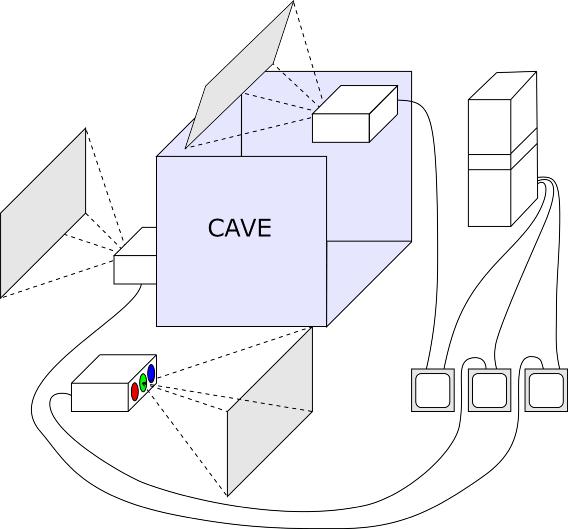
CAVE: a 3d immersive virtual environment, developed by Dan Sandin and Tom DeFanti at the Electronic Visualization Lab (EVL), Chicago:


http://en.wikipedia.org/wiki/Cave_Automatic_Virtual_Environment


some CAVEs:

@ EVL: http://www.evl.uic.edu/core.php?mod=4&type=1&indi=161
and http://www.evl.uic.edu/pape/CAVE/
@ Ars Electronica: http://www.aec.at/en/center/current_exhibition_detail.asp?iProjectID=11197
@ SAIC: http://bcchang.com/vrlab/index.php


some devices used in the CAVE:


head mounted display:
http://en.wikipedia.org/wiki/Head_mounted_display

data glove:
http://en.wikipedia.org/wiki/Data_glove


wand:
tracks the user and his/her interactions with and movements in the virtual environment.


what is...


... an immersive environment:

http://en.wikipedia.org/wiki/Immersive_environment

... augmented reality:
http://en.wikipedia.org/wiki/Augmented_reality


personalities important for the development of VR:

- Myron Krueger:

http://en.wikipedia.org/wiki/Myron_Krueger

- Dan Sandin:
http://en.wikipedia.org/wiki/Dan_Sandin

- Tom Defanti:
http://en.wikipedia.org/wiki/Thomas_A._DeFanti

- Scott Fisher:
http://en.wikipedia.org/wiki/Scott_Fisher_(technologist)

- Jaron Lanier:
http://en.wikipedia.org/wiki/Jaron_Lanier

- Marvin Minsky:
http://en.wikipedia.org/wiki/Marvin_minsky

- Timothy Leary:
By the mid 1980s, Leary had begun to incorporate computers, the Internet, and virtual reality into his aegis of thought. Leary established one of the earliest sites on the World Wide Web, and was often quoted describing the Internet as "the LSD of the 1990s."[citation needed] He became a promoter of virtual reality systems,[13] and sometimes demonstrated a prototype of the Mattel Power Glove as part of his lectures (as in From Psychedelics to Cybernetics). Around this time he cultivated friendships with a number of notable people in the field, including Brenda Laurel, a pioneering researcher in virtual environments and human-computer interaction.
http://en.wikipedia.org/wiki/Timothy_Leary#Leary.27s_last_two_decades


another VR-environment: the Immersa Desk

http://www.evl.uic.edu/core.php?mod=4&type=1&indi=163


some Art Projects done for the CAVE:

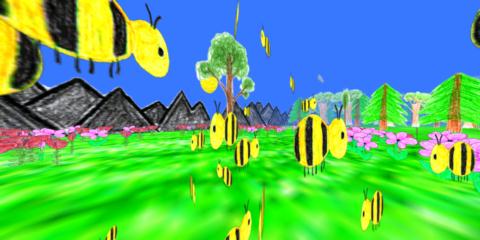
"Crayoland", one of the first and most successful CAVE-visualizations. Created by Dave OPape in 1995, 2d-crayon drawings serve as textures for the objects in this 3d-environment.


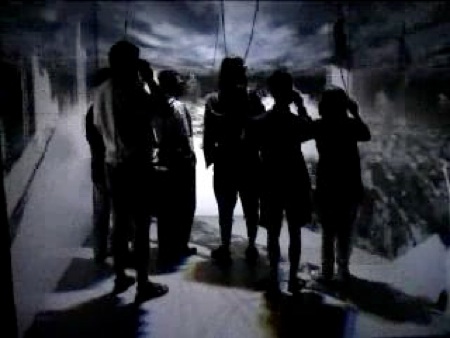
"CAVE", a project by Austrian artist Peter Kogler in collaboration with the Ars Electronica Futurelab, was realized in 1999. As a visitor, you could navigate through Kogler's abstract shapes.


"World Skin" is an award-winning CAVE-project created by French artists Maurice Benayoun and Jean-Baptiste Barrière. What was special about it was the novel approach to the user's interaction with the envoronment. The wand served as a photocamera. When you took a photo of the scenes around you, the object was washed out, leaving a blank space.


"Gesichtsraum" by Johannes Deutsch is anouther example for a collaboration of an artist with Ars Electronica's Futurelab: Deutsch and the programmers and 3d modellers worked together closely for a period of several months to develop an immersive environment out of Johannes Deutsch's paintings of his son.

2008-07-18

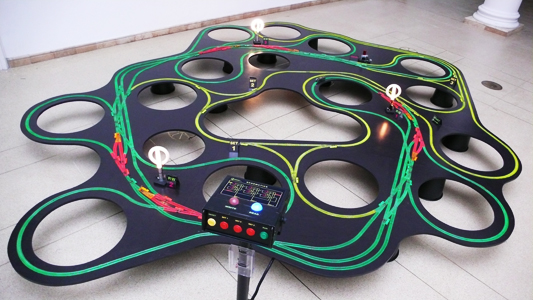
>> David Moises, Severin Hoffmann, "Turing Train Terminal", 2004

from the artists' website: http://www.monochrom.at/turingtrainterminal/abstract_eng.htm

"Scale trains have existed for almost as long as their archetypes, which were developed for the purposes of traffic,

transportation and trade. Economy and commerce have also been the underlying motivations for the invention of

computers, calculators and artificial brains.


Allowing ourselves to fleetingly believe in an earlier historical miscalculation that "... Computers in the future may have

only 1,000 vacuum tubes and perhaps weigh 1 1/2 tons." (Popular Mechanics, March 1949), we decided to put some

hundred tons of scaled steel together in order to build these calculating protozoa. The operating system of this

reckoning worm is the ultimate universal calculator, the Turingmachine, and is able to calculate whatever is capable of

being calculated. One just would have to continue building to see where this may lead..."


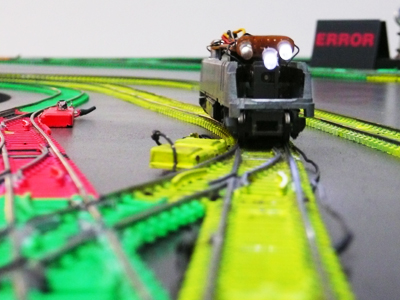
"There are three types of points in the layout.

- The distributors are orange;
- The lazy points look the same but appear in different colors;
- And the most common point is the sprung point, which is drawn with a clear preference for the route of the train.

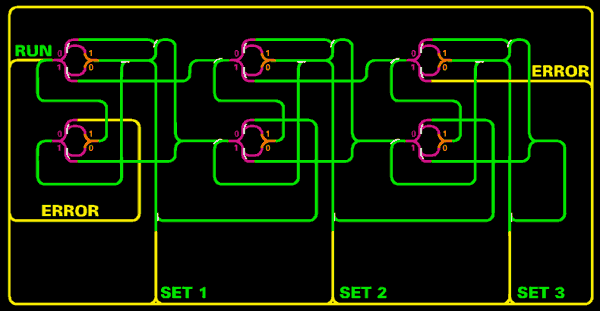
In order to prep the layout for input, all distributors and lazy points have to be set to 0. This is done, by pressing the RESET-Button. Now, the tape is set to 000.

To set the input to the tape, press the red SET-Buttons. So to set up the input 1+1 on the three-block layout, you need to send the train to the outer two SET lines: 1 0 1. Then press SET1, leave SET2 untouched and press SET3. These Buttons control the three points on the yellow ringline. Afterwards the green RUN-Button lets the train first write the INPUT-value into each read/write head. It then gets directed into the SET1 read/writehead and comes back out on that line. This has effectively set the digit stored in that block on the "tape" to 1. It passes the SET2 point, moves into SET 3 and sets this value to 1. Now the Input 1 0 1 is set - visible through the I/0-lamps.

The next station is the START point – Once the locomotive enters the system from that point the calculating starts. Now watch the train as it leaves again and finds a rest at the start point. The altered state, visible on the lamps, is the result. In this example 1 1 0, actually means 2 in the notation of this apparatus.

CALCULATING PROCEDURE

To set up the train set for a calculation it needs to be re-set. By pressing the yellow RESET Button all points get set to the value "0". This is visible through the three 1/0-lightsigns.

Now one can re-set the machine, by pressing the red SET-Buttons. After this the
locomotive is ready to calculate and it gets started with the green RUN-Button.

First the requested value gets written into the read/write-head (pink and orange) and then the train enters the system at the start-rail and gets directed through the system as the points have been pre-set and eventually leaves after a while. The altered state is the result.

The following operations can be calculated:


Input Output

0+0 000 000 = 0
0+1 010 100 = 1
1+0 100 100 = 1
1+1 101 110 = 2
0+2 011 110 = 2
2+0 110 110 = 2


background info: http://www.monochrom.at/turingtrainterminal/Chalcraft.pdf

>> Stelarc

go and visit his site: http://www.stelarc.va.com.au/arcx.html

absent body

We mostly operate as Absent Bodies. THAT'S BECAUSE A BODY IS DESIGNED TO INTERFACE WITH ITS ENVIRONMENT - its sensors are open-to-the-world (compared to its inadequate internal surveillance system). The body's mobility and navigation in the world require this outward orientation. Its absence is augmented by the fact that the body functions habitually and automatically. AWARENESS IS OFTEN THAT WHICH OCCURS WHEN THE BODY MALFUNCTIONS.

Reinforced by Cartesian convention, personal convenience and neurolo gical design, people operate merely as minds, immersed in metaphysical fogs. The sociologist P.L. Berger made the distinction between "having a body" and "being a body". AS SUPPOSED FREE AGENTS, THE CAPABILITIES OF BEING A BODY ARE CONSTRAINED BY HAVING A BODY.

Our actions and ideas are essentially determined by our physiology. We are at the limits of philosophy, not only because we are at the limits of language. Philosophy is fundamentally grounded in our physiology . . .


obsolete body

It is time to question whether a bipedal, breathing body with binocular vision and a 1400cc brain is an adequate biological form. It cannot cope with the quantity, complexity and quality of information it has accumulated; it is intimidated by the precision, speed and power of technology and it is biologically ill-equipped to cope with its new extraterrestrial environment.

The body is neither a very efficient nor very durable structure. It malfunctions often and fatigues quickly; its performance is determined by its age. It is susceptible to disease and is doomed to a certain and early death. Its survival parameters are very slim - it can survive only weeks without food, days without water and minutes without oxygen.

The body's LACK OF MODULAR DESIGN and its overactive immunological system make it difficult to replace malfunctioning organs. It might be the height of technological folly to consider the body obsolete in form and function, yet it might be the height of human realisations. For it is only when the body becomes aware of its present position that it can map its post-evolutionary strategies.

It is no longer a matter of perpetuating the human species by REPRODUCTION, but of enhancing male-female intercourse by human-machine interface. THE BODY IS OBSOLETE. We are at the end of philosophy and human physiology. Human thought recedes into the human past.


redesigning the body

It is no longer meaningful to see the body as a site for the psyche or the social, but rather as a structure to be monitored and modified - the body not as a subject but as an object - NOT AN OBJECT OF DESIRE BUT AS AN OBJECT FOR DESIGNING.

The psycho-social period was characterised by the body circling itself, orbiting itself, illuminating and inspecting itself by physical prodding and metaphysical contemplation.

But having confronted its image of obsolescence, the body is traumatised to split from the realm of subjectivity and consider the necessity of re-examining and possibly redesigning its very structure. ALTERING THE ARCHITECTURE OF THE BODY RESULTS IN ADJUSTING AND EXTENDING ITS AWARENESS OF THE WORLD.

As an object, the body can be amplified and accelerated, attaining planetary escape velocity. It becomes a post-evolutionary projectile, departing and diversifying in form and function.


the hum of the hybrid

Technology transforms the nature of human existence, equalising the physical potential of bodies and standardising human sexuality. With fertilisation now occuring outside the womb and the possibility of nurturing the foetus in an artificial support system, THERE WILL TECHNICALLY BE NO BIRTH. And if the body can be redesigned in a modular fashion to facilitate the replacement of malfunctioning parts, then TECHNICALLY THERE WOULD BE NO REASON FOR DEATH - given the accessibility of replacements.

Death does not authenticate existence. It is an out-moded evolutionary strategy. The body need no longer be repaired, but could simply have parts replaced. Extending life no longer means "existing" but rather "being operational". Bodies need not age or deteriorate; they would not run down nor even fatigue; they would stall then start - possessing both the potential for renewal and reactivation.

In the extended space-time of extraterrestrial environments, THE BODY MUST BECOME IMMORTAL TO ADAPT. Utopian dreams become post-evolutionary imperatives. THIS IS NO MERE FAUSTIAN OPTION NOR SHOULD THERE BE ANY FRANKENSTEINIAN FEAR IN TAMPERING WITH THE BODY.


the anaesthesised body

The importance of technology is not simply in the pure power it generates but in the realm of abstraction it produces through its operational speed and its development of extended sense systems.

Technology pacifies the body and the world, and disconnects the body from many of its functions. DISTRAUGHT AND DISCONNECTED, THE BODY CAN ONLY RESORT TO INTERFACE AND SYMBIOSIS.

The body may not yet surrender its autonomy but certainly its mobility. The body plugged into a machine network needs to be pacified. In fact, to function in the future and to truly achieve a hybrid symbiosis the body will need to be increasingly anaesthetised.


the shedding of the skin

Off the Earth, the body's complexity, softness and wetness would be difficult to sustain. The strategy should be to HOLLOW, HARDEN and DEHYDRATE the body to make it more durable and less vulnerable.

The present organ-isation of the body is unnecessary. The solution to modifying the body is not to be found in its internal structure, but lies simply on its surface. THE SOLUTION IS NO MORE THAN SKIN DEEP.

The significant event in our evolutionary history was a change in the mode of locomotion. Future developments will occur with a change of skin. If we could engineer a SYNTHETIC SKIN which could absorb oxygen directly through its pores and could efficiently convert light into chemical nutrients, we could radically redesign the body, eliminating many of its redundant systems and malfunctioning organs - minimising toxin build-up in its chemistry.

THE HOLLOW BODY WOULD BE A BETTER HOST FOR TECHNOLOGICAL COMPONENTS.


high fidelity illusion

With teleoperation systems, it is possible to project human presence and perform physical actions in remote and extraterrestrial locations. A single operator could direct a colony of robots in different locations simultaneously, or scattered human experts might collectively control a particular surrogate robot.

Teleoperation systems would have to be more than hand-eye mechanisms. They would have to create kinesthetic feel, providing the sense of orientation, motion and body tension. Robots would have to be semi-autonomous, capable of "intelligent disobedience". With Teleautomation (Conway/Voz/Walker), forward simulation - with time and precision clutches - assists in overcoming the problem of real time-delays, allowing prediction to improve performance.

The experience of Telepresence (Minsky) becomes the high-fidelity illusion of Tele-existence (Tachi). ELECTRONIC SPACE BECOMES A MEDIUM OF ACTION RATHER THAN INFORMATION. It meshes the body with its machines in ever-increasing complexity and interactiveness. The body's form is enhanced and its functions are extended. ITS PERFORMANCE PARAMETERS ARE NEITHER LIMITED BY ITS PHYSIOLOGY NOR BY THE LOCAL SPACE IT OCCUPIES.

Electronic space restructures the body's architecture and multiplies its operational possibilities. The body performs by coupling the kinesthetic action of muscles and machine with the kinematic pure motion of the images it generates.


phantom body

Technologies are becoming better life-support systems for our images than for our bodies. IMAGES ARE IMMORTAL, BODIES ARE EPHEMERAL.

The body finds it increasingly difficult to match the expectations of its images. In the realm of multiplying and morphing images, the physical body's impotence is apparent. THE BODY NOW PERFORMS BEST AS ITS IMAGE.

Virtual Reality technology allows a transgression of boundaries between male/female, human/machine, time/space. The self becomes situated beyond the skin.

This is not a disconnecting or a splitting, but an EXTRUDING OF AWARENESS. What it means to be human is no longer the state of being immersed in genetic memory but rather in being reconfigured in the electromagnetic field of the circuit - IN THE REALM OF THE IMAGE.


fractal flesh

The self-similarity found throughout nature - the small-scale infinitely reflecting the large-scale - could be absorbed into the human/machine symbiosis, in terms of both form and function. Granted the evolutionary importance of the human hand, for example, a post-evolutionary strategy might see each of the fingers having its own hand, vastly amplifying and fine-tuning human dexterity.

Alternatively, PYRAMID-PERSONAGES, able to operate simultaneously through macro to micro scales, could experience space/time realms and relations perceptually veiled from our present physiological perspective. THE RECURSIVE BEING WOULD MORE EFFECTIVELY EXTRUDE ITS EXISTENCE THROUGH A TELEMATIC SCALING OF THE SENSES.

Consider

  • a body that is directly wired into the Net - a body that stirs and is startled by the whispers and twitches of REMOTE AGENTS - other physical bodies in other places. AGENTS NOT AS VIRAL CODES BUT AS DISPLACED PRESENCES

  • a body whose authenticity is grounded not in its individuality, but rather in the MULTIPLICITY of of remote agents that it hosts

  • a body whose PHYSICALITY IS SPLIT - voltage-in to induce involuntary movements (from its net-connected computer muscle stimulation system) and voltage-out to actuate peripheral devices and to respond to remote transmissions

  • a body whose pathology is not having a split personality, but whose advantage is having a split physiology (from psycho-social to cyber-systemic) . . a body that can collaborate and perform tasks REMOTELY INITIATED AND LOCALLY COMPLETED - at the same time, in the one physiology . . or a body whose left side is remotely guided and whose right side intuitively improvises

  • a body that must perform in a technological realm where intention and action collapse, with no time to ponder - A BODY ACTING WITHOUT EXPECTATION, producing MOVEMENTS WITHOUT MEMORY. Can a body act with neither recall nor desire ? Can a body act without emotion ?

  • a body of FRACTAL FLESH, whose agency can be electronically extruded on the Net - from one body to another body elsewhere. Not as a kind of remote-control cyber-Voodoo, but as the DISPLACING OF MOTIONS from one Net-connected physical body to another. Such a body's awareness would be neither "all-here" nor "all-there". Awareness and action would slide and shift between bodies. Agency could be shared in the one body or in a multiplicity of bodies in an ELECTRONIC SPACE OF DISTRIBUTED INTELLIGENCE

  • a body with TELEMATIC SCALING OF THE SENSES, perceiving and operating beyond its biology and the local space and human scale it now occupies. Its VIRTUAL VISION augmenting and intensifying it retinal flicker

  • a body remapped and reconfigured - not in genetic memory but rather in electronic circuitry. A body needing to function not with the affirmation of its historical and cultural recall but in a ZONE OF ERASURE - a body no longer merely an individual but a body that needs to act beyond its human metabolism and circadian rhythms

  • a body directly wired into the Net, that moves not because of its internal stimulation, not because of its being remotely guided by another body (or a cluster of remote agents), BUT A BODY THAT QUIVERS AND OSCILLATES TO THE EBB AND FLOW OF NET ACTIVITY. A body that manifests the statistical and collective data flow, as a socio-neural compression algorithm. A body whose proprioception responds not to its internal nervous system but to the external stimulation of globally connected computer networks

>> Eduardo Kac, "GFP Bunny", 2000

http://www.ekac.org/gfpbunny.html

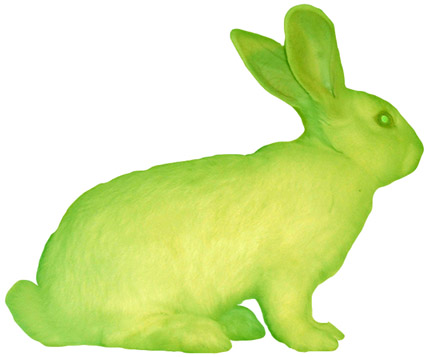
"My transgenic artwork "GFP Bunny" comprises the creation of a green fluorescent rabbit, the public dialogue generated by the project, and the social integration of the rabbit. GFP stands for green fluorescent protein. "GFP Bunny" was realized in 2000 and first presented publicly in Avignon, France. Transgenic art, I proposed elsewhere [1], is a new art form based on the use of genetic engineering to transfer natural or synthetic genes to an organism, to create unique living beings. This must be done with great care, with acknowledgment of the complex issues thus raised and, above all, with a commitment to respect, nurture, and love the life thus created.

WELCOME, ALBA

I will never forget the moment when I first held her in my arms, in Jouy-en-Josas, France, on April 29, 2000. My apprehensive anticipation was replaced by joy and excitement. Alba -- the name given her by my wife, my daughter, and I -- was lovable and affectionate and an absolute delight to play with. As I cradled her, she playfully tucked her head between my body and my left arm, finding at last a comfortable position to rest and enjoy my gentle strokes. She immediately awoke in me a strong and urgent sense of responsibility for her well-being.


Alba is undoubtedly a very special animal, but I want to be clear that her formal and genetic uniqueness are but one component of the "GFP Bunny" artwork. The "GFP Bunny" project is a complex social event that starts with the creation of a chimerical animal that does not exist in nature (i.e., "chimerical" in the sense of a cultural tradition of imaginary animals, not in the scientific connotation of an organism in which there is a mixture of cells in the body) and that also includes at its core: 1) ongoing dialogue between professionals of several disciplines (art, science, philosophy, law, communications, literature, social sciences) and the public on cultural and ethical implications of genetic engineering; 2) contestation of the alleged supremacy of DNA in life creation in favor of a more complex understanding of the intertwined relationship between genetics, organism, and environment; 3) extension of the concepts of biodiversity and evolution to incorporate precise work at the genomic level; 4) interspecies communication between humans and a transgenic mammal; 5) integration and presentation of "GFP Bunny" in a social and interactive context; 6) examination of the notions of normalcy, heterogeneity, purity, hybridity, and otherness; 7) consideration of a non-semiotic notion of communication as the sharing of genetic material across traditional species barriers; 8) public respect and appreciation for the emotional and cognitive life of transgenic animals; 9) expansion of the present practical and conceptual boundaries of artmaking to incorporate life invention.

GLOW IN THE FAMILY

"Alba", the green fluorescent bunny, is an albino rabbit. This means that, since she has no skin pigment, under ordinary environmental conditions she is completely white with pink eyes. Alba is not green all the time. She only glows when illuminated with the correct light. When (and only when) illuminated with blue light (maximum excitation at 488 nm), she glows with a bright green light (maximum emission at 509 nm). She was created with EGFP, an enhanced version (i.e., a synthetic mutation) of the original wild-type green fluorescent gene found in the jellyfish Aequorea Victoria. EGFP gives about two orders of magnitude greater fluorescence in mammalian cells (including human cells) than the original jellyfish gene [2].

The first phase of the "GFP Bunny" project was completed in February 2000 with the birth of "Alba" in Jouy-en-Josas, France. This was accomplished with the invaluable assistance of zoosystemician Louis Bec [3] and scientists Louis-Marie Houdebine and Patrick Prunet [4]. Alba's name was chosen by consensus between my wife Ruth, my daughter Miriam, and myself. The second phase is the ongoing debate, which started with the first public announcement of Alba's birth, in the context of the Planet Work conference, in San Francisco, on May 14, 2000. The third phase will take place when the bunny comes home to Chicago, becoming part of my family and living with us from this point on.

FROM DOMESTICATION TO SELECTIVE BREEDING

The human-rabbit association can be traced back to the biblical era, as exemplified by passages in the books Leviticus (Lev. 11:5) and Deuteronomy (De. 14:7), which make reference to saphan, the Hebrew word for rabbit. Phoenicians seafarers discovered rabbits on the Iberian Peninsula around 1100 BC and, thinking that these were Hyraxes (also called Rock Dassies), called the land "i-shepan-im" (land of the Hyraxes). Since the Iberian Peninsula is north of Africa, relative geographic position suggests that another Punic derivation comes from sphan, "north". As the Romans adapted "i-shepan-im" to Latin, the word Hispania was created -- one of the etymological origins of Spain. In his book III the Roman geographer Strabo (ca. 64 BC - AD 21) called Spain "the land of rabbits". Later on, the Roman emperor Servius Sulpicius Galba (5 BC - AD 69), whose reign was short-lived (68-69 AD), issued a coin on which Spain is represented with a rabbit at her feet. Although semi-domestication started in the Roman period, in this initial phase rabbits were kept in large walled pens and were allowed to breed freely.

Humans started to play a direct role in the evolution of the rabbit from the sixth to the tenth centuries AD, when monks in southern France domesticated and bred rabbits under more restricted conditions [5]. Originally from the region comprised by southwestern Europe and North Africa, the European rabbit (Oryctolagus cuniculus) is the ancestor of all domestic breeds. Since the sixth century, because of its sociable nature the rabbit increasingly has become integrated into human families as a domestic companion. Such human-induced selective breeding created the morphological diversity found in rabbits today. The first records describing a variety of fur colors and sizes distinct from wild breeds date from the sixteenth century. It was not until the eighteenth century that selective breeding resulted in the Angora rabbit, which has a uniquely thick and beautiful wool coat. The process of domestication carried out since the sixth century, coupled with ever increasing worldwide migration and trade, resulted in many new breeds and in the introduction of rabbits into new environments different from their place of origin. While there are well over 100 known breeds of rabbit around the world, "recognized" pedigree breeds vary from one country to another. For example, the American Rabbit Breeders Association (ARBA) "recognizes" 45 breeds in the U.S.A., with more under development.

In addition to selective breeding, naturally occurring genetic variations also contributed to morphological diversity. The albino rabbit, for example, is a natural (recessive) mutation which in the wild has minimal chances of survival (due to lack of proper pigmentation for camouflage and keener vision to spot prey). However, because it has been bred by humans, it can be found widely today in healthy populations. The human preservation of albino animals is also connected to ancient cultural traditions: almost every Native American tribe believed that albino animals had particular spiritual significance and had strict rules to protect them [6].

FROM BREEDING TO TRANSGENIC ART

"GFP Bunny" is a transgenic artwork and not a breeding project. The differences between the two include the principles that guide the work, the procedures employed, and the main objectives. Traditionally, animal breeding has been a multi-generational selection process that has sought to create pure breeds with standard form and structure, often to serve a specific performative function. As it moved from rural milieus to urban environments, breeding de-emphasized selection for behavioral attributes but continued to be driven by a notion of aesthetics anchored on visual traits and on morphological principles. Transgenic art, by contrast, offers a concept of aesthetics that emphasizes the social rather than the formal aspects of life and biodiversity, that challenges notions of genetic purity, that incorporates precise work at the genomic level, and that reveals the fluidity of the concept of species in an ever increasingly transgenic social context.

As a transgenic artist, I am not interested in the creation of genetic objects, but on the invention of transgenic social subjects. In other words, what is important is the completely integrated process of creating the bunny, bringing her to society at large, and providing her with a loving, caring, and nurturing environment in which she can grow safe and healthy. This integrated process is important because it places genetic engineering in a social context in which the relationship between the private and the public spheres are negotiated. In other words, biotechnology, the private realm of family life, and the social domain of public opinion are discussed in relation to one another. Transgenic art is not about the crafting of genetic objets d'art, either inert or imbued with vitality. Such an approach would suggest a conflation of the operational sphere of life sciences with a traditional aesthetics that privileges formal concerns, material stability, and hermeneutical isolation. Integrating the lessons of dialogical philosophy [7] and cognitive ethology [8], transgenic art must promote awareness of and respect for the spiritual (mental) life of the transgenic animal. The word "aesthetics" in the context of transgenic art must be understood to mean that creation, socialization, and domestic integration are a single process. The question is not to make the bunny meet specific requirements or whims, but to enjoy her company as an individual (all bunnies are different), appreciated for her own intrinsic virtues, in dialogical interaction.

One very important aspect of "GFP Bunny" is that Alba, like any other rabbit, is sociable and in need of interaction through communication signals, voice, and physical contact. As I see it, there is no reason to believe that the interactive art of the future will look and feel like anything we knew in the twentieth century. "GFP Bunny" shows an alternative path and makes clear that a profound concept of interaction is anchored on the notion of personal responsibility (as both care and possibility of response). "GFP Bunny" gives continuation to my focus on the creation, in art, of what Martin Buber called dialogical relationship [9], what Mikhail Bakhtin called dialogic sphere of existence [10], what Emile Benveniste called intersubjectivity [11], and what Humberto Maturana calls consensual domains [12]: shared spheres of perception, cognition, and agency in which two or more sentient beings (human or otherwise) can negotiate their experience dialogically. The work is also informed by Emmanuel Levinas' philosophy of alterity [13], which states that our proximity to the other demands a response, and that the interpersonal contact with others is the unique relation of ethical responsibility. I create my works to accept and incorporate the reactions and decisions made by the participants, be they eukaryotes or prokaryotes [14]. This is what I call the human-plant-bird-mammal-robot-insect-bacteria interface.

In order to be practicable, this aesthetic platform--which reconciles forms of social intervention with semantic openness and systemic complexity--must acknowledge that every situation, in art as in life, has its own specific parameters and limitations. So the question is not how to eliminate circumscription altogether (an impossibility), but how to keep it indeterminate enough so that what human and nonhuman participants think, perceive, and do when they experience the work matters in a significant way. My answer is to make a concerted effort to remain truly open to the participant's choices and behaviors, to give up a substantial portion of control over the experience of the work, to accept the experience as-it-happens as a transformative field of possibilities, to learn from it, to grow with it, to be transformed along the way. Alba is a participant in the "GFP Bunny" transgenic artwork; so is anyone who comes in contact with her, and anyone who gives any consideration to the project. A complex set of relationships between family life, social difference, scientific procedure, interspecies communication, public discussion, ethics, media interpretation, and art context is at work.

Throughout the twentieth century art progressively moved away from pictorial representation, object crafting, and visual contemplation. Artists searching for new directions that could more directly respond to social transformations gave emphasis to process, concept, action, interaction, new media, environments, and critical discourse. Transgenic art acknowledges these changes and at the same time offers a radical departure from them, placing the question of actual creation of life at the center of the debate. Undoubtedly, transgenic art also develops in a larger context of profound shifts in other fields. Throughout the twentieth century physics acknowledged uncertainty and relativity, anthropology shattered ethnocentricity, philosophy denounced truth, literary criticism broke away from hermeneutics, astronomy discovered new planets, biology found "extremophile" microbes living in conditions previously believed not capable of supporting life, molecular biology made cloning a reality.

Transgenic art acknowledges the human role in rabbit evolution as a natural element, as a chapter in the natural history of both humans and rabbits, for domestication is always a bidirectional experience. As humans domesticate rabbits, so do rabbits domesticate their humans. If teleonomy is the apparent purpose in the organization of living systems [15], then transgenic art suggests a non-utilitarian and more subtle approach to the debate. Moving beyond the metaphor of the artwork as a living organism into a complex embodiment of the trope, transgenic art opens a nonteleonomic domain for the life sciences. In other words, in the context of transgenic art humans exert influence in the organization of living systems, but this influence does not have a pragmatic purpose. Transgenic art does not attempt to moderate, undermine, or arbitrate the public discussion. It seeks to offer a new perspective that offers ambiguity and subtlety where we usually only find affirmative ("in favor") and negative ("against") polarity. "GFP Bunny" highlights the fact that transgenic animals are regular creatures that are as much part of social life as any other life form, and thus are deserving of as much love and care as any other animal [16].

In developing the "GFP Bunny" project I have paid close attention and given careful consideration to any potential harm that might be caused. I decided to proceed with the project because it became clear that it was safe [17]. There were no surprises throughout the process: the genetic sequence responsible for the production of the green fluorescent protein was integrated into the genome through zygote microinjection [18]. The pregnancy was carried to term successfully. "GFP Bunny" does not propose any new form of genetic experimentation, which is the same as saying: the technologies of microinjection and green fluorescent protein are established well-known tools in the field of molecular biology. Green fluorescent protein has already been successfully expressed in many host organisms, including mammals [19]. There are no mutagenic effects resulting from transgene integration into the host genome. Put another way: green fluorescent protein is harmless to the rabbit. It is also important to point out that the "GFP Bunny" project breaks no social rule: humans have determined the evolution of rabbits for at least 1400 years.

ALTERNATIVES TO ALTERITY

As we negotiate our relationship with our lagomorph companion [20], it is necessary to think rabbit agency without anthropomorphizing it. Relationships are not tangible, but they form a fertile field of investigation in art, pushing interactivity into a literal domain of intersubjectivity. Everything exists in relationship to everything else. Nothing exists in isolation. By focusing my work on the interconnection between biological, technological, and hybrid entities I draw attention to this simple but fundamental fact. To speak of interconnection or intersubjectivity is to acknowledge the social dimension of consciousness. Therefore, the concept of intersubjectivity must take into account the complexity of animal minds. In this context, and particularly in regard to "GFP Bunny", one must be open to understanding the rabbit mind, and more specifically to Alba's unique spirit as an individual. It is a common misconception that a rabbit is less intelligent than, for example, a dog, because, among other peculiarities, it seems difficult for a bunny to find food right in front of her face. The cause of this ordinary phenomenon becomes clear when we consider that the rabbit's visual system has eyes placed high and to the sides of the skull, allowing the rabbit to see nearly 360 degrees. As a result, the rabbit has a small blind spot of about l0 degrees directly in front of her nose and below her chin [21]. Although rabbits do not see images as sharply as we do, they are able to recognize individual humans through a combination of voice, body movements, and scent as cues, provided that humans interact with their rabbits regularly and don't change their overall configuration in dramatic ways (such as wearing a costume that alters the human form or using a strong perfume). Understanding how the rabbit sees the world is certainly not enough to appreciate its consciousness but it allows us to gain insights about its behavior, which leads us to adapt our own to make life more comfortable and pleasant for everyone.

Alba is a healthy and gentle mammal. Contrary to popular notions of the alleged monstrosity of genetically engineered organisms, her body shape and coloration are exactly of the same kind we ordinarily find in albino rabbits. Unaware that Alba is a glowing bunny, it is impossible for anyone to notice anything unusual about her. Therefore Alba undermines any ascription of alterity predicated on morphology and behavioral traits. It is precisely this productive ambiguity that sets her apart: being at once same and different. As is the case in most cultures, our relationship with animals is profoundly revealing of ourselves. Our daily coexistence and interaction with members of other species remind us of our uniqueness as humans. At the same time, it allow us to tap into dimensions of the human spirit that are often suppressed in daily life--such as communication without language--that reveal how close we really are to nonhumans. The more animals become part of our domestic life, the further we move breeding away from functionality and animal labor. Our relationship with other animals shifts as historical conditions are transformed by political pressures, scientific discoveries, technological development, economic opportunities, artistic invention, and philosophical insights. At the beginning of the twenty-first century, as we transform our understanding of human physical boundaries by introducing new genes into developed human organisms, our communion with animals in our environment also changes. Molecular biology has demonstrated that the human genome is not particularly important, special, or different. The human genome is made of the same basic elements as other known life forms and can be seen as part of a larger genomic spectrum rich in variation and diversity.

Western philosophers, from Aristotle [22] to Descartes [23], from Locke [24] to Leibniz [25], from Kant [26] to Nietsche [27] and Buber [28], have approached the enigma of animality in a multitude of ways, evolving in time and elucidating along the way their views of humanity. While Descartes and Kant possessed a more condescending view of the spiritual life of animals (which can also be said of Aristotle), Locke, Leibniz, Nietsche, and Buber are -- in different degrees -- more tolerant towards our eukaryotic others [29]. Today, our ability to generate life through the direct method of genetic engineering prompts a re-evaluation of the cultural objectification and the personal subjectification of animals, and in so doing it renews our investigation of the limits and potentialities of what we call humanity. I do not believe that genetic engineering eliminates the mystery of what life is; to the contrary, it reawakens in us a sense of wonder towards the living. We will only think that biotechnology eliminates the mystery of life if we privilege it in detriment to other views of life (as opposed to seeing biotechnology as one among other contributions to the larger debate) and if we accept the reductionist view (not shared by many biologists) that life is purely and simply a matter of genetics. Transgenic art is a firm rejection of this view and a reminder that communication and interaction between sentient and nonsentient actants lies at the core of what we call life. Rather than accepting the move from the complexity of life processes to genetics, transgenic art gives emphasis to the social existence of organisms, and thus highlights the evolutionary continuum of physiological and behavioral characteristics between the species. The mystery and beauty of life is as great as ever when we realize our close biological kinship with other species and when we understand that from a limited set of genetic bases life has evolved on Earth with organisms as diverse as bacteria, plants, insects, fish, reptiles, birds, and mammals.

TRANSGENESIS, ART, AND SOCIETY

The success of human genetic therapy suggests the benefits of altering the human genome to heal or to improve the living conditions of fellow humans [30]. In this sense, the introduction of foreign genetic material in the human genome can be seen not only as welcome but as desirable. Developments in molecular biology, such as the above example, are at times used to raise the specter of eugenics and biological warfare, and with it the fear of banalization and abuse of genetic engineering. This fear is legitimate, historically grounded, and must be addressed. Contributing to the problem, companies often employ empty rhetorical strategies to persuade the public, thus failing to engage in a serious debate that acknowledges both the problems and benefits of the technology. [31] There are indeed serious threats, such as the possible loss of privacy regarding one's own genetic information, and unacceptable practices already underway, such as biopiracy (the appropriation and patenting of genetic material from its owners without explicit permission).

As we consider these problems, we can not ignore the fact that a complete ban on all forms of genetic research would prevent the development of much needed cures for the many devastating diseases that now ravage human and nonhumankind. The problem is even more complex. Should such therapies be developed successfully, what sectors of society will have access to them? Clearly, the question of genetics is not purely and simply a scientific matter, but one that is directly connected to political and economic directives. Precisely for this reason, the fear raised by both real and potential abuse of this technology must be channeled productively by society. Rather than embracing a blind rejection of the technology, which is undoubtedly already a part of the new bioscape, citizens of open societies must make an effort to study the multiple views on the subject, learn about the historical background surrounding the issues, understand the vocabulary and the main research efforts underway, develop alternative views based on their own ideas, debate the issue, and arrive at their own conclusions in an effort to generate mutual understanding. Inasmuch as this seems a daunting task, drastic consequences may result from hype, sheer opposition, or indifference.

This is where art can also be of great social value. Since the domain of art is symbolic even when intervening directly in a given context [32], art can contribute to reveal the cultural implications of the revolution underway and offer different ways of thinking about and with biotechnology. Transgenic art is a mode of genetic inscription that is at once inside and outside of the operational realm of molecular biology, negotiating the terrain between science and culture. Transgenic art can help science to recognize the role of relational and communicational issues in the development of organisms. It can help culture by unmasking the popular belief that DNA is the "master molecule" through an emphasis on the whole organism and the environment (the context). At last, transgenic art can contribute to the field of aesthetics by opening up the new symbolic and pragmatic dimension of art as the literal creation of and responsibility for life.

(to see Eduardo Kac's notes, please visit the url above)

2008-07-17

>> Jens Brand, "Global Player", 2004

"the earth is a disc"

"Jens Brand’s GP4 (Global Player) functions basically like a regular

Compact Disc or record player. However, sound is not reproduced by a
stylus from the grooves of a record player that are picked up. Instead
the earth is scanned virtually via satellite travelling routes.
Topographical data are interpreted by the G-Player and reproduced in an
exact acoustic equivalent as audio files.

>From the outset Brand conceived the GP4 as a commercial product and,
therefore, staged his installations as a trade fair stall stand.
Mobility and availability are the buzzwords of the new product placement
strategies, thus the G-Player, the G-Pod and G-Turns have been developed
in reference to the newest phenomenon that has seen at the global music
market.

The newest version, G-Turns, makes the GP4 available in an online
version from which users can ‘download and play’ the earth on their
home computers. The earth as sound experience is available on the market
in three price brackets, depending on the distance of the satellite
routes between two co-ordinates that can be chosen by the user: five
minutes are available for only 4.95 euros. For fifteen minutes the user
has to pay only 14.95 euros. This further development of the project as
an online-store is presented to the public for the first time at the
exhibition SOUND//BYTES and is, therefore, premièring worldwide as
Oldenburg Branch: www.g-turns.com."
(http://osdir.com/ml/culture.internet.rohrpost/2007-03/msg00009.html)


the project's website:
http://www.g-turns.com/

video of the G-Pod:
http://www.directions.jp/airartlog/flv/AAL013/013-02.html


video of the G-Player:
http://www.directions.jp/airartlog/flv/AAL003/003-02.html

>> Art+Com, "Terravision",

"TerraVision is a self-contained, virtual reality, 1-to-1 representation of our Earth. By means of a stylised globe users can zoom in on any location in the world and obtain minutely detailed pictures. (virtual earth)

The system offers not only satellite images and aerial photos but also geographically referenced data of all types – e.g. topographical or architectural schematic representations.

TerraVision was the first system to provide visualisation and unlimited freedom of navigation within an infinitely large spatial data environment. Providing visuals ranging from overviews of the Earth to extremely detailed movements in buildings, TerraVision provides smooth, real time pictures in a single, comprehensive, virtual reality system."

>> Michael Naimark, "Be Now Here",


from: http://www.naimark.net/projects/benowhere.html

"Be Now Here is an installation about landscape and public places. Visitors gain a strong sense of place by wearing 3-D glasses and stepping into an immersive virtual environment. The imagery is of public plazas on the UNESCO World Heritage Centre's list of endangered places - Jerusalem, Dubrovnik, Timbuktu, and Angkor, Cambodia – places both exotic and disturbing. The style is ambient, as if the imagery is live.

For production, a unique recording system was built consisting of two 35mm motion-picture cameras (for 3D, one for each eye) mounted on a rotating tripod. The installation consists of an input pedestal for interactively choosing place and time, a stereoscopic projection screen, four-channel audio, and a 16-foot rotating floor on which the viewers stand.

Be Now Here is an extension of several media trajectories. One is of enhanced cinematic representation, such as the Imax-sized projections of the Lumiere brothers in 1900 and the 3-screen triptychs of Abel Gance’s Napoleon in 1927. Another is of non-narrative cultural activism, such as the films of Godfrey Reggio and Tony Gatlif. But Be Now Here also points forward: as a simulation of what net cinema can be, it is both a regard and a provocation."

>> Jeffrey Shaw, "The Legible City", 1989

from: http://www.jeffrey-shaw.net/html_main/show_work.php3?record_id=83#

"In The Legible City the visitor is able to ride a stationary bicycle through a simulated representation of a city that is constituted by computer-generated three-dimensional letters that form words and sentences along the sides of the streets. Using the ground plans of actual cities - Manhattan, Amsterdam and Karlsruhe - the existing architecture of these cities is completely replaced by textual formations written and compiled by Dirk Groeneveld. Travelling through these cities of words is consequently a journey of reading; choosing the path one takes is a choice of texts as well as their spontaneous juxtapositions and conjunctions of meaning.

The handlebar and pedals of the interface bicycle give the viewer interactive control over direction and speed of travel. The physical effort of cycling in the real world is gratuitously transposed into the virtual environment, affirming a conjunction of the active body in the virtual domain. A video projector is used to project the computer-generated image onto a large screen. Another small monitor screen in front of the bicycle shows a simple ground plan of each city, with an indicator showing the momentary position of the cyclist.

The Manhattan version (1989) of this work comprises eight separate fictional story lines in the form of monologues by ex-Mayor Koch, Frank Lloyd Wright, Donald Trump, a tour guide, a confidence trickster, an ambassador and a taxi-driver. Each story line has a specific letter colour so that the bicyclist can choose one or another to follow the path of a particular narration. In the Amsterdam (1990) and Karlsruhe (1991) versions all the letters are scaled so that they have the same proportion and location as the actual buildings which they replace, resulting in a transformed but exact representation of the actual architectural appearance of these cities. The texts for these two cities are largely derived from archive documents that describe mundane historical events there."


from Ars Electronica (Award of Distinction, interactive Art, 1990):

"In "The Legible City" by Jeffrey Shaw the visitor is able to ride a stationary bicycle through a simulated representation of a city that is constituted by computer-generated three-dimensional letters that form words and sentences along the sides of the streets.

The research and development of various mechanisms and codes of spatial representation has been a major preoccupation throughout the history of Western Art. The application of three dimensional computer imaging technologies in this context has a revolutionary meaning. Instead ofthe traditional activity of art as a representation of reality, the artwork can now become itself a simulation of reality within which the viewer's point of view is located. "The Legible City" is a first example of the possibility of the digital image to evoke a three dimensional virtual space which the spectator can enter and explore.

The spectator is able to use a bicycle to interactively travel in a video projected three dimensional virtual image space. In the first realized version of this work the image space in which the bicyclist can travel is based on the ground plan of part of Manhattan, New York - the area boundaried by 34th and 66thStreet, and Park and 11th Avenue. Using real-time computer graphic technology, the city visualised by solid three dimensional letters that form words and sentences along the sides of the streets. These words and sentences conform tothe actual plan and scale of this city - its particular organisation of streets, avenues, intersections, parks, etc. Thus the actual Manhattan architecture of buildings is completely replaced by a new architecture of text.

Travelling through this city of words is consequently a journey of reading. Choosing direction, choosing where to turn, is a choice of the story lines and the user's position. In this way this city of words is a kind of three dimensional book which can be read in any direction, and where the spectators construct their own conjunction of texts and meanings as they bicycle their chosen path there.

The image of the city is video projected onto a large video screen in front of the bicyclist. The bicycle is fixed on a platform in the installation, but the spectator controls his / her speed and direction of movement in the projected image space by pedalling faster or slower, and by turning the handle bars. The virtual world where the bicyclist is travelling simulates faithfully the experience of bicycling in the real world.

In this work the city is constituted physically by the three dimensional arrangement of words into streets, and the city is constituted psychologically by the meanings these words carry as they are read by the bicyclist travelling through these streets. The texts have been written as eight separate storylines that have a particular relationship to Manhattan - for instance monologues spoken by Mayor Koch, Frank Lloyd Wright, Donald Trump, Noah Webster, a cab driver, a tour guide, an ambassador, etc. Each storyline has a specific location in the city, and each is visually identifiable by the particular colour of its letters.Thus the bicyclist / reader can follow one story line by following its colour, andalso recognise higher shifts from one storyline to another because of the colour changes.

Directly in front of the bicyclist, a small video screen shows a plan of Manhattan, and the actual location of the bicyclist there by means of a flashing dot that represents the position and direction of movement. Electronic devices attached to the steering wheel and pedals of the bicycle measure the rotation of the steering wheel and speed of pedalling. Responding to this formation, the Manhattan database is interactively calculated and displayed by a Silicon Graphics Personal IRIS graphics computer. Video output from this computer goes to a video projector which shows the image on the large screen in front of the bicyclist. Another personal computer handles the small video display of the plan of Manhattan and the indication of the bicyclist's position there.

The authors of this work intend to realise more versions based on the ground plans of other major cities. What is felt to be interesting are the different formal geometries of these cities' plans, which will strongly effect the character of their lettered visualisation. Furthermore, each city's plan and historical identity asks for a different approach to the content and writing of the text.

"The Legible City", as it now has been created, is in a fundamental way determined by the capabilities of state-of-the-art computer graphic visualisation technologies. The ongoing and rapid evolution of these technologies generates new capabilities that are significant to future developments of this work. For instance utilizing NASA's stereoscopic head-mounted display, the bicyclist would experience the work as a totally surrounding three dimensional space of imagery."


from medienkunstnetz:

"Visitors to ‘The Legible City', created at the Institut für Neue Medien in Frankfurt/M., are seated on a stationary bicycle and ‘move' through streets projected onto the surface in front of them. In contrast to those of a normal city, the streets here are literally legible, lined not by buildings but by letters. On their passage through the city, cyclist-visitors can pursue various narrative threads, accumulating their own history of the city. On a small display on the handlebars is a map of the city on which the cyclists can plot their position. Between 1988 and 1991 Jeffrey Shaw created three versions of ‘The Legible City': Manhattan, Amsterdam and Karlsruhe. The Manhattan variant was one of the very first interactive installations, today regarded as a key work of the genre."

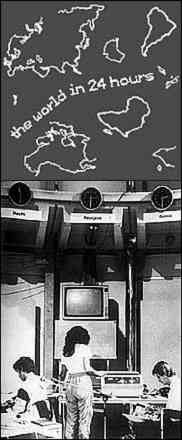
>> Bob Adrian X, "The World in 24 Hours", 1982


A PROJECT CONNECTING ARTISTS AROUND THE WORLD
IN A NON-STOP
SERIES OF DIALOGUES BEGINNING AT 12 NOON ON SEPTEMBER 27 AND
ENDING AT 12 NOON ON SEPTEMBER 28 (CENTRAL EUROPEAN TIME).


This is a "low-technology" project using simple, cheap and readily available "off-the-shelf" equipment that operates via normal telephone or amateur (ham) radio networks.

There are three proven media (see other side) that have been successfully used in previous artist's telecommunications projects and there are probably others as yet untried. Artists or groups wishing to participate in this project may propose any medium providing that it operates via telephone, amateur radio or other freely accessible network, and that compatible hardware and access is available in Linz, Austria.

The budget provided by the ARS ELECTRONICA sponsors for this project is intended to provide for central organisation and telephone costs for one hour between Linz and each participating location. Each location will be called from
Linz at 12 noon local time (this will vary somewhat in Europe).

Each call will last for about one hour.

Locations working together with amateur radio operators are of course NOT restricted by telephone costs or availability of phone lines during the event.

MEDIA INFORMATION (see attached sheets for detailed information)


from: http://alien.mur.at/rax/24_HOURS/index.html


"ARS ELECTRONICA'82
27-28 SEPTEMBER 1982

A world-wide 24 hour telecommunications project organised by Robert Adrian for the Ars Electronica, Linz.


Artists and groups in Vienna, Frankfurt, Amsterdam, Bath, Wellfleet, Pittsburgh, Toronto, San Francisco, Vancouver, Honolulu, Tokyo, Sydney, Istanbul and Athens participated using any or all of Slow-scan TV, Fax, Computer Mailbox or telephone sound. Each location was called from Linz at 12:00 local time - so the project ran from 12:00 noon Central European Time on Sept.27 and followed the midday sun around the world, ending at 12:00 noon on Sept.28."


ARTISTS'' USE OF TELECOMMUNICATIONS
This telecommunications program by artists is, like other such events in the past, intended to develop techniques for individual, personal, use of existing telecommunications technology.

It is often claimed that modern electronic systems and networks are not accessible to private individuals but actually access is a relatively easy matter, the real problems only arise when one seeks ways in which these systems can be used. One soon discovers that, with the exception of the games and entertainment sector, all this technology is designed for the corporate user. Individual users are isolated from the design of new technology because, having no precise need, it is assumed that their interests are met by firms interested in marketing high-tech by-products, in serving existing demand rather than assisting in the development of possible alternative directions in electronic technology.
If any sort of chance arises to develop new techniques by means of which private individuals can make meaningful use of these electronic media -- to assert their right to genuine participation in the development of this new electronic world -- then it will have to be very soon. It is probably too late even now to really change the direction of design development but we can try at least to discover ways to insert human content into commercial/military world floating in this electronic space.
And this is where artists are traditionally strong ... in discovering new ways to use media and materials, in inventing new and contradictory meanings for existing organisations and systems, in subverting self-serving power-structures in the interests of nearly everyone.

Artists using electronic telecommunications are trying to find human meaning in an electronic space.
Robert Adrian X


The World In 24 Hours
A project connecting artists around the world in a non-stop series of dialogues beginning at 12 noon on September 27 and ending at 12 noon on September 28, 1982 (Central European Time).

14 artists or groups around the world will be in communication with Linz, Austria, during the 24 hour project. Each of the participating locations will be called on the telephone from the central location in Linz at 12 noon local time (i. e. 18.00 in Linz = 12 noon in Toronto). Each contact will last about one hour, permitting the exchange of visual material via telephone by means of either Slow-scan Television or Telefacsimile transceiving equipment. In addition the I. P. Sharp computer timesharing network will be available for computer graphic exchange and/or coordination of the projects. Participants have been offered the opportunity of choosing any telecommunications medium for their contribution providing that it operates via normal telephone and is also available in Linz. However the present state of development makes only the 3 media mentioned above - and described below - feasible for use by artists or other private individuals.
1. Computer timesharing: (I. P. Sharp APL Network) Equipment: Computer Terminal. Medium: Local Telephone to nearest IPSA office. The I. p, Sharp office in Vienna will provide computer time and technical assistance to participants wishing to use I. p, Sharp software for computer graphic exchange. The ARTBOX and CONFER programs will also be available for coordination of the project and for computer communications exchanges.
2. Slow-scan television (SSTV): Equipment: SSTV Transceiver (e.g.. robot 530) Medium: Direct long-distance telephone connection. Signals from a video camera are converted by the transceiver into audio signals and transmitted via telephone, The received signal is reconverted to a video signal and displayed on a monitor. Each image takes 8.5 seconds to be completed.
3. Telefacsimile (Telefax): Equipment: Telefax transceiver (e.g., 3 M "9136", group III (transceiver) Medium: Direct long-distance telephone connection. Telefax transceivers convert images on paper into audio signals and transmit them via telephone. A compatible machine then converts the signal back into an image on paper, There are 3 different types of machine available. Groups I, II and 111. The latest of these are the group III machines which can transmit an A 4 page in under a minute. Machines like the 3 M "9136" are also compatible with the slower group I and II machines.

The 24 hour program will begin with an extensive European section lasting about 6 hours, from 12 noon until 18.00 (Central European Time). The European section will include contributions from FLORENCE, FRANKFURT, GENEVA, VIENNA and, concluding the European section, DUBLIN. There will also be an experiment called "PI- NETWORKING" (using the I. P. Sharp Timesharing Network) initiated by Roy Ascott in Bath, U. K, going on during the whole European section.

The overseas program will comprise at least 4 North American locations, (there may also be a New York City participant), Hawaii, Sydney/Australia and Tokyo, The final contact will be from Turkey at 11:00 on September 28 (Linz time).

The schedule
(All times Central European Time)
12:00-18.00 Exchanges with Frankfurt, Florence, Geneva, Amsterdam, Vienna and Dublin.
18:00 - 21:00 Toronto and Pittsburgh (New York?).
21:00 - 23:00 San Francisco and Vancouver.
23:00 - 03:00 Hawaii (with Pacific region conference)
03:00-04:00 Sydney
04:00 - 05:00 Tokyo
05:00 -09:00 open for conferencing, discussion, preparation of documentation, rest etc.
09:00-11:00 Summing up and discussion of project with European participants.
11:00 -12:00 Telex exchange with minus-delta-t in Turkey, en route to Bangkok.


[PARTICIPATING LOCATIONS]

LINZ
This project was begun in January 1982 when a series of workshops was arranged at the HOCHSCHULE FÜR KÜNSTLERISCHE UND INDUSTRIELLE GESTALTUNG, Linz. These workshops by Robert Adrian X (funded by the Österreichische Kulturservice) were intended to create a team of artists and students able to prepare and transmit original work and to man the equipment during the 24 hour event. The workshops were coordinated by Waltraud Cooper, lecturer at the Hochschule under Professor Laurids Ortner, Waltraud Cooper will also be coordinating participation by the Linz group during the program.
The workshop participants were: Bruno Aichinger, Helmut Guntner, Gerald Hackenberg, Josel Horvat, Elisabeth Juan, Moidi Kretschmann, Michael Langanger, Jörg Mikesch, Otto Mittmannsgruber, Sonja Reischi.

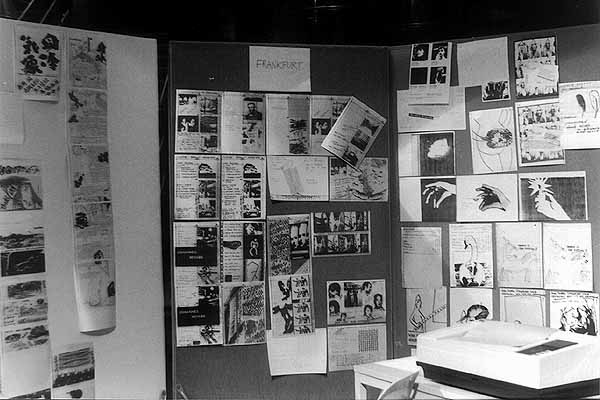
FRANKFURT
Coordination: Thomas Bayrle
Location: Städelschule, Hochschule für Kunst, Frankfurt/Main
Participants: Thomas Bayrle, Ernst Caramelle, Jochen Fey, Jürgen Riehm and Monika Schwitte.
Media: Telefacsimile
Thomas Bayrle is an artist working with photography, traditional media and artists books and is Dozent at the Städelschule.

FLORENCE
Coordination: Maurizio Nannucci
Location: Zona, Florence Participants: Fabrizio Corneli, Albert Mayr, Paolo Nasi, Massimo Nannucci, Maurizio Nannucci, Gianni Pettena, Marino Vismara
Media: Telefacsimile
ZONA is an independent group of artists working together in all media - including music, performance, radio, video etc., ZONA is also an artist-run space in the center of Florence.

VIENNA
Coordination: Helmut Mark
Location: Österreichische Kulturservice "Studio"
Participants: Markus Geiger, Ruth Labak, Helmut Mark, Alice Weber, Heimo Zobernig Project: SPUTNIK MACHT'S MÖGLICH The 5 artists will meet at the Kulturservice "Studio" (Grunangergasse 6) from 10 am to 6 PM every day from Sept. 24 to 29. On Sept. 25 and 26 they will hold workshops on telecommunications media in preparation for the 24 hour event on Sept. 27 and 28. On Sept. 29 a discussion of the entire project is planned.
Media: Computer Timesharing and Telefacsimile
Helmut Mark is an artist working in many media, mainly in public space. He lives in Vienna.

AMSTERDAM
Coordination: Annie Wright and David Garcia
Location: Mazzo, Amsterdam
Project: LATE TIMES EXTRA ". , ,one of a number of works we have made based on the insertion of 'fictions' into everyday formats. We have previously used shop windows, street posters, publications and television and now telecommunications." The project will treat the computer terminal as a news agency teleprinter, developing a plot trough the mixture of "real" news and fiction.
Media: Computer Timesharing
Annie Wright and David Garcia are English artist/ writers living in Amsterdam,

BATH
Coordination: Roy Ascott.
Location: Art Access/Networking, Bath, England.
Participants:
Project: PSI-BERNETIC NETWORKING (2 projects proposed). 1. "To identify nine people with terminal access around the planet, each to choose a card in sequence to make up the Celtic spread (with my card). We shall then participate and interact trough the network to generate meanings trough the spread."
2, "A second project will involve a kind of round table seance, automatic writing at the ASCII keyboard, This use of chance coupled with our individual/group intuitions and intimations will likely also generate some unexpected material."
"Both proposals attempt to generate a kind of group consciousness of planetary dimensions through the network to get at new ideas, texts or images. The second project may include, as input, trance utterances by clairvoyants if we can involve enough individuals in sufficient countries to make it global."
Media: Computer Timesharing.
Roy Ascott is an artist and theoretician presently Head of the School of Fine Art, Gwent College of Higher Education, Newport, Wales, member of the advisory board, International Network for the Arts, New York, member of the Editorial Advisory Board of "LEONARDO", Pergamon Press, Oxford and Director of Art Access/Networking.

TORONTO
Coordination: Derek Dowden (Artculture Resource Center) and Dieter Hastenteufel.
Location: COMMUNITEX: Community Videotex,
Participants: Dieter Hastenteufel, Derek Dowden, Peeter Sepp, Nancy Paterson, and others,
project: in preparation.
Media: Computer Timesharing, Slow-Scan and/or Telefacsimile.
Derek Dowden works with Artculture Resource Center, a non-profit organising facility for cultural projects.
COMMUNITEX is a non-profit organisation to promote and facilitate artistic, cultural and community use of new telecommunications technology.

SAN FRANCISCO
Coordination: Tom Klinkowstein.
Location: Audio Visual Center, the San Francisco State University.
Participants: Staff and students at the Audio Visual Center and at the Broadcast Communications Art Department (S.F.S.U.),
Project: "THE CUSTOMER IS ALWAYS RIGHT" Advertising or advertising-related images will be broadcast live via the (interactive) Cable Television station in San Francisco and via Slow-Scan Television to Linz. Similar material will be displayed as slides or video tapes to the audience at the ORF center in Linz and transmitted to San Francisco via Slow-Scan Television. Responses to the transmitted images will be exchanged via the I.P. Sharp Computer Timesharing network.
Media: Computer Timesharing and Slow-Scan Television.
Tom Klinkowstein is an artist, designer and teacher specialising in electronic media, audio-visual techniques and telecommunications, He divides his time between San Francisco and Amsterdam, Holland.

PITTSBURGH
Coordination: Bruce Breland.
Location: Department of Fine Arts, Carnegie-Mellon University, Pittsburgh.
Participants: GEKKO (Generative Energy /Kinetic Knowledge/Order), Bruce Breland, Herb Coshak, James Kocher, Harry Holland, Diane Samuels and Cindy Snodgrass.
Project: GEKKO'S WINDOW. 1. Bruce Breland - CASTING COLOR ON THE CONEMAUGH (SSTV) 2. James Kocher - X/O (SSTV) 3. Diane Samuels - FINGER PERFORMANCE (SSTV) 4. Herb Coshak - ALETH (SSTV) 5. Cindy Snodgrass -WINDRAYS, AIRWAVES, HIGHWAYS (SSTV) 6. Harry Holland - STRATA VARIANTS (Computer Timesharing).
Media: Slow-Scan Television and Computer Timesharing.

VANCOUVER
Coordination: Henry Bull and BilI Bartlett.
Location: Western Front Society, Vancouver.
Participants: Henry Bull, Bill Bartlett, Kate Craig, Gien Lewis and members of the Western Front Society.
Media: Slow-Scan Television and Computer Timesharing.
Henry Bull is an artist, musician and curator working in practically every medium from photography to radio. He lives in Vancouver and is responsible for the gallery program at the Western Front.
Bill Bartlett is a pioneer of artists use of telecommunications, especially with Slow-Scan Television and Computer Communications. He lives on Pender ISiand, British Columbia.
Western Front is an artist-run center (founded in 1972) that offers programmes in visual arts, music, dance and video as well as an ambitious "artist-in-residence" program.

HAWAII
Coordination: John Southworth.
Location: University of Hawaii, Honolulu.
Participants: John Southworth, Joseph Tanton and staff and students of the University.
Media: Computer Timesharing and Slow-Scan Television.
John Southworth is an educator and specialist for integrated electronic learning systems. He lives and works in Hawaii.

SYDNEY
Coordination: Eric Gidney.
Location: City Art Institute, Sydney, Australia,
Participants: Eric Gidney, lan Howard and students of the City Art Institute.
Media: Computer Timesharing and/or Telefacsimile,
Eric Gidney and lan Howard are lecturers at the City Art Institute.

TOKYO
Coordination: Kazue Kobata,
Location: Body Weather Laboratory,
Participants: Min Tanaka, Yoshi Nobu, Kazue Kobata
Project: In preparation.
Kazue Kobata is an artist and dancer working in Japan and America.

TURKEY
Coordination: Minus Delta t
Location: Turkey (en route to Bangkok)
Participants: Karel Dudesek, Mike Henz, Bernard Müller
Project: BANGKOK/ARCHIV EUROPA
Media: Telex?
Minus Delta t is a group of artists who been, since 1980, on the expedition "Project Bangkok".
The project encompasses the ARCHIVE EUROPA, A FESTIVAL, the transportation and erection of a large and heavy monument, and working in the countries through which they are traveling until the end of December 1982. Apparently a classic expedition, but Minus Delta t are making art as field research.

DUBLIN [did NOT participate!]

GENEVA [did NOT participate!]


report:

Vienna, December 9, 1982

It is now just over 2 months since "THE WORLD IN 24 HOURS" project took place and this report completes, finally, the documentation. The enclosed material, including copies of telefax pages, photos of SSTV images, descriptions and photos of the activities in Linz during the project, and a nearly complete copy of "ARS CONFERENCE" on the I.P.Sharp network, is a selection from all the material we received during the 24 hours. We also have over 2 hours of U-Mativ Video tape which will be edited to about 20 minutes. Dubs of this tape are available to anyone interested for the cost of tape and dubbing time.

The strain of 24 hours of non-stop activity on people and equipment is obvious in the uneven quality (and quantity) of the enclosed material ... some things didn't get recorded or photographed ... the sound recording equipment broke down ... the person with the camera went home to bed, with the camera! ... we ran out of video tape in the middle of the night when everything was locked ... one telephone died and another got very neurotic in the early morning ... we all forgot and lost things, including telephone numbers.

But on the whole it was a successfull experiment. We learned a lot ... for one thing, we learned that most things, including people are not designed for non-stop, 24 hour, activity. But we also learned that such a project is possible and that the next one will be even better given the experience we now have.

There are, of course, many things we would do differently if we had to do it all again but three things stand out:
  1. More time for preparation. We had 9 months but it needed at least a year.
  2. Better audio recording equipment. The ORF (Austrian Radio/TV) supplied excellent sound equipment but the wrong tape deck. We should have paid a lot more attention on this point.
  3. More telephones. We had 3 lines but needed 5. For a total telecommunications experience you need all the media working at once ... plus a communication line for emergencies.
Telecommunications, by artists or anybody, only gets really exciting when carried out on a global scale. But the price of global scale telecommunications projects is all the pain and problems of language and cultural differences, time zones, networking and night-working. On balance I think it is worth it ... looking through the material we received one can feel a new kind of art developing, a new medium. Its a very exciting feeling.

Lets do it again soon!

Robert Adrian X


This documentation has been made possible by the cooperation of the 3M company and the Österreichische Kultur Service.

>> labels

>> cloudy with a chance of tags


Powered By:Blogger Widgets

followers

.........

My photo
... is a Media Art historian and researcher. She holds a PhD from the University of Art and Design Linz where she works as an associate professor. Her PhD-thesis is on "Speculative Archiving and Digital Art", focusing on facial recognition and algorithmic bias. Her Master Thesis "The Grammar of New Media" was on Descriptive Metadata for Media Arts. For many years, she has been working in the field of archiving/documenting Media Art, recently at the Ludwig Boltzmann Institute for Media.Art.Research and before as the head of the Ars Electronica Futurelab's videostudio, where she created their archives and primarily worked with the archival material. She was teaching the Prehystories of New Media Class at the School of the Art Institute of Chicago (SAIC) and in the Media Art Histories program at the Danube University Krems.