http://www.youtube.com/view_play_list?p=FE019426C78CD603
http://www.t-h-e-n-e-t.com/start_html.htm
Showing posts with label cybernetics. Show all posts
Showing posts with label cybernetics. Show all posts
2009-09-14
"the net", lutz dammbeck, 2004
0
replies
tags -
cybernetics,
internet,
unabomber

Bookmark this post: | 


|
2008-07-15
>> Brian Holmes, "Escape the Overcode", 2006
info (from joncates):
Escape the Overcode - Brian Holmes (2006)is a presentation by Brian Holmes on Cybernetics in jonCates' Prehistories of New Media course at the School of the Art Institute of Chicago.
0
replies
tags -
cybernetics,
lecture
Bookmark this post: |
|
2008-06-26
>> Ken Rinaldo, Autopoiesis, 2001
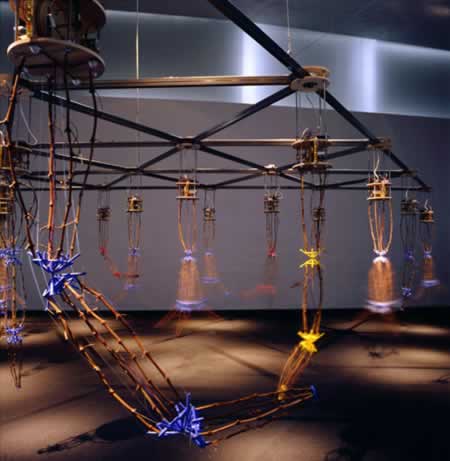
"My interdisciplinary media art installations look to the intersection between natural and technological systems. Integration of the organic and electro-mechanical elements asserts a confluence and co-evolution between living and evolving technological material. I am fascinated and encouraged with human kinds struggle to evolve technological systems that move toward intelligence and autonomy which are modeled from our current conceptions of the natural. My art works are influenced by theories on living systems, artificial life, interspecies communication and the underlying beauty and pattern inherent in the nature and organization of matter, energy, and information. While I find hope and fascination with our techno-cultural evolution, many of my works express concern for ecological issues, which are often not considered within the realm of technological and cultural progress.
[...] The branching and joining of physical forms in my work echoes the behavioral flow and multiple directions an interactive piece may take in the act of self-organizing. I am compelled by open structures that define form but do not close the form off to the viewer. I use exposed electronics and mechanics as part of the aesthetic in proposing structural relationships between wire, circuits and natural structures. I believe it is imperative that technological systems acknowledge and model the evolved wisdom of natural living systems, so they will inherently fuse, to permit an emergent and interdependent earth. Symbio - technoetic can describe this philosophy."
(http://accad.osu.edu/~rinaldo/)
The term autopoiesis was originally introduced by Chilean biologists Humberto Maturana and Francisco Varela in 1973:
- "An autopoietic machine is a machine organized (defined as a unity) as a network of processes of production (transformation and destruction) of components which: (i) through their interactions and transformations continuously regenerate and realize the network of processes (relations) that produced them; and (ii) constitute it (the machine) as a concrete unity in space in which they (the components) exist by specifying the topological domain of its realization as such a network." (Maturana, Varela, 1980, p. 78)
- "[…] the space defined by an autopoietic system is self-contained and cannot be described by using dimensions that define another space. When we refer to our interactions with a concrete autopoietic system, however, we project this system on the space of our manipulations and make a description of this projection." (Maturana, Varela, 1980, p. 89)
The term autopoiesis was originally conceived as an attempt to characterize the nature of living systems. More generally, the notion of autopoiesis is often associated with that of self-organization; an autopoietic system is characterised as being: autonomous and operationally closed, in the sense that every process within it directly helps maintaining the whole. Medium and system are structurally coupled together in a continuous dynamic exchange, which can be considered as knowledge. (compare with Luhmann's Systems Theory).
(shortened from the wikipedia-entry)
0
replies
tags -
artists,
cybernetic art,
cybernetics,
media art
Bookmark this post: |
|
>> Edward Ihnatovicz, SAM - Sound Activated Mobile
from: http://www.senster.com/ihnatowicz/SAM/sam.htm
SAM consisted of an assembly of aluminium castings somewhat reminiscent of verebrae, surmounted by a flower-like fibreglass reflector with an array of four small microphones mounted immediately in front of it. The vertebrae contained miniature hydraulic pistons which enabled them to move in relation to each other so that the whole column could twist from side to side and lean forwards and backwards. A simple electronic circuit used the signals from the four microphones to determine the direction which any sound in the vicinity was coming from and two electo-hydraulic servo-valves moved the column in the direction of the sound until the microphones faced it.
The resultant behaviour, that of following the movement of people as they walked around its plinth, facinated many observers. Also, since the sculpture was sensitive to quiet but sustained noise, rather than shrieks, a great many people spent hours in front of SAM trying to produce the right level of sound to attract its attention."
--> compare it to cyclops ( Leading Edge Design Corp. , JP, 2001):
0
replies
tags -
artists,
cybernetic art,
cybernetics,
early exhibitions,
early new media
Bookmark this post: |
|
>> Edward Ihnatovicz, "Senster", 1970
from: http://www.senster.com/ihnatowicz/senster/index.htm
Its size - it was over 15 feet (4 m) long and could reach as high into the air - made the use of aluminium castings inappropriate, so it was welded out of steel tubing, with the castings employed only in the more intricate microphone positioning mechanism. Its behaviour, controlled by a computer, was much more subtle than SAM's but still fairly simple. The microphones would locate the direction of any predominant sound and home in on it, rather like SAM but much more efficiently, and the rest of the structure would follow them in stages if the sound persisted. Sudden movements or loud noises would make it shy away. The complicated acoustics of the hall and the completely unpredictable behaviour of the public made the Senster's movements seem a lot more sophisticated than they actually were. It soon became obvious that it was that behaviour and not anything in its appearance which was responsble for the impact which the Senster undoubtedly had on the audience."
--> compare it to Ken Rinaldo's "Autopoiesis", 2001
--> compare it to Theo Jansen's "Strandbeest"
--> compare it to "Gsellmann's Worldmachine"
0
replies
tags -
artists,
cybernetic art,
cybernetics,
early exhibitions,
early new media,
media
Bookmark this post: |
|
>> Gordon Pask
 "The Colloquy of Mobiles" was exhibited at the Cybernetic Serendipity exhibition in 1968. It consisted of five mobile, three female and two male, that were hanging from the ceiling and trying to mate with each other by reacting to stimuli of light and sound. The audience could interfere in that process by using flashlights and mirrors. "The Colloquy of Mobiles" can therefor be considered a technical as well as a social system.
"With this installation, Pask brought to a conclusion his idea for an «aesthetic potential environment»", Margit Rosen writes on mediaartnet. "After a phase of inactivity, the females (made of fiberglass) began to glow more intensely and the three males emitted a ray of light. When the ray of light struck the mirror inside the female mobile’s structure, by way of rotating the mirror, she tried deflecting the ray back at the free-hanging light sensors above and below the male’s aluminum body. The goal of communicating was to achieve this moment of satisfaction, and the mobiles learned to optimize their behavior to the point where this state could be reached with the least possible use of energy."
The technical description, also from mediaartnet:
"The installation covered a surface of 5 x 4 meters and consisted of five mobiles, each suspended at a height of 3,75 meters from the floor. This allowed the visitors to move between the hanging mobiles. The installation was conceived for dark lighting conditions. The mobiles rotated on their own axis. In addition, the males were attached to the end of a rotating rod—forcing them to coordinate their behavior. The females, encased in a three-part, shell-like fiberglass covering, were able to make 180-degree swinging motions, either up or down. The males consisted of an aluminum cube outfitted with a car’s headlight on a dimmer. The small, free-hanging plates with light sensors hung above and below the cube. Both the female and male mobiles were equipped with a loudspeaker and microphone for making and registering «hooting»noises. The mobiles contained no controlling devices. Cables inserted in the ceiling led to the control unit of a special purpose computer. The program’s hardware, implemented with electromagnetic relays, combined analog and digital computer technologies."
In "A comment on the cybernetic psychology of pleasure" Pask describes the the motivation of the system to interact:
"With all this in view, it is worth considering the properties of aesthetically potent environments, that is, of environments designed to encourage or foster the type of interaction which is (by hypothesis) pleasurable. It is clear that an aesthetically potent environment should have the following attributes:
- It must have sufficient variety to provide the potentially controllable novelty required by a man (however, it not swamp him with variety - if it did, the environment would merely be unintelligible).
- It must contain forms that a man can interpret or learn to interpret at various levels of abstraction.
- It must provide cues or tacitly stated instructions to guide the learning and abstractive process.
- It may, in addition, respond to a man, engage him in conversation and adapt its characteristics to the prevailing mode of discourse."
This is the mastershot of the installation. More can be seen in the close-up version.
0
replies
tags -
artists,
cybernetic art,
cybernetics,
early exhibitions,
early new media
Bookmark this post: |
|
>> Cybernetic Serendipity, ICA London, August 2nd - October 20th, 1968

"«Cybernetics - derives from the Greek «kybernetes» meaning «steersman»; our word «governor» comes from the Latin version of the same word. The term cybernetics was first used by Norbert Wiener around 1948. In 1948 his book «Cybernetics» was subtitled «communication and control in animal and machine.» The term today refers to systems of communication and control in complex electronic devices like computers, which have very definite similarities with the processes of communication and control in the human nervous system. A cybernetic device responds to stimulus from outside and in turn affects external environment, like a thermostat which responds to the coldness of a room by switching on the heating and thereby altering the temperature. This process is called feedback. Exhibits in the show are either produced with a cybernetic device (computer) or are cybernetic devices in themselves. They react to something in the environment, either human or machine, and in response produce either sound, light or movement. Serendipity – was coined by Horace Walpole in 1754. There was a legend about three princes of Serendip (old name for Ceylon) who used to travel throughout the world and whatever was their aim or whatever they looked for, they always found something very much better. Walpole used the term serendipity to describe the faculty of making happy chance discoveries. Through the use of cybernetic devides to make graphics, film and poems, as well as other randomising machines which interactc with the spectator, many happy discoveries were made. Hence the title of this show.» London 1968  from mediaartnet:
Statement by the curator, Jasia Reichardt: «One of the journals dealing with the Computer and the Arts in the mid-sixties, was Computers and the Humanities. In September 1967, Leslie Mezei of the University of Toronto, opened his article on «Computers and the Visual Arts» in the September issue, as follows: «Although there is much interest in applying the computer to various areas of the visual arts, few real accomplishments have been recorded so far. Two of the causes for this lack of progress are technical difficulty of processing two-dimensional images and the complexity and expense of the equipment and the software. Still the current explosive growth in computer graphics and automatic picture processing technology are likely to have dramatic effects in this area in the next few years.» The development of picture processing technology took longer than Mezei had anticipated, partly because both the hardware and the software continued to be expensive. He also pointed out that most of the pictures in existence in 1967 were produced mainly as a hobby and he discussed the work of Michael Noll, Charles Csuri, Jack Citron, Frieder Nake, Georg Nees, and H.P. Paterson. All these names are familiar to us today as the pioneers of computer art history. Mezei himself too was a computer artist and produced series of images using maple leaf design and other national Canadian themes. Most of the computer art in 1967 was made with mechanical computer plotters, on CRT displays with a light pen or from scanned photographs. Mathematical equations that produced curves, lines or dots, and techniques to introduce randomness, all played their part in those early pictures. Art made with these techniques was instantaneously recognisable as having been produced either by mechanical means or with a program. It didn't actually look as if it had been done by hand. Then, and even now, most art made with the computer carries an indelible computer signature. The possibility of computer poetry and art was first mentioned in 1949. By the beginning of the 1950s it was a topic of conversation at universities and scientific establishments, and by the time computer graphics arrived on the scene, the artists were scientists, engineers, architects. Computer graphics were exhibited for the first time in 1965 in Germany and in America. 1965 was also the year when plans were laid for a show that later came to be called «Cybernetic Serendipity,» and presented at the ICA in London in 1968. It was the first exhibition to attempt to demonstrate all aspects of computer-aided creative activity: art, music, poetry, dance, sculpture, animation. The principal idea was to examine the role of cybernetics in contemporary arts. The exhibition included robots, poetry, music and painting machines, as well as all sorts of works where chance was an important ingredient. It was an intellectual exercise that became a spectacular exhibition in the summer of 1968." Jasia Reichardt, London 2005 from "Cybernetic Serendipity Revisited" by Brent MacGregor:
"Jasia Reichardt was Associate Director of the Institute of Contemporary Arts in London, when, as a result of organizing an exhibition on concrete poetry, she met Max Bense whose inspired words to her in 1965 were ‘look into computers’. Through various periodicals such as Data Systems and Computers and Automation (and their annual computer art competition), she made contact with Michael Noll of Bell Telephone Labs. These two contacts in Europe
and America and the computer Technique Group in Tokyo led her into new networks. After a substantial period of research, the ICA held a press conference in December of 1966, announcing the exhibition and commencing the process of fund raising. Supported by the Rt. Hon. Anthony Wedgewood Benn, Minister for Technology, letters went out to over 200 appropriate firms seeking support. This futile search for sponsors led to some of the tight fisted corporations being named and shamed later at the exhibition press launch. Only IBM helped with significant contributions in kind without which the exhibition would have not gone ahead. In all £20,000 was raised with the Arts Council providing £5000 and the US State Department coming up with a travel grant to support a research visit to New York. The scale of the project can be compared to the contemporary Matisse exhibition at London’s Hayward Gallery which cost £60,000. The exhibition was advertised at selected sites in the London underground (subway).
PARTICIPANTS
These ranged from corporate giants such as IBM, Boeing, General Motors, Westinghouse, Calcomp, major research institutes such as Bell Telephone Labs and US Airforce Research Labs. There were the ‘founding fathers’: Charles Csuri, Charles [hic! should be Gordon] Pask, Frieder Nake, Michael Noll, John Whitney, Edward Ihnatowicz, the Computer Technique Group, Tokyo (a list in no particular order and not exhaustive). These creators from various backgrounds who
were using computers in exciting new ways were joined by ‘traditional’ (non digital) contemporary artists who worked with machines and whose work would already have been seen in various gallery contexts. These artists included Bruce Lacey (photographed at the opening with Princess Margaret), Naim June Paik, Roger Dainton, Tsai Wen Ying, Jean Tinquely, and James Seawright. Lowell Nesbitt’s paintings of computers were also shown. There was the work of avantgarde musicians such as John Cage, Iannis Xenakis and Peter
Zinovieff and poetry including Edwin Morgan’s Computer’s first Christmas card. Films by Kenneth Knowlton, Michael Noll, Nicholas Negroponte and John Whitney among others were shown in a specially build viewing area. Finally the status of the event was such that Umberto Eco came from Italy to view its wonders.
THE EXHIBITION
As clearly stated in the exhibition Cybernetic Serendipity, was organised in three sections:
• computer generated work
• cybernetic devices-robots, painting machines
• machines demonstrating use of computers/history of cybernetics
It aim was clear: ‘. . . dealing with an exploratory field, all attempts at a historical perspective or firm evaluation were out of place. The exhibition and this record, therefore, are essentially a reportage of current trends and developments’ [7].
Quite sensibly the exhibition did not tear machine assisted creative work from its context and contemporary work which was not made in any way by machine was included. For example, Bridget Riley's geometric work was exhibited alongside similar computer generated work. Equally the contemporary avant-garde music on the exhibition record included work which was, for the most part, produced in nondigital ways but which helped to set the context for the computer generated work. Also it is important to note that a wide range of disciplines were represented in the exhibition, not just the visual arts. Poetry, music, dance, film and animation work with a technological dimension were all shown.
The much quoted and consulted publication is not, as is so often assumed, a catalogue of the exhibition, but rather a publication to coincide with the show. Many of the machines and some of the works displayed or referred to in the publication were not actually in the ICA show. which was nevertheless described as ‘a gallery full of tame wonders which look as if they’ve come straight out of a science
museum for the year 2000’ [8].
FINDINGS
Cybernetic Serendipity has a reputation as being the first computer art exhibition. It was not. There had been computer art exhibitions earlier in Germany and America. More crucially perhaps, Cybernetic Serendipity was, just as its title suggests, about cybernetics - ‘control and communication in the animal and machine’ [9] rather than exclusively concerning itself with computer generated work. The stated aim of the exhibition was to explore ‘the relationships between technology and creativity’ [10]. While clearly
centering on computers for publicity (and fund raising) purposes, there were only two digital machines in the exhibition and much of the work was produced using analogue technology. Of the two computers on show at the opening, one had nothing to do with creative work. This was an airline reservation system provided by IBM (the only industrial sponsor of some 200 approached to make any kind of contribution). The second, used by Peter Zinovieff to
compose music was removed for use by the composer for his continued use. The robotic devices in the exhibition which were a big hit with critics and the public alike were not digitally enabled.
INSIGHTS AND FORESIGHT
‘one can foresee the day when computers will replace railway trains and airliners as the cult symbols of the under twelve’s’ [11].
‘Cybernetic Serendipity deals with possibilities rather than achievements, and in this sense it is prematurely optimistic. There are no heroic claims to be made because computers have so far neither revolutionized music, nor art, nor poetry, in the same way that they have revolutionized science’ [12].
‘The computer is only a tool which, at the moment, still seems far removed from those polemic preoccupations which concern art. . . . The possibilities inherent in the computer as a creative tool will do little to change those idioms of art which rely primarily on the dialogue between the artist, his ideas and the canvas. They will, however, increase the scope of the art and contribute to its diversity’ [13].
These observations, made by curator Jasia Reichardt were, and remain, remarkably insightful, standing the test of time. The exhibitors were a mixture of artists and scientistengineers experimenting in a way not possible today. Whereas in 1968 scientists, engineers and artist all had to write software to produce work, today artists can use digital tools without needing coding skills. Teams of artists and engineers are less likely to exist today. Equally engineers and software developers are also less likely to experiment with artistic output.
--> what do you think about the last highlighted paragraph?, is the computer just a tool?
article in Time magazine from October 1968:
http://www.time.com/time/printout/0,8816,838821,00.html
0
replies
tags -
cybernetic art,
cybernetics,
early exhibitions
Bookmark this post: |
|
>> Wiener, Rosenblueth, Bigelow "Behaviour, Purpose and Teleology"
click to enlarge


0
replies
tags -
cybernetics,
information theory,
text
Bookmark this post: |
|
2008-06-17
>> Deleuze/Guattari, "overcoding"
“[...]The social axiomatic of modern societies is caught between two poles and is constantly oscillating from one pole to the other. Born of decoding and deterritorialization, on the ruins of the despotic machine, these societies are caught between the Urstaat that they would like to resuscitate as an overcoding and reterritorializing unity, and the unfettered flows that carry them toward an absolute threshold. They recode with all their might, with world-wide dictatorship, local dictators, and an all-powerful police, while decoding—or allowing the decoding of—the fluent quantities of their capital and their populations. They are torn in two directions: archaism and futurism, neoarchaism and ex-futurism, paranoia and schizophrenia. They vacillate between two poles: the paranoiac despotic sign, the sign-signifier of the despot that they try to revive as a unit of code; and the sign-figure of the schizo as a unit of decoded flux, a schiz, a point-sign or flow-break. They try to hold on to the one, but they pour or flow out through the other. They are continually behind or ahead of themselves”
(Deleuze and Guattari 1983, 260).
Brian Holmes on Overcoding:
"Overcoding is defined in A Thousand Plateaus as the expression of the capitalist axiomatic, resulting in “phenomena of centering, unification, totalization, integration, hierarchization and finalization.” But far from being just a linguistic phenomenon, overcoding works through the built environment, which must be conceived as inseparable from its many language machines (billboards, speakers, televisions, computers, etc.). The desire to formulate collective enunciations through participation in deterritorializing flows is an attempt to speak another kind of language, and more than a language. It’s here that Guattari rejoins Deleuze: in the engagement with experimental literatures and their geopolitical deliriums, expressed in the books they wrote together. In their assemblage, resistance to the sociological problem of cybernetic behavior-patterning rejoins the deeper philosophical problem of resistance to cognitive science paradigms, or what Jean-Pierre Dupuy has called “the mechanization of the mind,” emerging from cybernetics and information theory – and present in the linguistic structuralism of Levi-Strauss and his followers (including Lacan). However, Guattari in particular would always insist that semiotics extends beyond language, to embrace all signifying systems, whether visual, affective, gestural, volumetric, musical, etc. Thus his call for the creation of truly complex machines, simultaneously aesthetic and logical, pathic and rhizomatic: paradoxical vehicles of an embodied attempt to escape the overcode."
(http://brianholmes.wordpress.com/2007/07/20/escape-the-overcode/)
0
replies
tags -
cybernetics,
theory
Bookmark this post: |
|
2008-06-02
>> some keywords and definitions for cybernetics
definition of cybernetics on Principia Cybernetica Web:
http://134.184.131.111/ASC/CYBERNETICS.html
The full Web Dictionary on Cybernetics and Systems:
http://134.184.131.111/ASC/indexASC.html
0
replies
tags -
cybernetics,
definitions,
dictionary,
glossary
Bookmark this post: |
|
Subscribe to:
Posts (Atom)
>> additional class blogs


>> subscribe


 Posts
All Comments
Posts
All Comments
.........

- Nina Wenhart ...
- ... is a Media Art historian and researcher. She holds a PhD from the University of Art and Design Linz where she works as an associate professor. Her PhD-thesis is on "Speculative Archiving and Digital Art", focusing on facial recognition and algorithmic bias. Her Master Thesis "The Grammar of New Media" was on Descriptive Metadata for Media Arts. For many years, she has been working in the field of archiving/documenting Media Art, recently at the Ludwig Boltzmann Institute for Media.Art.Research and before as the head of the Ars Electronica Futurelab's videostudio, where she created their archives and primarily worked with the archival material. She was teaching the Prehystories of New Media Class at the School of the Art Institute of Chicago (SAIC) and in the Media Art Histories program at the Danube University Krems.