<< preface

this blog is nina wenhart's collection of resources on the various histories of new media art. it consists mainly of non or very little edited material i found flaneuring on the net, sometimes with my own annotations and comments, sometimes it's also textparts i retyped from books that are out of print.

it is also meant to be an additional resource of information and recommended reading for my students of the prehystories of new media class that i teach at the school of the art institute of chicago in fall 2008.

the focus is on the time period from the beginning of the 20th century up to today.

>> search this blog

Showing posts with label wearable computing. Show all posts

2008-07-02

>> Steve Mann, "MaybeCam"

http://www.eyetap.org/wearcam/maybecamera/:


WearCam concept: MaybeCam

The following are experiments that the writer has conducted and purposely taken to the extreme in order to (a) illustrate a point and (b) experience reactions and observations first hand. It is not likely that the average reader would go to these extremes but some more subtle variations of these experiments will still provide similar insight or reactions.
Maybe Camera
You cannot patent a mere "idea", but, rather, the idea must first be reduced to practice. Similarly, you cannot copyright an idea, it must first manifest itself as some tangible form. Conceptual art, however, provides us with a means where the idea itself is the contribution.
  • Take one piece 1/8 inch black or dark acrylic, cut to 3 by 4 inches.
  • Obtain a bulky sweatshirt in your size.
  • For your protection, a video record of you and your establishment may be transmitted and recorded at remote locations.

    ALL CRIMINAL ACTS PROSECUTED

    Lay out the lettering so as to leave room for the acrylic between the words "locations" and "ALL" ("locations" to be at the end of one line of text, and "ALL" to begin the next line of text).
  • Affix the acrylic securely to the shirt.
  • Wear the completed shirt into a department store or other location where
    • video surveillance is used but
    • photography is prohibited (this criterion can be determined experimentally even before the shirt is made, by entering the proposed establishment with a 35mm camera or the like, and taking pictures within said establishment in a somewhat obvious manner).

The above piece is entitled "Maybe Camera --- Who's Paranoid?". Just as the customer doesn't know what's in the mysterious ceiling dome of wine-dark opacity, and must therefore be on his best behaviour at all times, so too, the shopkeeper doesn't know what's inside the customer's shirt, and likewise must be on his best behaviour at all times.
Probably Camera
Depending on the level of paranoia, if `Maybe-Camera...' is not "understood" by your audience, then perhaps the following conceptual/performance/reflectionist piece would be:
  • Obtain one miniature (12 inches in diameter or smaller) ceiling dome of wine-dark opacity, together with a camera and pan-tilt-zoom mechanism suitable for that dome.
  • Affix dome to backpack, facing backwards, cutting appropriate mounting hole in backback, leaving sufficient space, and installing appropriate housing for camera and pan-tilt-zoom mechanism. Leave the camera out for the time being.
  • Insert a small battery powered computer equipped with video capture hardware, and means of controlling the function of the pan-tilt-zoom controls automatically.
  • Insert into the pack, means of wireless communication to/from the Internet, or to/from an Internet gateway/server.
  • Prepare software to allow the function of the apparatus to be controlled remotely via a WWW page, with ability to capture and display images from the camera if the camera is present. Make this WWW page world-accessible and known to various people around the world.
  • Leave the work area and have someone else do the final assembly in your absence, according to the following instructions: Roll two dice, and:
    • If the total comes to two or three, insert into the dome a small light bulb, affixed to the pan-tilt-zoom sensor but connected to it in no way, together with sufficient ballast into the pack to make up the difference in weight between the bulb and the camera, so that the wearer could not determine this difference by weight.
    • If the dice total exceeds three, insert the camera, properly mounting it and connecting it to video digitizer. Verify its operation using a Web browser of your choice.
  • Wear backpack together with shirt (`Maybe Camera...'), into a record store, preferably Tower Records, where ceiling domes of wine-dark opacity are used. If asked if it is a camera, or what it is, indicate that you're not certain, but point out the domes upon their ceiling and indicate the similarity, so that perhaps it could be a light fixture. (Security guards at Tower records have informed the author that their ceiling domes of wine-dark opacity are "light fixtures")
The above piece is called `Probably Camera --- Who's Paranoid?'. Probably Camera and Maybe Camera can be worn together of course, since one uses the front of the body, while the other uses the back.
No Camera
Dan Graham uses video time delay together with mirrors, etc., to create a delay between cause and effect. His video feedback involves both senses of the word "feedback": (1) the cameras "sees" the screen which is displaying the output from the camera, and (2) the users who see themselves on the screen adjust their behaviour according to this psychological "feedback". A conceptual piece, involving time-delay, to symbolize the disjointness between cause and effect that video recording creates is now described:
  • Place pinhole camera and microphone into baseball cap, and record video from an establishment where photography, filming, and the like is strictly prohibited, but where video surveillance is used, and where there are documented cases of hidden cameras having been used. While recording video, talk to members of establishment, including manager. Ask whether or not they use video surveillance, and if so, why they are videotaping you without your permission. Ask what their "ceiling domes of wine-dark opacity" are, if any are present.
  • Leave this establishment, and return with the following, but without the camera:
    • Flat-panel television screen affixed to shirt.
    • Source of previously recorded video material.
    • Means of switching between previously recorded material and standard broadcast television channels.
  • Play the previously recorded video on the television screen, and if you are informed that photography, filming, or the like, is prohibited, indicate that there is NO CAMERA, and that what you are wearing is merely a television. Switch through the various channels, indicating that one of them (the one playing the previously recorded material) looks like it "must be a local channel --- a VERY local channel".
The piece is called `No Camera --- Who's Paranoid?'.
`My manager'
`My Manager', borrows from the Stellarc/Elsenaar tradition in performance art: not just that the author's `third eye' might be analogous to Stellarc's third hand, but, more importantly, that the body is controlled remotely. `My Manager' allows participants to, via Radio TeleTYpe (RTTY), become managers and remotely contribute to the creation of a documentary video in an environment under totalitarian surveillance (where photography, video, etc., other than by the totalitarian regime is prohibited). The artist is metaphorically a puppet on a "string" (to be precise, a puppet on a wireless data connection) who, for example, dutifully marches into the establishment in question, goes over to the stationery department, selects a pencil for purchase, and marches past the magazine rack without stopping to browse the magazines. In this example, he has been sent on an errand to purchase a pencil for a higher and unquestionable authority. When challenged by the department store's infrastructure, as to the purpose of the cameras he is wearing, the artist indicates that his manager requires him to wear the apparatus so that she can make sure that he does not stop and read magazines while he is performing errands on company time. Just as representatives in an organization absolve themselves of responsibility for their surveillance systems by blaming surveillance on managers or others higher up their official hierarchy, the artist absolves himself of responsibility for taking pictures of these representatives without their permission because it is the remote manager(s) together with the thousands of viewers on the World Wide Web who are taking the pictures. The subjects of the pictures, for example, department store managers, who had previously stated that "only criminals are afraid of video cameras", or that the use of video surveillance is beyond their control, either implicate themselves of their own accusations by showing fear in the face of a camera, or acknowledge the undesirable state of affairs that can arise from cameras that function as an extension of a higher and unquestionable authority. If their response is one of fear and paranoia, they are handed a form, entitled RFD (Request For Deletion) which they may use to make a request to have their pictures deleted from the artist's manager's database (they are informed the images have already been transmitted to the manager and cannot be deleted by the artist). The form asks them for name, social security number, and the reason for which they'd like to have their images deleted, and requests that they sign a section certifying that the reason is not one of concealing criminal activity, such as hiding the fact that their fire exits are illegally chained shut. Through `reflectionism' the department store attendant/representative sees himself/herself in the bureaucratic "mirror" created by the artist who is a puppet on a (wireless) "string". `My Manager' forces attendants/maintainers/supporters of the video `Surveillance Superhighway', with all of its rhetoric and bureaucracy, to realize or admit that they are "puppets" for a brief instant, and confront the reality of what their blind obedience leads to."

>> Steve Mann, "Shooting Back"

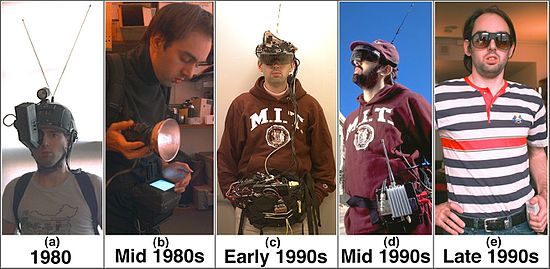
>> "the world's first cyborg"
>> www - wireless wearable webcams, wearable computing
>> Humanistic Intelligence
>> surveillanec and susveillance
>> moblogging


"cyborg, n. a person whose physiological functioning is aided by or dependent upon a mechanical or electronic device. Steve Mann is a cyborg, and the inventor of the wearable computer, called the WearComp. He sees the world as images imprinted onto his retina by rays of laser light. This allows him to transmit his viewpoint live to the Internet, block out billboards and other unwanted visual stimuli, and turn his world into a series of hyperlinks. Constantly connected to the WearComp system, Mann has all the capabilities of a standard office at his disposal, even as he utilizes shrinking technologies to turn himself into a portable movie studio. The first person to live in total constant intimate contact with the computer, Steve Mann exists at once in the real and virtual worlds, living an entirely videographic existence, seeing everything around him, including himself, through a wearable computer. Over the past twenty years, Steve Mann has been his own human guinea pig, testing his various wearable computer prototypes on himself. In Cyborg, he uses his own unique experiences to assess the state of wearable computers and their potential impact on our lives, articulating a vision for a tomorrow that sees humanity freer, safer, and smarter in ways most of us can only imagine. Mann is fascinated by the possibilities of the cyborg future, but he does not shrink away from frankly discussing the dangers of a post-human age in which our computers come to control us. In this unique ground-breaking book, Mann charts the development of a wearable computer industry, and warns of dangers to our liberty, privacy, and democracy. He contrasts those dangers with his own sweeping inclusive vision of a wearable computing age that brings about new ways to teach, learn, make art, communicate, and even think. Part biography, part breath-taking manifesto, part startling look into the very near future, Cyborg is a powerful book that challenges preconceptions and invites readers to enter the mind of one of the most fascinating thinkers of our time." (http://wearcam.org/cyborg.htm)


http://www.eyetap.org/wearcam/shootingback/shootingback.html:

"First Person(al) Documentary: Crime Reduction with Personal Imaging and Personal Image

The proposed performance will involve a reflectionist critique of video surveillance, using personal imaging (described in IEEE Computer, Vol 30, No. 2) as a medium with which to hold a mirror up to society.

Personal Imaging will be used to create a personal documentary to record and transmit images of potentially dangerous situations (e.g. fire exits that are illegally chained shut, poorly lit stairways, cluttered corridors and exits, poorly marked exits, and potentially abusive or irresponsible security guards and other representatives).

This will attempt to suggest that rather than having a police state, individual citizens might take on the role of monitoring and reporting crime and dangerous situations, while leaving police with the task of acting on reported crimes without having to place the population under surveillance themselves.

Personal Imaging has created its own metaphors for the aesthetics of self-defense, such as the antenna in its most familiar form which is the automotive cellular antenna. Re-situating this familiar object in a disturbing and dis-orienting manner (as a wearable apparatus), provides an obvious and visible deterrent to the seizing or destroying of image content.

Other highly visible crime deterrents comprise a highly obtrusive (yet still wearable) camera with a red led which people readily understand is symbolic of recording equipment in its recording mode of operation.

Most notably, a flat computer screen, sewn onto a shirt, allows others to see themselves on the WWW in a virtual mirror of sorts, which makes the reflectionist philosophy literal as well as metaphoric. The virtual mirror echoes the television set suspended from the ceilings of many establishments that use video surveillance, and serves the same process of providing a visceral and constant reminder that one should not commit crime.

In the words of Daniel Shurman, personal imaging allows one to project a social identity, to play out on the world in the same way that the Internet itself is a means with which to project a public identity.

"VideoClips" will also be used to confront representatives of the surveillance superhighway with a new genre of personal electronic news gathering.

Furthermore, it is hoped that the new aesthetic will give rise to a proliferation of "maybecams" in the form of a "firing squad" backed by zero-knowledge cryptography.

ShootingBack: An Attempt at Using Personal Imaging to Define a New Genre of Film/Video

With Personal Imaging I have attempted to define a new form of interaction between humans and technology. "Wearable Computing: A First Step Toward Personal Imaging", by Steve Mann, IEEE Computer Volume 30 Number 2, http://computer.org/pubs/computer/1997/0297toc.htm

I have equipped a pair of ordinary sunglasses with miniature spatial light modulators, CCD sensor arrays, and appropriate optics, so that when I put them on, I see a computer screen. On my computer screen I see a video image of what is actually present in the real world. Rather than allow the light to simply pass through, as would be the case with ordinary sunglasses, the apparatus absorbs and quantifies incoming light, processes it computationally, and then sends the processed result on toward my eyes.

After several years of adaptation the apparatus has begun to function as a visual prosthetic of sorts - a true extension of my mind and body that allows me to record exactly what I see.

Clearly I don't need to carry a camera because I am a camera, but in ShootingBack, I do anyway. Thus the act of merely making a documentary with an ordinary camcorder (while wearing my prosthetic camera), allows one camera to see through the other, and thus allows the audience the unique first-person perspective, as though being inside my eye, while I am shooting with a camcorder.

In ShootingBack, I confront representatives of the "Surveillance Superhighway" (establishments such as department stores where video surveillance is used extensively, yet photography by customers is strictly prohibited). I begin with my camcorder held down at my side, pointing away from a representative of the SS. Then, I ask the representative "What are those mysterious ceiling domes - those dark hemispheres..." or "Is that a video camera? Why are you taking pictures of me without my permission?". After the representative tells me that I am paranoid and that only criminals are concerned about cameras, I raise the camcorder up to my eye (the vantage point of the audience, who see the face-to-face conversation followed by the eyecup of a camcorder, eventually revealing the inside of the viewfinder, upon which we now see the representative of the SS displayed).

At this point, the representative of the SS often shows great concern about my camcorder, and thus, in a 180 degree reversal, is self-incriminating."

>> labels

>> cloudy with a chance of tags


Powered By:Blogger Widgets

followers

.........

My photo
... is a Media Art historian and researcher. She holds a PhD from the University of Art and Design Linz where she works as an associate professor. Her PhD-thesis is on "Speculative Archiving and Digital Art", focusing on facial recognition and algorithmic bias. Her Master Thesis "The Grammar of New Media" was on Descriptive Metadata for Media Arts. For many years, she has been working in the field of archiving/documenting Media Art, recently at the Ludwig Boltzmann Institute for Media.Art.Research and before as the head of the Ars Electronica Futurelab's videostudio, where she created their archives and primarily worked with the archival material. She was teaching the Prehystories of New Media Class at the School of the Art Institute of Chicago (SAIC) and in the Media Art Histories program at the Danube University Krems.