One of the most important and influential birthplaces of HCI
was the work on interaction and graphics centered around
the TX-2 computer at MIT’s Lincoln Laboratory in the
1960’s [25]. For example, it is hard to imagine the
innovation that happened at Xerox PARC in the ‘70s having
been possible without the foundation that Lincoln Labs
provided.
Showing posts with label HCI. Show all posts
Showing posts with label HCI. Show all posts
2008-07-03
>> Lincoln Labs and history of computer graphics
0
replies
tags -
computer graphics,
computer history,
HCI

Bookmark this post: | 


|
2008-06-25
>> Ivan Sutherland, "Sketchpad", 1963
 Ivan Sutherland,
Sketchpad: A man-machine graphical communication system
"The Sketchpad system makes it possible for a man and a computer to converse rapidly through the medium of line drawings. Heretofore, most interaction between man and computers has been slowed down by the need to reduce all communication to written statements that can be typed; in the past, we have been writing letters to rather than conferring with our computers. For many types of communication, such as describing the shape of a mechanical part or the connections of an electrical circuit, typed statements can prove cumbersome. The Sketchpad system, by eliminating typed statements (except for legends) in favor of line drawings, opens up a new area of man-machine communication.
[...] Information about how the drawing is tied together is stored in the computer as well as the information which gives the drawing its particular appearance.
[...] If the master hexagon is changed, the entire appearance but not the structure of the hexagonal pattern will be changed." (--> principle of master and instance; copy function)
(from: proceedings of the AFIPS Spring Joint Computer Conference, Detroit, Michigan, May 21-23, 1963, pp. 329-346.; link to this article at teh bottomof this page)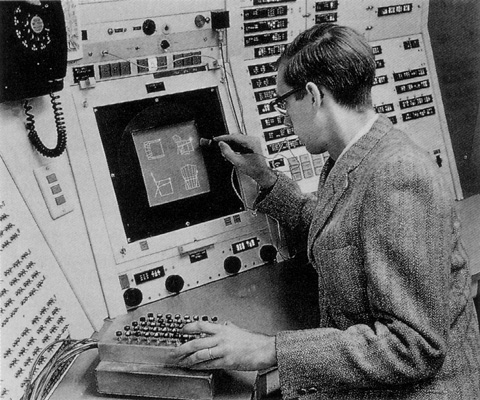
Sketchpad is a graphical interface and anticipates a lot of later developed GUI-elements.
Sutherland saw the use of sketchpad in the following applications:
- For storing and updating drawings
- For gaining scientific or engineering understanding of operations that can be described graphically
- As a topological input device for circuit simulators, etc.
- For highly repetitive drawings
the light pen:
- for drawing
- for making changes in existing drawings
- "inking-up": by touching the display with the pen, the tracking is initiated, the pen is represented as a cross on the screen (--> mouse pointer)
 constraint-functions:
"The major feature which distinguishes a Sketchpad drawing from a paper and pencil drawing is the user’s ability to specify to Sketchpad mathematical conditions on already drawn parts of his drawing which will be automatically satisfied by the computer to make the drawing take the exact shape desired. The process of fixing up a drawing to meet new conditions applied to it after it is already partially complete is very much like the process a designer goes through in turning a basic idea into a finished design. As new requirements on the various parts of the design are thought of, small changes are made to the size or other properties of parts to meet the new conditions. By making Sketchpad able to find new values for variables which satisfy the conditions imposed, it is hoped that designers can be relieved of the need of much mathematical detail. The effort expended in making the definition of constraint types as general as possible was aimed at making design constraints as well as geometric constraints equally easy to add to the system. "
--> make lines straight, corrections, image manipulation
Sketchpad and art:
 |
 Figure 16. Winking girl, “Nefertite,” and her component parts. Figure 16. Winking girl, “Nefertite,” and her component parts. |
Link to the full phd-thesis pdf:
http://www.cl.cam.ac.uk/techreports/UCAM-CL-TR-574.pdf
some key terms and implications:
- predecessor of CAD-programs
- object oriented programming --> objects, instances
- GUI
- HCI
- inspired by Vanevar Bush's "As we may think", 1945
- x-y point plotter display
- light pen
- ran on the TX-2 computer
- uses a window for the first time
more info on sketchpad: http://www.guidebookgallery.org/articles/sketchpadamanmachinegraphicalcommunicationsystem
video-lecture from: http://www.archive.org/details/AlanKeyD1987
Sketchpad presentation with Alan Kay's voice over:
Sketchpad demo from the 60ies (2 parts):
0
replies
tags -
computer graphics,
computer history,
GUI,
HCI,
publications,
theory
Bookmark this post: |
|
Subscribe to:
Posts (Atom)
>> additional class blogs


>> subscribe


 Posts
All Comments
Posts
All Comments
.........

- Nina Wenhart ...
- ... is a Media Art historian and researcher. She holds a PhD from the University of Art and Design Linz where she works as an associate professor. Her PhD-thesis is on "Speculative Archiving and Digital Art", focusing on facial recognition and algorithmic bias. Her Master Thesis "The Grammar of New Media" was on Descriptive Metadata for Media Arts. For many years, she has been working in the field of archiving/documenting Media Art, recently at the Ludwig Boltzmann Institute for Media.Art.Research and before as the head of the Ars Electronica Futurelab's videostudio, where she created their archives and primarily worked with the archival material. She was teaching the Prehystories of New Media Class at the School of the Art Institute of Chicago (SAIC) and in the Media Art Histories program at the Danube University Krems.