 http://www.ekac.org/gfpbunny.html
"My transgenic artwork "GFP Bunny" comprises the creation of a green fluorescent rabbit, the public dialogue generated by the project, and the social integration of the rabbit. GFP stands for green fluorescent protein. "GFP Bunny" was realized in 2000 and first presented publicly in Avignon, France. Transgenic art, I proposed elsewhere [1], is a new art form based on the use of genetic engineering to transfer natural or synthetic genes to an organism, to create unique living beings. This must be done with great care, with acknowledgment of the complex issues thus raised and, above all, with a commitment to respect, nurture, and love the life thus created.
WELCOME, ALBA
I will never forget the moment when I first held her in my arms, in Jouy-en-Josas, France, on April 29, 2000. My apprehensive anticipation was replaced by joy and excitement. Alba -- the name given her by my wife, my daughter, and I -- was lovable and affectionate and an absolute delight to play with. As I cradled her, she playfully tucked her head between my body and my left arm, finding at last a comfortable position to rest and enjoy my gentle strokes. She immediately awoke in me a strong and urgent sense of responsibility for her well-being.
Alba is undoubtedly a very special animal, but I want to be clear that her formal and genetic uniqueness are but one component of the "GFP Bunny" artwork. The "GFP Bunny" project is a complex social event that starts with the creation of a chimerical animal that does not exist in nature (i.e., "chimerical" in the sense of a cultural tradition of imaginary animals, not in the scientific connotation of an organism in which there is a mixture of cells in the body) and that also includes at its core: 1) ongoing dialogue between professionals of several disciplines (art, science, philosophy, law, communications, literature, social sciences) and the public on cultural and ethical implications of genetic engineering; 2) contestation of the alleged supremacy of DNA in life creation in favor of a more complex understanding of the intertwined relationship between genetics, organism, and environment; 3) extension of the concepts of biodiversity and evolution to incorporate precise work at the genomic level; 4) interspecies communication between humans and a transgenic mammal; 5) integration and presentation of "GFP Bunny" in a social and interactive context; 6) examination of the notions of normalcy, heterogeneity, purity, hybridity, and otherness; 7) consideration of a non-semiotic notion of communication as the sharing of genetic material across traditional species barriers; 8) public respect and appreciation for the emotional and cognitive life of transgenic animals; 9) expansion of the present practical and conceptual boundaries of artmaking to incorporate life invention.
GLOW IN THE FAMILY
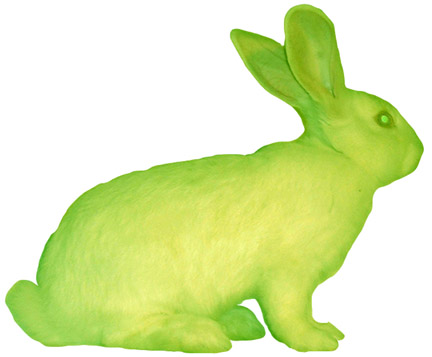
"Alba", the green fluorescent bunny, is an albino rabbit. This means that, since she has no skin pigment, under ordinary environmental conditions she is completely white with pink eyes. Alba is not green all the time. She only glows when illuminated with the correct light. When (and only when) illuminated with blue light (maximum excitation at 488 nm), she glows with a bright green light (maximum emission at 509 nm). She was created with EGFP, an enhanced version (i.e., a synthetic mutation) of the original wild-type green fluorescent gene found in the jellyfish Aequorea Victoria. EGFP gives about two orders of magnitude greater fluorescence in mammalian cells (including human cells) than the original jellyfish gene [2].
The first phase of the "GFP Bunny" project was completed in February 2000 with the birth of "Alba" in Jouy-en-Josas, France. This was accomplished with the invaluable assistance of zoosystemician Louis Bec [3] and scientists Louis-Marie Houdebine and Patrick Prunet [4]. Alba's name was chosen by consensus between my wife Ruth, my daughter Miriam, and myself. The second phase is the ongoing debate, which started with the first public announcement of Alba's birth, in the context of the Planet Work conference, in San Francisco, on May 14, 2000. The third phase will take place when the bunny comes home to Chicago, becoming part of my family and living with us from this point on.
FROM DOMESTICATION TO SELECTIVE BREEDING
The human-rabbit association can be traced back to the biblical era, as exemplified by passages in the books Leviticus (Lev. 11:5) and Deuteronomy (De. 14:7), which make reference to saphan, the Hebrew word for rabbit. Phoenicians seafarers discovered rabbits on the Iberian Peninsula around 1100 BC and, thinking that these were Hyraxes (also called Rock Dassies), called the land "i-shepan-im" (land of the Hyraxes). Since the Iberian Peninsula is north of Africa, relative geographic position suggests that another Punic derivation comes from sphan, "north". As the Romans adapted "i-shepan-im" to Latin, the word Hispania was created -- one of the etymological origins of Spain. In his book III the Roman geographer Strabo (ca. 64 BC - AD 21) called Spain "the land of rabbits". Later on, the Roman emperor Servius Sulpicius Galba (5 BC - AD 69), whose reign was short-lived (68-69 AD), issued a coin on which Spain is represented with a rabbit at her feet. Although semi-domestication started in the Roman period, in this initial phase rabbits were kept in large walled pens and were allowed to breed freely.
Humans started to play a direct role in the evolution of the rabbit from the sixth to the tenth centuries AD, when monks in southern France domesticated and bred rabbits under more restricted conditions [5]. Originally from the region comprised by southwestern Europe and North Africa, the European rabbit (Oryctolagus cuniculus) is the ancestor of all domestic breeds. Since the sixth century, because of its sociable nature the rabbit increasingly has become integrated into human families as a domestic companion. Such human-induced selective breeding created the morphological diversity found in rabbits today. The first records describing a variety of fur colors and sizes distinct from wild breeds date from the sixteenth century. It was not until the eighteenth century that selective breeding resulted in the Angora rabbit, which has a uniquely thick and beautiful wool coat. The process of domestication carried out since the sixth century, coupled with ever increasing worldwide migration and trade, resulted in many new breeds and in the introduction of rabbits into new environments different from their place of origin. While there are well over 100 known breeds of rabbit around the world, "recognized" pedigree breeds vary from one country to another. For example, the American Rabbit Breeders Association (ARBA) "recognizes" 45 breeds in the U.S.A., with more under development.
In addition to selective breeding, naturally occurring genetic variations also contributed to morphological diversity. The albino rabbit, for example, is a natural (recessive) mutation which in the wild has minimal chances of survival (due to lack of proper pigmentation for camouflage and keener vision to spot prey). However, because it has been bred by humans, it can be found widely today in healthy populations. The human preservation of albino animals is also connected to ancient cultural traditions: almost every Native American tribe believed that albino animals had particular spiritual significance and had strict rules to protect them [6].
FROM BREEDING TO TRANSGENIC ART
"GFP Bunny" is a transgenic artwork and not a breeding project. The differences between the two include the principles that guide the work, the procedures employed, and the main objectives. Traditionally, animal breeding has been a multi-generational selection process that has sought to create pure breeds with standard form and structure, often to serve a specific performative function. As it moved from rural milieus to urban environments, breeding de-emphasized selection for behavioral attributes but continued to be driven by a notion of aesthetics anchored on visual traits and on morphological principles. Transgenic art, by contrast, offers a concept of aesthetics that emphasizes the social rather than the formal aspects of life and biodiversity, that challenges notions of genetic purity, that incorporates precise work at the genomic level, and that reveals the fluidity of the concept of species in an ever increasingly transgenic social context.
As a transgenic artist, I am not interested in the creation of genetic objects, but on the
invention of transgenic social subjects. In other words, what is important is the completely integrated process of creating the bunny, bringing her to society at large, and providing her with a loving, caring, and nurturing environment in which she can grow safe and healthy. This integrated process is important because it places genetic engineering in a social context in which the relationship between the private and the public spheres are negotiated. In other words, biotechnology, the private realm of family life, and the social domain of public opinion are discussed in relation to one another.
Transgenic art is not about the crafting of genetic objets d'art, either inert or imbued with vitality. Such an approach would suggest a conflation of the operational sphere of life sciences with a traditional aesthetics that privileges formal concerns, material stability, and hermeneutical isolation. Integrating the lessons of
dialogical philosophy [7] and
cognitive ethology [8], transgenic art must promote awareness of and respect for the spiritual (mental) life of the transgenic animal. The word
"aesthetics" in the context of transgenic art must be understood to mean that creation, socialization, and domestic integration are a single process. The question is not to make the bunny meet specific requirements or whims, but to enjoy her company as an individual (all bunnies are different), appreciated for her own intrinsic virtues, in dialogical interaction.
One very important aspect of "GFP Bunny" is that Alba, like any other rabbit, is sociable and in need of interaction through communication signals, voice, and physical contact. As I see it, there is no reason to believe that the interactive art of the future will look and feel like anything we knew in the twentieth century. "GFP Bunny" shows an alternative path and makes clear that a profound concept of interaction is anchored on the notion of personal responsibility (as both care and possibility of response). "GFP Bunny" gives continuation to my focus on the creation, in art, of what Martin Buber called dialogical relationship [9], what Mikhail Bakhtin called dialogic sphere of existence [10], what Emile Benveniste called intersubjectivity [11], and what Humberto Maturana calls consensual domains [12]: shared spheres of perception, cognition, and agency in which two or more sentient beings (human or otherwise) can negotiate their experience dialogically. The work is also informed by Emmanuel Levinas' philosophy of alterity [13], which states that our proximity to the other demands a response, and that the interpersonal contact with others is the unique relation of ethical responsibility. I create my works to accept and incorporate the reactions and decisions made by the participants, be they eukaryotes or prokaryotes [14]. This is what I call the human-plant-bird-mammal-robot-insect-bacteria interface.
In order to be practicable, this aesthetic platform--which reconciles forms of social intervention with semantic openness and systemic complexity--must acknowledge that every situation, in art as in life, has its own specific parameters and limitations. So the question is not how to eliminate circumscription altogether (an impossibility), but how to keep it indeterminate enough so that what human and nonhuman participants think, perceive, and do when they experience the work matters in a significant way. My answer is to make a concerted effort to remain truly open to the participant's choices and behaviors, to give up a substantial portion of control over the experience of the work, to accept the experience as-it-happens as a transformative field of possibilities, to learn from it, to grow with it, to be transformed along the way. Alba is a participant in the "GFP Bunny" transgenic artwork; so is anyone who comes in contact with her, and anyone who gives any consideration to the project. A complex set of relationships between family life, social difference, scientific procedure, interspecies communication, public discussion, ethics, media interpretation, and art context is at work.
Throughout the twentieth century art progressively moved away from pictorial representation, object crafting, and visual contemplation. Artists searching for new directions that could more directly respond to social transformations gave emphasis to process, concept, action, interaction, new media, environments, and critical discourse. Transgenic art acknowledges these changes and at the same time offers a radical departure from them, placing the question of actual creation of life at the center of the debate. Undoubtedly, transgenic art also develops in a larger context of profound shifts in other fields. Throughout the twentieth century physics acknowledged uncertainty and relativity, anthropology shattered ethnocentricity, philosophy denounced truth, literary criticism broke away from hermeneutics, astronomy discovered new planets, biology found "extremophile" microbes living in conditions previously believed not capable of supporting life, molecular biology made cloning a reality.
Transgenic art acknowledges the human role in rabbit evolution as a natural element, as a chapter in the natural history of both humans and rabbits, for domestication is always a bidirectional experience. As humans domesticate rabbits, so do rabbits domesticate their humans. If teleonomy is the apparent purpose in the organization of living systems [15], then transgenic art suggests a non-utilitarian and more subtle approach to the debate. Moving beyond the metaphor of the artwork as a living organism into a complex embodiment of the trope, transgenic art opens a nonteleonomic domain for the life sciences. In other words, in the context of transgenic art humans exert influence in the organization of living systems, but this influence does not have a pragmatic purpose. Transgenic art does not attempt to moderate, undermine, or arbitrate the public discussion. It seeks to offer a new perspective that offers ambiguity and subtlety where we usually only find affirmative ("in favor") and negative ("against") polarity. "GFP Bunny" highlights the fact that transgenic animals are regular creatures that are as much part of social life as any other life form, and thus are deserving of as much love and care as any other animal [16].
In developing the "GFP Bunny" project I have paid close attention and given careful consideration to any potential harm that might be caused. I decided to proceed with the project because it became clear that it was safe [17]. There were no surprises throughout the process: the genetic sequence responsible for the production of the green fluorescent protein was integrated into the genome through zygote microinjection [18]. The pregnancy was carried to term successfully. "GFP Bunny" does not propose any new form of genetic experimentation, which is the same as saying: the technologies of microinjection and green fluorescent protein are established well-known tools in the field of molecular biology. Green fluorescent protein has already been successfully expressed in many host organisms, including mammals [19]. There are no mutagenic effects resulting from transgene integration into the host genome. Put another way: green fluorescent protein is harmless to the rabbit. It is also important to point out that the "GFP Bunny" project breaks no social rule: humans have determined the evolution of rabbits for at least 1400 years.
ALTERNATIVES TO ALTERITY
As we negotiate our relationship with our lagomorph companion [20], it is necessary to think rabbit agency without anthropomorphizing it. Relationships are not tangible, but they form a fertile field of investigation in art, pushing interactivity into a literal domain of intersubjectivity. Everything exists in relationship to everything else. Nothing exists in isolation. By focusing my work on the interconnection between biological, technological, and hybrid entities I draw attention to this simple but fundamental fact. To speak of interconnection or intersubjectivity is to acknowledge the social dimension of consciousness. Therefore, the concept of intersubjectivity must take into account the complexity of animal minds. In this context, and particularly in regard to "GFP Bunny", one must be open to understanding the rabbit mind, and more specifically to Alba's unique spirit as an individual. It is a common misconception that a rabbit is less intelligent than, for example, a dog, because, among other peculiarities, it seems difficult for a bunny to find food right in front of her face. The cause of this ordinary phenomenon becomes clear when we consider that the rabbit's visual system has eyes placed high and to the sides of the skull, allowing the rabbit to see nearly 360 degrees. As a result, the rabbit has a small blind spot of about l0 degrees directly in front of her nose and below her chin [21]. Although rabbits do not see images as sharply as we do, they are able to recognize individual humans through a combination of voice, body movements, and scent as cues, provided that humans interact with their rabbits regularly and don't change their overall configuration in dramatic ways (such as wearing a costume that alters the human form or using a strong perfume). Understanding how the rabbit sees the world is certainly not enough to appreciate its consciousness but it allows us to gain insights about its behavior, which leads us to adapt our own to make life more comfortable and pleasant for everyone.
Alba is a healthy and gentle mammal. Contrary to popular notions of the alleged monstrosity of genetically engineered organisms, her body shape and coloration are exactly of the same kind we ordinarily find in albino rabbits. Unaware that Alba is a glowing bunny, it is impossible for anyone to notice anything unusual about her. Therefore Alba undermines any ascription of alterity predicated on morphology and behavioral traits. It is precisely this productive ambiguity that sets her apart: being at once same and different. As is the case in most cultures, our relationship with animals is profoundly revealing of ourselves. Our daily coexistence and interaction with members of other species remind us of our uniqueness as humans. At the same time, it allow us to tap into dimensions of the human spirit that are often suppressed in daily life--such as communication without language--that reveal how close we really are to nonhumans. The more animals become part of our domestic life, the further we move breeding away from functionality and animal labor. Our relationship with other animals shifts as historical conditions are transformed by political pressures, scientific discoveries, technological development, economic opportunities, artistic invention, and philosophical insights. At the beginning of the twenty-first century, as we transform our understanding of human physical boundaries by introducing new genes into developed human organisms, our communion with animals in our environment also changes. Molecular biology has demonstrated that the human genome is not particularly important, special, or different. The human genome is made of the same basic elements as other known life forms and can be seen as part of a larger genomic spectrum rich in variation and diversity.
Western philosophers, from Aristotle [22] to Descartes [23], from Locke [24] to Leibniz [25], from Kant [26] to Nietsche [27] and Buber [28], have approached the enigma of animality in a multitude of ways, evolving in time and elucidating along the way their views of humanity. While Descartes and Kant possessed a more condescending view of the spiritual life of animals (which can also be said of Aristotle), Locke, Leibniz, Nietsche, and Buber are -- in different degrees -- more tolerant towards our eukaryotic others [29]. Today, our ability to generate life through the direct method of genetic engineering prompts a re-evaluation of the cultural objectification and the personal subjectification of animals, and in so doing it renews our investigation of the limits and potentialities of what we call humanity. I do not believe that genetic engineering eliminates the mystery of what life is; to the contrary, it reawakens in us a sense of wonder towards the living. We will only think that biotechnology eliminates the mystery of life if we privilege it in detriment to other views of life (as opposed to seeing biotechnology as one among other contributions to the larger debate) and if we accept the reductionist view (not shared by many biologists) that life is purely and simply a matter of genetics. Transgenic art is a firm rejection of this view and a reminder that communication and interaction between sentient and nonsentient actants lies at the core of what we call life. Rather than accepting the move from the complexity of life processes to genetics, transgenic art gives emphasis to the social existence of organisms, and thus highlights the evolutionary continuum of physiological and behavioral characteristics between the species. The mystery and beauty of life is as great as ever when we realize our close biological kinship with other species and when we understand that from a limited set of genetic bases life has evolved on Earth with organisms as diverse as bacteria, plants, insects, fish, reptiles, birds, and mammals.
TRANSGENESIS, ART, AND SOCIETY
The success of human genetic therapy suggests the benefits of altering the human genome to heal or to improve the living conditions of fellow humans [30]. In this sense, the introduction of foreign genetic material in the human genome can be seen not only as welcome but as desirable. Developments in molecular biology, such as the above example, are at times used to raise the specter of eugenics and biological warfare, and with it the fear of banalization and abuse of genetic engineering. This fear is legitimate, historically grounded, and must be addressed. Contributing to the problem, companies often employ empty rhetorical strategies to persuade the public, thus failing to engage in a serious debate that acknowledges both the problems and benefits of the technology. [31] There are indeed serious threats, such as the possible loss of privacy regarding one's own genetic information, and unacceptable practices already underway, such as biopiracy (the appropriation and patenting of genetic material from its owners without explicit permission).
As we consider these problems, we can not ignore the fact that a complete ban on all forms of genetic research would prevent the development of much needed cures for the many devastating diseases that now ravage human and nonhumankind. The problem is even more complex. Should such therapies be developed successfully, what sectors of society will have access to them? Clearly, the question of genetics is not purely and simply a scientific matter, but one that is directly connected to political and economic directives. Precisely for this reason, the fear raised by both real and potential abuse of this technology must be channeled productively by society. Rather than embracing a blind rejection of the technology, which is undoubtedly already a part of the new bioscape, citizens of open societies must make an effort to study the multiple views on the subject, learn about the historical background surrounding the issues, understand the vocabulary and the main research efforts underway, develop alternative views based on their own ideas, debate the issue, and arrive at their own conclusions in an effort to generate mutual understanding. Inasmuch as this seems a daunting task, drastic consequences may result from hype, sheer opposition, or indifference.
This is where art can also be of great social value. Since the domain of art is symbolic even when intervening directly in a given context [32], art can contribute to reveal the cultural implications of the revolution underway and offer different ways of thinking about and with biotechnology. Transgenic art is a mode of genetic inscription that is at once inside and outside of the operational realm of molecular biology, negotiating the terrain between science and culture. Transgenic art can help science to recognize the role of relational and communicational issues in the development of organisms. It can help culture by unmasking the popular belief that DNA is the "master molecule" through an emphasis on the whole organism and the environment (the context). At last, transgenic art can contribute to the field of aesthetics by opening up the new symbolic and pragmatic dimension of art as the literal creation of and responsibility for life.
(to see Eduardo Kac's notes, please visit the url above)

 Areas of continued research




 Posts
Posts


