<< preface

this blog is nina wenhart's collection of resources on the various histories of new media art. it consists mainly of non or very little edited material i found flaneuring on the net, sometimes with my own annotations and comments, sometimes it's also textparts i retyped from books that are out of print.

it is also meant to be an additional resource of information and recommended reading for my students of the prehystories of new media class that i teach at the school of the art institute of chicago in fall 2008.

the focus is on the time period from the beginning of the 20th century up to today.

>> search this blog

2008-07-09

>> Georg Nees


Jasia Reichardt in "The Computer in Art", 1971:
"Georg Nees, one of the first exponents in the field, has made graphics based on random parameters, developing one or two themes with great ingenuity and using repetition as his subject."


to the work shown here:
"

Schotter by George Nees

This work by Nees is a portrait-format graphic assembled from twelve sets of twenty-two squares, each set having the same length along the sides. Read from left to right, as one would read a European language, it shows disorder that increases from top to bottom as one views the graphic. The visible defines the order, which is not the same as the order of the pictures, but an optimal state in which the squares lie along a horizontal line, forming a row in which each one is set precisely beside the next one, so that straight lines are formed by the upper and lower edges. This state is not seen in the picture as illustrated here. Row by row, the state of disorder successively increases down to the lower border of the picture. The program creates disorder through the rotation of each square at the point of intersection of its diagonal, and also through the increasing distortion in the graphic space.

[...]

"Image 38, Schotter, is produced by invoking the SERIE procedure [...]. The non-parametric procedure QUAD serves to generate the elementary figure which is reproduced multiple times in the composition process controlled by SERIE. QUAD is located in lines 4 through 15 of the generator. This procedure draws squares with sides of constant length but at random locations and different angles. From lines 9 and 10, it can be seen that the position of a single square is influenced by random generator J1, and the angle placement by J2. The successively increasing variation between the relative coordinates P and Q, and the angle position PSI of a given square, is controlled by the counter index I, which is invoked by each call from QUAD (see line 14)."

Schotter code

(from: http://www.chart.ac.uk/chart2004/papers/weiss.html)


"On the occasion of Georg Nees’s 80th birthday, the ZKM continues its series on early computer art, inaugurated by an exhibition of the works of Frieder Nake, with this co-operative exhibition organized in 2005 by the Bremen Kunsthalle. Along with Herbert Franke and Frieder Nake, Nees is looked upon as one of the pioneers of computer art. In 1959, he began to program digital computers. In 1965, he procured for his department at Siemens a table-sized, punched tape-operated drawing automaton constructed by Konrad Zuse, the »Zuse-Graphomat«, which could move a descendible drawing pencil in two right-angled axes over a page of drawing paper. Nees recalls: »There it was, the great temptation for me, for once not to represent something technical with this machine but rather something ‘useless’ – geometrical patterns«. Together with Nake, Nees organized in Stuttgart the first exhibition of computer drawings and described these expressly as »computer art«. At a time when the computer was used exclusively for military and scientific purposes, Nees succeeded in transferring algorithmic thought to art. His independent drawings are accordingly based on the programming language ALGOL and the Siemens computer system 2002 in combination with the »Zuse-Graphomat«.
In 1968, he was one of the first to submit to Max Bense, the Stuttgart aesthetic theorist of information, with a work on the aesthetic categories of computer graphics, entitled »Generative Computer Graphics«." (http://on1.zkm.de/zkm/stories/storyReader$5255)

>> Robert Mallary, TRAN 2

from: http://www.atariarchives.org/artist/sec2.php


"How/why did you become involved with the computer in producing art?"

My involvement with the computer is the consequence of a long-standing interest in art-and-technology that extends back to the very beginning of my career in 1936. My first enthusiasm was the Mexican school of mural painting and my model was David Alfaro Siqueiros, who as early as 1932 was advocating a revolution in the technology of art. For Siqueiros this meant using the airbrush and synthetic automobile lacquers to paint his out-sized propaganda murals, and I began by following in his footsteps.

During the forties I was experimenting with both acrylic and polyester plastics, with fluorescent dyes and pigments, and spent a couple of months researching a cinematographic approach to kinetic sculpture based on what I described as 'multiplanar sequential image projection.' In 1951 I constructed an eight-bladed stroboplane to test the principle, and demonstrated the device in a one-man show in Los Angeles a year later. Along with some drawings on plaster I also displayed a cluster of transparent fluorescent sculptures illuminated by black light. These latter triggered my first publicity break—a full page color reproduction in Time.

I turned to the computer in 1967 on learning for the first time about its ability to generate and transform images. Almost immediately I realized that my earlier idea of multi-planar image synthesis could be used to describe three-dimensional forms within the computer by slicing and stacking them as two-dimensional shapes—something like a contour map. The result was my computer sculpture program TRAN2, the first version of which was written in 1968 for the IBM 1130 system at Amherst College.

image

'Quad IV', Iaminated marble, 11 inches high. The computer sculpture program TRAN 2 was used to design the sculpture and draw the cross sections, which were transferred to the marble slabs and traced. The slabs were cut out, Iaminated together with epoxy, then ground to a smooth contour and polished.

"What is your art background?"

My reputation, such as it is, is based not so much on my activities in art-and-technology and with the computer as on the Neo-Dada and assemblage constructions I was doing in New York about 1960. However, even this 'junk art' could not have been made but for polyester resin, which I came across in 1946 as a consequence of my explorations in art-and-technology. But I gave up using all plastics, solvents and spray cans after 1962 on learning they were poisoning me, and for the five years before dis- covering the computer, had virtually no explicit involvement with art-and-technology.

The year 1967 was crucial for me in a number of other ways. It was the year I began teaching at the University of Massachusetts in Amherst and had the opportunity to try out computers, and it was also about that time that art-and-technology shook the art world—thanks mainly to Robert Rauchenberg and his friends in the Experiments in Art and Technology group (E.A.T.). Unfortunately, this high-octane group, after launching art-and-technology in this country, promptly sank it with a series of technically amateurish and Pop-ridden exhibitions that were not long in giving art-and-technology a bad name. Those of us who are really serious about art-and-technology (and have stuck with it during hard times) are still paying the price. But things are looking better. For since its nadir about 1971 the movement has been reviving. In fact, its prospects might even be called promising now that it has struck up an alliance with the computer and has achieved a solid base of operations in a few key colleges and universities.

However, the artists and engineers who organized E.A.T. should be given their due. Although they certainly did not invent art-and-technology out of whole cloth (whose roots are as diverse as Constructivism, the Bauhaus, and the Mexicans—to mention only a few), they nevertheless managed to contribute a catchy if less than euphonious name for a movement that had long been in need of one.

In sum, my art background is art-and-technology, and my enduring interest is the potential of science and technology for art.

"What role does the computer play for you?"

The power of the computer in art is that it can play a variety of roles, many of them cybernetic, or 'brain-like'. The computer, like any tool or machine, extends human capabilities. But it is unique in that it extends the power of the mind as well as the hand. Hence, a clear distinction must be made between this brain-like function and the output instrumentalities (like film, video, photography, holography, kinetic sculpture, graphics, light art, etc.) through which this power is expressed. This explains why the computer is not an art medium as such, and why the phrase 'computer art,' if used to convey this meaning, is a misnomer. Properly defined, the role of the computer is that of a key cybernetic component in a host medium, art form, or art-generating system where it performs a variety of functions, some of them far more sophisticated than others from a cybernetic standpoint. In other words, some of them have more to do with the brain than the hand, and in this respect are more portentous in their long-term implications for art. And it is these cybernetic implications that interest me the most.

For example, one artist might use the computer for its speed, precision, and implacable tirelessness; another for its ability to imitate biological, physiological, or psychological stimulus/response interactions; another for its ability to simulate other kinds of art; another as a way of mediating the flow of energy and information within a transductive system (as when sound ignites the visual kinetics on a CRT or video display); another for its ability to regulate precise and fast-moving performances (as in a kinetic laser system); another for its ability to calculate the minute 'iterations-with-a-difference' of a spiralgraphic-like composition; and another for its ability to calculate a hologram, or the small differences of imagery in a stereo pair.

image

'2-color computer graphic', 9¾ × 9¾ inches, 1972. A two-color plotter graphic made on the Amherst College IBM 1130 system. The program, called GRAF/D, was written in Fortran IV by the artist. The program stops while the pens are changed by hand. Felt tip and ball point pens are combined in the same drawing.

As for myself, although the underlying concept of TRAN2 has yet to be fully implemented, eventually this sculpture program will exploit the computer's interactive 'conversational' capabilities to speed and enhance the design of sculptural forms, continuously shaping and reshaping them by means of a large library of transformation algorithms and routines. Another program of mine, called GRAF/D, uses the plotter for no better reason than to draw a grid of lines straighter, faster, and more evenly than I could by hand. Yet another program, called TRPL, uses the machine to calculate the interpolations between a set of master lines, while also incrementing and decrementing the intervals between the lines. In this case these microscopic nuances are beyond my ability either to calculate or to draw.

image

'3-Color Computer Graphic', 12¾ high × 9¾ inches wide, 1972. A three-color graphic made on the Amherst College IBM system. The program, called GRAF/D, was written by the artist in Fortran IV. The program stops while the pens are changed by hand. Felt tip and ballpoint colored pens are combined in the same drawing.

But within the context of the computer itself almost all of the capabilities I have just mentioned are somewhat on the order of mechanical skills when compared to the computer's truly cybernetic potential. This comes into play when the computer begins to make aesthetic distinctions, choices, and assessments, and when it has been programmed with the information needed for it to organize and compose art of a superior quality automatically and seemingly 'on its own.' Used this way, the computer can be turned into a marvelous tool for research in art theory and aesthetics, and for testing the structural syntax, principles, devices, and ratios against the quality of the serial output. Because the computer is preeminently a calculating machine it can output as alphanumeric listings the quantifiable features and relationships needed for close study and analysis.

SHAPE was written five years ago as a start in this direction, and last summer its name was changed to SHAPE3/D when it was enlarged as a 3-dimensional program for organizing a repertoire of solids into various kinds of compositions, some simple and some complex. Thirty parameters can define an enormous range of forms, features, and compositional set-ups which can be rotated for viewing from any arbitrary perspective. The ratios of size, spacing, height, color, empty-to-filled space, and other characteristics can all be prespecified within an approximate range, while using the random number subroutine to generate the 'variety-within-specified-limits' which is the essence of the approach.

Last summer an interdisciplinary group of artists, environmental planners, and computer specialists on our campus was funded by the National Endowment for the Arts to study the aesthetic aspect of stripmine reclamation, approaching it from the standpoint of landscape design and large-scale environmental sculpture. This is very much a computer-oriented project in which we will be combining into a single integrated package a number of the computer capabilities just enumerated.

For example, using the system in its interactive mode, the designer/sculptor will compose landform arrangements based on a substructure of geometrical primitives, which at the right moment can be joined and unified by a curve-fitting algorithm that scans the topographical surface. Or, put into the automated mode, the computer will suggest ideas of its own—all of them in accord with a complex web of criteria that, in addition to the explicitly aesthetic specifications, also includes environmental, land use, cost, and other requirements that must be considered. These plans and designs will then be out-putted in a variety of visual forms (film, video, stereo, CRT display, plotter, etc.) for the more efficient and vivid communication of this visual information. What I am describing, of course, is an ultimate objective. Our immediate goals are more modest.

In short, the 'role' of the computer for me is precisely its diversity of roles, most of them cybernetic in some way or degree.

"Are your computer works related to non-computer art?"

Definitely yes—particularly to the geometry and formalism of Constructivism and Neo-Plasticism. In fact, the more geometric and mathematically-based kinds of computer art (like spiralgraphics) might even qualify as a subset and off-shoot of Constructivism, which in turn is likely to be both revitalized and broadened by this new development in art-and-technology. And the same holds for Op Art, in which are buried a number of still unexplored potentials that only a computer can uncover. Although the moire patterns generated by my program TRPL are surely not Op Art as such, they suggest something of what I have in mind.

"Do you have a final image in mind when work begins?"

It is a common fallacy that artists simply copy a ready-made image that is fixed and unchanging in the mind's eye. The error here is in thinking of the creative process as essentially static and undialectical. The start-up stage for most artists is a rather vague idea that evolves towards definition and completeness in the course of the work itself (and in the case of Abstract Expressionism and gesture painting this open-ended strategy is practically a sine-qua-non). Moreover, contemporary artists are likely to jettison the original idea completely if something better happens along while the work is underway.

I can't see that the computer changes this very much. In developing, then using a program so as to express the original idea, there are usually experiments with the parameter settings to get the most out of the program and optimize the output. Or in the course of debugging a program, the output might reveal a possibility that could not be foreseen when the program was first planned. However, I would hazard the generalization that the greater the power, scope, and versatility of a program, the greater the possibility of these unexpected discoveries. In fact, one of the delights of complex programs with many parameters is these surprising productions. And this also points up that one has to learn how best to use a program once it has been written.

image

'4-Color Computer Graphic', 9¼ × 9½ inches, 1972. A four-color plotter graphic made on the Amherst College IBM 1130 system. The program, called GRAF/D, was written in Fortran IV by the artist. For making this drawing the program was run through twice, once for the upper half and again for the lower half. Each drawing is one-of-a-kind.

"Could your work be done without the aid of a computer? If yes, why use the computer?"

My program GRAF/D does nothing but draw straight lines in grid-like patterns. I don't doubt there are thousands of artists who could draw similar graphics by hand if they were of a mind to. But I couldn't—or more precisely, wouldn't—because I'd either be climbing the walls, or making blotches on the next to the last line. Although this use of the computer can hardly be called cybernetic, it is still a sufficient excuse to use it. Mere convenience is a justification, just as we use machines to do many things we are able to do without them. But we use them nevertheless—and why not? And why not use the computer just for its convenience when making certain kinds of art?

TRPL is another cup of tea. In this case it would be plain madness to attempt to calculate, then hand-draw the precise scheme of lines and spaces required for generating the moire patterns that are so important to this series.

This same question might also be relevant to the three or four sculptures I made in the late sixties using TRAN2 as the program. Since these works appear to be rather conventional examples of abstract volumetric sculpture, it is difficult to perceive what role the computer played. But rest assured, it did play a role at the design stage, even though its contribution is not apparent. What is missing here, of course, is an output medium that matches the computer in its contemporaneity—something like holography, for example. In fact, I am still looking for that medium, and the delay in finding it explains in part why the punch cards for TRAN2 are resting on the shelf.

"To what extent are you involved in the technical production of your work, for example, in programming?"

At first I was unable to do any of the programming I needed and I relied mainly on students and paid assistants. But I have since learned some Fortran, enjoy programming as a designing and problem-solving activity, and wish I had the time to become better at it. And if need be I can pinch hit for Dave Backer, a student in the computer science program who helps me teach the Computer Graphic Workshop we have going at the University of Massachusetts.

When confronted with a really formidable programming task, however, I like to work with an expert. In this case my contribution is to specify the over-all character and purpose of the program, insist on some user-oriented features, and help in defining and naming the variables and parameters that are needed. By knowing something about programming myself I can work more effectively with the programmer.

But I have yet to come across any canned program or so-called graphics language that can do any of the things I am likely to ask of a computer (a possible exception is Ken Knowlton's EXPLOR, which I look forward to trying out now that it has been implemented on our UMass CDC KRONOS system). Occasionally I come across a program that I admire very much, like Jeff Bangert's simulation of the hand-made art his wife Colette was doing some years back. In this kind of situation I feel challenged to test whether I might obtain better results from the program than its authors (in fact, I put the challenge to them once). Or perhaps results of the same high quality, but of a different character. However, the Bangerts are not about to let this program out of their hands, and I certainly don't blame them. This sophisticated program is much too personal to throw to the winds, or even to put into the hands of a trusted friend.

image

'2 Color Plotter Graphic', 4×5 inches, 1973. A two-color plotter graphic made on the Amherst College IBM 1130 computer and plotter. The main program (called TRPL) was written by the artist. A curve fitting subroutine (called XFIT) was written by Dr. Roger Ehrich. The program interpolates a series of lines between a master line on the left and another on the right. A third master line is used to graph the spacing between the lines. The moire patterns result from the interaction between the spaced lines with a peculiarity of the pen, which is restricted by a system program to moving either vertically, horizontally, or at some increment of 45 degrees.

Those aspiring to a serious involvement with the computer should trouble themselves to learn something about programming, even if they have no intention of ever becoming experts. Nor does mastering one of the easy-to-learn graphic languages qualify anyone as a programmer. Real programming requires a close analysis and clear definition of the task to be performed, then an ability to design a program and devise the required algorithms. This is an intellectual discipline of the first order that has a potential in education beyond the technicalities of programming computers. I am also convinced it can play a role in the education of art students by helping them to think and discuss what they are doing more explicitly and analytically. At least, this is a major part of the philosophy behind our Computer Graphics Workshop and its teaching of Fortran to art students.

"Do you feel art work created with a computer has now or will have an impact on art as a whole in the future?"

Computer art has yet to make much of an impact, but it will. In fact, if I were not confident of its future I would not be interested in computer art, because the current level of performance is simply not that impressive. At this point I am charitable in judging both my own work and that of others (the question I throw back is: "What good is a baby?") But as time goes on standards must, and will, stiffen. Even now it is time to move beyond the easy gimmicks towards more substantial achievements.

"Do you intend to continue using the computer to create art pieces?"

Yes, even despite the constant irritation and frustrations of not having the resources to achieve what I know in my bones can be accomplished by means of the computer. Here again, I am inspired not by what is currently being done, but by what I know is possible.

"Do you recommend the use of the computer for others in creating works of art?"

Those who are right for computer art will find their way to it. But a minimal critical mass of information must be available and circulating. In fact, this collection of statements, articles, and material prepared for 'Artist and Computer' should help a lot.

Amherst, Massachusetts
November 1975


article published in "Artist and Computer", Ruth Leavitt, 1976


--> 3d computer graphics and animation called "computer scultpure" in the beginning

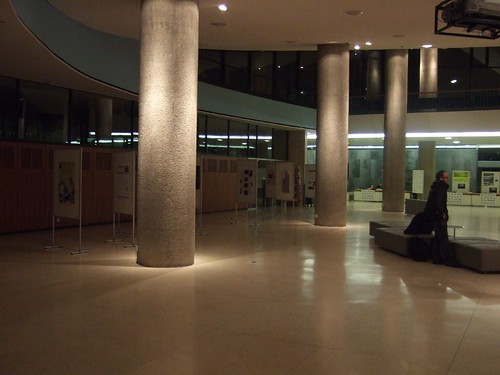
>> re:place - poster presentation


http://www.flickr.com/photos/ninawenhart/sets/72157603265770404/

>> Bela Julesz

Jasia Reichardt in "The Computer in Art", 1971:

"Activities in the field of computer graphics at Bell Telephone Laboratories also include Bela Julesz's experiments with texture and visual perception, in which he used the techniques employed in the random generation of patterns. Ranom-dot patterns generated by computers have shown that the recognition of familiar shapes is not needed for the discrimination of textures, or even for the binocular perception of depth. Julesz used random fields of coloured dots. He discovered that texture discrimination is highly dependent on the way component colours are paired, which, for instance, red and yellow giving a higher degree of discrimination than blue and yellow or blue and green. The objective was to determine those pattern properties that make it impossible to distinguish immediately two adjacent displays. He found that it is the statistical properties of patterns that allow for spontaneous discrimination. This is independent of vrightness distribution but relies on the isolation of darker clusters hich could be said to form certain patterns. Using stereo pairs, Julesz found that one can perceive camouflaged objects with binocular vision which are invisible in a two-dimensional representation."

>> article: "TV as a creative Medium. Howard Wise and Video Art", Marita Sturken, 1984

Read this document on Scribd: AfterImageMay84(1004)


from: www.vasulka.org/archive/4-30c/AfterImageMay84(1004).rtf

2008-07-08

>> Siggraph - history

shorten this!

http://www.awn.com/mag/issue2.5/2.5pages/2.5collinssiggraph.html

SIGGRAPH: Past and Present
by Joan Collins
Animation World Magazine, Issue 2.5, August 1997


TRON, released by Buena Vista in 1982.TRON, released by Buena Vista in 1982.

Even before ACM (Association for Computing Machinery)/SIGGRAPH started, there was computer animation. Despite popular belief, computer animation was not created to do visual effects. The new-comer animators go to the SIGGRAPH conference to see the latest and greatest animations. However, there was a time when going to SIGGRAPH's Film Show meant you waited with anticipation until the end of the show to see the one computer generated movie piece: like the Death Star from Star Wars done in 1977 by Larry Cuba or, the magnificent breakthrough piece, TRON done in 1982 by Magi Synthavision, Triple III, and Robert Abel & Associates.

One would go to SIGGRAPH to see work that one had never seen before, with people that were colleagues and collaborators. It was cool. You had to be there. In 1985, the short film Luxo Jr. by John Lasseter and William Reeves premiered at SIGGRAPH. The Academy followed the next year by nominating it for best Short Animated Film. One went to see Loren Carpenter's Vol Libre premiere at SIGGRAPH in 1980, because it couldn't be seen anywhere else. There was just no other market for showing a camera move around a snow-covered fractal mountain, except in academia.

A Beginning
SIGGRAPH has changed since its beginning. Imagine attending when the papers were primarily from academia. In it's infancy, computer animation was not economically feasible. Hence, the government was the only group that could afford to create CG hardware. The types of people that came to SIGGRAPH were heavily involved in the hardware and display industries. This lack of an industrial application defined the kind of attendees: military, aerospace, and government. The government worked in conjunction with the display industry and computer automation. Today, the first SIGGRAPH convention probably seems nerdy and sterile, but those pioneers are responsible for stimulating the birth of the photo-real visual effects industry that we take for granted.

SIGGRAPH has expanded from 30 signatures on a petition to start a computer graphics group in 1967, to 40,000 attendees expected at this summer's conference. Andries van Dam and Sam Matsa got ACM to endorse the formation of a special interest committee on computer graphics. The growing interest was evidenced by the standing room only crowds that attended the computer graphics professional development seminars given by van Dam and Matsa throughout the U.S. and Europe in the `60s. This provided the impetus for the development of an international SIGGRAPH community.

In 1969, the special interest committee became the Association for Computing Machinery's Special Interest Group on Computer Graphics (ACM/SIGGRAPH). Over the years SIGGRAPH has grown to 7,000 plus members.

John Lasseter's milestone 1985 short film, Luxo Jr.

Early Conference Firsts
This Summer's 1997 SIGGRAPH conference will reunite some of the biggest early players in the visual effects industry such as Digital Productions, Omnibus, and Robert Abel and Associates. These risk-takers embody the pioneering spirit of early SIGGRAPH. One example of the extraordinary team-work that occurred was the film High Fidelity. Randy Roberts designed this test film to prove the concept of raster graphics, the next step beyond animation based solely on vectors. It was started in 1983, and shown at the 1985 SIGGRAPH in San Francisco. No "off-the-shelf" software here! Abel's created a distributed render, digital compositing system for visual effects. Their focus was to create elements that would be digitally composited. Michael Wahrman, systems architect on the raster graphics system at Abel's, was also director of a laboratory at the Rand Corporation. He purchased one of the first commercial UNIX licenses for use with Nick England's hardware, and wrote an Ikonas device driver (a software layer that allows an application to talk to the hardware). But there was no "packaged" solution. They even had to compute on a VAX 750 which by today's terms is less powerful than the average laptop.

Jim Clark, who was formerly with Bell Labs and now with SGI, previewed the first Silicon Graphics IRIS graphics system in a hotel suite at 1983's SIGGRAPH. Jim issued the very first purchase order for a SGI to be used in entertainment to Robert Abel and Associates. Doc Bailey did some modeling work but when Joe Bell's film recorder didn't work, Tom Baron brought over a Mitchell camera and shot the images off of the screen. There was no whining about "the software not being able to handle key-frames." If they needed it, they wrote it. My heroes.

When Abel was purchased by Omnibus, it converged with Digital Productions and their approach to "Scene Simulation." Gary Demos, of Digital Productions, spent more time on the math. "Scene Simulation" was better, but not necessarily easier. The "Scene Simulation" concept, copyrighted at Digital Productions in 1984, won a Scientific and Engineering Academy Award for the practical simulation of motion picture photography by means of computer-generated images.

However, the SIGGRAPH conferences weren't just this DOA (Digital Productions, Omnibus, and Robert Abel and Associates) triad representing the "leading edge of technology." The Lucas Sprocket Systems Group had also received one of the first three SGI's and Doug Smythe, Lincoln Hu, Doug Kay and ILM received a technical Academy Award for their efforts in the creation of the ILM digital film compositing system.

Life Before TRON
There were computer animators prior to TRON, including many pioneers in the early 1970s. In 1974, The National Film Board of Canada produced a short film called The Hunger, directed by Hungarian animator Peter Földes. The Hunger received an Academy Award nomination for its trailblazing progress in the development of software and techniques for computer assisted key framing for character animation, a system developed by Nestor Burtnyk and Marcelli Wein at the National Research Council of Canada. Carl Machover, one of SIGGRAPH's most fondly revered pioneers, recalls selling Marcelli Wein equipment through the company that he founded, Information Display Systems (IDI), in 1960. There was also a computer animation User Group called UAIDE that published proceedings on the Stromberg Carlson Film Recorder, i.e. the SC 4020, in 1969. Character animation was created with a cathode-ray tube that put an electron beam through a stencil mask held in the recorder's neck. It was a conventional monochromatic vector display, but the point is that the technology existed.

According to Machover, the first SIGGRAPHs were not practical for the animation industry. Animation was still in the "stop-frame" phase. Animation was created by a plotter storage tube that made a picture, photographed it, then erased it in order to make another picture. This was 2D-based, and few were for entertainment purposes.

Jon Meads worked on such a plotter to create the "Carol Burnett - What's in the Stars" sequence for her variety show. The 35 mm frame-by-frame film was completed by Hiram French using a "Whirlwind." Bill Albertson came up with ideas, and Meads figured out how to do the programming. In 1974, Jon "Troll" Meads and Bob Shiffman decided that SIGGRAPH members needed a place to gather to exchange ideas about the latest computer graphics developments. The first SIGGRAPH conference was organized that year at the University of Colorado in Boulder. Over 600 attendees arrived when only 300 people were expected. Meads was the Program Chair.

The First Films
At the first SIGGRAPH conference, there was an interest in interactive devices, and in being able to work directly on screen. Animation was limited, but the proceedings were published in the journal Computers and Graphics. A young grad student came up to Meads and asked if it "would be inappropriate to submit a paper on the use of computers to do video animation." This young student was Tom Defanti, currently the Director of Electronic Visualization, and Associate Director, Virtual Environment NCSA. In Dallas, at SIGGRAPH 1986, a Local Groups party reminded Tom Defanti of the way the Film Show used to be. Attendees would bring the 3/4" video of their latest work, we'd cue it up and play it. No judging and everything got shown.

Frank Foster, who organized the first International Film Festival in 1974, had 200 entries from all of the world, including The Hunger from Canada. The majority of the work at the time was technical research, which was the most advanced computer generated work. Even the most artistic pieces were simplistic. They showed all entrees over the course of three nights. They divided the entries into two categories: Art and Science. There were two nights of science and one night of art. In the Art category, Gary Demos had two films which contained mostly analog animation, with hardly any digital at all.

Generally speaking, if you were turning out computer generated "art" pieces in the early `70s, you were on a grant program that teamed an artist with a techie. Through the power of a grant, artist in residence, Lillian Schwartz teamed up with Ken Knowlton, who was in the computer techniques research department, for a collaboration at Bell Labs. Knowlton and other technical innovators were able to participate in "art" films by working for companies that pursued growth in the computing field. Stan VanDerBeek was also an artist in residence at Bell Labs with Knowlton. They collaborated on many computer generated films including the Poem Fields (Series 1 - 8). It was programmed in a CG language that Knowlton developed, called Beflix which was short for Bell Flicks. Another such example is John Whitney, Sr. who did Arabesque at IBM.

John Whitney created Arabesque in 1975, during an artist residency at IBM Labs.

John Whitney created Arabesque in 1975, during an artist residency at IBM Labs.

John Whitney created Arabesque in 1975, during an artist residency at IBM Labs.


SIGGRAPH Begins to Put On A Show
The first SIGGRAPH Film Shows were predominately 16mm film. Since so much content was academic, there wasn't a film theater audience. The contributors were distributing to educational outlets that couldn't afford 35mm film playback. So, the producers would output on 35mm and down-rez for distributions on 16mm film. In fact, the first SIGGRAPH Film Show contained no video at all (or 35mm, for that matter). There were only 16mm entries. The only video available was only black and white, reel-to-reel. Color video existed on 2" quad tape and only television stations could afford such hardware. One-inch video was not in color at SIGGRAPH until the `80s.

The artists' ease-of-use only started when computers became cheaper and more user-friendly. Today's user interfaces allow the "newbies" to fly through, mastering the art of computer graphics. Character animation is also technically easier now, but talent is in ever-increasing demand to drive the quality.

But Can It Make Money?
Computer generated imagery was hardly being used for entertainment in the `70s. There were a few toothpaste commercials and some corporate broadcast graphics shown at the SIGGRAPH conferences. However, the CG community would look at the pieces, and, with work stations costing hundreds of thousands of dollars, say, "There's no money in it."

No one was convinced that CG had a commercial value, until James Cameron and ILM built a system to make it reliable. They took computer graphics into the commercial realm. It became apparent, after more Academy Awards started popping up, that visual effects could be financially feasible. ILM took awards for: The Abyss in 1989, Terminator 2 in 1991, and Jurassic Park in 1993. Total Recall captured an award for Metrolight and Tim McGovern in 1990. The topper was a Special Achievement Award to John Lasseter for the development and inspired application of techniques that made possible the first feature-length computer-animated film, Toy Story. Now, we see clips from movie after movie that use photo-real computer animation. You no longer have to wait for SIGGRAPH to see computer animation. Now, what movie doesn't use CGI?

The Biz Grows Up
According to CG pioneer Michael Wahrman, "Once upon a time, a group of pioneers proved that a hundred things that people said couldn't work, worked. Of those hundred, five are used every day in every film, and maybe another five are used occasionally. The other 90 are completely ignored. Computer generated character animation for films was once a wild idea, as was digital compositing, graphical user interfaces, behavioral animation [such as flocking and herding] and performance animation [real-time digital puppeteering]. But all of them worked, even though in each case they are limited and don't do everything." Wahrman was part of the Symbolics' team that presented "flocking and herding" in Stanley and Stella in 1987. "We presumed people would use behavioral animation, and we were delighted to see that Independence Day had used behavioral animation to do a lot of the dog fights. They called it `smart particles' deliberately avoiding the term behavioral, but I thought it looked great."

Toy Story, the first fully computer-animated
feature film. © Disney Enterprises, Inc.
Toy Story, the first fully computer-animated feature film. � Disney Enterprises, Inc.

Michael continues by saying, "SIGGRAPH used to be the place you had to be to see the best work the first time ever. It used to be where the people that said, `I did that film,' were not your competitors. They were your co-conspirators. They had done the animation not for competition, but because they were making it work. But, it turns out the people in the audience were not your collaborators, but your competitors."

It is not so much that the SIGGRAPH culture has changed; it has expanded to include today's breed of computer animators and their recruiters. If one looks at the forerunners of computer animation, one can see that they didn't fit into a category with which corporate America was comfortable. No one foresaw the future. The pioneers would take risks and fail. Talking with some of these old-timers is an experience that I highly recommend. They will tell you, "if it isn't off the shelf, figure it out yourself."

There are so many more stories of how we got here that couldn't all be included in this article, and often, each story is countered by someone else who remembers it slightly differently. Carl Machover is the SIGGRAPH 1998 History Chair if you feel the need to clarify history. Or come to the Los Angeles Convention Center August 3 - 8 to see SIGGRAPH `97: the 24th International Conference on Computer Graphics and Interactive Techniques.

For information visit http://www.siggraph.org

Special thanks to:
Betsy Johnsmiller, Carl Machover, Frank Foster, Jon Meads, Michael Wahrman, and Steve Cunningham.

2008-07-07

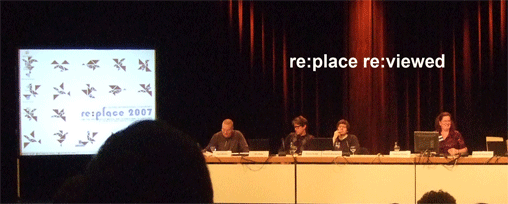
>> re:place re:view

Panel 1 was on the topic of art, science and engineering as sites/places where early experiments in media art took place, most often as a combined form of research and development, focusing on examples of their intersections. The panel was moderated by Edward Shanken, with panelists Michael Century, Stephen Jones, Eva Moraga and Robin Oppenheimer.

The first presenter, Michael Century spoke about how R.M.Baecker's research on hand-drawn digital animation at MIT's Lincoln Labs lead to the development of the Graphical User Interface (GUI)1. GENESYS was created in the late 60ies and tested by artists of Harvard's Visual Art Center. What was important to the artists was not what could be seen in the frame, but in the behaviour of the tool. Century spoke of this process of refining GENESYS, with the help of artists, as a co-invention between engineer and artist. Alan Kay, researcher at Xerox PARC, saw GENESYS' potential for his own interests, its potential of being an open ended medium with expressive possibilities, similar to clay or paper. The GUI he imagined was just like that: a personal dynamic medium. In his summary, Century thinks the reason for GENESYS' success was that it had worked as a boundary object2 between animation and computer research.

The second speaker, Stephen Jones discussed early experiments in art and technology at the University of
Sydney (from 1968 to 1975). John Bennett, a British Computer Engineer headed the Basser Department of
Computing at the University's School of Physics. The department developed computer graphics for simulations and also made animations for the US airforce, computed algorithms that were recorded frame by frame with a movie camera and later coloured by hand. After visiting the Cybernetic Serendipity exhibition in London, Bennett became fascinated by the possibilities of using the computer as a medium for artistic expression. In 1969 he gave a talk on technology and art and encouraged his students to use the computer to make art themselves. Out of this grew a rhizomatic network of students collaborating in media enhanced art projects.
What both Century and Jones wanted to show is the network of relations and flows of influences. Whereas
Century's talk showed a rather linear way from one person/idea to the other, it was different in Jones'
presentation: Starting with John Bennett a rhizomatic net of people, disciplines and projects spread out. Both
speakers followed the traces and networks of people, inventions and mutual influences. In the end Century's
presentation lead to the development of an (industrial) product while Jones' lead into manifold art projects.

Eva Moraga presented The Computational Center at Madrid University (1969 - 1973), a project made possible by the support of IBM. They gave two high end computers to the University plus a yearly financial donation of 1 Actually it was called the PARC User Interface. 2 Fred Turner uses the terms „boundary object“ and „trading zone“ in his book „From Counterculture to Cyberculture: Stewart Brand, the Whole Earth Network and the Rise of Digital Utopianism“; „boundary object“ taken from Susan Leigh Star and James Greisemer, „trading zone“ coming from Peter Galison. Throughout all panels both terms were frequently used. 18.000€. The Center should have been open to researchers from all over Spain. Its mission was to study automation of research and analysis processes in fields where automation had not been brought in yet, like „Mathematics Linguistics“, „Automatic Generation of Architectonic Spaces“ and „Automatic Generation of Plastic Forms“. IBM had not allowed the University to use the computers for administrative tasks. For that, the Center would have to buy seperate machines from IBM. IBM also influenced the Center by naming the director.
The Center's approach was interdisciplinary, the staff consisted of computer experts with international
experience and artists could apply for scholarships. A research goal would be, for example, to find out the
grammar rules a specific artist would apply when producing his/her work. Moraga's presentation remained within the field of mere facts. She didn't take a critical position regarding IBM's influence or the political situation of Franco-Spain or on how those two together had an impact on the Center's supposed autonomy. Time and Space, the panel's framing constituents, became strangely visible by their absolute absence in her talk.

The goal of Robin Oppenheimer's talk was to show the emergence of new collaborative practices and forms of communication at the intersection of art and engineering in E.A.T.'s „9 Evenings“. In the 10 month long
collaboration between the Greenwich Village art scene and engineers from Bell Labs, artists and engineers had to define a common base to work on. Oppenheimer also used Fred Turner's interpretation of the „boundary object“ and the „trading zone“ to describe this search for bridging difficulties in understanding each other's ideas, in articulating the ideas of one field in a way that was meaningful for the other and finally in being able to create something together.
Oppenheimer mentions that the ethical values of openness and egalitarian collaboration were crucial to this
experiment. I would like to question the notion of collaboration implied here: The artists involved in „9
Evenings“ had already been well established. Their names attracted the audience and still do. At a concurrent
exhibition at Tesla, an art space in Berlin, the descriptions of projects from „9 Evenings“ were headed by the
project's title, the artist and then, almost as a footnote or addendum came the name of the project engineer. So this collaboration had been less egalitarian but rather shows a clear hierarchy of art over engineering.

Contextualization:
None of the panelists spoke about the influence of the futuristic zeitgeist of the 60ies with its perspectives of
landing on the moon, etc. Time was only present as history, the military background of the labs and the
chronological development of technologies invented for military purposes. All projects had in common that they started or were made possible in a field of military research: The Lincoln Labs as an institute of MIT and funded by the US military (Xerox PARC functioning as a commercial follow up in this case); Moraga's project placed in Franco-Spain where it was instrumentalized both by the regime to show off and by IBM (who didn't show moral fibre in collaborating with Franco-Spain, but merely wanted the Center to do research IBM would profit from and maybe even sell their products to the University); and finally Oppenheimer's presentation on E.A.T.'s „9 Evenings“ was again related to military R+D through Bell Labs.

Penalties for the panelists - Discussions:
Time was crucial to this panel in another way: Each speaker got exactly 20 minutes for the presentation, which was too short for each of them. Century and Oppenheimer dealt with it by talking very fast, so that it was hard to follow. Moraga and Jones spoke slower, but unfortunately couldn't finish their presentations. The way that these time constraints were put on this panel was quite impolite towards the speakers and their interesting topics as well as towards the audience. A result of the strictly executed 20-minutes-setup discussions after each presentation were rare and not very lively. Robin Oppenheimer had the advantage that her topic was the most commonly known and got great support from the audience: Artist Gerd Stern (USCO) had attended the „9 Evenings“ and could give an authentic impression of the event.

Moderator or Administrator?
re:place chose to have moderators for the panels, Edward Shanken was the first to go and do the job and interpreted his role in a strictly administrative sense. He didn't give an introduction on the panel's topic, but made clear the „rules of the game“: Each panelist had 20 minutes time for a presentation or otherwise would have „their heads cut off“ (sic!), followed by 10 minutes for discussion, this was repeated four times so that in the end 30 minutes would remain for a panel discussion. To structure a conference into different thematic panels suggests to me an explanation of why certain microhistories are combined. It literally wants an introduction to be made that could open up discussion in the final round. To structure the panel in this way, to introduce, sum up, and contextualize would have been the role of the moderator. And this was badly missing.

>> labels

>> cloudy with a chance of tags


Powered By:Blogger Widgets

followers

.........

My photo
... is a Media Art historian and researcher. She holds a PhD from the University of Art and Design Linz where she works as an associate professor. Her PhD-thesis is on "Speculative Archiving and Digital Art", focusing on facial recognition and algorithmic bias. Her Master Thesis "The Grammar of New Media" was on Descriptive Metadata for Media Arts. For many years, she has been working in the field of archiving/documenting Media Art, recently at the Ludwig Boltzmann Institute for Media.Art.Research and before as the head of the Ars Electronica Futurelab's videostudio, where she created their archives and primarily worked with the archival material. She was teaching the Prehystories of New Media Class at the School of the Art Institute of Chicago (SAIC) and in the Media Art Histories program at the Danube University Krems.