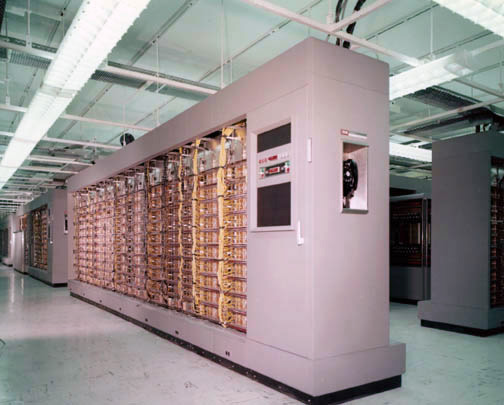
"project Charles" was started at MIT to develop a demo, they developed their Whirlwind computer, a real-time system, furhter.
"project Charles" was also the starting point for the Lincoln Labs, whre the SAGE project was continued from 1954 on. IBM cooperated with MIT on this project, which made it the dominat company in computer industry.
The outcome of SAGE was AN/FSQ-7, the largest computer ever built. It used more than 50.000 tubes and because of the tubes' unreliability, a SAGE system always consisted of two computers for backup - a dual processor so to say.
impact of SAGE for further computer developments; online systems, interactive computing, rel-time computing, data communications with modems.
background-info:
"The Whirlwind project was very expensive and made up the bulk of the Office of Naval Research budget. As a result, it became the target of congressional budget cutters, who threatened to reduce the allocation from $1.15M to $250K in 1951. Through intense lobbying by MIT, the Whirlwind computer was ultimately adopted by the U.S. Air Force for use in its new SAGE (Semi-Automatic Ground Environment) air defense system, which became operational in 1958 with more advanced display capabilities."
(http://design.osu.edu/carlson/history/lesson2.html)
an official video:
video showing how SAGE was used:
2008-07-03
>> SAGE project
0
replies
tags -
computer history

Bookmark this post: | 


|
>> Ed Zajac, "A Two Gyro Gravity Gradient Altitude Control System", 1962

0
replies
tags -
computer animation,
computer graphics,
Labs,
scientific visualization
Bookmark this post: |
|
>> Lincoln Labs and history of computer graphics
One of the most important and influential birthplaces of HCI
was the work on interaction and graphics centered around
the TX-2 computer at MIT’s Lincoln Laboratory in the
1960’s [25]. For example, it is hard to imagine the
innovation that happened at Xerox PARC in the ‘70s having
been possible without the foundation that Lincoln Labs
provided.
0
replies
tags -
computer graphics,
computer history,
HCI
Bookmark this post: |
|
>> theses @ Lincoln Labs
http://www.billbuxton.com/Lincoln.html
On the website of his Lincoln Labs History project, Bill Buxton collected links to some influential theses written at the Lincoln Labs.
The project furthermore provides information about the history, the proceedings of the 2005 conference on the Lincoln Labs in the 1960ies and especially about the TX-2 computer.
0
replies
tags -
computer history,
Labs
Bookmark this post: |
|
>> MIT's Lincoln Labs

"In 1950, MIT undertook a summer study, named Project Charles, to explore the feasibility of establishing a major laboratory focused on air defense. The summer study recommended the establishment of a laboratory, named Project Lincoln to be operated by MIT for the Army, Navy and Air Force. The name "Project Lincoln" was chosen because the Laboratory sits near the towns 
In the early years, the most important developments to come out of Lincoln Lab were SAGE (Semi-Automatic Ground Environment), a nationwide network of radar and anti-aircraft weapons linked to digital computers.
Some of the earliest computer graphics and user interface research was done at the laboratory, including Sutherland's Sketchpad system. Research into "packetized speech," (now VoIP) done in collaboration with other researchers, led to the creation of UDP.
MIT's relationship with Lincoln Lab has come under intense scrutiny several times. During the late 1960s and early 1970s, growing disaffection with U.S. involvement in Vietnam led to student demonstrations demanding that MIT halt defense research, MIT responded by spinning off the semi-autonomous Draper Labs entirely and moving all on-campus classified research to Lincoln Lab."

Bill Buxton's presentation on the history of the Lincoln Labs on ePresence.tv
http://epresence.tv/Presentation/3
from their own history page:
Created in 1951 as a federally funded research center of the Massachusetts Institute of Technology, Lincoln Laboratory was focused on improving the nation's air defense system through advanced electronics.
The Laboratory’s inception was prompted by the Air Defense Systems Engineering Committee’s 1950 report that concluded the U.S. was unprepared for the threat of an air attack. Because of MIT’s management of the Radiation Laboratory during World War II, the experience of some of its staff on the Air Defense Systems Engineering Committee, and its proven competence in electronics, the Air Force was convinced that MIT could provide the research needed to develop an air defense that could detect, identify, and ultimately intercept air threats.

Over the 50+ years since the Laboratory’s establishment, the scope of the problems has broadened from the initial emphasis on air defense to include space surveillance, missile 
In the early 1960s, MIT Lincoln Laboratory initiated the development of satellite communications systems for national defense, resulting in the launch of eight experimental communications satellites.
Nonmilitary Applications
The Laboratory demonstrated advances in autonomous spacecraft control, the use of solid state devices to ensure long-term spacecraft reliability, and the development of mobile earth terminals for secure communications systems.
In the early 1970s, MIT Lincoln Laboratory began an active program in civil air traffic control, emphasizing radar surveillance, collision avoidance, hazardous-weather detection, and the use of automation aids in the control of aircraft.
In the 1980s, the Laboratory accomplished significant experiments in compensating for the effects of atmospheric turbulence by using adaptive optics and developed a high-power laser radar system.
In the 1990s, work for other government agencies included sensor development for NOAA and NASA. The Laboratory developed an advanced land imaging instrument as part of NASA’s New Millennium Program.
To support its aggressive approach to advanced systems development, MIT Lincoln Laboratory has also maintained a leadership role in basic research in surface and solid-state physics and materials relevant to solid-state physics.
The Laboratory performed the initial research for the development of the semiconducting laser and designed an infrared laser radar to develop techniques for high-precision pointing and tracking of satellites."
The Laboratory has also made significant contributions to the early development of modern computer graphics, the theory of digital signal processing, and the design and construction of high-speed digital signal processing computers. Signal processing remains a key element of many Laboratory programs, including special-purpose high-throughput processors.
The Laboratory has advanced the technology of speech coding for digital processing. Speech coding and recognition, along with automatic translation, are continuing areas of interest."
>> Small Talk, Shazam (animation SW), Dynabook
http://www.newmediareader.com/book_samples/nmr-26-kay.pdf
"Much of the design of SHAZAM, their animation tool, is an automation of the media with which animators are familiar: movies consisting of sequences of frames which are a composition of transparent cels containing foreground and background drawings. Besides retaining these basic concepts of conventional animation, SHAZAM incorporates some creative supplementary capabilities. Animators know that the main action of animation is due not to an individual frame, but to the change from one frame to the next. It is therefore much easier to plan an animation if it can be seen moving as it is being created. SHAZAM allows any cel of any frame in an animation to be edited while the animation is in progress. A library of alreadycreated cels is maintained. The animation can be singlestepped; individual cels can be repositioned, reframed, and redrawn; new frames can be inserted; and a frame sequence
can be created at any time by attaching the cel to the pointing device, then showing the system what kind of movement is desired. The cels can be stacked for background parallax; holes and windows are made with transparent paint. Animation objects can be painted by programs as well as by hand. The control of the animation can also be easily done from a Smalltalk simulation. For example, an animation of objects bouncing in a room is most easily accomplished by a few lines of Smalltalk that express the class of bouncing objects in physical terms."
--> McLaren
--> Baecker, GENESYS
+++++++++++++++
SMALL TALK
... is an object-oriented programming language, developed at Xerox PARC by Alan Kay, Adele Goldberg, et.at. in the 1970ies. Influences come from LOGO (as mentioned below), Lisp, Simula and Sketchpad.
Seymour Papert, a great influence on Kay, was creating computer systems for children to use creatively on the other side of the United States, at MIT. There, he developed LOGO (see ◊28). Kay’s previous work on FLEX had sought to create a computer that users could program themselves. This work led to the definition of object-oriented programming (inspired, in part, by Sutherland’s “Sketchpad” (◊09)). From Papert’s work, Kay saw how far this idea could be carried, and refined his notion of why it was important. The next stage of Kay’s work in this area culminated in Smalltalk.
http://www.newmediareader.com/book_samples/nmr-26-kay.pdf, page 2:
Kay on Papert's Papert’s influence in 1990:
“I was possessed by the analogy between print literacy and LOGO. While designing the FLEX machine I had believed that end users needed to be able to program before the computer could become truly theirs—but here was a real demonstration, and with children! The ability to ‘read’ a medium means you can access materials and tools generated by others. The ability to ‘write’ in a medium means you can generate materials and tools for others. You must have both to be literate. In print writing, the tools you generate are rhetorical; they demonstrate and convince. In computer writing, the tools you generate are processes; they simulate and decide.” (“User Interface: A Personal View,” 193)
(http://www.smalltalk.org/smalltalk/TheEarlyHistoryOfSmalltalk_Abstract.html)
"Early Smalltalk was the first complete realization of these new points of view as parented by its many predecessors in hardware, language and user interface design. It became the exemplar of the new computing, in part, because we were actually trying for a qualitative shift in belief structures--a new Kuhnian paradigm in the same spirit as the invention of the printing press-and thus took highly extreme positions which almost forced these new styles to be invented." (Alan Kay)
++++++++++++++++
DYNABOOK
"I remembered a wonderful phrase of Marshall McLuhan. He said, I don't know who discovered water, but it wasn't a fish. The idea is if you are immersed in a context you can't even see it. So we decided to follow Seymour Papert's lead and instead of trying to design for adults we would try and see what this Dynabook of the future would be like for children and then maybe hope some of it would spill over into the adult world. So children were an absolutely critical factor here. " (Alan Kay, http://www.artmuseum.net/w2vr/archives/Kay/01_Dynabook.html#)
The concept of the Dynabook is what later on became the laptop. The target audience would be children. The Dynabook ran on Small Talk. Kay was one of the main developers and was involved in the creation of the 1-Laptop-per-Child group.
Alan Kay about Humans and Media:
“Devices” which variously store, retrieve, or manipulate information in the form of messages embedded in a medium have been in existence for thousands of years. People use them to communicate ideas and feelings both to others and back to themselves. Although thinking goes on in one’s head, external media serve to materialize thoughts and, through feedback, to augment the actual paths the thinking follows. Methods discovered in one medium provide metaphors which contribute new ways to think about notions in other media."
Alan Kay on Dynabook:
(http://www.smalltalk.org/smalltalk/TheEarlyHistoryOfSmalltalk_Abstract.html)
"Most ideas come from previous ideas. The sixties, particularly in the ARPA community, gave rise to a host of notions about "human-computer symbiosis" through interactive time-shared computers, graphics screens and pointing devices. Advanced computer languages were invented to simulate complex systems such as oil refineries and semi-intelligent behavior. The soon-to-follow paradigm shift of modern personal computing, overlapping window interfaces, and object-oriented design came from seeing the work of the sixties as something more than a "better old thing." This is, more than a better way: to do mainframe computing; for end-users to invoke functionality; to make data structures more abstract. Instead the promise of exponential growth in computing /$/ volume demanded that the sixties be regarded as "almost a new thing" and to find out what the actual "new things" might be. For example, one would computer with a handheld "Dynabook" in a way that would not be possible on a shared mainframe; millions of potential users meant that the user interface would have to become a learning environment along the lines of Montessori and Bruner; and needs for large scope, reduction in complexity, and end-user literacy would require that data and control structures be done away with in favor of a more biological scheme of protected universal cells interacting only through messages that could mimic any desired behavior."
0
replies
tags -
computer animation,
computer history,
Xerox PARC
Bookmark this post: |
|
Subscribe to:
Posts (Atom)
>> additional class blogs


>> subscribe


 Posts
All Comments
Posts
All Comments
.........

- Nina Wenhart ...
- ... is a Media Art historian and researcher. She holds a PhD from the University of Art and Design Linz where she works as an associate professor. Her PhD-thesis is on "Speculative Archiving and Digital Art", focusing on facial recognition and algorithmic bias. Her Master Thesis "The Grammar of New Media" was on Descriptive Metadata for Media Arts. For many years, she has been working in the field of archiving/documenting Media Art, recently at the Ludwig Boltzmann Institute for Media.Art.Research and before as the head of the Ars Electronica Futurelab's videostudio, where she created their archives and primarily worked with the archival material. She was teaching the Prehystories of New Media Class at the School of the Art Institute of Chicago (SAIC) and in the Media Art Histories program at the Danube University Krems.