<< preface

this blog is nina wenhart's collection of resources on the various histories of new media art. it consists mainly of non or very little edited material i found flaneuring on the net, sometimes with my own annotations and comments, sometimes it's also textparts i retyped from books that are out of print.

it is also meant to be an additional resource of information and recommended reading for my students of the prehystories of new media class that i teach at the school of the art institute of chicago in fall 2008.

the focus is on the time period from the beginning of the 20th century up to today.

>> search this blog

2008-07-02

>> Steve Mann, "MaybeCam"

http://www.eyetap.org/wearcam/maybecamera/:


WearCam concept: MaybeCam

The following are experiments that the writer has conducted and purposely taken to the extreme in order to (a) illustrate a point and (b) experience reactions and observations first hand. It is not likely that the average reader would go to these extremes but some more subtle variations of these experiments will still provide similar insight or reactions.
Maybe Camera
You cannot patent a mere "idea", but, rather, the idea must first be reduced to practice. Similarly, you cannot copyright an idea, it must first manifest itself as some tangible form. Conceptual art, however, provides us with a means where the idea itself is the contribution.
  • Take one piece 1/8 inch black or dark acrylic, cut to 3 by 4 inches.
  • Obtain a bulky sweatshirt in your size.
  • For your protection, a video record of you and your establishment may be transmitted and recorded at remote locations.

    ALL CRIMINAL ACTS PROSECUTED

    Lay out the lettering so as to leave room for the acrylic between the words "locations" and "ALL" ("locations" to be at the end of one line of text, and "ALL" to begin the next line of text).
  • Affix the acrylic securely to the shirt.
  • Wear the completed shirt into a department store or other location where
    • video surveillance is used but
    • photography is prohibited (this criterion can be determined experimentally even before the shirt is made, by entering the proposed establishment with a 35mm camera or the like, and taking pictures within said establishment in a somewhat obvious manner).

The above piece is entitled "Maybe Camera --- Who's Paranoid?". Just as the customer doesn't know what's in the mysterious ceiling dome of wine-dark opacity, and must therefore be on his best behaviour at all times, so too, the shopkeeper doesn't know what's inside the customer's shirt, and likewise must be on his best behaviour at all times.
Probably Camera
Depending on the level of paranoia, if `Maybe-Camera...' is not "understood" by your audience, then perhaps the following conceptual/performance/reflectionist piece would be:
  • Obtain one miniature (12 inches in diameter or smaller) ceiling dome of wine-dark opacity, together with a camera and pan-tilt-zoom mechanism suitable for that dome.
  • Affix dome to backpack, facing backwards, cutting appropriate mounting hole in backback, leaving sufficient space, and installing appropriate housing for camera and pan-tilt-zoom mechanism. Leave the camera out for the time being.
  • Insert a small battery powered computer equipped with video capture hardware, and means of controlling the function of the pan-tilt-zoom controls automatically.
  • Insert into the pack, means of wireless communication to/from the Internet, or to/from an Internet gateway/server.
  • Prepare software to allow the function of the apparatus to be controlled remotely via a WWW page, with ability to capture and display images from the camera if the camera is present. Make this WWW page world-accessible and known to various people around the world.
  • Leave the work area and have someone else do the final assembly in your absence, according to the following instructions: Roll two dice, and:
    • If the total comes to two or three, insert into the dome a small light bulb, affixed to the pan-tilt-zoom sensor but connected to it in no way, together with sufficient ballast into the pack to make up the difference in weight between the bulb and the camera, so that the wearer could not determine this difference by weight.
    • If the dice total exceeds three, insert the camera, properly mounting it and connecting it to video digitizer. Verify its operation using a Web browser of your choice.
  • Wear backpack together with shirt (`Maybe Camera...'), into a record store, preferably Tower Records, where ceiling domes of wine-dark opacity are used. If asked if it is a camera, or what it is, indicate that you're not certain, but point out the domes upon their ceiling and indicate the similarity, so that perhaps it could be a light fixture. (Security guards at Tower records have informed the author that their ceiling domes of wine-dark opacity are "light fixtures")
The above piece is called `Probably Camera --- Who's Paranoid?'. Probably Camera and Maybe Camera can be worn together of course, since one uses the front of the body, while the other uses the back.
No Camera
Dan Graham uses video time delay together with mirrors, etc., to create a delay between cause and effect. His video feedback involves both senses of the word "feedback": (1) the cameras "sees" the screen which is displaying the output from the camera, and (2) the users who see themselves on the screen adjust their behaviour according to this psychological "feedback". A conceptual piece, involving time-delay, to symbolize the disjointness between cause and effect that video recording creates is now described:
  • Place pinhole camera and microphone into baseball cap, and record video from an establishment where photography, filming, and the like is strictly prohibited, but where video surveillance is used, and where there are documented cases of hidden cameras having been used. While recording video, talk to members of establishment, including manager. Ask whether or not they use video surveillance, and if so, why they are videotaping you without your permission. Ask what their "ceiling domes of wine-dark opacity" are, if any are present.
  • Leave this establishment, and return with the following, but without the camera:
    • Flat-panel television screen affixed to shirt.
    • Source of previously recorded video material.
    • Means of switching between previously recorded material and standard broadcast television channels.
  • Play the previously recorded video on the television screen, and if you are informed that photography, filming, or the like, is prohibited, indicate that there is NO CAMERA, and that what you are wearing is merely a television. Switch through the various channels, indicating that one of them (the one playing the previously recorded material) looks like it "must be a local channel --- a VERY local channel".
The piece is called `No Camera --- Who's Paranoid?'.
`My manager'
`My Manager', borrows from the Stellarc/Elsenaar tradition in performance art: not just that the author's `third eye' might be analogous to Stellarc's third hand, but, more importantly, that the body is controlled remotely. `My Manager' allows participants to, via Radio TeleTYpe (RTTY), become managers and remotely contribute to the creation of a documentary video in an environment under totalitarian surveillance (where photography, video, etc., other than by the totalitarian regime is prohibited). The artist is metaphorically a puppet on a "string" (to be precise, a puppet on a wireless data connection) who, for example, dutifully marches into the establishment in question, goes over to the stationery department, selects a pencil for purchase, and marches past the magazine rack without stopping to browse the magazines. In this example, he has been sent on an errand to purchase a pencil for a higher and unquestionable authority. When challenged by the department store's infrastructure, as to the purpose of the cameras he is wearing, the artist indicates that his manager requires him to wear the apparatus so that she can make sure that he does not stop and read magazines while he is performing errands on company time. Just as representatives in an organization absolve themselves of responsibility for their surveillance systems by blaming surveillance on managers or others higher up their official hierarchy, the artist absolves himself of responsibility for taking pictures of these representatives without their permission because it is the remote manager(s) together with the thousands of viewers on the World Wide Web who are taking the pictures. The subjects of the pictures, for example, department store managers, who had previously stated that "only criminals are afraid of video cameras", or that the use of video surveillance is beyond their control, either implicate themselves of their own accusations by showing fear in the face of a camera, or acknowledge the undesirable state of affairs that can arise from cameras that function as an extension of a higher and unquestionable authority. If their response is one of fear and paranoia, they are handed a form, entitled RFD (Request For Deletion) which they may use to make a request to have their pictures deleted from the artist's manager's database (they are informed the images have already been transmitted to the manager and cannot be deleted by the artist). The form asks them for name, social security number, and the reason for which they'd like to have their images deleted, and requests that they sign a section certifying that the reason is not one of concealing criminal activity, such as hiding the fact that their fire exits are illegally chained shut. Through `reflectionism' the department store attendant/representative sees himself/herself in the bureaucratic "mirror" created by the artist who is a puppet on a (wireless) "string". `My Manager' forces attendants/maintainers/supporters of the video `Surveillance Superhighway', with all of its rhetoric and bureaucracy, to realize or admit that they are "puppets" for a brief instant, and confront the reality of what their blind obedience leads to."

>> Steve Mann, "Shooting Back"

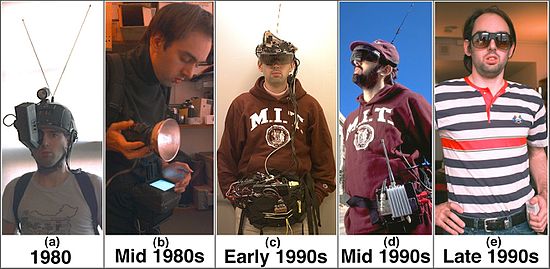
>> "the world's first cyborg"
>> www - wireless wearable webcams, wearable computing
>> Humanistic Intelligence
>> surveillanec and susveillance
>> moblogging


"cyborg, n. a person whose physiological functioning is aided by or dependent upon a mechanical or electronic device. Steve Mann is a cyborg, and the inventor of the wearable computer, called the WearComp. He sees the world as images imprinted onto his retina by rays of laser light. This allows him to transmit his viewpoint live to the Internet, block out billboards and other unwanted visual stimuli, and turn his world into a series of hyperlinks. Constantly connected to the WearComp system, Mann has all the capabilities of a standard office at his disposal, even as he utilizes shrinking technologies to turn himself into a portable movie studio. The first person to live in total constant intimate contact with the computer, Steve Mann exists at once in the real and virtual worlds, living an entirely videographic existence, seeing everything around him, including himself, through a wearable computer. Over the past twenty years, Steve Mann has been his own human guinea pig, testing his various wearable computer prototypes on himself. In Cyborg, he uses his own unique experiences to assess the state of wearable computers and their potential impact on our lives, articulating a vision for a tomorrow that sees humanity freer, safer, and smarter in ways most of us can only imagine. Mann is fascinated by the possibilities of the cyborg future, but he does not shrink away from frankly discussing the dangers of a post-human age in which our computers come to control us. In this unique ground-breaking book, Mann charts the development of a wearable computer industry, and warns of dangers to our liberty, privacy, and democracy. He contrasts those dangers with his own sweeping inclusive vision of a wearable computing age that brings about new ways to teach, learn, make art, communicate, and even think. Part biography, part breath-taking manifesto, part startling look into the very near future, Cyborg is a powerful book that challenges preconceptions and invites readers to enter the mind of one of the most fascinating thinkers of our time." (http://wearcam.org/cyborg.htm)


http://www.eyetap.org/wearcam/shootingback/shootingback.html:

"First Person(al) Documentary: Crime Reduction with Personal Imaging and Personal Image

The proposed performance will involve a reflectionist critique of video surveillance, using personal imaging (described in IEEE Computer, Vol 30, No. 2) as a medium with which to hold a mirror up to society.

Personal Imaging will be used to create a personal documentary to record and transmit images of potentially dangerous situations (e.g. fire exits that are illegally chained shut, poorly lit stairways, cluttered corridors and exits, poorly marked exits, and potentially abusive or irresponsible security guards and other representatives).

This will attempt to suggest that rather than having a police state, individual citizens might take on the role of monitoring and reporting crime and dangerous situations, while leaving police with the task of acting on reported crimes without having to place the population under surveillance themselves.

Personal Imaging has created its own metaphors for the aesthetics of self-defense, such as the antenna in its most familiar form which is the automotive cellular antenna. Re-situating this familiar object in a disturbing and dis-orienting manner (as a wearable apparatus), provides an obvious and visible deterrent to the seizing or destroying of image content.

Other highly visible crime deterrents comprise a highly obtrusive (yet still wearable) camera with a red led which people readily understand is symbolic of recording equipment in its recording mode of operation.

Most notably, a flat computer screen, sewn onto a shirt, allows others to see themselves on the WWW in a virtual mirror of sorts, which makes the reflectionist philosophy literal as well as metaphoric. The virtual mirror echoes the television set suspended from the ceilings of many establishments that use video surveillance, and serves the same process of providing a visceral and constant reminder that one should not commit crime.

In the words of Daniel Shurman, personal imaging allows one to project a social identity, to play out on the world in the same way that the Internet itself is a means with which to project a public identity.

"VideoClips" will also be used to confront representatives of the surveillance superhighway with a new genre of personal electronic news gathering.

Furthermore, it is hoped that the new aesthetic will give rise to a proliferation of "maybecams" in the form of a "firing squad" backed by zero-knowledge cryptography.

ShootingBack: An Attempt at Using Personal Imaging to Define a New Genre of Film/Video

With Personal Imaging I have attempted to define a new form of interaction between humans and technology. "Wearable Computing: A First Step Toward Personal Imaging", by Steve Mann, IEEE Computer Volume 30 Number 2, http://computer.org/pubs/computer/1997/0297toc.htm

I have equipped a pair of ordinary sunglasses with miniature spatial light modulators, CCD sensor arrays, and appropriate optics, so that when I put them on, I see a computer screen. On my computer screen I see a video image of what is actually present in the real world. Rather than allow the light to simply pass through, as would be the case with ordinary sunglasses, the apparatus absorbs and quantifies incoming light, processes it computationally, and then sends the processed result on toward my eyes.

After several years of adaptation the apparatus has begun to function as a visual prosthetic of sorts - a true extension of my mind and body that allows me to record exactly what I see.

Clearly I don't need to carry a camera because I am a camera, but in ShootingBack, I do anyway. Thus the act of merely making a documentary with an ordinary camcorder (while wearing my prosthetic camera), allows one camera to see through the other, and thus allows the audience the unique first-person perspective, as though being inside my eye, while I am shooting with a camcorder.

In ShootingBack, I confront representatives of the "Surveillance Superhighway" (establishments such as department stores where video surveillance is used extensively, yet photography by customers is strictly prohibited). I begin with my camcorder held down at my side, pointing away from a representative of the SS. Then, I ask the representative "What are those mysterious ceiling domes - those dark hemispheres..." or "Is that a video camera? Why are you taking pictures of me without my permission?". After the representative tells me that I am paranoid and that only criminals are concerned about cameras, I raise the camcorder up to my eye (the vantage point of the audience, who see the face-to-face conversation followed by the eyecup of a camcorder, eventually revealing the inside of the viewfinder, upon which we now see the representative of the SS displayed).

At this point, the representative of the SS often shows great concern about my camcorder, and thus, in a 180 degree reversal, is self-incriminating."

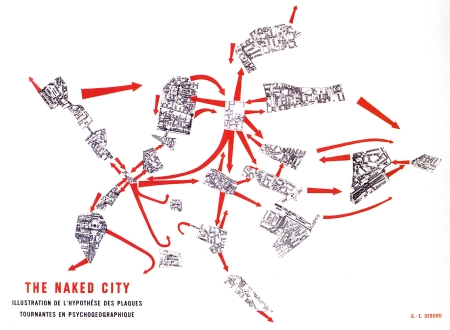
>> The Situationist International, psychogeography, dérive, unitary urbanism

>> mapping
>> executable instructions
>> the concept of the flaneur from Ch. Baudelaire

"In a dérive one or more persons during a certain period drop their usual motives for movement and action, their relations, their work and leisure activities, and let themselves be drawn by the attractions of the terrain and the encounters they find there… But the dérive includes both this letting go and its necessary contradiction: the domination of psychogeographical variations by the knowledge and calculation of their possibilities."
Knabb, Ken, ed. Situationist International Anthology, Berkley: Bureau of Public Secrets, 1995. pg 50.


"All space is occupied by the enemy. We are living under a permanent curfew. Not just the cops – the geometry"
Gray, Christopher, editor, Leaving the 20th Century: the Incomplete Work of the Situationist International, London: Rebel P, 1998. p26.

"a maneuver within the enemy's field of vision"
McDonough, Tom, ed. Guy Debord and the Situationist International: Texts and Documents, Boston: October Press, 2004. pg 259.


The dérive was a course of preparation, reconnaissance, a means of shaping situationist psychology among urban explorers for the eventuality of the situationist city. (wikipedia)

>> Guy Debord, "Hurlements en faveur de Sade", 1952

This is a 4 minutes excerpt from youtube, the full movie is about 90 minutes long and can be found on ubuweb (http://www.ubuweb.com/film/debord_hurlements.html)
The movie consists of either black or white images only. In the white-phases, you can hear a conversation between four people, in the black-phases, there is only silence.
When it was first shown, the film was stopped after a short time because of audience-protests. Next time, Situationists stopped the audience from leaving the cinema, by promising them things and threatening them. The last part of the movie is 24 minutes of black and silence.

--> compare to Peter Kubelka's work "Arnulf Rainer" (1960), which is also just black or white and sound or silence, but follows a strict mathematical structure.


>> Adorno, Horkheimer & Culture Industry

short excerpt from wikipedia:
"Culture Industry" is a term coined by Theodor Adorno (1903-1969) and Max Horkheimer (1895-1973), who argued that popular culture is akin to a factory producing standardized cultural goods to manipulate the masses into passivity; the easy pleasures available through consumption of popular culture make people docile and content, no matter how difficult their economic circumstances. Adorno and Horkheimer saw this mass-produced culture as a danger to the more difficult high arts. Culture industries may cultivate false needs; that is, needs created and satisfied by capitalism. True needs, in contrast, are freedom, creativity, or genuine happiness. Herbert Marcuse was the first to demarcate true needs from false needs."

keywords:
Frankfurt School, Dialectical Materialism, Historical Materialsim, Hegel
one single marketplace, centralized power; culture shapes society by standardization and commodity, mass production shapes consumers' needs, not the other way round; de-emancipating people, making objects, not subjects, tyranny of the producers

>> The ABC of Tactical Media, David Garcia & Geert Lovink, 1997

Tactical Media are what happens when the cheap 'do it yourself' media, made possible by the revolution in consumer electronics and expanded forms of distribution (from public access cable to the internet) are exploited by groups and individuals who feel aggrieved by or excluded from the wider culture. Tactical media do not just report events, as they are never impartial they always participate and it is this that more than anything separates them from mainstream media.

A distinctive tactical ethic and aesthetic that has emerged, which is culturally influential from MTV through to recent video work made by artists. It began as a quick and dirty aesthetic although it is just another style it (at least in its camcorder form) has come to symbolize a verite for the 90's.

Tactical media are media of crisis, criticism and opposition. This is both the source their power, ("anger is an energy" : John Lydon), and also their limitation. their typical heroes are; the activist, Nomadic media warriors, the pranxter, the hacker, the street rapper, the camcorder kamikaze, they are the happy negatives, always in search of an enemy. But once the enemy has been named and vanquished it is the tactical practitioner whose turn it is to fall into crisis. Then (despite their achievements) its easy to mock them, with catch phrases of the right, "politically correct", "Victim culture" etc. More theoretically the identity politics, media critiques and theories of representation, that became the foundation of much western tactical media are themselves in crisis. These ways of thinking are widely seen as, carping and repressive remnants of an outmoded humanism.

To believe that issues of representation are now irrelevant is to believe that the very real life chances of groups and individuals are not still crucially affected by the available images circulating in any given society. And the fact that we no longer see the mass media as the sole and centralized source of our self definitions might make these issues more slippery but that does not make them redundant.

Tactical media a qualified form of humanism. A useful antidote to both, what Peter Lamborn Wilson described, as "the unopposed rule of money over human beings". But also as an antidote to newly emerging forms of technocratic scientism which under the banner of post-humanism tend to restrict discussions of human use and social reception.

What makes Our Media Tactical? In 'The Practice of Every Day Life' De Certueau analyzed popular culture not as a 'domain of texts or artifacts but rather as a set of practices or operations performed on textual or text like structures'. He shifted the emphasis from representations in their own right to the 'uses' of representations. In other words how do we as consumers use the texts and artifacts that surround us. And the answer, he suggested, was 'tactically'. That is in far more creative and rebellious ways than had previously been imagined. He described the process of consumption as a set of tactics by which the weak make use of the strong. He characterized the rebellious user (a term he preferred to consumer) as tactical and the presumptuous producer (in which he included authors, educators, curators and revolutionaries) as strategic. Setting up this dichotomy allowed him to produce a vocabulary of tactics rich and complex enough to amount to a distinctive and recognizable aesthetic. An existential aesthetic. An aesthetic of Poaching, tricking, reading, speaking, strolling, shopping, desiring. Clever tricks, the hunter's cunning, maneuvers, polymorphic situations, joyful discoveries, poetic as well as warlike.

Awareness of this tactical/strategic dichotomy helped us to name a class of producers of who seem uniquely aware of the value of these temporary reversals in the flow of power. And rather than resisting these rebellions do everything in their power to amplify them. And indeed make the creation of spaces, channels and platforms for these reversals central to their practice. We dubbed their (our) work tactical media.

Tactical Media are never perfect, always in becoming, performative and pragmatic, involved in a continual process of questioning the premises of the channels they work with. This requires the confidence that the content can survive intact as it travels from interface to interface. But we must never forget that hybrid media has its opposite its nemesis, the Medialen Gesamtkunstwerk. The final program for the electronic Bauhaus.

Of course it is much safer to stick to the classic rituals of the underground and alternative scene. Bu tactical media are based on a principal of flexible response, of working with different coalitions, being able to move between the different entities in the vast media landscape without betraying their original motivations. Tactical Media may be hedonistic, or zealously euphoric. Even fashion hypes have their uses. But it is above all mobility that most characterizes the tactical practitioner. The desire and capability to combine or jump from one media to another creating a continuous supply of mutants and hybrids. To cross boarders, connecting and re-wiring a variety of disciplines and always taking full advantage of the free spaces in the media that are continually appearing because of the pace of technological change and regulatory uncertainty.

Although tactical media include alternative media, we are not restricted to that category. In fact we introduced the term tactical to disrupt and take us beyond the rigid dichotomies that have restricted thinking in this area, for so long, dichotomies such as amateur Vs professional, alternative Vs mainstream. Even private Vs public.

Our hybrid forms are always provisional. What counts are the temporary connections you are able to make. Here and now, Not some vaporware promised for the future. But what we can do on the spot with the media we have access to. Here in Amsterdam we have access to local TV, digital cities and fortresses of new and old media. In other places they might have theater, street demonstrations, experimental film, literature, photography.

Tactical media's mobility connects it to a wider movement of migrant culture. Espoused by the proponents of what Nie Ascherson described as the stimulating pseudo science of Nomadism. 'The human race say its exponants are entering a new epoch of movement and migration. The subjects of history once the settled farmers and citizens, have become the migrants, the refugees the gastarbeiters, the asylum seekers, the urban homeless.'

An exemplery example of the tactical can be seen in the work of the Polish artist Krzystof Wodiczko who 'perceives how the hordes of the displaced that now occupy the public space of cities squares, parks or railway station concourses which were once designed by a triumphant middle class to celebrate the conquest of its new political rights and economic liberties. Wodiczko thinks that these occupied spaces form new agoras, which should be used for statements. 'The artist', he says, 'needs to learn how to operate as a nomadic sophist in a migrant polis.'

Like other migrant media tactitions Wodiczko has studied the techniques by which the weak become stronger than the opressors by scatering , by becoming centreless, by moving fast across the physical or media and virtual landscapes. 'The hunted must discover the ways become the hunter.'

But capital is also radically deterritorialized. This is why we like being based in a building like De Waag, an old fortress in the center of Amsterdam. We happily accept the paradox of *centers* of tactical media. As well as castles in the air, we need fortresses of bricks and mortar, to resist a world of unconstrained nomadic capital. Spaces to plan not just improvise and the possibility of capitalizing on acquired advantages, has always been the preserve of 'strategic' media. As flexible media tacticians, who are not afraid of power, we are happy to adopt this approach ourselves.

Every few years we do a Next 5 Minutes conference on tactical media from around the world. Finally we have a base (De Waag) from which we hope to consolidate and build for the longer term. We see this building as a place to plan regular events and meetings, including coming The Next 5 Minutes. We see the coming The Next 5 Minutes (in January 1999), and discussions leading up to it, as part of a movement to create an antidote to what Peter Lamborn Wilson described, as 'the unopposed rule of money over human beings.'


This manifest was written for the opening of the web site of the Tactical Media Network, hosted by the Waag, the Society for Old and New Media (www.waag.org/tmn). First distributed via Nettime in 1997.

>> The Yes Men

http://www.gatt.org
http://www.theyesmen.org/

"Here is the true story of how Andy and Mike—a couple of semi-employed, middle-class (at best) activists with only thrift-store clothes and no formal economics training—posed as spokespeople for the World Trade Organization.

In 1999, just before the big protests in Seattle, Mike and Andy set up a parody of the WTO website at the domain GATT.org. Some people mistook it for the real thing and wrote in with questions about all sorts of trade matters. Finally, Mike and Andy found themselves invited to conferences to speak as the organization they opposed. They scrounged up their savings, bought plane tickets, and went.

As the World Trade Organization, Andy and Mike delivered shocking satires of WTO policy to audiences of so-called “experts.” At an international trade law conference in Salzburg, Austria, they (i.e. the WTO) proposed a free-market solution to democracy: auctioning votes to the highest bidder. On the TV program CNBC Marketwrap Europe, the WTO announced that might equalled right, that a privatized education market would help replace Abbie Hoffman with Milton Friedman, and that there ought to be a market in human rights abuses. At a textiles conference in Tampere, Finland the WTO unveiled a 3-foot phallus for administering electric shocks to sweatshop employees. At a university in Plattsburgh, New York the WTO proposed that to solve global hunger, the poor should have to eat hamburgers—and then recycle them up to ten times. And at an accounting conference in Sydney, Australia, the WTO announced that in light of all its mistakes, it would shut itself down, refounding as an organization whose goals were not to help corporations, but rather to help the poor and the environment."

>> labels

>> cloudy with a chance of tags


Powered By:Blogger Widgets

followers

.........

My photo
... is a Media Art historian and researcher. She holds a PhD from the University of Art and Design Linz where she works as an associate professor. Her PhD-thesis is on "Speculative Archiving and Digital Art", focusing on facial recognition and algorithmic bias. Her Master Thesis "The Grammar of New Media" was on Descriptive Metadata for Media Arts. For many years, she has been working in the field of archiving/documenting Media Art, recently at the Ludwig Boltzmann Institute for Media.Art.Research and before as the head of the Ars Electronica Futurelab's videostudio, where she created their archives and primarily worked with the archival material. She was teaching the Prehystories of New Media Class at the School of the Art Institute of Chicago (SAIC) and in the Media Art Histories program at the Danube University Krems.