<< preface

this blog is nina wenhart's collection of resources on the various histories of new media art. it consists mainly of non or very little edited material i found flaneuring on the net, sometimes with my own annotations and comments, sometimes it's also textparts i retyped from books that are out of print.

it is also meant to be an additional resource of information and recommended reading for my students of the prehystories of new media class that i teach at the school of the art institute of chicago in fall 2008.

the focus is on the time period from the beginning of the 20th century up to today.

>> search this blog

2008-07-08

>> Siggraph - history

shorten this!

http://www.awn.com/mag/issue2.5/2.5pages/2.5collinssiggraph.html

SIGGRAPH: Past and Present
by Joan Collins
Animation World Magazine, Issue 2.5, August 1997


TRON, released by Buena Vista in 1982.TRON, released by Buena Vista in 1982.

Even before ACM (Association for Computing Machinery)/SIGGRAPH started, there was computer animation. Despite popular belief, computer animation was not created to do visual effects. The new-comer animators go to the SIGGRAPH conference to see the latest and greatest animations. However, there was a time when going to SIGGRAPH's Film Show meant you waited with anticipation until the end of the show to see the one computer generated movie piece: like the Death Star from Star Wars done in 1977 by Larry Cuba or, the magnificent breakthrough piece, TRON done in 1982 by Magi Synthavision, Triple III, and Robert Abel & Associates.

One would go to SIGGRAPH to see work that one had never seen before, with people that were colleagues and collaborators. It was cool. You had to be there. In 1985, the short film Luxo Jr. by John Lasseter and William Reeves premiered at SIGGRAPH. The Academy followed the next year by nominating it for best Short Animated Film. One went to see Loren Carpenter's Vol Libre premiere at SIGGRAPH in 1980, because it couldn't be seen anywhere else. There was just no other market for showing a camera move around a snow-covered fractal mountain, except in academia.

A Beginning
SIGGRAPH has changed since its beginning. Imagine attending when the papers were primarily from academia. In it's infancy, computer animation was not economically feasible. Hence, the government was the only group that could afford to create CG hardware. The types of people that came to SIGGRAPH were heavily involved in the hardware and display industries. This lack of an industrial application defined the kind of attendees: military, aerospace, and government. The government worked in conjunction with the display industry and computer automation. Today, the first SIGGRAPH convention probably seems nerdy and sterile, but those pioneers are responsible for stimulating the birth of the photo-real visual effects industry that we take for granted.

SIGGRAPH has expanded from 30 signatures on a petition to start a computer graphics group in 1967, to 40,000 attendees expected at this summer's conference. Andries van Dam and Sam Matsa got ACM to endorse the formation of a special interest committee on computer graphics. The growing interest was evidenced by the standing room only crowds that attended the computer graphics professional development seminars given by van Dam and Matsa throughout the U.S. and Europe in the `60s. This provided the impetus for the development of an international SIGGRAPH community.

In 1969, the special interest committee became the Association for Computing Machinery's Special Interest Group on Computer Graphics (ACM/SIGGRAPH). Over the years SIGGRAPH has grown to 7,000 plus members.

John Lasseter's milestone 1985 short film, Luxo Jr.

Early Conference Firsts
This Summer's 1997 SIGGRAPH conference will reunite some of the biggest early players in the visual effects industry such as Digital Productions, Omnibus, and Robert Abel and Associates. These risk-takers embody the pioneering spirit of early SIGGRAPH. One example of the extraordinary team-work that occurred was the film High Fidelity. Randy Roberts designed this test film to prove the concept of raster graphics, the next step beyond animation based solely on vectors. It was started in 1983, and shown at the 1985 SIGGRAPH in San Francisco. No "off-the-shelf" software here! Abel's created a distributed render, digital compositing system for visual effects. Their focus was to create elements that would be digitally composited. Michael Wahrman, systems architect on the raster graphics system at Abel's, was also director of a laboratory at the Rand Corporation. He purchased one of the first commercial UNIX licenses for use with Nick England's hardware, and wrote an Ikonas device driver (a software layer that allows an application to talk to the hardware). But there was no "packaged" solution. They even had to compute on a VAX 750 which by today's terms is less powerful than the average laptop.

Jim Clark, who was formerly with Bell Labs and now with SGI, previewed the first Silicon Graphics IRIS graphics system in a hotel suite at 1983's SIGGRAPH. Jim issued the very first purchase order for a SGI to be used in entertainment to Robert Abel and Associates. Doc Bailey did some modeling work but when Joe Bell's film recorder didn't work, Tom Baron brought over a Mitchell camera and shot the images off of the screen. There was no whining about "the software not being able to handle key-frames." If they needed it, they wrote it. My heroes.

When Abel was purchased by Omnibus, it converged with Digital Productions and their approach to "Scene Simulation." Gary Demos, of Digital Productions, spent more time on the math. "Scene Simulation" was better, but not necessarily easier. The "Scene Simulation" concept, copyrighted at Digital Productions in 1984, won a Scientific and Engineering Academy Award for the practical simulation of motion picture photography by means of computer-generated images.

However, the SIGGRAPH conferences weren't just this DOA (Digital Productions, Omnibus, and Robert Abel and Associates) triad representing the "leading edge of technology." The Lucas Sprocket Systems Group had also received one of the first three SGI's and Doug Smythe, Lincoln Hu, Doug Kay and ILM received a technical Academy Award for their efforts in the creation of the ILM digital film compositing system.

Life Before TRON
There were computer animators prior to TRON, including many pioneers in the early 1970s. In 1974, The National Film Board of Canada produced a short film called The Hunger, directed by Hungarian animator Peter Földes. The Hunger received an Academy Award nomination for its trailblazing progress in the development of software and techniques for computer assisted key framing for character animation, a system developed by Nestor Burtnyk and Marcelli Wein at the National Research Council of Canada. Carl Machover, one of SIGGRAPH's most fondly revered pioneers, recalls selling Marcelli Wein equipment through the company that he founded, Information Display Systems (IDI), in 1960. There was also a computer animation User Group called UAIDE that published proceedings on the Stromberg Carlson Film Recorder, i.e. the SC 4020, in 1969. Character animation was created with a cathode-ray tube that put an electron beam through a stencil mask held in the recorder's neck. It was a conventional monochromatic vector display, but the point is that the technology existed.

According to Machover, the first SIGGRAPHs were not practical for the animation industry. Animation was still in the "stop-frame" phase. Animation was created by a plotter storage tube that made a picture, photographed it, then erased it in order to make another picture. This was 2D-based, and few were for entertainment purposes.

Jon Meads worked on such a plotter to create the "Carol Burnett - What's in the Stars" sequence for her variety show. The 35 mm frame-by-frame film was completed by Hiram French using a "Whirlwind." Bill Albertson came up with ideas, and Meads figured out how to do the programming. In 1974, Jon "Troll" Meads and Bob Shiffman decided that SIGGRAPH members needed a place to gather to exchange ideas about the latest computer graphics developments. The first SIGGRAPH conference was organized that year at the University of Colorado in Boulder. Over 600 attendees arrived when only 300 people were expected. Meads was the Program Chair.

The First Films
At the first SIGGRAPH conference, there was an interest in interactive devices, and in being able to work directly on screen. Animation was limited, but the proceedings were published in the journal Computers and Graphics. A young grad student came up to Meads and asked if it "would be inappropriate to submit a paper on the use of computers to do video animation." This young student was Tom Defanti, currently the Director of Electronic Visualization, and Associate Director, Virtual Environment NCSA. In Dallas, at SIGGRAPH 1986, a Local Groups party reminded Tom Defanti of the way the Film Show used to be. Attendees would bring the 3/4" video of their latest work, we'd cue it up and play it. No judging and everything got shown.

Frank Foster, who organized the first International Film Festival in 1974, had 200 entries from all of the world, including The Hunger from Canada. The majority of the work at the time was technical research, which was the most advanced computer generated work. Even the most artistic pieces were simplistic. They showed all entrees over the course of three nights. They divided the entries into two categories: Art and Science. There were two nights of science and one night of art. In the Art category, Gary Demos had two films which contained mostly analog animation, with hardly any digital at all.

Generally speaking, if you were turning out computer generated "art" pieces in the early `70s, you were on a grant program that teamed an artist with a techie. Through the power of a grant, artist in residence, Lillian Schwartz teamed up with Ken Knowlton, who was in the computer techniques research department, for a collaboration at Bell Labs. Knowlton and other technical innovators were able to participate in "art" films by working for companies that pursued growth in the computing field. Stan VanDerBeek was also an artist in residence at Bell Labs with Knowlton. They collaborated on many computer generated films including the Poem Fields (Series 1 - 8). It was programmed in a CG language that Knowlton developed, called Beflix which was short for Bell Flicks. Another such example is John Whitney, Sr. who did Arabesque at IBM.

John Whitney created Arabesque in 1975, during an artist residency at IBM Labs.

John Whitney created Arabesque in 1975, during an artist residency at IBM Labs.

John Whitney created Arabesque in 1975, during an artist residency at IBM Labs.


SIGGRAPH Begins to Put On A Show
The first SIGGRAPH Film Shows were predominately 16mm film. Since so much content was academic, there wasn't a film theater audience. The contributors were distributing to educational outlets that couldn't afford 35mm film playback. So, the producers would output on 35mm and down-rez for distributions on 16mm film. In fact, the first SIGGRAPH Film Show contained no video at all (or 35mm, for that matter). There were only 16mm entries. The only video available was only black and white, reel-to-reel. Color video existed on 2" quad tape and only television stations could afford such hardware. One-inch video was not in color at SIGGRAPH until the `80s.

The artists' ease-of-use only started when computers became cheaper and more user-friendly. Today's user interfaces allow the "newbies" to fly through, mastering the art of computer graphics. Character animation is also technically easier now, but talent is in ever-increasing demand to drive the quality.

But Can It Make Money?
Computer generated imagery was hardly being used for entertainment in the `70s. There were a few toothpaste commercials and some corporate broadcast graphics shown at the SIGGRAPH conferences. However, the CG community would look at the pieces, and, with work stations costing hundreds of thousands of dollars, say, "There's no money in it."

No one was convinced that CG had a commercial value, until James Cameron and ILM built a system to make it reliable. They took computer graphics into the commercial realm. It became apparent, after more Academy Awards started popping up, that visual effects could be financially feasible. ILM took awards for: The Abyss in 1989, Terminator 2 in 1991, and Jurassic Park in 1993. Total Recall captured an award for Metrolight and Tim McGovern in 1990. The topper was a Special Achievement Award to John Lasseter for the development and inspired application of techniques that made possible the first feature-length computer-animated film, Toy Story. Now, we see clips from movie after movie that use photo-real computer animation. You no longer have to wait for SIGGRAPH to see computer animation. Now, what movie doesn't use CGI?

The Biz Grows Up
According to CG pioneer Michael Wahrman, "Once upon a time, a group of pioneers proved that a hundred things that people said couldn't work, worked. Of those hundred, five are used every day in every film, and maybe another five are used occasionally. The other 90 are completely ignored. Computer generated character animation for films was once a wild idea, as was digital compositing, graphical user interfaces, behavioral animation [such as flocking and herding] and performance animation [real-time digital puppeteering]. But all of them worked, even though in each case they are limited and don't do everything." Wahrman was part of the Symbolics' team that presented "flocking and herding" in Stanley and Stella in 1987. "We presumed people would use behavioral animation, and we were delighted to see that Independence Day had used behavioral animation to do a lot of the dog fights. They called it `smart particles' deliberately avoiding the term behavioral, but I thought it looked great."

Toy Story, the first fully computer-animated
feature film. © Disney Enterprises, Inc.
Toy Story, the first fully computer-animated feature film. � Disney Enterprises, Inc.

Michael continues by saying, "SIGGRAPH used to be the place you had to be to see the best work the first time ever. It used to be where the people that said, `I did that film,' were not your competitors. They were your co-conspirators. They had done the animation not for competition, but because they were making it work. But, it turns out the people in the audience were not your collaborators, but your competitors."

It is not so much that the SIGGRAPH culture has changed; it has expanded to include today's breed of computer animators and their recruiters. If one looks at the forerunners of computer animation, one can see that they didn't fit into a category with which corporate America was comfortable. No one foresaw the future. The pioneers would take risks and fail. Talking with some of these old-timers is an experience that I highly recommend. They will tell you, "if it isn't off the shelf, figure it out yourself."

There are so many more stories of how we got here that couldn't all be included in this article, and often, each story is countered by someone else who remembers it slightly differently. Carl Machover is the SIGGRAPH 1998 History Chair if you feel the need to clarify history. Or come to the Los Angeles Convention Center August 3 - 8 to see SIGGRAPH `97: the 24th International Conference on Computer Graphics and Interactive Techniques.

For information visit http://www.siggraph.org

Special thanks to:
Betsy Johnsmiller, Carl Machover, Frank Foster, Jon Meads, Michael Wahrman, and Steve Cunningham.

2008-07-07

>> re:place re:view

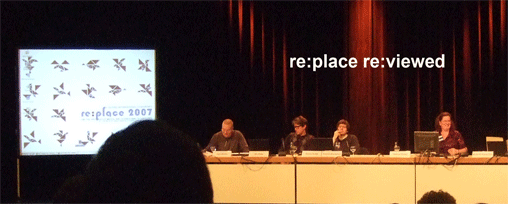
Panel 1 was on the topic of art, science and engineering as sites/places where early experiments in media art took place, most often as a combined form of research and development, focusing on examples of their intersections. The panel was moderated by Edward Shanken, with panelists Michael Century, Stephen Jones, Eva Moraga and Robin Oppenheimer.

The first presenter, Michael Century spoke about how R.M.Baecker's research on hand-drawn digital animation at MIT's Lincoln Labs lead to the development of the Graphical User Interface (GUI)1. GENESYS was created in the late 60ies and tested by artists of Harvard's Visual Art Center. What was important to the artists was not what could be seen in the frame, but in the behaviour of the tool. Century spoke of this process of refining GENESYS, with the help of artists, as a co-invention between engineer and artist. Alan Kay, researcher at Xerox PARC, saw GENESYS' potential for his own interests, its potential of being an open ended medium with expressive possibilities, similar to clay or paper. The GUI he imagined was just like that: a personal dynamic medium. In his summary, Century thinks the reason for GENESYS' success was that it had worked as a boundary object2 between animation and computer research.

The second speaker, Stephen Jones discussed early experiments in art and technology at the University of
Sydney (from 1968 to 1975). John Bennett, a British Computer Engineer headed the Basser Department of
Computing at the University's School of Physics. The department developed computer graphics for simulations and also made animations for the US airforce, computed algorithms that were recorded frame by frame with a movie camera and later coloured by hand. After visiting the Cybernetic Serendipity exhibition in London, Bennett became fascinated by the possibilities of using the computer as a medium for artistic expression. In 1969 he gave a talk on technology and art and encouraged his students to use the computer to make art themselves. Out of this grew a rhizomatic network of students collaborating in media enhanced art projects.
What both Century and Jones wanted to show is the network of relations and flows of influences. Whereas
Century's talk showed a rather linear way from one person/idea to the other, it was different in Jones'
presentation: Starting with John Bennett a rhizomatic net of people, disciplines and projects spread out. Both
speakers followed the traces and networks of people, inventions and mutual influences. In the end Century's
presentation lead to the development of an (industrial) product while Jones' lead into manifold art projects.

Eva Moraga presented The Computational Center at Madrid University (1969 - 1973), a project made possible by the support of IBM. They gave two high end computers to the University plus a yearly financial donation of 1 Actually it was called the PARC User Interface. 2 Fred Turner uses the terms „boundary object“ and „trading zone“ in his book „From Counterculture to Cyberculture: Stewart Brand, the Whole Earth Network and the Rise of Digital Utopianism“; „boundary object“ taken from Susan Leigh Star and James Greisemer, „trading zone“ coming from Peter Galison. Throughout all panels both terms were frequently used. 18.000€. The Center should have been open to researchers from all over Spain. Its mission was to study automation of research and analysis processes in fields where automation had not been brought in yet, like „Mathematics Linguistics“, „Automatic Generation of Architectonic Spaces“ and „Automatic Generation of Plastic Forms“. IBM had not allowed the University to use the computers for administrative tasks. For that, the Center would have to buy seperate machines from IBM. IBM also influenced the Center by naming the director.
The Center's approach was interdisciplinary, the staff consisted of computer experts with international
experience and artists could apply for scholarships. A research goal would be, for example, to find out the
grammar rules a specific artist would apply when producing his/her work. Moraga's presentation remained within the field of mere facts. She didn't take a critical position regarding IBM's influence or the political situation of Franco-Spain or on how those two together had an impact on the Center's supposed autonomy. Time and Space, the panel's framing constituents, became strangely visible by their absolute absence in her talk.

The goal of Robin Oppenheimer's talk was to show the emergence of new collaborative practices and forms of communication at the intersection of art and engineering in E.A.T.'s „9 Evenings“. In the 10 month long
collaboration between the Greenwich Village art scene and engineers from Bell Labs, artists and engineers had to define a common base to work on. Oppenheimer also used Fred Turner's interpretation of the „boundary object“ and the „trading zone“ to describe this search for bridging difficulties in understanding each other's ideas, in articulating the ideas of one field in a way that was meaningful for the other and finally in being able to create something together.
Oppenheimer mentions that the ethical values of openness and egalitarian collaboration were crucial to this
experiment. I would like to question the notion of collaboration implied here: The artists involved in „9
Evenings“ had already been well established. Their names attracted the audience and still do. At a concurrent
exhibition at Tesla, an art space in Berlin, the descriptions of projects from „9 Evenings“ were headed by the
project's title, the artist and then, almost as a footnote or addendum came the name of the project engineer. So this collaboration had been less egalitarian but rather shows a clear hierarchy of art over engineering.

Contextualization:
None of the panelists spoke about the influence of the futuristic zeitgeist of the 60ies with its perspectives of
landing on the moon, etc. Time was only present as history, the military background of the labs and the
chronological development of technologies invented for military purposes. All projects had in common that they started or were made possible in a field of military research: The Lincoln Labs as an institute of MIT and funded by the US military (Xerox PARC functioning as a commercial follow up in this case); Moraga's project placed in Franco-Spain where it was instrumentalized both by the regime to show off and by IBM (who didn't show moral fibre in collaborating with Franco-Spain, but merely wanted the Center to do research IBM would profit from and maybe even sell their products to the University); and finally Oppenheimer's presentation on E.A.T.'s „9 Evenings“ was again related to military R+D through Bell Labs.

Penalties for the panelists - Discussions:
Time was crucial to this panel in another way: Each speaker got exactly 20 minutes for the presentation, which was too short for each of them. Century and Oppenheimer dealt with it by talking very fast, so that it was hard to follow. Moraga and Jones spoke slower, but unfortunately couldn't finish their presentations. The way that these time constraints were put on this panel was quite impolite towards the speakers and their interesting topics as well as towards the audience. A result of the strictly executed 20-minutes-setup discussions after each presentation were rare and not very lively. Robin Oppenheimer had the advantage that her topic was the most commonly known and got great support from the audience: Artist Gerd Stern (USCO) had attended the „9 Evenings“ and could give an authentic impression of the event.

Moderator or Administrator?
re:place chose to have moderators for the panels, Edward Shanken was the first to go and do the job and interpreted his role in a strictly administrative sense. He didn't give an introduction on the panel's topic, but made clear the „rules of the game“: Each panelist had 20 minutes time for a presentation or otherwise would have „their heads cut off“ (sic!), followed by 10 minutes for discussion, this was repeated four times so that in the end 30 minutes would remain for a panel discussion. To structure a conference into different thematic panels suggests to me an explanation of why certain microhistories are combined. It literally wants an introduction to be made that could open up discussion in the final round. To structure the panel in this way, to introduce, sum up, and contextualize would have been the role of the moderator. And this was badly missing.

>> Helen Thorington, "What is Radio Art?",

Tate Intermedia, May 2008
(http://www.tate.org.uk/intermediaart/radio_art_text.shtm)


What is Radio Art?

Radio art had a special meaning to those who created it in the US during the Eighties and Nineties. From the most complex hi-tech studio productions to the raw energy of live and interactive broadcasts, these artists were predominantly engaged with subverting media conventions by presenting something other than familiar radio forms.

Thus while the work might use journalistic devices or dramatic conventions, it was neither journalism, nor drama; it wasn’t music either though it might be composed entirely of non-textual sound. American radio art was a vast array of different forms that recognised radio’s distinct means and parameters, and at the same time, its creative possibilities, how it might challenge existing social and cultural norms and create/fashion new ones.

Part of its appeal, as Claire Brilliant so aptly remarks, lay in the tension created when the experimental artist tried to subvert the medium’s mainstream status while simultaneously leveraging its capacity to reach a wide audience.[i]

In the mid 1980s, when I started New American Radio, a weekly series of half-hour radio art programmes by artists for American public radio, there was a stranglehold on channels of distribution; most people, and certainly most artists, were excluded from radio production, just as we were excluded from book publishing and music distribution. Across the US, Europe and the Pacific a handful of great radio programmes focused on radio art and experimental music – The Listening Room in Australia, for instance; Kunstradio in Austria; the Pacifica stations in the US. These, however, were the only places that sound artists could enter broadcasting and take advantage of radio’s mass distribution. And those of us who produced the programming for them, whether we liked it or not, were gatekeepers. There was no such thing as open access.

Today that stranglehold is broken. Personal computers and networked connections are everywhere; and anyone with a computer and a network connection has the capital required for production and can produce and distribute whatever he or she wants – alone or with others.[ii]

The radio scene has changed. Broadcast radio is shrinking under the flood of new technologies. And, as a friend recently remarked, ‘radio art as such seems to have vanished.’[iii] Or has it?

The Networked World: Radio meets Art, meets Life

In 1996 my organisation, New Radio and Performing Arts, Inc., extended its mandate to networked art (art that uses the internet as its medium and that cannot be experienced without it) and launched its Turbulence site. Turbulence commissions artists exploring the networked medium and originating innovative work for it. Several of the works on Turbulence reflect the changes taking place in production as a result of the internet. Prototype #44, Net Pirate Number Station by Yoshi Sodeoka is an online short-wave radio station that broadcasts numbers derived from websites. Software in the work goes out to websites of all sizes, grabs some text, converts it into numbers, filters the numbers and then transmits them to the listener using a prerecorded video host personality. Why a radio station that broadcasts numbers rather than music and news? The artist’s reply: ‘We hope you, the user, will look for meaning where there may not seem to be meaning… we want you to see the world in a new way.’

Still it was our blog, Networked_Performance,[iv] launched in July 2004, that brought home the truth of the radical changes taking place as a result of the Internet and its spawn of new technologies. In 2004 the blog entries archived the practice made possible by the ready availability of inexpensive portable devices – wireless, mobile phones, PDAs, GPS cards, Bluetooth, and others. Computation was leaving the desktop and migrating to the street. It would now be carried in the hand, worn on the body, or embedded in devices and in the environment.

Further we observed that the work was being produced by a growing generation of programming capable artists, artistically minded engineers, architects, academics, and others – many of whom did not identify as artists – all repurposing objects from the everyday world, embedding unfamiliar functions in them.

A boxing bag plays meditative tones when struck; an American semi-tropical climbing Philodendron functions as an instrument in a musical ensemble; a park bench moves and sings; a goblet lights up when a distant friend or lover drinks from it; a wall is so sensitive to human presence that touching it sends resonant vibrations through the bodies of the room’s occupants; a darkened room responds to the aggregate breathing of its inhabitants and the lights rise, illuminating the space.

Why create work like this? Why embed alternate functions in familiar objects? The answer resonates with Sodeoko’s earlier reply: ‘We want you to see the world in a new way.’

As mobile technologies became more readily available, those interested in transmission ideas and broadcast tools began to take radio out of the studio: In Soundpocket 2, a huge oak tree, a sculpture, and a small pond served as local radio stations, transmitting internet radio streams; Radio Cycle broadcast stories, news and sounds directly onto the streets via teams of radio-carrying cyclists. CUT-n-PASTE, an Amsterdam women’s artist group, connected its listeners with a number of personalities in Amsterdam’s nightlife, transmitting their lives by the permanent open mike of their mobile phones to audiences via radio, the internet or into a performance venue. For eight days in September 2007, The FM Ferry Experiment, transformed the Staten Island Ferry into a floating radio station, broadcasting to the NYC region as it continuously traveled between Staten Island and Lower Manhattan. Mobile Radio, Sarah Washington and Knut Aufermann’s travelling radio and sound-art project was initiated, its mission, to seek out new forms of radio art by taking radio production out of the studio environment.

Some of these radio projects broadcast alternative content; some did not. All removed radio production from its original source in the broadcast organisation’s studio and put it in the hands of artists and other creative people.

The Emergence of Sound Art as a Prominent Practice

While the issue of everyday sound’s inclusion in the musical repertoire was settled by composers some time ago, it is only recently that we have seen sound-based artistic work flourish, with manifestations ranging from field recordings and sound tools, to immersive installations and computer games.

This rapid and diverse development is particularly evident in the emerging field of sonification. Data sonification – as described by Wikipedia – has long been viewed as a valuable tool for studying complex sets of scientific data by allowing researchers to perceive variations and trends invisible to other analysing techniques; it has not been used extensively by artists until recently. Today, however, sound compositions created by the translation of data to sound are legion.

In August 2007, for instance, composer Chris Chafe let five vats of different varieties of tomatoes from his garden ripen to perfection. He and his collaborator Nikolaos Hanselmann recorded the ripening process by tracking the changes in CO2 that the ripening produces. Music was generated in real time by computer algorithms influenced by CO2, temperature and light readings from sensors in each vat. After the ripening, time was speeded up and a stand-alone computer music piece, Tomato Music was created. Tomato Music is then a sonification of seven days of ripening that takes place in the course of 49 minutes.

In an earlier work by Miya Masaoka, Pieces for Plants, a semi-tropical climbing Philodendron’s real-time responses to its physical environment were sonified or translated to sound by means of highly sensitive electrodes attached to the leaves of the plant. A human, the so-called ‘plant player’ worked with scored movements – proximity, and touch – to stimulate physiological responses in the plant. The ‘plant player’s’ interactions with the plant were then expressed in sound via midi and synthesiser.

German composer Frank Halbig used ice-core data – collected by the European Project for Ice Coring in Antarctica – to create Antarktica: a climatic time-travel, a concert for string quartet, live electronics and video, performed in 2006.

In 2004, Andrea Polli, a digital media artist living in New York City, sonified the summer heat in Central Park.

DJ Spooky’s most recent large-scale multimedia performance work is Nova: The Antarctica Suite, an acoustic portrait in which every sound is made from the sound of ice (environmental, geological, magnetic, atmospheric etc).

The list goes on and includes many projects where the focus is on sounds in our environment that are undetectable by the human ear: the sound of naturally occurring emissions such as radio signals created by the planet itself;[v] sounds intercepted from space; sounds of clouds – their size, moisture content transformed into musical sequences.

Still other works use the sounds of objects in our environment to create compositions.

In Music for Rocks and Water by Cheryl Leonard, performers play water and a variety of rocks which are ‘dripped, drizzled, poured, rolled, rocked, brushed, rubbed, stacked and even tickled’; sometimes they are played underwater.

Peter Traub’s ItSpace makes use of the sounds of household objects to shape a series of short compositions.

These sound works renew our connection with real life, with the objects and things around us, with the natural world, our environmental concerns, with our universe. As Leigh Landy writes,

[they] offer a return to the connection of art and life because...[their] specific content creates experiential [and imaginary] associations linked with meaning by listeners.[vi]

People latch onto a sound’s perceived origin – they recognise it; they remember; and their memories fill the experience of hearing it again. These references bring the work close to daily life. They shape something we might call an interaction with the world around us, an experience of being in the world.

For many of us the flourishing of sound art is most welcome, signalling that the hegemony of vision may not be forever and that this enhancement of our sensorial experience will bring with it a deeper understanding of our relation, not just to one another but to the world we inhabit and all things in it, and therefore a richer experience of ourselves as perceiving subjects.

From my perspective, we can look on this as one of the true positives that the re-distribution of power across society and geography is making possible.

We Together: Active Listening, Collaboration and Participation

New technologies have developed since the networked_performance blog was initiated. Based on the observation that people go online not for pre-programmed material but to do things together, commerce has returned and established what we call social space: commercial content aggregators like like MySpace, Facebook, YouTube, and Flickr. Free and participatory in nature, they give users control of the media they produce and consume.[vii]

Non-commercial specialised sites are plentiful as well, sites like Jason Van Arden’s BubbleBeats, which allows users to combine colourful bubbles filled with music (or other sounds) to create new compositions. They are social spaces. As Van Arden says of Bubblebeats:

It combines the addictive diversion of a casual game, the free expression of music, and the fun of participating in an active social network.

Free, fun, participatory, social spaces are fast becoming the next broadcasters (or perhaps narrow-casters). Activated by them, otherwise passive audiences are making new friends, composing and playing music, uploading videos and photographs, talking, sharing, exchanging, and perhaps most significantly, publishing and distributing themselves.

Virtual worlds offer other kinds of experiences. There, residents explore the technologies and social ramifications of synthetic, multi-user environments, The extraordinary success of virtual worlds such as Linden Lab’s Second Life, rests almost entirely on the decision the company made to support an openness within their 3D virtual world, to turn control over to users, to make it possible for any user to add almost anything to the environment.[viii]

Changes will not stop here. New technologies, new interests, new commercial ventures, will bring additional players to the networked environment, changing existing institutions and how they relate to experimental practices. The new environmental awareness, for instance, has already unleashed a wave of innovation in every category of technology – including portable music and video players.[ix] And, according to media futurist and author Gerd Leonhard, the music industry has undergone more changes in the last months than it has in the past ten years.[x] What lies ahead? Leonhard writes,

… fully interactive, fully-share-enabled, full-length-tracks, will become a default setting on the social networks…. regardless of the record industry’s ‘permission-denied’ tendencies….

…and they will broadcast to (and from!) those always-on, always-within-reach and utterly personalised mobile devices fka [formerly known as] mobile phones, not just to or from computers. Blogs will amalgamate with, and integrate into social networks. Personal publishing will evolve to include entire ‘me-casting’ toolboxes. My taste, my list, my ears, my audience, my artists, my, my network…[xi]

Access and participation define internet activity today. The nexus of experimental activity in radio has shifted and because it has, it has opened doors for thousands whose voices were silent before, and brought with it the possibility of a creative practice that, as Sodeoka hoped for his i#44, Net Pirate Number Station, lets us see our world in a new way.

Helen Thorington, 2008


[i] Retrieved from http://somewhere.org/NAR/index.htm Stationary Flow: Process and Politics in Audio Art On the Air and Online

[ii] Yochai Benkler in The Wealth of Networks, Yale University Press, 2006 has discussed this at length

[iii] Jacki Apple in a 4/18/08 email

[iv] http://turbulence.org/blog initiated by Jo-Anne Green, co-director of New Radio and Performing Arts and the Turbulence website; Michelle Riel, Associate Professor of New Media at California State University at Monterey Bay – and myself.

[v] see Robin McGinley proposal for an interactive sound installation entitled The Earth’s Original 4.5 Billion Year Old Electronic Music Composition (A Work in Progress) which explores an artistic approach to these natural phenomena. http://transition.turbulence.org/networked_music_review/?s=robin+mcginley&x=10&y=8

[vi] in his introduction to Understanding the Art of Sound Organization, MIT Press, 2007

[vii] The observation that people were coming to the internet not for preprogrammed content but to do things together, lead to the return of commerce to the Internet after the dot.com bust and the establishment of social spaces

[viii] As Don Tapscott said in his book Wikinomics: In 2006, successful companies launched open access platforms while the losers built walled gardens.

[ix] Artists are becoming increasingly involved in large infrastructure issues There are, for instance,wastewater treatment systems designed by artists in park areas, such as the work of Jackie Brookner.

[x] Media futurist and author , Gerd Leonard on his blog, 3September 2007.

[xi] Retrieved from http://www.mediafuturist.com/2008/04/future-stories.html Future Stories #1 (8 April 2008) Blogs will be Record Labels, and Bloggers will be the new Music Moguls. BlogJs anyone?

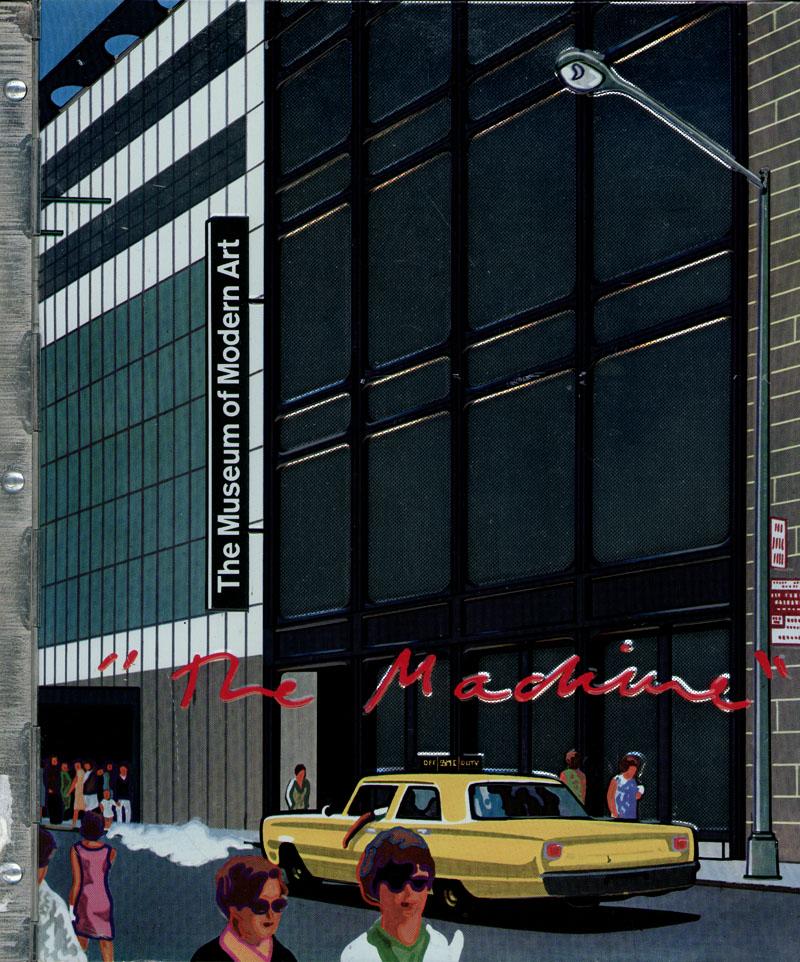
>> exhibition: The Machine as Seen at the end of the Mechanical Age, MoMa, 1968

curated by K.G. Pontus Hultén, November 1968 - February 9, 1969


put these in correct posts: Cybernetic Serendipity (ICA, curated by Jasia Reichardt, 1968); The Machine as Seen at the End of the Mechanical Age (MOMA, curated by K.G. Pontus Hulten, 1968); Software, Information Technology: Its Meaning for Art (Jewish Museum, New York, curated by Jack Burnham, 1970); Information (MOMA, curated by Kynaston McShine, 1970); and Art and Technology (LACMA, curated by Maurice Tuchman, 1970).

"Hulten remarks: "technology
today is undergoing a critical transition. . . . the mechanical
machine - which can most easily be defined as an imitation of our
muscles - is losing its dominating position among the tools of
mankind; while electronic and chemical devices - which imitate
the processes of the brain and the nervous system - are becoming increasingly important" (page 3).

[...] His (Hultén's) preferences include, in my opinion, the Dadaists, the Constructivists,
Charlie Chaplin and Jean Tinguely. This somewhat disparate collection of artists appears to be united - in Hulten's view - by their desire to dominate the mechanical world, to establish
better relations with machines so that a greater measure of humor, harmony and humanity might reign in our irrevocable marriage with technology.

[...] "The decisions that will shape our society in the future will have to be arrived at, developed, and carried out through technology. But they must be based on the same criteria of respect and appreciation for human capacities, freedom, and responsibility that prevail in art" (page I3).
"In planning for such a world, and in helping to bring it into being, artists are more important than politicians, and even than technicians" (page i).

[...] Nonetheless, he (Hultén) uses these symbols, and the application of "car" to Bugatti's La Royale (page I42), Fuller's Dymaxion Car (page I43) and Farhner's Boot Hill Express (page I8o) implies a simple distinction between "art" and "machine."

(from: William A. Camfield, The Machine as Seen at the End of the Mechanical Age by K. G. Pontus Hultén (review), The Art Bulletin, Vol. 53, No. 2, (Jun., 1971), pp. 275-277
Published by: College Art Association, Stable URL: http://www.jstor.org/stable/3048856)

>> Adrian Ward, Signwave Auto-Illustrator

from their website: http://www.auto-illustrator.com/

"Signwave Auto-Illustrator is an experimental, semi-autonomous, generative software artwork and a fully functional vector graphic design application to sit alongside your existing professional graphic design utilities.

Use it to explore a wide range of generative and procedural techniques in the production of your own graphic designs. Discover how easy it is to produce complex designs in an exciting and challenging environment that questions how contemporary software should behave.

Download a demo version using the links above. You will need one of the operating systems above, a fast processor (G3/G4 Macintosh 300MHz, Windows 600MHz), atleast 64MB RAM and a full install of QuickTime 4 or higher. Requires Mac OS 8.6 or higher, built for Mac OS X."


In 2001, Adrian Ward's Auto-Illustrator won a Honorary Mention in the Prix Ars Electronica's Interactive Art category. The description on Ars Electronica's website:

"Although presented much like a traditional piece of graphic design software, Auto-Illustrator expresses a vast new way of treating codeas a creative extension of the self. The routines of Auto-Illustrator have been imbued with coded implementations of the author/artist’s creative decision-making process. In effect, this results in a deferred artistic activity, away from the original author, and as it is a computer application, in the hands of the person executing it.

This brings about many questions regarding authorship and authenticity of digital artworks. It poses new possibilities for the valuation of mechanically reproduced artworks, and offers the possibility that programming (a creative act above anything else) becomes more than just a method of production (i.e., a craft)—thus rendering the author as code. This also opens us to the possibility of a real-world implementation of cyborgism. When you run Auto-Illustrator, you interact with me, the author of the code. Your final products (despite thinking they are created by you) will actually have been produced in collaboration with the me.

Also presented as a parody of Adobe Illustrator, it mimics certain interface elements in an attempt to highlight the growing inadequacies of modern software. Professional software development is now about making software for the masses, and not for the professionals. The latest incarnation of Adobe Photoshop typifies this move away from focused professionalism to extreme popularist automation; Photoshop will now render all your web page buttons for you. Hopefully, within a few years, all web pages will conform to Adobe’s graphic design specifications!

As an extreme reaction against this, Auto-Illustrator deliberately forces the user to experience a slightly jarring and dysfunctional approach to graphic design. Every time you ask it to draw an oval, it tries to draw a psychotic face. It’ll never draw the same psychotic face twice, mind you.

Process over Product?
Auto-Illustrator features a great deal of tools and utilities that allow the user to explore different ways of generating artwork. As well as allowing traditional visual design skills, users can automate their own behaviours, and reiterate them on their own artwork, or even on others’. The menus of fitters, transformations and plug-ins reveal that it is possible to codify graphic design skills as code. On a practical level, this makes generating certain visual designs easy (through automation), and yet on a philosophical level, we start to question where a graphic designer’s skills may lie. Would it be possible to render yourself purely as code, and then sell your skills as applications?"


--> hacking
--> critique of commercial software and its "creativity"
--> irony

>> Ken Knowlton, "On the Frustrations of Collaborating with Artists", 2001

Read this document on Scribd: Ken Knowlton OnCollaboration

>> Vanevar Bush, "Memex", 1945


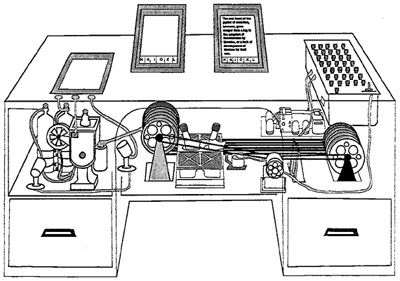
memex: a sort of microfilm-based knowledge desk.
pre-digital precursor to the internet.


The Atlantic Monthly, 1945: Vanevar Bush, "As We May Think"
http://www.theatlantic.com/doc/194507/bush


>> labels

>> cloudy with a chance of tags


Powered By:Blogger Widgets

followers

.........

My photo
... is a Media Art historian and researcher. She holds a PhD from the University of Art and Design Linz where she works as an associate professor. Her PhD-thesis is on "Speculative Archiving and Digital Art", focusing on facial recognition and algorithmic bias. Her Master Thesis "The Grammar of New Media" was on Descriptive Metadata for Media Arts. For many years, she has been working in the field of archiving/documenting Media Art, recently at the Ludwig Boltzmann Institute for Media.Art.Research and before as the head of the Ars Electronica Futurelab's videostudio, where she created their archives and primarily worked with the archival material. She was teaching the Prehystories of New Media Class at the School of the Art Institute of Chicago (SAIC) and in the Media Art Histories program at the Danube University Krems.