<< preface

this blog is nina wenhart's collection of resources on the various histories of new media art. it consists mainly of non or very little edited material i found flaneuring on the net, sometimes with my own annotations and comments, sometimes it's also textparts i retyped from books that are out of print.

it is also meant to be an additional resource of information and recommended reading for my students of the prehystories of new media class that i teach at the school of the art institute of chicago in fall 2008.

the focus is on the time period from the beginning of the 20th century up to today.

>> search this blog

2008-07-07

>> ASCII-Art


(images from: http://blog.modernmechanix.com)

--> compare to Knowlton/Harmon, "Nude"
--> "IX", by h3x3n (magic by numbers, hacking, critique)
--> typewriter art, keyboard art, drawing by numbers
--> compare "me and you and everyone we know"

>> exhibition: "Computer-Generated Pictures", 1965

First exhibition of computer generated art,
1965 at the Howard Wise Galleries in New York.
artists: Bela Julesz and A. Michael Noll (both from Bell Labs)

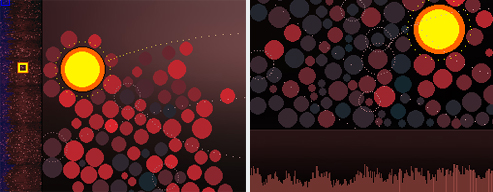
>> Golan Levin, "The Dumpster"

"The Dumpster applet allows its users to browse brief descriptions of 20,000 breakups which were posted to Internet blogs during 2005. This page presents a small selection of representative breakups, with the intent of illustrating the range of the collected information. " (Dumpster project description)


Lev Manovich on "The Dumspter":
"Although The Dumpster by Golan Levin (working with Kamal Nigam and Jonathan Feinberg) can be related to traditional genres such as portraiture or documentary, as well as established new-media genres such as visualisation and database art, it is something new and different. I would like to call it a ‘social data browser’. It allows you to navigate between the intimate details of people’s experiences and the larger social groupings. The particular and the general are presented simultaneously, without one being sacrificed to the other.

[...] But in Levin’s group portrait, you are encouraged to navigate both horizontally, vertically, and diagonally between the particular and the general. You can, for example, simply click on different circles, jumping from one breakup case to another and randomly explore the overall data space. Or you can explore the circles that are similar in colour – which means that the corresponding postings are similar in some ways. Or you can explore the circles that have an opposite color and thus belong to a different grouping. In short, the seemingly incompatible points of view of Tolstoy and Durkheim – the subjective experience and the social facts – are brought together via the particular information architecture and navigation design of The Dumpster."

(http://www.tate.org.uk/intermediaart/entry15484.shtm)

>> processing


on www.proce55ing.net:
"
Processing is an open source programming language and environment for people who want to program images, animation, and interactions. It is used by students, artists, designers, researchers, and hobbyists for learning, prototyping, and production. It is created to teach fundamentals of computer programming within a visual context and to serve as a software sketchbook and professional production tool. Processing is an alternative to proprietary software tools in the same domain."

(http://www.proce55ing.net/copyright.html:)
"Processing was started in Fall 2001 by Ben Fry and Casey Reas. Fry was a PhD candidate at the MIT Media Laboratory and Reas was an Associate Professor at the Interaction Design Institute Ivrea. While Fry and Reas were employees of these institutions, Processing began as a personal initiative and development took place during the night and weekends through 2003. MIT indirectly funded Processing through Fry's graduate stipend and Ivrea indirectly funded Processing through Reas's salary. Due to his research agreement with MIT, all code written by Fry during this time is copyright MIT.

In summer 2003, Ivrea funded four individuals to work on the project for a few months. This resulted in Dan Mosedale's preprocessor using Antlr and Sami Arola's contributions to the graphics engine. The code for these elements are both copyright 2003 Interaction Design Institute Ivrea.

In August 2003, Reas left the Interaction Design Institute Ivrea and in June 2004, Fry left the MIT Media Laboratory. The code and complete reference written since June 2004 are copyright Ben Fry and Casey Reas.

Portions of the code were written by other contributors and are attributed in the source code. For example, portions of the graphics engine were written by Karsten Schmidt. There are many contributions to the Exhibition and Examples on the Processing.org website and these are attributed in context.

The Reference for the Language and Environment are under a Creative Commons license which makes it possible to re-use this content for non-commercial purposes if it is credited."


eamples of artworks done with processing:

- Golan Levin, "The Dumpster"
- LIA
- Casey Reas, "Microimage"
- Ben Fry, "Valence"
- Josh On, "Inequality"
- Marius Watz, "C Drawer"
- Ed Burton, "SodaProcessing"
- JonahBrucker-Gohen, "Tech Support"
- Justin Manor, "Presidential Discombobulator"
- Alvaro Cassinelli, "Khronos Projector"
- Art+Com, "Process"
- Philip Worthington, "Shadow Monsters"
- rAndom international, "Pixel Roller"

"Processing is written in Java and enables the creation of Java Applications and Applets within a carefully designed set of constraints. It uses a 2D/3D Java rendering API that is a cross between postscript-style imaging in 2D and 3D rendering with OpenGL. Through developing Processing as a solid and general technical platform, we hope teaching the concepts of interaction and computer programming will focus more on the qualities and content of medium, rather than the technology." (http://www.groupc.net/2002/proce55ing/index.html)

>> Casey Reas

http://reas.com/

"I like to manifest the software in different media because each media gives me some sort of different way of presenting a thought or a concept. When presenting the software as running software, as interactive software, it allows me to explore the domain of response. Doing it as a print allows me to explore a new level of materiality and tactile quality, which is not possible in screen based media. All the work that is being shown here explores being able not to have control over the machine. So, in essence, it's the same software but each media gives me a different way of exploring a piece of code."
(http://www.artificial.dk/articles/reas.htm)


a bit further down:

"Perhaps one of your more ambitious projects is Processing, which is also featured here at Ars Electronica. It's a programming language and software environment that you are developing with Ben Fry. When and why did you start this project?

We began 2 years ago, I guess, actually, I have been programming for 5 years then. Ha-ha... time flies! Ben and I are both teachers doing all our work in software and we are really frustrated with the current software environments that exist for doing this kind of work. Nobody has really designed a software environment for working in the way that we like to work, so that's why we started building it. We always worked in software environments like C, C++, Java, and OpenGL. These environments are too complex. They're trying to do everything so they're just massively difficult to use. And what we need is just something that is specifically tailored for the work that we want to do. So in our language for example, we have a simpler and better control over color than any other programming language that I have ever seen before. So it's specifically designed for the things we find important.

An artistic tool?
Yes, it's specifically made for what we call electronic arts. Oh, and it's very good for connecting electronics to computers as well. So you're able to connect a camera or connect two computers together.

Is it possible to learn without any previous programming knowledge?
It has three different learning levels. In the most basic layer you're able to type in just a few lines of code and see a result, and the next layer there's a slightly larger structure that allows you to do things that are responsive and things that can be animated. And then, in the third layer, you are actually programming in Java itself. We taught a lot of workshops were we had people who had never learned to program before and after just two weeks they were doing really nice works. Another really important thing about the language is that we have designed it slowly over 2 years, and we have always been teaching with it and using it personally the whole time, so it grows very organically.

I heard Golan Levin quote John Maeda, saying something like "When you use other people's software you live in somebody else's dream". Do you recognize the quote? - Are 'processing users' living in your dream?

I don't know this quote directly, but it makes sense. There are many levels of software from the general to the specific. As software becomes more specific, it limits the possibilities. Processing is very general and doesn't put many constraints on the possibilities of software. In many respects Processing is living in the dream of Java and OpenGL. It's more a collage of ideas than a specific revolution…"

>> LIA

www.re-move.org
www.strangethingshappen.org


see also @c, a collaboration of LIA, Miguel Carvalhais and Pedro Tudela:
http://www.at-c.org/

2008-07-05

>> Herbert Marshall McLuhan


short explanations of key terms of McLuhan's thinking
(all quotes mentioned here from wikipedia)

pop culture

the medium is the message

"[I]f a new technology extends one or more of our senses outside us into the social world, then new ratios among all of our senses will occur in that particular culture. It is comparable to what happens when a new note is added to a melody. And when the sense ratios alter in any culture then what had appeared lucid before may suddenly become opaque, and what had been vague or opaque will become translucent."

--> media are extension of men
--> media have the capacity to environ
--> media form and shape infrastructures
--> media shape environments
--> media have social impact
--> media change social interactions
--> the message is not the content delivered by new media, but the structuring capacities of the media, the medium is the message

--> new media have
effects on cognition, which continues to affect social organization
--> society affected by the characteristics of the medium itself

example: light bulbs enabled us to create new spaces in the dark

“The medium, or process, of our time - electric technology is reshaping and restructuring patterns of social interdependence and every aspect of our personal life.
It is forcing us to reconsider and re-evaluate practically every thought, every action, and every institution formerly taken for granted.
Everything is changing: you, your family, your education, your neighborhood, your job, your government, your relation to “the others”.
And they’re changing dramatically.”


--> unintended consequences
--> change of schale, pace or pattern that medium has on human affairs --> change in social dynamics --> medium is anything that can initiate change

--> retribalizing, away from individualism
--> everyone everyone in the world gets the same message
--> media work through our senses
--> the way in which we see, feel,... changes with the change of media
--> from industrial/postindustrial times to information age


concept gets clearer when you compare the characteristics of the gutenberg-age and the time of the global village:


the gutenberg galaxy
--> linear, serial
--> print, assembly line
--> predominance of the visual over the aural
--> books first teaching machine


global village
--> parallelity, synchronicity, field not line
--> no center, every place becomes a center
--> electronic nervous system as a common metaphor
--> electronic age will shift from visual to aural culture, from individualism to collectivity

"Instead of tending towards a vast Alexandrian library the world has become a computer, an electronic brain, exactly as an infantile piece of science fiction. And as our senses have gone outside us, Big Brother goes inside. So, unless aware of this dynamic, we shall at once move into a phase of panic terrors, exactly befitting a small world of tribal drums, total interdependence, and superimposed co-existence. [...] Terror is the normal state of any oral society, for in it everything affects everything all the time. [...] In our long striving to recover for the Western world a unity of sensibility and of thought and feeling we have no more been prepared to accept the tribal consequences of such unity than we were ready for the fragmentation of the human psyche by print culture"


hot and cool media
hot: high level of involvement of the user, low level of stimulance/participation; examples: a lecture, radio, film; sequential, linear, logical; emphasize one sense
cool: low level of involvement of the user, high level of stimulance/participation; examples: a seminar, comics, TV

their connection not dichotomous, but continous,

"There is a basic principle that distinguish a hot medium like radio from a cool one like the telephone, or a hot medium like the movie from a cool one like TV. A hot medium is one that extends one single sense in "high definition." High definition is the state of being well filled with data. A photograph is, visually, "high definition." A cartoon is "low definition," simply because very little visual information is provided. Telephone is a cool medium, or one of low definition, because the ear is given a meager amount of information. And speech is a cool medium of low definition, because so little is given and so much has to be filled in by the listener. On the other hand, hot media do not leave so much to be filled in or completed by the audience. Hot media are, therefore. low in participation, and cool media are high in participation or completion by the audience. Naturally, therefore, a hot medium like radio has very different effects on the user from a cool medium like the telephone."
--> one to many vs many to many

tetrad of media effects:

  • What does the medium enhance?
  • What does the medium make obsolete?
  • What does the medium retrieve that had been obsolesced earlier?
  • What does the medium flip into when pushed to extremes?

TV-interview on the CBC archives:
http://archives.cbc.ca/arts_entertainment/media/clips/1814/


McLuhan publications online:
--> "Understanding Media: the Extensions of Men" (1964):
http://cultofjim.com/scripture/understanding_media/
--> "The Medium is the Massage", audio-recording from 1967, on ubuweb:
http://ubu.artmob.ca/sound/mcluhan_marshall/Mcluhan-Marshall_The-Medium-Is-The-Massage_01.mp3 and
http://ubu.artmob.ca/sound/mcluhan_marshall/Mcluhan-Marshall_The-Medium-Is-The-Massage_02.mp3
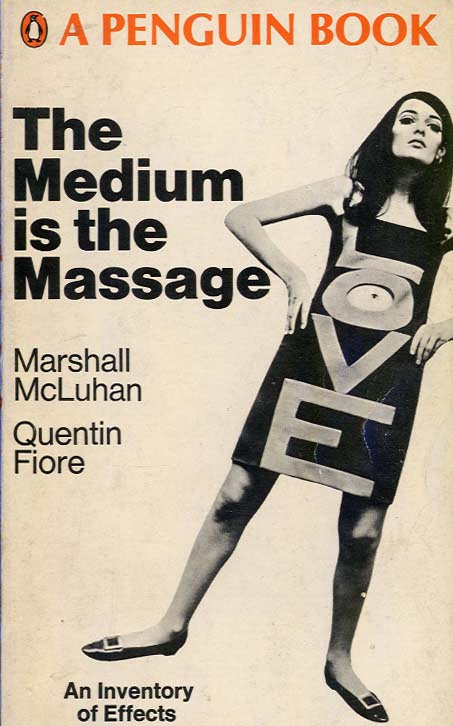
--> "The Medium is the Massage", 1967:

Marshall McLuhan - The Medium is the Massage


youtube playlist of McLuhan videos:


Read this document on Scribd: Marshall McLuhan - The Medium is the Massage

>> labels

>> cloudy with a chance of tags


Powered By:Blogger Widgets

followers

.........

My photo
... is a Media Art historian and researcher. She holds a PhD from the University of Art and Design Linz where she works as an associate professor. Her PhD-thesis is on "Speculative Archiving and Digital Art", focusing on facial recognition and algorithmic bias. Her Master Thesis "The Grammar of New Media" was on Descriptive Metadata for Media Arts. For many years, she has been working in the field of archiving/documenting Media Art, recently at the Ludwig Boltzmann Institute for Media.Art.Research and before as the head of the Ars Electronica Futurelab's videostudio, where she created their archives and primarily worked with the archival material. She was teaching the Prehystories of New Media Class at the School of the Art Institute of Chicago (SAIC) and in the Media Art Histories program at the Danube University Krems.