the classic 50ies animation about the different uses of atoms.
produced in 1953 by John Sutherland Productions Inc.
2008-09-23
>> A is for Atom
2008-09-15
>> Roland Barthes, "Death of the Author", 1967
full text available here:
http://www.ubu.com/aspen/aspen5and6/threeEssays.html#barthes
or:
http://www.pdf-search-engine.com/roland-barthes-%E2%80%9Cthe-death-of-the-author,%E2%80%9D-1968-in-his-story-sarrasine-html-www.mariabuszek.com/kcai/PoMoSeminar/Readings/BarthesAuthor.html
In his story Sarrasine Balzac, describing a castrate disguised as a woman, writes the following
sentence: “This was woman herself, with her sudden fears, her irrational whims, her instinctive
worries, her impetuous boldness, her fussings, and her delicious sensibility.” Who is speaking
thus? Is it the hero of the story bent on remaining ignorant of the castrato hidden beneath the
woman? Is it Balzac the individual, furnished by his personal experience with a philosophy of
Woman? Is it Balzac the author professing “literary” ideas on femininity? Is it universal
wisdom? Romantic psychology? We shall never know, for the good reason that writing is the
destruction of every voice, of every point of origin. Writing is that neutral, composite, oblique
space where our subject slips away; the negative where all identity is lost, starting with the very
identity of the body writing.
No doubt it has always been that way. As soon as a fact is narrated no longer with a view
to acting directly on reality but intransitively, that is to say, finally outside of any function other
than that of the very practice of the symbol itself, this disconnection occurs, the voice loses its
origin, the author enters into his own death, writing begins. The sense of this phenomenon,
however, has varied; in ethnographic societies the responsibility for a narrative is never assumed
by a person but by a mediator, shaman or relator whose “performance”—the mastery of the
narrative code—may possibly be admired but never his “genius.” The author is a modern figure,
a product of our society in so far as, emerging from the Middle Ages with English empiricism,
French rationalism and the personal faith of the Reformation, it discovered the prestige of the
individual, of, as it is more nobly put, the “human person.” It is thus logical that in literature it
should be this positivism, the epitome and culmination of capitalist ideology, which has attached
the greatest importance to the “person” of the author. The author still reigns, in histories of
literature, biographies of writers, interviews, magazines, as in the very consciousness of men of
letters anxious to unite their person and their work through diaries and memoirs. The image of
literature to be found in ordinary culture is tyrannically centered on the author, his person, his
life, his tastes, his passions, while criticism still consists for the most part in saying that
Baudelaire’s work is the failure of Baudelaire the man, Van Gogh’s his madness, Tchaikovsky’s
his vice. The explanation of a work is always sought in the man or woman who produced it, as if
it were always in the end, through the more or less transparent allegory of the fiction, the voice
of a single person, the author “confiding” in us.
Though the sway of the Author remains powerful (the new criticism has often done no
more than consolidate it), it goes without saying that certain writers have long since attempted to
loosen it. In France, Mallarmé was doubtless the first to see and to foresee in its full extent the
necessity to substitute language itself for the person who until then had been supposed to be its
owner. For him, for us too, it is language which speaks, not the author; to write is, through a
prerequisite impersonality (not at all to be confused with the castrating objectivity of the realist
novelist), to reach that point where only language acts, “performs,” and not “me.” Mallarmé’s
entire poetics consists in suppressing the author in the interests of writing (which is, as will be
seen, to restore the place of the reader). Valéry, encumbered by a psychology of the Ego,
considerably diluted Mallarmé’s theory but, his taste for classicism leading him to turn to the
lessons of rhetoric, he never stopped calling into question and deriding the Author; he stressed
the linguistic and, as it were, “hazardous” nature of his activity, and throughout his prose works
he militated in favor of the essentially verbal condition of literature, in the face of which all recourse to the writer’s interiority seemed to him pure superstition. Proust himself, despite the
apparently psychological character of what are called his analyses, was visibly concerned with
the task of inexorably blurring, by an extreme subtilization, the relation between the writer and
his characters; by making of the narrator not he who has seen and felt nor even he who is writing,
but he who is going to write (the young man in the novel—but, in fact, how old is he and who is
he?—wants to write but cannot; the novel ends when writing at last becomes possible), Proust
gave modern writing its epic. By a radical reversal, instead of putting his life into his novel, as is
so often maintained, he made of his very life a work for which his own book was the model; so
that it is clear to us that Charlus does not imitate Montesquieu but that Montesquieu—in his
anecdotal, historical reality—is no more than a secondary fragment, derived from Charlus.
Lastly, to go no further than this prehistory of modernity, Surrealism, though unable to accord
language a supreme place (language being system and the aim of the movement being,
romantically, a direct subversion of codes—itself moreover illusory: a code cannot be destroyed,
only”played off”), contributed to the desacrilization of the image of the Author by ceaselessly
recommending the abrupt disappointment of expectations of meaning (the famous surrealist
“jolt”), by entrusting the hand with the task of writing as quickly as possible what the head itself
is unaware of (automatic writing), by accepting the principle and the experience of several
people writing together. Leaving aside literature itself (such distinctions really becoming
invalid), linguistics has recently provided the destruction of the Author with a valuable analytical
tool by showing that the whole of the enunciation is an empty process, functioning perfectly
without there being any need for it to be filled with the person of the interlocutors. Linguistically,
the author is never more than the instance writing, just as I is nothing other than the instance
saying I: language knows a “subject,” not a “person, and this subject, empty outside of the very
enunciation which defines it, suffices to make language “hold together,” suffices, that is to say,
to exhaust it.
The removal of the Author (one could talk here with Brecht of a veritable “distancing,”
the Author diminishing like a figurine at the far end of the literary stage) is not merely an
historical fact or an act of writing; it utterly transforms the modern text (or—which is the same
thing—the text is henceforth made and read in such a way that at all its levels the author is
absent). The temporality is different. The Author, when believed in, is always conceived of as
the past of his own book: book and author stand automatically on a single line divided into a
before and an after. The Author is thought to nourish the book, which is to say that he exists
before it, thinks, suffers, lives for it, is in the same relation of antecedence to his work as a father
to his child. In complete contrast, the modem scriptor is born simultaneously with the text, is in
no way equipped with a being preceding or exceeding the writing, is not the subject with the
book as predicate; there is no other time than that of the enunciation and every text is eternally
written here and now. The fact is (or, it follows) that writing can no longer designate an
operation of recording, notation, representation, “depiction” (as the Classics would say); rather, it
designates exactly what linguists, referring to Oxford philosophy, call a performative, a rare
verbal form (exclusively given in the first person and in the present tense) in which the
enunciation has no other content (contains no other proposition) than the act by which it is
uttered—something like the I declare of kings or the I sing of very ancient poets. Having buried
the Author, the modern scriptor can thus no longer believe, as according to the pathetic view of
his predecessors, that this hand is too slow for his thought or passion and that consequently,
making a law of necessity, he must emphasize this delay and indefinitely “polish” his form. For
him, on the contrary, the hand, cut off from any voice, borne by a pure gesture of inscription (and not of expression), traces a field without origin—or which, at least, has no other origin than
language itself, language which ceaselessly calls into question all origins. We know now that a
text is not a line of words releasing a single “theological” meaning (the “message” of the Author-
God) but a multi-dimensional space in which a variety of writings, none of them original, blend
and clash. The text is a tissue of quotations drawn from the innumerable centers of culture.
Similar to Bouvard and Pécuchet, those eternal copyists, at once sublime and comic and whose
profound ridiculousness indicates precisely the truth, of writing, the writer can only imitate a
gesture that is always anterior, never original. His only power is to mix writings, to counter the
ones with the others, in such a way as never to rest on any one of them. Did he wish to express
himself, he ought at least to know that the inner “thing” he thinks to “translate” is itself only a
ready-formed dictionary, its words only explainable through other words, and so on indefinitely;
something experienced in exemplary fashion by the young Thomas de Quincey, he who was so
good at Greek that in order to translate absolutely modern ideas and images into that dead
language, he had, so Baudelaire tells us (in Paradis Artificiels), “created for himself an unfailing
dictionary, vastly more extensive and complex than those resulting from the ordinary patience of
purely literary themes.” Succeeding the Author, the scriptor no longer bears within him passions,
humours, feelings, impressions, but rather this immense dictionary from which he draws a
writing that can know no halt: life never does more than imitate the book, and the book itself is
only a tissue of signs, an imitation that is lost, infinitely deferred.
Once the Author is removed, the claim to decipher a text becomes quite futile. To give a
text an Author is to impose a limit on that text, to furnish it with a final signified, to close the
writing. Such a conception suits criticism very well, the latter then allotting itself the important
task of discovering the Author (or its hypostases: society, history, psyche, liberty) beneath the
work: when the Author has been found, the text is “explained”—victory to the critic. Hence there
is no surprise in the fact that, historically, the reign of the Author has also been that of the Critic,
nor again in the fact that criticism (be it new) is today undermined along with the Author. In the
multiplicity of writing, everything is to be disentangled, nothing deciphered; the structure can be
followed, “run” (like the thread of a stocking) at every point and at every level, but there is
nothing beneath: the space of writing is to be ranged over, not pierced; writing ceaselessly posits
meaning ceaselessly to evaporate it, carrying out a systematic exemption of meaning. In
precisely this way literature (it would be better from now on to say writing), by refusing to assign
a “secret,” an ultimate meaning, to the text (and to the world as text), liberates what may be
called an antitheological activity, an activity that is truly revolutionary since to refuse to fix
meaning is, in the end, to refuse God and his hypostases - reason, science, law.
Let us come back to the Balzac sentence. No one, no “person,” says it: its source, its
voice, is not the true place of the writing, which is reading. Another—very precise—example
will help to make this clear: recent research (J.-P. Vernant)1 has demonstrated the constitutively
ambiguous nature of Greek tragedy, its texts being woven from words with double meanings that
each character understands unilaterally (this perpetual misunderstanding is exactly the “tragic”);
there is, however, someone who understands each word in its duplicity and who, in addition,
hears the very deafness of the characters speaking in front of him—this someone being precisely
the reader (or here the listener). Thus is revealed the total existence of writing: a text is made of
multiple writings, drawn from many cultures and entering into mutual relations of dialogue,
parody, contestation, but there is one place where this multiplicity is focused and that place is the
reader, not, as was hitherto said, the author. The reader is the space on which all the quotations
that make up a writing are inscribed without any of them being lost; a text’s unity lies not in its origin but in its destination. Yet this destination cannot any longer be personal: the reader is
without history, biography, psychology; he is simply that someone who holds together in a single
field all the traces by which the written text is constituted. Which is why it is derisory to
condemn the new writing in the name of a humanism hypocritically turned champion of the
reader’s rights. Classic criticism has never paid any attention to the reader; for it, the writer is the
only person in literature. We are now beginning to let ourselves be fooled no longer by the
arrogant antiphrastical recriminations of good society in favor of the very thing it sets aside,
ignores, smothers or destroys; we know that to give writing its future, it is necessary to
overthrow the myth: the birth of the reader must be at the cost of the death of the Author.
0
replies
tags -
Critical Theory,
text

Bookmark this post: | 


|
2008-07-24
2008-07-18
>> Charles Babbage Institute
archive of the Charles Babbage Institue:
http://www.cbi.umn.edu/collections/archmss.html
0
replies
tags -
archive,
publications
Bookmark this post: |
|

>> David Moises, Severin Hoffmann, "Turing Train Terminal", 2004
 from the artists' website: http://www.monochrom.at/turingtrainterminal/abstract_eng.htm
"Scale trains have existed for almost as long as their archetypes, which were developed for the purposes of traffic,
transportation and trade. Economy and commerce have also been the underlying motivations for the invention of
computers, calculators and artificial brains. Allowing ourselves to fleetingly believe in an earlier historical miscalculation that "... Computers in the future may have
only 1,000 vacuum tubes and perhaps weigh 1 1/2 tons." (Popular Mechanics, March 1949), we decided to put some
hundred tons of scaled steel together in order to build these calculating protozoa. The operating system of this
reckoning worm is the ultimate universal calculator, the Turingmachine, and is able to calculate whatever is capable of
being calculated. One just would have to continue building to see where this may lead..."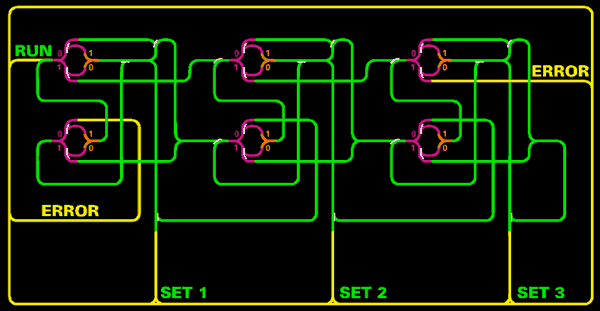 "There are three types of points in the layout.
- The distributors are orange;
- The lazy points look the same but appear in different colors;
- And the most common point is the sprung point, which is drawn with a clear preference for the route of the train.
- The lazy points look the same but appear in different colors;
- And the most common point is the sprung point, which is drawn with a clear preference for the route of the train.
In order to prep the layout for input, all distributors and lazy points have to be set to 0. This is done, by pressing the RESET-Button. Now, the tape is set to 000.
To set the input to the tape, press the red SET-Buttons. So to set up the input 1+1 on the three-block layout, you need to send the train to the outer two SET lines: 1 0 1. Then press SET1, leave SET2 untouched and press SET3. These Buttons control the three points on the yellow ringline. Afterwards the green RUN-Button lets the train first write the INPUT-value into each read/write head. It then gets directed into the SET1 read/writehead and comes back out on that line. This has effectively set the digit stored in that block on the "tape" to 1. It passes the SET2 point, moves into SET 3 and sets this value to 1. Now the Input 1 0 1 is set - visible through the I/0-lamps.
The next station is the START point – Once the locomotive enters the system from that point the calculating starts. Now watch the train as it leaves again and finds a rest at the start point. The altered state, visible on the lamps, is the result. In this example 1 1 0, actually means 2 in the notation of this apparatus.
CALCULATING PROCEDURE
To set up the train set for a calculation it needs to be re-set. By pressing the yellow RESET Button all points get set to the value "0". This is visible through the three 1/0-lightsigns.
Now one can re-set the machine, by pressing the red SET-Buttons. After this the
locomotive is ready to calculate and it gets started with the green RUN-Button.
First the requested value gets written into the read/write-head (pink and orange) and then the train enters the system at the start-rail and gets directed through the system as the points have been pre-set and eventually leaves after a while. The altered state is the result.
The following operations can be calculated:
Input Output
0+0 000 000 = 0
0+1 010 100 = 1
1+0 100 100 = 1
1+1 101 110 = 2
0+2 011 110 = 2
2+0 110 110 = 2
background info: http://www.monochrom.at/turingtrainterminal/Chalcraft.pdf
0
replies
tags -
artists,
interactive art,
media art
Bookmark this post: |
|
>> interview with J. Presper Eckert
0
replies
tags -
computer history,
interview,
text
Bookmark this post: |
|
Subscribe to:
Posts (Atom)
>> additional class blogs


>> subscribe


 Posts
All Comments
Posts
All Comments
.........

- Nina Wenhart ...
- ... is a Media Art historian and researcher. She holds a PhD from the University of Art and Design Linz where she works as an associate professor. Her PhD-thesis is on "Speculative Archiving and Digital Art", focusing on facial recognition and algorithmic bias. Her Master Thesis "The Grammar of New Media" was on Descriptive Metadata for Media Arts. For many years, she has been working in the field of archiving/documenting Media Art, recently at the Ludwig Boltzmann Institute for Media.Art.Research and before as the head of the Ars Electronica Futurelab's videostudio, where she created their archives and primarily worked with the archival material. She was teaching the Prehystories of New Media Class at the School of the Art Institute of Chicago (SAIC) and in the Media Art Histories program at the Danube University Krems.