this blog is nina wenhart's collection of resources on the various histories of new media art. it consists mainly of non or very little edited material i found flaneuring on the net, sometimes with my own annotations and comments, sometimes it's also textparts i retyped from books that are out of print.
it is also meant to be an additional resource of information and recommended reading for my students of the prehystories of new media class that i teach at the school of the art institute of chicago in fall 2008.
the focus is on the time period from the beginning of the 20th century up to today.
"Jens Brand’s GP4 (Global Player) functions basically like a regular
Compact Disc or record player. However, sound is not reproduced by a stylus from the grooves of a record player that are picked up. Instead the earth is scanned virtually via satellite travelling routes. Topographical data are interpreted by the G-Player and reproduced in an exact acoustic equivalent as audio files.
>From the outset Brand conceived the GP4 as a commercial product and, therefore, staged his installations as a trade fair stall stand. Mobility and availability are the buzzwords of the new product placement strategies, thus the G-Player, the G-Pod and G-Turns have been developed in reference to the newest phenomenon that has seen at the global music market.
The newest version, G-Turns, makes the GP4 available in an online version from which users can ‘download and play’ the earth on their home computers. The earth as sound experience is available on the market in three price brackets, depending on the distance of the satellite routes between two co-ordinates that can be chosen by the user: five minutes are available for only 4.95 euros. For fifteen minutes the user has to pay only 14.95 euros. This further development of the project as an online-store is presented to the public for the first time at the exhibition SOUND//BYTES and is, therefore, premièring worldwide as Oldenburg Branch: www.g-turns.com." (http://osdir.com/ml/culture.internet.rohrpost/2007-03/msg00009.html)
Dialtones ented sonic phenomena and musically interesting structures. Moreover, by directing our attention to the unexplored musical potential of a ubiquitous modern appliance, Dialtones inverts our understandings of private sound, public space, electromagnetic etiquette, and the fabric of the communications network which connects us.
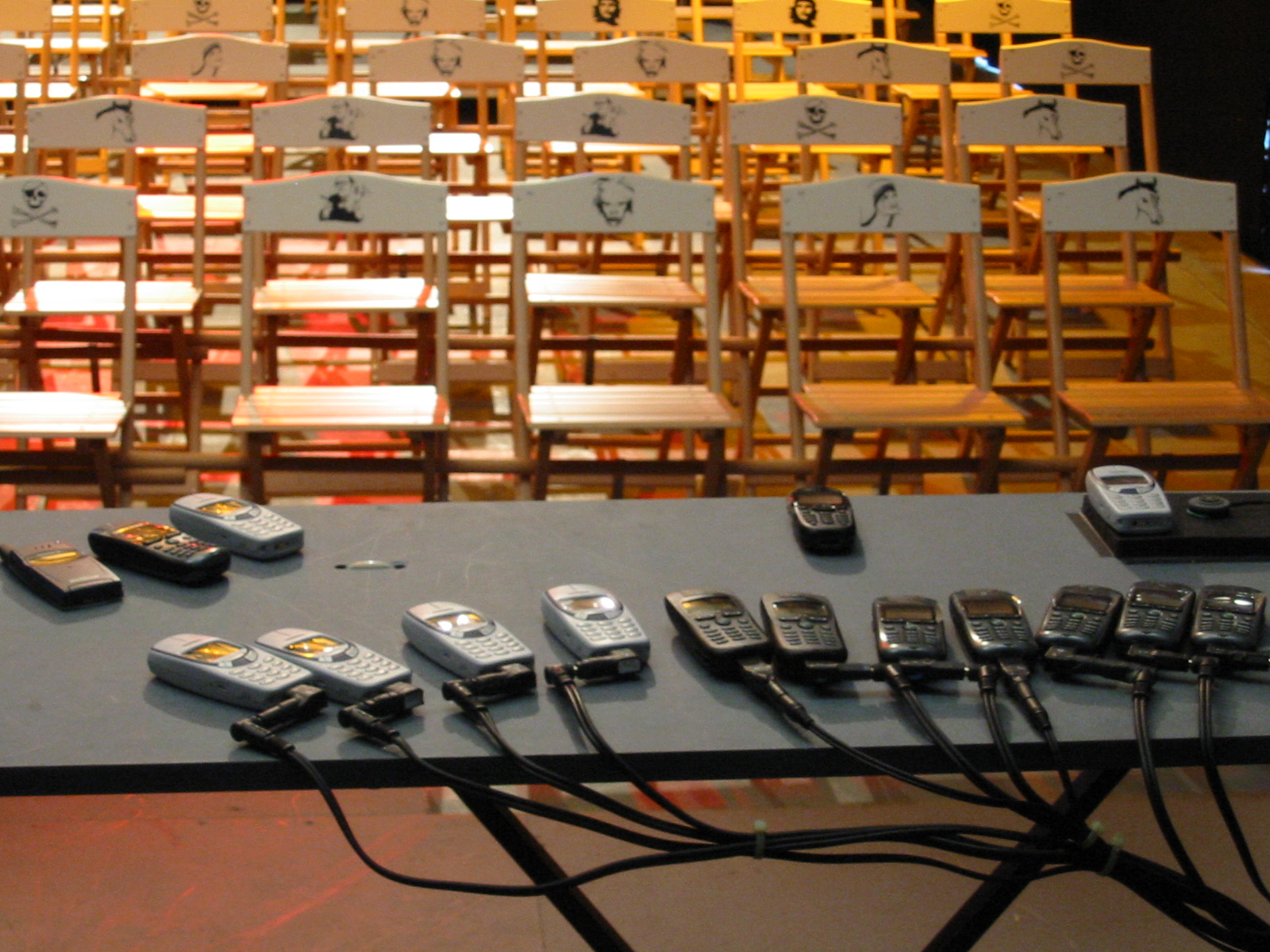
Dialtones was presented in two consecutive concerts in September, 2001, as a co-production of Golan Levin and the Ars Electronica Festival, and in seventeen performances in May/June 2002 at the Swiss National Exposition. Dialtones begins with a brief preparation phase prior to its performance, during which the members of the audience register their wireless telephone numbers at a cluster of secure Web kiosks. In exchange for this information, the participants receive seating assignment tickets for the concert venue, and new "ringtones" are then automatically downloaded to their handsets. During the concert itself, the audience's mobile phones are brought to life by a small group of musicians, who perform the phones en masse by dialing them up with a specially designed, visual-musical software instrument. Because the audience's positions and sounds are known to the Dialtones computer system, the performers can create spatially-distributed melodies and chords, as well as novel textural phenomena like waves of polyphony which cascade across the crowd; these musical structures, moreover, are visualized by a large projection system connected to the performers' interfaces. Towards the end of its half-hour composition, Dialtones builds to a remarkable crescendo in which nearly two hundred mobile phones peal simultaneously. It is hoped that the experience of Dialtones can permanently alter the way in which its participants think about the cellular space we inhabit.
ARTISTS' STATEMENT Wireless telephony has quickly become an indispensable aspect of modern life. Today, one out of ten people on the planet possesses a mobile phone; over the next three years, according to the industrial analysis firm The Gartner Group, this market is expected to increase by almost a billion new users [1]. Ironically, the astonishing eagerness with which we have adopted mobile phones is matched by our almost equal repulsion on the occasion of a cell phone's ringing. Mobile phones now infuse our theaters and public spaces with the least welcome details of our neighbors' intimacies, and perforate our private lives with the sonic machinery of electronic commerce. Our emotional reactions to these interjections can even outstrip the veneer of our professional identities: when ringing mobile phones interrupted keynote speakers at a recent telecommunications conference in Finland, the conference manager became enraged and threatened to get a radio-frequency scrambler to silence the din [2]. Caught between adoration and irritation, we have come to regard our intimate communications apparel with a deep ambivalence.
In the hype, hate and hypnosis surrounding the mobile phone, its potential as an ingredient of art has been largely overlooked. As with the proverbial fish who would never discover water, we take for granted that we are immersed in cellular space, our imaginations dulled by the extraordinary ubiquity of our wireless devices. Announcers at every modern-day concert command us to turn off our cell phones, but what Cagean aesthetic possibilities might we discover in leaving them on? What deranged beauty might we find, or what might we learn about our interconnected selves, in their high, pure tones? The mobile phone's speakers and ringers make it a performance instrument. The buttons make it a keyboard and remote control. Its programmable rings make it a portable synthesizer. Yet, although no sacred space has remained unsullied by the interruptions of mobile phone ringtones, there is no sacred space, either, which has been specifically devoted to their free expression. In the context of this lack, and in the context of our society's contradictory attitudes towards wireless communication technologies, Dialtones is proposed.
If our global communications network can be thought of as a single communal organism, then the goal of Dialtones is to indelibly transform the way we hear and understand the twittering of this monumental, multicellular being. One of Dialtones's strategies for doing so is the musical reification of this organism's sprawling and enveloping omnipresence. By placing every participant at the center of a massive cluster of distributed speakers, Dialtones makes the ether of cellular space viscerally perceptible. In a rejoinder to the eminent electronic composer Iannis Xennakis— who once complained that all electronic music sounded alike, because it would inevitably emanate from the same pair of speakers —Dialtones's radical surround-sound is at once musically and phenomenologically unique.
In an appropriate acoustic environment, the sporadic triggering of calls to mobile phones can evoke the placid chirps and trills of crickets, cicadas, frogs and birds. If hundreds or even thousands of mobile phones were to ring simultaneously, by contrast, the result would be an unimaginably seething, engulfing cacophony. Between these two textural extremes lies an enormous terrain of more musically familiar possibilities: gently shifting diatonic chord progressions, distributed and aggregate melodies, roving clouds of spatialized sound-clusters, and pointillistic hyper-polyphonies. Over the course of its half-hour duration, Dialtones explores sequences and combinations of each of these possibilities, scaffolded throughout by a set of recurring harmonic themes and slowly-evolving melodic phrases. Ultimately, the exact composition of Dialtones is a function of both the scored performance produced by the project's staff, and the specific settings of the phones brought by the concert's attendees.
In Dialtones, the phones, and not their owners, speak to one another. By summoning a communication between communications technologies in which there is no interlocutor, Dialtones invites its participants to perceive an order in what is otherwise disorganized public noise, and ratify it as a chorus of organized social sound. Thus the overdetermination of the world of Work is countered with an equally determined Play, as the ringing of mobile phones—ordinarily, the noise of business, of untimely interruptions, of humans enslaved to technology—is transformed into a sound of deliberate expression, startling whimsy, and unconventional beauty.
TECHNICAL REALIZATION Dialtones'technical realization is broadly divided into three distinct software subsystems: (A) the means by which the audience's mobile phones were registered (prior to the performance) into a networked database; (B) the means by which the audience's cell phones were computationally dialed (and thereby performed) during the concert itself; and (C) the telephony middleware which communicated the dialing requests from the performance system to the infrastructure of the local Mobile Switching Center. In addition, two special optical subsystems added visual and diagrammatic dimensions to the performance: (D) a vertical video projection system, in which spots of light were cast from above onto actively ringing audience members; and (E) an assembly of autonomous miniature lights which visually augmented the audience's highly-localized cellular activities. In this section, each of these mechanisms is treated in turn.
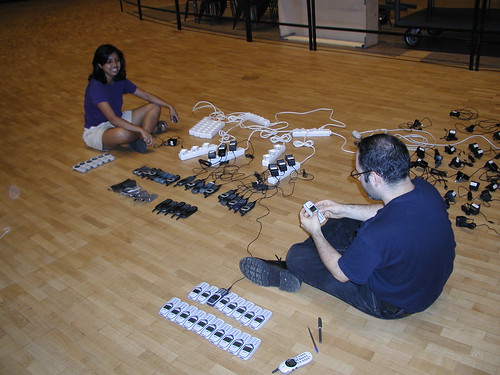
A. Prior to the Dialtones concert, audience participants register their mobile phone numbers (and model numbers) at special Web-based terminals placed outside and around the performance venue. ASP-based CGI scripts are used to store this information in a SQL database. At the same time, the scripts also use a ticketing algorithm to issue the audience member an assigned seat in the concert auditorium. Depending on the make and model of the participant's phone, it can be possible to programmatically modify its ringtone at this time; if so, a specially-composed ringtone is encoded in the RTTTL (ringtone text transmission language) data format and transmitted to the user's phone as an SMS message. The Dialtones staff composed more than 100 customized ringtones for the concert, wrote special software to convert these ringtones from MIDI sequences into RTTTL, and created a special CGI system to transmit these tones automatically to the audience's phones. In the Linz performances, a small number of preconfigured phones were also available as temporary loans for phoneless participants.
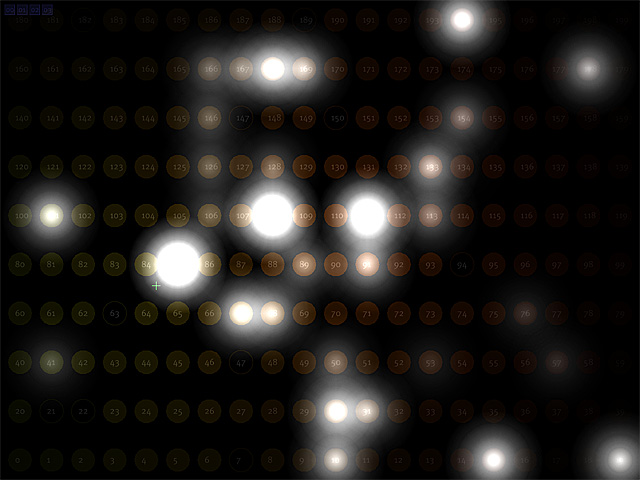
B. After the participants' phone numbers and models have been collected and stored in a database, Dialtones itself is performed live on a custom software instrument which makes use of this database. This performance system consists of an interactive graphical software interface, which represents each mobile phone in the audience as a spatialized cell in a visual grid. During the performance, the performers place "animated paint" into specific cells in the visual grid; these actions trigger the ringing of the corresponding mobile phones in the audience. It is important to emphasise that all of the phone dialings are executed "by hand"; that is, they are set into motion by the direct action of a human performer. The performance instrument is implemented as an OpenGL-based Windows application.
C. The Windows-based performance software transmits dialing requests over a TCP/IP LAN to a nearby Linux-based telephony server. This machine uses an Aculab telephony card to convert these requests into actual phone calls. The Aculab card transmits the phone calls over two dedicated E1 lines (primary-rate 2Mbit ISDN connections), directly into the Mobile Switching Center (MSC) of the local mobile service provider (in Linz, A1 Mobilkom Austria; at the Swiss National Exposition, Swisscom Mobile). The local Base Transceiver Station (BTS, or cell antenna) in the location of the concert venue was specially modified by the provider in order to allow at least 60 simultaneous signalling channels.
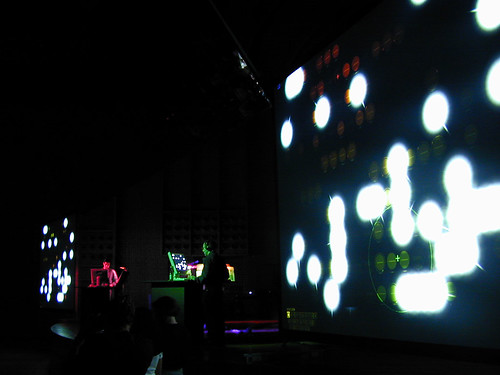
D. The audience-orchestras at the two Linz performances each consisted of 200 participants, who were arranged in a 20x10 seating grid. The performers' grid-based graphical interface is projected onto the audience from above, and carefully registered with their seats. As a result, each participant is lit up by a personal spot of light whenever their handset is rung. The concerts performed in Linz used a 12000 ANSI Lumen Barco ELM R12, with a special wide-angle lens, for the projection of these spotlights.
In order to more clearly show how the spots of light play across the audience— indicating which people are ringing at any instant— a very large, multi-panel Mylar mirror (6x12 meters) is erected at an angle above the crowd.
Of the 200 participants in Linz—whose phones hailed from 13 different countries—as many as sixty could be dialed at any one instant. Each performance lasted approximately 28-30 minutes, and entailed the placement of more than 5000 phone calls. The seventeen concerts presented at the Swiss National Exposition used orchestras of 99 participants [9x11], of whom any 60 could be dialed simultaneously.
E. The last visual subsystem consisted of a set of two hundred small keychain lights, which were distributed to the audience-participants at the time of their pre-concert registration. These inexpensive and autonomous devices, which are sensitive to energy in the 800-1900 mHz radio band, illuminate a small red LED when they are within one meter of a ringing mobile phone. Despite their small size, the darkness of the concert hall made it possible to observe the flashing of these lights, which were also reflected in the large suspended mirror.
Generally speaking, these keychain lights would flash about two seconds prior to the ringing of a nearby mobile phone, while the overhead video projection system would typically enable its corresponding spotlight within half a second after the phone had begun to ring. These minute differences in timing had the effect of diffusing events over time, creating micro-anticipations and multilayered syncopations between the light and sound of the performance.
The combined effect of the telephone rings with their synchronized visual phenomena was to render each participant as an audio-visual pixel, a twinkling particle in an audio-visual substance—and the visitors, as a group, could at once be audience, orchestra and (active) score.
THE COMPOSITION
The Dialtones composition consists of three major subsections, or "movements", each approximately ten minutes long. The first section is produced entirely through the ringing of the mobile phones of the 200-person audience; these phones were completely unamplified by any means. The second section, a "solo" movement, is performed by Dialtones staff member Scott Gibbons on ten amplified (but otherwise unmodified) mobile phones. In the third section, the soloist plays together with the ensemble.
The goal of Dialtones' three-part structure is to introduce the contrasting aesthetic possibilities of virtuosic real-time cellphone performance ("mobile phone jockeying") on the one hand, with coordinated-ensemble handheld-music on the other. In addition to yielding a variety of sonic contrasts, this structure also allows for the exploration of a broad range of musical interaction-models: from the deeply practiced (e.g. Gibbons' solo performance), to the entirely visual (e.g. the graphical interface controls used by Levin and Shakar to interactively perform the audience phones), to a lightweight model of consumer participation (e.g. through one's selection/purchase of a phone model, negotiation of its ringtone, and manner of displaying it during the performance).
Within each of the three movements, the composition is structured as a sequence of sound-textures. These texture-segments are realized as interestingly distinct combinations of ringtones; while the sound of one texture resembles a forest full of twittering birds, another consists of pure drones, and recalls the sound of a pipe organ. There are about fifteen sound-textures in all, each approximately two minutes long. Although the order and duration of these sound-textures is explicitly scored, the moment-to-moment details within each texture are left to the improvisation of the Dialtones performers.
The final movement of the Dialtones concert concludes with a climactic crescendo involving both orchestra and soloist. During the course of this section, the Dialtones soloist Scott Gibbons initiates the "ringing" of a phone's vibrator, transduced by a flat piezoelectric microphone and amplified by a subwoofer. At the same time, increasingly greater numbers of phones are introduced until the maximum possible number of simultaneous rings (60) is achieved. At this point, louder phones are swapped with quieter ones, and the selection of rings shifted around the orchestra until, within the space of a few seconds, all 200 of the audience phones have been triggered.
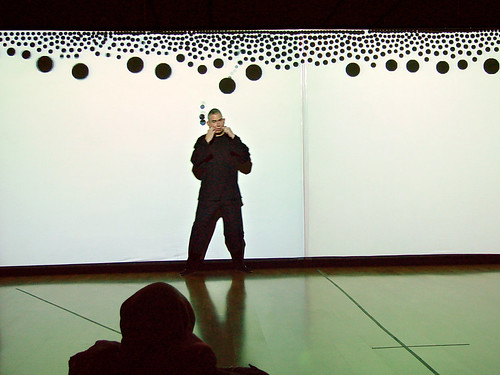
"A performance and installation in which the speech, shouts and songs produced by two vocalists are augmented in real-time by custom interactive visualization software." (Golan Levin, Zachary Lieberman)
from the project's website:
"overview: Messa di Voce (Ital., "placing the voice") is an audiovisual performance in which the speech, shouts and songs produced by two abstract vocalists are radically augmented in real-time by custom interactive visualization software.The performance touches on themes of abstract communication, synaesthetic relationships, cartoon language, and writing and scoring systems, within the context of a sophisticated, playful, and virtuosic audiovisual narrative.
Tmema's software transforms every vocal nuance into correspondingly complex, subtly differentiated and highly expressive graphics. These visuals not only depict the singers' voices, but also serve as controls for their acoustic playback. While the voice-generated graphics thus become an instrument which the singers can perform, body-based manipulations of these graphics additionally replay the sounds of the singers' voices — thus creating a cycle of interaction that fully integrates the performers into an ambience consisting of sound, virtual objects and real-time processing.
Messa di Voce lies at an intersection of human and technological performance extremes, melding the unpredictable spontaneity and extended vocal techniques of two master composer-improvisers with the latest in computer vision and speech analysis technologies. Utterly wordless, yet profoundly verbal, Messa di Voce is designed to provoke questions about the meaning and effects of speech sounds, speech acts, and the immersive environment of language.
background: Messa di Voce, like our previous augmented-reality artworks RE:MARK and Hidden Worlds of Noise and Voice, is concerned with the poetic implications of making the human voice visible. In Messa di Voce, the core technology which makes this possible is a custom software system which integrates real-time computer vision and speech analysis algorithms. Specifically, a computer uses a video camera in order to track the locations of the performers' heads. This computer also analyses the audio signals coming from the performers' microphones. In response, the computer displays various kinds of visualizations on a projection screen behind the performers; these visualizations are synthesized in ways which are tightly coupled to the sounds spoken and sung by the performers. Owing to the head-tracking system, moreover, these visualizations can be projected such that they appear to emerge directly from the performers' mouths. In some of the visualizations, projected graphical elements not only represent vocal sounds visually, but also serve as a playable interactive interface by which the sounds they depict can be re-triggered and manipulated by the performers.
Our group's interest in phonesthesia, or phonetic symbolism, is at the heart of the Messa di Voce project. According to this idea, the sounds of words tend to reflect, to some extent, associated connotations from other perceptual domains such as shape or texture. A classic illustration of the phonesthetic principle can be found in Wolfgang Köhler's pioneering psychology experiment from 1927, in which he asked subjects, "which of the figures below represents the sound maluma, and which one represents the sound takete?" Nearly all viewers respond with the same answer — suggesting rich research opportunities for artmaking and cognitive psychology alike. Messa di Voce brings together findings from phonesthesia research with our group's shared interests in abstract language, extended vocal techniques, interactive systems, and live audiovisual performance. In our concert, these ideas take shape in a series of twelve brief vignettes which explore different symbolic, tactile and audiovisual aspects of phonesthetic relationships. The entire Messa di Voce performance generally runs 30 to 40 minutes in length."
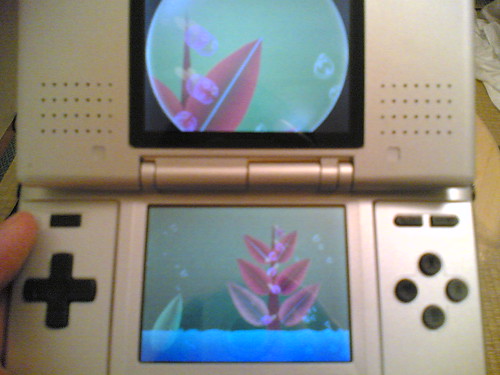
electroplankton is in a way Toshio Iwai's portfolio, a portfolio that invites people to play with. It is a special edition of the nintendo gameboy that features ten different soundobjects Iwai developed. By playing electroplankton, users can create their own melodies. the term "play music" gets a new connotation by that.
from the yamaha-website (for which iwai developed the tenori-on):
Tenori-on captures the imagination of so many different people. From the creative and professional media artist to non-musicians alike, this new form of musical interface is opening many new avenues of musical exploration and creativity.
A recent independent dissertation by UK-based Graham Wynne is a fascinating document as he explores the extent to which instruments such as Electroplankton and Tenori-on are overcoming barriers to creativity in modern music production. With related quotes from Toshio Iwai, Brian Eno, Steve Reich and Norman Fairbanks you can read Graham's dissertation HERE
"Toshio Iwai, the Tenori-on's inventor in conjunction with Yamaha, is a world renowned Japanese designer (who has also designed the Electro-plankton innovative interactive music game with Nintendo). The tenori-on device embodies visualisation of music, auditory and visual display and an intuitive interface for layering and performing sounds. Its basic operation can be sunstantially augmented by a sound expert by loading banks of your own samples, thereby enriching its auditory scope to a potentially limitless and individual set. Additional memory allows you store and record creations for later performance. As my research looks at digital means to augment conventional music devices and hyper instruments, aesthetic digital display, as well as the bimodality of auditory and visual display, this device encompasses all of those concerns. I am interested to use it, to study its usability and investigate the interaction of the visual and auditory output. It also ties into the 'gestural interaction with sound' theme of my ARC research.
Concept: Media artist Toshio Iwai and Yamaha have collaborated to design a new digital sonic interface for the 21st century, TENORI-ON. A 16x16 matrix of LED switches allows users to play music intuitively, creating a "visible music" interface. The TENORI-ON is a unique 16 x 16 LED button matrix interactive sound device with a stunning matrix visual display.
Operation: It is simultaneously a performance input controller and display. By operating and interacting with the LED buttons and the light they produce you gain access to the TENORI-ON's operation modes. These include Score Mode, Random Mode, Draw Mode, Bounce Mode, Push Mode and Solo Mode.
TENORI-ON layers can be thought of as “performance parts” or “recording tracks.” The TENORI-ON has a total of 16 layers. Separate notes and voices can be assigned to each layer, and all layers can be played together in synchronization. The 16 layers are divided into six performance mode groups as shown in the illustration below. The six modes have different note entry methods and operation. Up to 16 layers created using different modes can be combined for rich, complex musical expression. A completed set of 16 layers is called a “block.”
The TENORI-ON can store up to 16 programmed blocks (16-layer groups) in memory, and you can switch from block to block instantly during performance.
You could, for example, create a musical composition in one block, then copy that composition to another block and edit it to create a variation of the original composition. Or you can load a number of previously-created compositions into separate blocks from an SD Memory Card and switch between them to create variation during playback. See links above for full specs and info or to watch a Youtube video demo>/i> (mine coming soon to my blog) "
"Music Plays Images x Images Play Music" is a multi-media concert that uses the system of Toshio Iwai's piano piece and visualizes a musical performance by Ryuichi Sakamoto in real time.
The idea for this collaborative performance has its origins in Toshio Iwai's installation "Piano as image media" created at the ZKM, Karlsruhe, Germany in 1995. Conceived upon Iwai's return to Japan when he met Ryuichi Sakamoto, "Music Plays Images x Images Play Music" is a multi-media concert that uses the system of Iwai's piano piece and visualizes a musical performance by Sakamoto in real time. Over the course of a year, Iwai, who lives in Tokyo, often corresponded by e-mail with Sakamoto, who lives in New York. During their correspondence, the concept for the collaboration expanded rapidly, developing from the simple idea of "Sakamoto playing Iwai's 'Piano as image media'" to a performance that links, in various ways, musical sounds with visual images. The actual performance was given on December 16, 1996 at the Art Tower Mito in Mito City, Japan. The result of the collaboration was more than a "novel combination of music and image." Many elements including the actual presence of Sakamoto/Iwai, the machinery that is called the piano, the acoustic sounds produced by the piano, and the virtual images generated from computers were linked and developed in various ways. From the feedback produced, a radically new space of musicality-visuality was created. In addition, the performance was transmitted over the Internet and relayed world-wide. This experiment, the first of its kind, was an attempt to utilize the interactive medium of the Internet. People on the other side of the Internet were able to play the piano located in Mito by remote control and in turn Sakamoto had a session with their playing.
The Set-Up of the Stage Two concert grand pianos are placed on the stage. A semi-transparent screen 8 meters in height and 10 meters in width is suspended above them. The lids of both pianos are removed and their interiors and keyboards clearly illuminated. The screen is irradiated with a beautiful shade of blue. A black and white video camera is placed on each of the pianos in order to film the movements of the performer's fingers and the piano keys. The video cameras project enlarged images of each piano keyboard onto the screen on either side of the pianos. Several computers are set up on a long narrow table placed on the right side of the stage.
The Content of the Performance 1) Sakamoto does not initially appear on the stage. Amidst the silence, the piano begins to play on its own without a player. An image of Sakamoto playing the piano gradually comes into view on the screen to the side of the piano. Sakamoto's image slowly disappears as the music ends.
2) Sakamoto appears on the left side of the stage. He begins to play the small keyboard placed there. As he plays this keyboard, the piano starts to play. A faint light gradually emanates from the piano. At a certain point, Sakamoto stops playing. However, the last musical phrase repeats itself automatically, slowly fading out.
3) Sakamoto plays the piano directly. The light-images that visually represent each note of the musical piece begin to rise from within the piano. The images capture not only the timing of the notes, but every aspect of the music, including the length of the notes and their loudness. They are represented in a way that the eye can recognize.
4) During Sakamoto's performance, Iwai gradually modifies the image. The lights, which correspond to each note of the piece, are transformed over time in various ways. They do not merely rise from within the piano and fade into thin air. They radiate from the center of the screen out in all directions or revolve in a whirling pattern, eventually disappearing into a vortex. The metamorphoses of the projected images influence Sakamoto's playing as he watches the various transformations.
5) The image-objects, composed of 88 elements the same number as the number of keys on a piano appear on the center of the screen. Each of the elements coincides with the keys of the piano and the objects are continually transformed according to Sakamoto's piano performance.
6) Clicking a computer mouse, Iwai places dots of light onto the screen. Whenever the dots of light fall on the piano, the piano begins to play. The dots of light then rebound to their original position, striking the keyboard at fixed intervals. Depending on where the dots of light are placed, the pitch of the notes and the patterns of repetition change. The number of dots of light are increased. The dots of light bouncing from the piano are all shifted back and forth from left to right. The whole musical scale changes according to how the dots of light are moved. The dots of light are transformed into rays and then polygonal figures.
7) The video camera films Sakamoto's entire body. The computer captures the image in real time. Sakamoto's silhouette is pixelized and then projected onto the screen above the piano. When Sakamoto moves and the image of his body overlaps with the piano, the piano plays. When Sakamoto moves toward or away from the camera, or when a close-up image of his hands is projected, the sound is changed dynamically. The images of Sakamoto's hands and body are what plays the machine called the piano. Iwai implements further modifications by zooming in on and rotating Sakamoto's image on the screen thereby slowly modifying the sound. Sakamoto continues to move his body while looking on.
8) A chessboard-like grid appears on the screen and begins to rotate. Sakamoto and Iwai take turns placing glowing dots of light onto the grid, thereby creating a repetition of short melodic patterns. As the music is created through this collaboration, Iwai transposes the musical pattern, changing the octave and altering the sounds and the images. Sakamoto continues to create new patterns. Finally, with the completed musical phrases as a backdrop, Sakamoto improvises on the piano. Iwai continues to modify the performance piece.
9) The music played by Sakamoto is turned into an image. The image that springs from the first piano and lands on the second piano creates a parabola in its fall. The second piano plays according to this image. The figure of Sakamoto performing on the first piano is projected next to the second piano with a delay that coincides with the imaged music arriving at the second piano. It appears as if there are two Sakamotos playing the two different pianos.
10) The short musical phrase performed by Sakamoto and the resulting image loop between the two pianos, repeating again and again. Sakamoto continues to add more sounds to the loop. The repeating images and sounds, flowing forth like a waterfall between the two pianos, grow in layered richness and complexity. (translated from Japanese by Dano O'Neill)
... is a Media Art historian and researcher. She holds a PhD from the University of Art and Design Linz where she works as an associate professor. Her PhD-thesis is on "Speculative Archiving and Digital Art", focusing on facial recognition and algorithmic bias. Her Master Thesis "The Grammar of New Media" was on Descriptive Metadata for Media Arts. For many years, she has been working in the field of archiving/documenting Media Art, recently at the Ludwig Boltzmann Institute for Media.Art.Research and before as the head of the Ars Electronica Futurelab's videostudio, where she created their archives and primarily worked with the archival material. She was teaching the Prehystories of New Media Class at the School of the Art Institute of Chicago (SAIC) and in the Media Art Histories program at the Danube University Krems.
 "the earth is a disc"
The newest version, G-Turns, makes the GP4 available in an online






 Posts
Posts