

from: http://home.wanadoo.nl/eli.ichie/biographyxenakis.html#music
 "After writing some early works in the late 1940s, Xenakis' first mature work is Metastasis. At its premiere in 1955 it caused a scandal because it did not deal with serialism, incorporating sound blocks and masses of glissandi instead. This composition is the first where Xenakis, still intuitively, uses mathematical calculations as the basic musical material.
In later works Xenakis started to introduce the probability theory, leading to his so calle Stochastic music.
But he continues searching for new roads and possibilities, resulting in compositions like Duel and Stratégies, based on game-like strategies or Evryali, a composition using aborescences, tree-like branching curves.
From early on and throughout his compositional career, Xenakis composed tape music. His first work is Diamorphoses from 1957 and his most recent composition is S.709 of 1994. In his later tape works he uses computers as well. A fine example of his tape music is Concret PH, composed in 1958 as an overture to Varèse's Poème électronique in the Philips Pavilion at the Expo in Brussels. Part of many of his large scale instrumental and electronic works is the use of light effects, slide shows and laser projections. Examples of these works are his Polytopes, Diatope and Mycènes alpha.
Even though the use of all mathematical theories, which is a method for Xenakis to avoid putting emotion in his music, it definitely is music with beauty, power and character. The brutal sound-blocks of Cendrées and Nomos Gamma, the sweeping rhythms of Psappha and Kottos and the screaming glissandi of Metastasis and Mikka S nevertheless bear emotions that grow on further listening. It definitely isn't easy music, but being a world in itself, it is extremely rewarding.
1958 - Philips Pavilion Poème Electronique, by Le Corbusier, Iannis Xenakis, and Edgar Varèse
 Philips Industries commissioned Le Corbusier to build their pavilion for the 1958 World's F
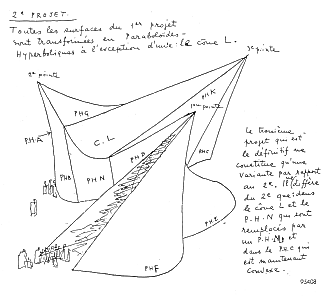
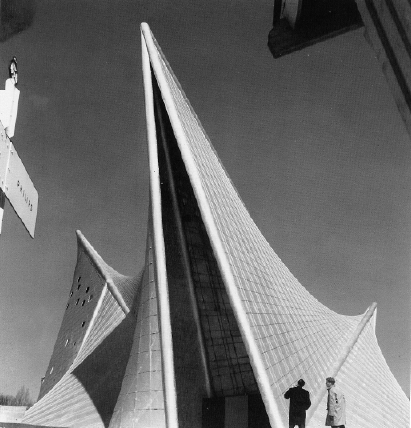 air to be a showcase of their technology. Iannis Xenakis was working for Le Corbusier at the time and ended up designing the building as well as writing music for some of the spaces (Concret P.H.. Le Corbusier designed the visuals for the inside and chose Edgar Varèse to create the music for the main space. It was an extremely complex installation with 350 speakers, all sorts of lights, slide and film projectors, sculpture and more. Xenakis' music and architecture was heavily based on mathematics, especially hyperbolic paraboloid shapes. Edgar Varèse worked in Philips then new sound studio in Eindhoven with two full-time technitions to create the main musical piece. Le Corbusier worked with his firm to create the visuals.
No comments:
Post a Comment